


We’re very much looking forward to visiting the National Galleries of Scotland’s exhibition on James VI & I at the Portrait Gallery opening in late April. And we’re here to give you a wee preview not only of the exhibition, but of the excellent book that accompanies it.
Art & Court of James VI & I
By Kate Anderson, with Catriona Murray, Jemma Field, Anna Groundwater, Karen Hearn and Liz Louis
Published by National Galleries Scotland
History has not been kind to james vi of Scotland and I of England and Ireland. For many, he has fallen between the cracks of the reigns of his mother, Mary, Queen of Scots, and his son Charles I, overshadowed by their contentious and heavily romanticised legacies. Both James’s reign and character were heavily criticised in the seventeenth century by writers, notably Sir Anthony Weldon. Published posthumously in 1650, the pejorative account of James’s physical appearance claimed that the king’s tongue was too big for his mouth, that he possessed weak legs and constantly fidgeted with his codpiece.1 Weldon was a former English courtier who had been dismissed from his position, and the memoir was anti-Scottish in sentiment and full of scandal and unfounded rumour. However, its legacy continued to impact on subsequent histories of the king for centuries. While recent scholarship has revised some of these inaccuracies and prejudices, misconceptions about James and his reign still exist. One of the aims of this book, and the exhibition it accompanies, is to reframe James and consider his life and reign in a wider context; they also seek to explore the extraordinary art, objects and culture that were produced during this period, and demonstrate how James, his family and members of the court used them to promote messages of status, power and allegiance.
This is not a detailed biography of James. His reign and character are incredibly complex, and while the narrative here is multi-layered, it does not set out to comprehensively examine the historical context of Scotland, England and Europe during this time. Instead, an object-based approach has been taken, with the visual and material culture of the Jacobean period being placed at the centre of this study, alongside an overview of some of the key individuals and events that shaped the king. In an attempt to address the imbalance of scholarly attention that the Scottish and English courts have received over the years, a concerted effort has been made to highlight James’s Scottish period. However, it is too simplistic to directly compare the artistic quality and output of the two courts, as the political, religious and economic climate in Scotland during James’s early life had a major impact on the development of the country’s cultural productivity.
This book has been published to accompany the exhibition The World of King James VI and I. It is hoped, however, that the essays and catalogue will have a legacy beyond the exhibition. Many of the artworks and objects in the exhibition are published here for the first time.

Spread from Art & Court of James VI & I showing: Left: Unknown artist Double Portrait of Mary, Queen of Scots and James VI, 1580s Collection at Blair Castle, Perthshire Right: Unknown artist Mary, Queen of Scots (1542–1587), 1610–15, after an original of 1578 National Galleries of Scotland, Edinburgh (PG 1073)

Attributed to John de Critz the Elder (c.1550–1642) James VI & I, 1604 National Galleries of Scotland, Edinburgh (PG 561)

John de Critz the Elder or workshop of John de Critz the Elder (c.1550–1642) Anna of Denmark, c.1605 National Galleries of Scotland, Edinburgh (PG 3800)
Art & Court of James VI & I by Kate Anderson, with Catriona Murray, Jemma Field, Anna Groundwater, Karen Hearn and Liz Louis, is published by National Galleries Scotland, priced £24.99.
Karen Campbell continues to write fantastic novels full of heart, of people and places that deserve their stories told. David Robinson is impressed by This Bright Life‘s humanity and insightfulness.
This Bright Life
By Karen Campbell
Published by Canongate
Nearly 40 years ago, the Guardian newspaper ran a TV ad that impressed me so much that I can still remember it. A skinhead is shown running towards a businessman with a briefcase. From one angle, it looks as though he is about to mug him. A wider angle shows a hoisted palette of bricks about to spill on top of the businessman’s head. Far from being a mugger, in other words, the skinhead is a potential lifesaver. ‘It’s only when you get the whole picture,’ the voiceover concludes, ‘that you can see what’s going on.’
I couldn’t help thinking of this while reading Karen Campbell’s new novel, This Bright Life. It too has a mugging at its heart – a real one this time – and two central characters even more different than a skinhead and a businessman. It too demands that we see the whole picture, and it too adds to our comprehension.
The novel begins inside the head of Gerard, a 12-year-old boy. He’s on his bike, freewheeling down Whitehill Street in Glasgow’s Dennistoun. His brain is freewheeling too. It’s not even the summer holidays, but already he’s thinking about his senior school, which of his friends will be going there and which won’t, wondering which nicknames he’ll shed and which he’ll probably get stuck with. His bantering mates in the Broncos (‘a gang named after a horse will get your head panned in at secondary’) are off up to Celtic Park but Gerard heads home because it’s lunchtime, so his mum will probably be up by now.
Those two opening pages are a mini-masterclass in writing character. Drenched with empathy they may be, but there’s a precision about them too. Those nicknames, that matey banter, those drifting thoughts about the future – each carefully triangulates what kind of person Gerard is. That’s a hard enough challenge, but Campbell adds to it. Because despite all his mates’ teasing, she also makes us realise that there is something seriously wrong with him. As he heads downhill to his home in a squalid flat in Duke Street, Gerard wonders what it would be like to pedal downhill as fast as he can into the traffic, keeping his eyes firmly shut all the time.
But Campbell hasn’t finished getting inside people’s heads, and straight away she takes us behind the eyes of an 82-year-old widow. Margaret lives in a ground floor flat opposite the Buffalo Bill statue (Gerard and the Broncos have just visited it) in the home she shared with her husband Bert for six decades before his death the previous year. Within another half a dozen pages her unobtrusive, secluded life is just as firmly delineated as young Gerard’s vibrant, ragged, edgy one.
Now for the bigger picture. The home Gerard returns to is hellish. His junkie mother is out for the count, his screaming baby sister has a dirty nappy, and his seven-year-old brother is desperate for food. There’s none in the flat, and nothing to buy it with in his mother’s purse. There’s only one thing he can think of to do, and so goes out onto the street, and is wondering how he’ll be able to rob the local greengrocer’s till when he spots an old lady – Margaret of course – with a purse sticking out of her handbag. As he grabs it, Margaret turns and falls badly on the pavement. She is seriously injured. Gerard runs off home.
At this point, Campbell introduces her third main character. Claire is a solicitor in her thirties going through the double traumas of divorce and moving house when she witnesses the mugging and rushes over to help the pensioner, who seems to be choking. She removes the old lady’s dentures, and puts them in her pocket. An ambulance arrives and rushes the pensioner off to hospital. Five minutes later, Claire spots the young mugger in the street and phones the police. They arrest him. The pensioner, he is told, has been very badly hurt indeed. If she dies, the police warn him, he could be facing a charge of culpable homicide. Meanwhile Claire puts her hand in her pocket and finds the dentures she forgot to hand over to the ambulance crew.
Three characters, three completely different stories, and yet Campbell manages to bring each fully to life. They also change in entirely credible ways: returning from hospital, Margaret’s infirmity nudges her towards depression and resentment at having to rely on her neighbours. Claire begins to overcome her habit of overthinking and gradually becomes more at peace with herself. Both also have their own secrets which are gradually revealed. But the novel’s focus remains firmly on Gerard. When we see the whole picture – the junkie mum, the drugs, the crime, the unremitting poverty, all on top of the fact that he cannot read or write – is there any realistic chance of redemption? And just suppose there is, how can you write that story without it sounding, er, like an ad for the Guardian?
Discussing homelessness – the main theme of her last novel, Paper Cup – Campbell recalled how ‘profoundly disturbing’ she found it in the five years in her twenties in which she served as a Glasgow policewoman to encounter ‘a netherworld of people with nothing and nowhere to go’ in the middle of a bustling city. I can’t help wondering whether she met young lads like Gerard too; certainly the Child Protection Hearing feels perfectly authentic (‘Remember, this is about conversation, not confrontation’), not least in the befuddlement they create in Gerard’s mind. Here he is, unable to read but in a world of acronyms, an ACE child (Adverse Childhood Experience) on an ICSO (Interim Compulsory Supervision Order) before his first session with the CAMHS (Child and Adolescent Mental Health Team) psychologist.
Try as all these adults might, they can’t untangle the confusion Gerard feels. When the psychologist asks him to look at where his feelings come from, he knows he is lost. ‘Normal folk don’t need to pull feelings out their heads and ask them what they’re doing there’ he thinks to himself. But even in a (mercifully, for once, unsatirised) middle-class foster home, that feeling of lostness doesn’t go away: how can it when he is separated from his siblings, unsure when he’ll see them next or when he’ll be told he’ll have to move on. No wonder he longs for his mother – the one fixed point in his life, no matter how much he knows he can’t rely on her – even when it looks like she might be asking him to break the law…
With so many things against him, the outlook for Gerard might appear to be grim. But this is a novel of hope. There is, it reminds us, such a thing as society, and it’s there in the quiet humanity of the volunteers who take kids like him guerrilla gardening or on trips to city farms, or in the kindness of a Glasgow waitress who puts a cake next to a crying woman customer (‘There you go hen, it’s on the house’) or foster parents who homeschool their charges and pick up on what they’ve not understood about reading and writing. This Bright Life is written with empathy, humour and precision and reminds us just what an enjoyable, thought-provoking, whole-picture novelist Karen Campbell can be.
This Bright Life by Karen Campbell is published by Canongate, priced £16.99.
Art Deco Scotland by Bruce Peter is the latest release from Historic Environment Scotland showcasing Scotland’s place within this artistic moment in building, transport and interior design. It’s a fascinating book full of fantastic images, and we’d like to share some with your now.
Art Deco Scotland
By Bruce Peter
Published by Historic Environment Scotland

Russell Institute, Paisley
James Steel Maitland of Abercrombie and Maitland, 1927
Bruce Peter

Dick Place, Edinburgh
William Kininmonth, 1933
Courtesy of Thelma Ewing (top); Bruce Peter (bottom left); Bruce Peter Collection (bottom right)

Bennie Railplane Poster
WCN, McCorquodale & Co, 1930
Bruce Peter Collection


Fountainbridge Library, Edinburgh
John Alexander William Grant, 1940
Bruce Peter

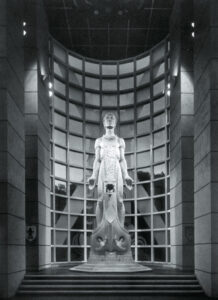
Top image
South Cascade, Tower of Empire & Garden Club, Empire Exhibition
Thomas S Tait of Sir John Burnet Tait & Lorne and Launcelot Ross, 1938
Bottom image
Statue of St Andrew in the Scotland (South) Pavilion, Empire Exhibition
Archibald Dawson, 1938
Courtesy of Ian Johnston

The Regal, Bathgate
Andrew D Haxton, 1938
Bruce Peter
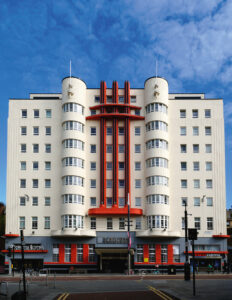
Former Bereseford Hotel, Sauchiehall Street, Glasgow
William Beresford Inglis of Weddell & Inglis, 1938
Bruce Peter
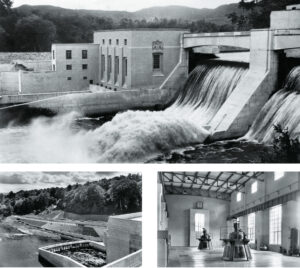
Pitlochry Dam and Power Station, Pitlochry
James Williamson & Partners and Harold Ogle Tarbolton, 1950
Bruce Peter Collection (top); HES SC914038 (bottom left); HES SC914023 (bottom right)
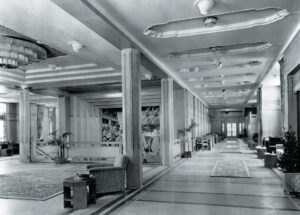
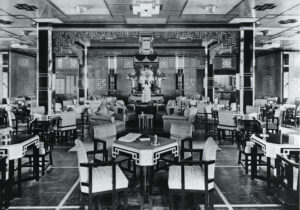
Top image
First Class Mall, Empress of Britain
Percy Angelo Staynes, Albert Henry Jones and Maurice Grieffenhagen, 1931
Bottom image
Cathay Lounge, Empress of Britain
Edmund Dulac, 1931
Bruce Peter Collection
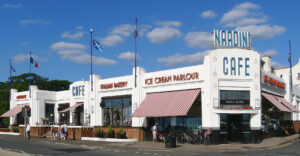
Nardini’s, Greenock Road, Largs
Charles James Davidson and George Veitch Davidson, 1935 (renovated in 2008)
Bruce Peter
Art Deco Scotland by Bruce Peter is published by Historic Environment Scotland, priced £30.00
Little Door’s picture books are always charming and colourful with heartwarming stories and brilliant illustrations. Their latest release, My Dog Max, celebrates all things canine and we hope you love these sample spreads as much as we do!
My Dog Max
By Alan Dapré, illustrated by Alex Ayliffe
Published by Little Door Books

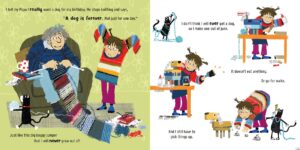
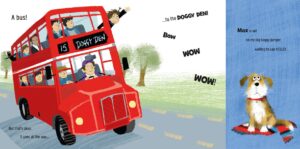
My Dog Max, by Alan Dapré, and illustrated by Alex Ayliffe, is published by Little Door Books, priced £7.99.
David Robinson is impressed with Richard Strachan’s debut novel, The Unrecovered, a gothic literary thriller that keeps readers guessing.
The Unrecovered
By Richard Strachan
Published by Raven Books
It’s March 1918, and in Flanders, the Germans are breaking through British lines. Within a week or so, the casualties will arrive at Ruttinglaw House, a mansion near South Queensferry converted into a military hospital. Volunteer nurse Esther Worrell, widowed at the start of the war, will be among those taking care of them.
One of the patients is a local man, Captain McQuarrie. ‘Our first from the Palestinian front,’ the Medical Officer tells Esther as she follows him on his rounds. Bayonet wound, says the note on the bedstead, though the bandaged hole in his chest seems a bit too wide for that. She fills the glass of water by his bedside and they move on.
Already, though, I’ve cheated, the way all reviewers cheat. It’s in the nature of the job: we’re looking back, re-viewing, and inevitably concentrating on the characters who will figure later on. But at the start of The Unrecovered, Richard Strachan tells us so much more: not just about Esther, but the hopes and fears of her nursing colleagues; not just about Captain McQuarrie but gossipy case notes on all the other wounded soldiers on the morning round; not just about the makeshift hospital but also about the half-ruined castle across the fields the medical officer wants to requisition to cope with imminent flood of casualties. Comprehensively imagined and carefully described, this is a convincing piece of stage-setting.
Gallondean, the gothic pile across the fields from the hospital, is the kind of place you might expect to find in a supernatural horror novel, all crumbling masonry, rotting carpets, damp wooden floors, and secret chambers with their own grim mythologies. Its grounds are similarly cursed, not least the rocky outcrop on the nearby coast called Hound Point. Centuries ago, at the exact moment when the laird of Gallondean died, his faithful dog was said to have howled in mourning – even though his master was many miles away at the time, and this happens whenever any subsequent laird dies. Preposterous, you might think – except that you’ll find a version of this story in every guide book you’ll ever read about Hound Point, the very real headland on the Dalmeny Estate a mile east of the Forth Bridge.
Jacob Beresford is the new laird of Gallondean, and he has just arrived from India to take ownership. The nurses at neighbouring Ruttinglaw can’t work out whether he reminds them more of Dracula or Heathcliff, but the medical officer knows a tubercular patient when he sees one. More than his health, though, Jacob is obsessed with getting to the bottom of that centuries-old legend about a tyrannical owner of the castle whose son went on a Crusade to the Holy Land after his death. There’s a statue of this knight – and his faithful dog – in the hospital grounds, though when one of the nurses sleepwalks past it, it doesn’t seem to be there any more.
Sorry: I’ve done it again. Because that was just a silly dream one of Esther’s colleagues mentioned to her, wasn’t it? Just a bit of chitchat between the nurses as they went about the far more important task of looking after their patients, feeding the man who had come back from the front without any hands, talking about the production of Peter Pan that the wounded troops are planning to put on to raise their morale, or about the snared animals whose mutilated bodies the gamekeepers (presumably) have left in the nearby woods. Yet as readers, we’re always trying to guess the path the novelist is taking us on, and the dream-disappeared statue makes us suspicious. A red flag, surely?
Except that in The Unrecovered these coincidences, false trails, and people who remind the main characters of others who know secrets about them, positively abound. So many, in fact, that they’re not red flags at all. Yet if a red flag is something that stops you reading, what we have here is the opposite: an encouragement to read on, if only to find out which clues turn out to be true and which ones false.
I can’t say much more without spoilers, but I will mention a key fact – one I’d completely forgotten – that is grounded in history just as surely as the novel’s Hound Point (and come to that, Mons Hill) are grounded in West Lothian’s geography. When Jerusalem fell to General Allenby’s British-led troops in December 1917, he became the first Christian for centuries to control the city. Does that help you join any plot dots? Can you work out what was likely to have caused that wound in Captain McQuarrie’s chest?
(Don’t worry: neither could I.)
But I’ve kept the most important thing about Richard Strachan’s writing to the end. There are plenty of writers who write competently about horror and the supernatural but who lack the descriptive skill to animate everyday reality or handle their characters’ psychological complexity. Strachan can do both.
I’ll give you an example. When we are first introduced to Esther, we know that she is married, but little more. Carefully, Strachan drip-feeds key facts about her: we learn, for example, that she is a would-be poet and is passionate about Browning, whom she defends against McQuarrie’s accusations that he is both old-fashioned and obscure. ‘It’s just that he lets his information unfold more gradually,’ she says, but that’s true of Strachan’s portrait of her too: she’s not just married, but widowed; not just recently, but early in the war, when his ship was sunk. Her honeymoon was in Florence in July 1914, and naturally she wanted to see Elizabeth Barrett Browning’s tomb in the English Cemetery there, but her husband wasn’t bothered and didn’t even attempt to hide his boredom and frustration. It was a hot summer’s day and he was forever complaining about how far away the cemetery was, and insisted on having a glass of wine at each cafe they passed. There were a lot of cafes….
You’d expect to find a scene like this – pivotal to the heavily literary and somewhat over-ornate plot, as it happens – in, say, a short story by William Trevor or Bernard MacLaverty rather than genre fiction. But Strachan’s talents for descriptive writing are equally evident even when – as in a superlative scene set in the hills of Judea at the end of the book – he is handling an all-out action sequence. Like Iain Sinclair, who calls this ‘a formidable and deeply crafted nightmare,’ I was hugely impressed.
I live in the same city (Edinburgh) as Strachan but hadn’t heard of him before, though a quick internet search reveals that he is a former bookseller and has already penned several novels for Games Workshop’s Black Library imprint. For none of these, though, has he had a book launch although he has just had one for this, his literary debut. And as debuts go, it’s a very assured one indeed.
The Unrecovered by Richard Strachan is published by Raven Books, priced £16.99
David F. Ross’s new novel, The Weekenders, takes us to the underbelly of 1960s West of Scotland where who you know determines how much you can get away with, including murder. With his trademark black humour and sharp dialogue, it’s another brilliant slice of Glasgow life that delves deeper and darker into the city and its past. In this extract, we are introduced to Stevie ‘Minto’ Milloy, footballer turned journalist.
The Weekenders
By David F. Ross
Published by Orenda Books
Nervous initially, Stevie Milloy relaxes a little when he smells the newsroom. He has missed the dressing-room stench of alpha-male body odour. But it’s present here, and it’s comforting to him. He sniffs it all in, the stinking socks and putrid farts. The hair tonic and Brut 55. The cigarette smoke and alcohol stench. And, bizarrely, the Algipan. For the lumbago, most likely.
Introductions over. The odd handshake. Nods from some. A squad of fifteen here. Almost obscured by the fog of fag smoke. Everyone stooped and out of shape, and looking a decade older than they probably are. He sees monochrome tones. Frayed, off-white shirts. Trussed-up ties. Regulation short back and sides. Cheapside Street formality. In comparison he’s a peacock.
For half an hour there is an impromptu press conference with his new teammates:
‘Ye ever kick a baw these days, Stevie?’
‘Wis it sair when the leg went, Stevie?’
‘Did that cunt Geordie McCracken ever say sorry, Stevie?’
‘How much wid ye have been on at Stamford Bridge, Stevie?’
‘Who d’ye think’ll win the World Cup, Stevie?’
‘How the fuck did ye end up here, Minto?’
The last one was a question he has been asking himself since waking up in the Victoria, left leg in plaster from ankle to thigh.
He should have moved to England the previous season. Everybody said so. But he stayed. Because Denice didn’t want to go. London was so far away, she’d said. He stayed at Thistle. Turned down Chelsea. Turned down the chance to play with Ron Harris, John Hollis, Eddie McCreadie. Buying his clothes from King’s Road boutiques. Drinking in Soho pubs alongside The Beatles and The Stones. He decided to wait until Denice was ready. And while he waited, she was warming the bed of two of his international teammates.
After the injury, the Chelsea deal was off, naturally. Thistle stood by him. But he knew it was over the minute he looked down at his snapped leg. You don’t come back from a compound fracture like that. A rapid descent. No fans standing him a drink anymore. No handshakes at the players’ entrance. No requests for autographs. Not even the baiting from rival supporters. Just pitied looks and weary shakes of the head. Nowhere to go except the boozer. And the bookies.
Then the money ran out.
Luckily, he pulled out of the tailspin just in time. Took old Alf’s advice and joined a local library. Found the days disappearing. But in a good way. Time spent in the stimulating company of George Orwell. D.H. Lawrence. Barry Hines. Colin MacInnes. Time spent being inspired by words. Sentences. Paragraphs. Chapters. Fiction. Non-fiction. Values. Ideology. Social justice. Reconnecting with an education he had left behind. Spirits lifted instead of lifting spirits.
His was a life of two halves.
The whistle sounds.
The second half begins.
‘Milloy!’ A howitzer voice. A six-letter shell. Cascading off the walls. Even though its owner isn’t in the room. It puts a stop to the questions from the assembled hacks.
Stevie follows the reverberation to its source: a small office off the press room.
‘Jesus Christ, whit the blazes are you wearin’?’ asks Gerry Keegan as Stevie enters. Keegan runs the press room.
‘Casual, boss,’ says Stevie.
They size each other up. Both wondering if the other will be too much trouble for the wages.
Keegan shakes his head. ‘Ye done much writin’ before?’
‘No’ really, Mr Keegan. Notes in the Thistle programmes, that sorta thing. But ah’m a quick learner.’
‘That right?’
‘Ah’ve still got the contacts, an’ obviously ah’ve played the game.’
‘Mibbe so. Playin’ fitba an’ writin’ aboot it, they’re worlds apart.’
‘Did ye see me play, Mr Keegan? Mibbe the Scotland games?’
‘Look, Milloy, ye’re here cos some high heid yin oan the top floor vouched for ye. No’ ma idea, obviously, but ah’m nothin’ if no’ fair-minded.’
‘Ah understand that, Mr Keegan.’
‘That’s ma squad oot there. They might no’ be up for a Nobel Prize for Literature but they put a decent shift in. They know how tae get the job done. Tae cut corners. Tae file copy oan time. Tae work tae The Man’s plan. Ah trust every single yin ae them.’
‘They look like a decent bunch, Mr Keegan.’
‘Trust has tae be earned, Milloy.’
‘Totally agree, Mr Keegan.’
‘Havin’ an ability tae kick a baw willnae make ye a sportswriter.’
‘Aye, ye said.’
‘Aye. Ah did.’
‘Well, proof’s in the puddin’, Mr Keegan.’
‘The proof’s in the eatin’, son. If yer gonnae use expressions, use them right.’
‘Appreciate the tip, Mr Keegan.’
‘Aye. Right. Well. Then.’ Gerry Keegan sits. ‘Noo’ that we’ve got that oot the way, ye’re goin’ tae Ayrshire on Thursday. The Brazilians are there. Get some exclusives. How’s Pele feelin’ about their chances? Who’s starting against Bulgaria. Who’s injured? That sorta thing. Elsie’s got yer pass, an’ ye can take one ae the motors.’
‘Great,’ says Stevie.
‘An’ then, if ye dinnae fuck that up, ye’re shadowin’ Meikle for the rest ae the month. Got it?’
‘Aw’right, Mr Kee — ’
‘An’ drap aw that “Mr Keegan” stuff, right? It’s “boss”, or “gaffer”.’
‘Got ye, gaffer!’ says Stevie. ‘Oh an’, gaffer … ’
‘Whit?’
‘You can call me “Minto”.’
Gerry Keegan’s hardman exterior crumples. He rubs his chin. He sniggers. ‘Aye. Right.’
Stevie Milloy smiles. He winks at his new manager.
He is back in the first team.
Inside left.
Socks rolled down.
The baw at his feet.
Goal gaping.
The Weekenders by David F. Ross is published by Orenda Books, priced £9.99.
This is What You Get is the story of a group of young men who enlist in the army in the 1980s as their only escape from Thatcher’s Britain. We follow them on tours of Germany and the first Gulf War, and explore themes of duty, loyalty, betrayal and shifting morals. We hope you enjoy this extract.
This is What You Get
By Iain McLachlain
Published by Rymour Books
Ye had tae learn tae anticipate fit wis expected o ye. Some boys were ready for it straight awa. Livin in poverty, bein brought up by strict parents or haein tae work fae a young age helped ye. Maist o the boys that were recruited in the eighties grew up in Thatcher’s wasteland so they were nae strangers tae hardship or lack o opportunity.
If ye could get along an keep yer mooth shut an manage tae bide oot the line o fire ye could remain unnoticed. If yer were slow tae adjust tae yer new life ye were noticed for the wrong reasons an ye’d get punished. Some boys thought they knew the script, but it wisna initiative they were lookin for, they were lookin for obedience. They did look for leadership qualities though, but jumpin the gun got ye noticed for the wrong reasons an aa. Some boys could tread the line in atween. Some boys were born leaders.
Get up, the duty recruit clicked the switch an the strip light buzzed an pinged intae life.
Zander draped his towel ower his shooder an headed for the ablutions. He put his stuff on the shelf abeen the sink an looked intae the mirror. Tae his left Sharpe applied shavin foam tae his face. Zander looked inside his bag at his shavin brush an shavin soap. The brush, wi its smooth widden handle, had been left ahin by his faither. He looked in the mirror at Sharpe an Sharpe dragged his razor along the line o his jaw. Along the line o sinks, aa the ither recruits were usin shavin foam.
Zander brushed his teeth an filled the sink wi warm water an began tae wash, conscious o the boys aroon im. He patted his face wi his towel an began tae put his stuff back in the bag.
Are ye no shavin? Sharpe waved his razor.
Zander shook his heed.
Ye huv tae shave evry day if ye need tae or no, but, Sharpe’s voice echoed off the ablution waas.
Zander put his bag back on the shelf an filled the sink again. He took his time an hoped that maist o the boys widve gone afore he got his shavin brush oot. He took oot his brush an soap an dipped the brush in the sink an swirled it aboot a bit.
Check im oot wi iz ancient shavin brush, man, Sharpe wis in the mirror abeen Zander’s shooder. Boys turned tae look.
Zander rubbed the brush aroon the soap.
Is it yer granda’s, een o the boys elbowed Sharpe.
Naw, it’s his granny’s, Sharpe elbowed the boy back.
Ye done wi this sink, Miller shoodered Sharpe tae een side.
Settle, man, Sharpe stood aside.
Miller took Sharpe’s wash bag off the shelf an pushed it intae his chest an placed his ain bag on the shelf. He took oot his stuff, extractin it slowly. Toothbrush, toothpaste. Shavin stick an brush. Aul single blade razor.
He nodded at Zander’s brush.
Is that horsehair?
Zander telt im he wisna sure.
Ye get a much better lather wi a shavin brush, eh?
Zander nodded.
The boys went back tae their ain sinks an oot o the corner o his eye Zander watched Miller an mirrored the actions o Miller shavin. Carefully, deliberately, like it wis a ritual.
Corporal Munro marched them tae the clothin stores an he telt the boy at the front tae lead in an the recruits started anither process that wid flush mair o the civilian oot o them. They’d had their civvies locked awa, the hair clipped fae their heeds an the freedom tae walk an talk as they liked had been greatly diminished. In the stores they wid be issued wi the uniform an equipment that wid further transform them intae soldiers.
Zander edged forward an craned his neck tae try an see inside the storeroom. He could see boots that dangled fae kitbags an at the far side o the buildin a Tam O’Shanter sat on the top o a boy’s bag. Zander wis eager tae pull on his ain TOS an tae go fae bein naebdy tae bein a soldier an tae look smart an feel proud. Tae be like his faither.
Then he wis in through the door an immersed in the storeroom an the storeroom wis heavy wi the smell o a century an mair o leather an canvas an the trappins o conflicts an world wars. The kit stored here had absorbed the men who had come afore. Their sweat, through fear an labour alike. Their blood an tears were ingrained intae the kit an the soil an mud an rivers that they had crawled an fought through were ingrained intae the kit. Aa this had soaked intae the brick an timber o the storeroom an swirled aroon the recruits an seeped intae their skin so that they were not only bein issued wi a uniform, but they were also bein infused wi the spirits o aa those who’d gone afore. Aa those who’d been equipped in this buildin an had been sent awa tae break their kit in. Tae be torn, cut an chaffed by it. Tae clean it, an press it, an polish it. Tae lose it an tae beg borrow an steal it. Tae be kept warm an dry by it an tae be protected an saved by it. Tae die in it.
This is What You Get by Iain McLachlain is published by Rymour Books, priced £11.99.
The River is a life-spanning epic novel about death and new beginnings. It’s also about love, Scotland, happiness and acceptance. Here is author, Craig A. Smith, reading from the beginning.
The River
By Craig A. Smith
Published by Into Books
The River by Craig A. Smith is published by Into Books, priced £11.99.
I Don’t Do Mountains is an adventure story for children that explores the fears and beauty of getting out into nature. We spoke to author Barbara Henderson about her relationship to the book and The Great Outdoors.
I Don’t Do Mountains
By Barbara Henderson
Published by Scottish Mountaineering Press
Hello Barbara; it’s brilliant to see you publish another fantastic children’s book. What can you tell us about I Don’t Do Mountains?
It was so much fun to write. Most of my children’s book so far are historical fiction, so it was very freeing to write a contemporary adventure set in the great outdoors! It’s an adventure story about a hillwalking expedition which goes spectacularly wrong: the adult leader goes missing and the four youngsters must form unlikely alliances to navigate the dangers and challenge they face. Ultimately, though, I hope that the book inspires curiosity and enthusiasm rather than fear. The Scottish hills are an unfamiliar environment for many young people, so it was a great opportunity to feed in some information about what to do in an emergency, for example, or feature some of the region’s spectacular wildlife.
How much time do you spend in nature and why is it important to you as a writer?
Haha, I’m a dog owner, so I am outside four times a day. I live in Inverness, so some of the most spectacular landscape in Scotland is right on my doorstep. It’s one of the best ways to clear your head and get a bit of distance from day-to-day life. Nothing gives you perspective like a great view, right? And that doesn’t mean you have to head into the loneliest of places for days at a time. I am not particularly lithe or muscly outdoor material, but the hills are for everyone! Whatever your fitness or experience, there is a walk for you. One of my current favourites is a short circular wander into the hills above Loch Ness called the Change House Walk.
This book is set in The Cairngorms in particular. What do you love about them?
There is so much to love about the Cairngorms. As an avid birdwatcher, I particularly appreciate the wildlife there, but also the crystal-clear waters, often so still that they double the mountains in gorgeous reflections. The snow-topped distant peaks which have inspired countless myths and legends, too. My favourite time is just before sunrise when the undulating horizon takes on otherworldly pinks and orange hues – ‘the hidden fires’ as Nan Shepherd called them. If you want to get a feel for the place, you can do no better than Merry Glover’s book of the same title.
Your books are always packed with adventure. How do you keep coming up with troublesome scenarios to put your characters through?
I ask the ‘what if’ question, all of the time. Reading is a bit like a rollercoaster – if we are absorbed in the story, we have the illusion of danger, while being safe all the time. But even those feelings build resilience, and kids like the stakes to be high – they can handle the tension. I took to heart the advice from children’s author Helen Peters: ‘You can NEVER have enough jeopardy’.
Your main character Kenzie is a bit reluctant to leave her home comforts at first. How would you encourage young people to get outdoors and explore?
Kenzie doesn’t do mountains. She doesn’t do strangers either. In fact, Kenzie would happily stick to the library and other places where she feels safe – and who would blame her? I think people are reluctant to head out because they worry that they will meet challenges, but these environments are nothing to be scared of! Begin small – a gentle circular walk, or a smaller hill with a good path. There are loads of options on https://www.walkhighlands.co.uk/, and you can search by region, length and difficulty. I myself am far from a hardcore outdoorsy person – we just need to explore, give things a try and find out what works for us! As adults, I think we have a responsibility to facilitate this for young people too. If they know and appreciate the wild places, they are more likely to protect them.
What are you looking forward to reading in 2025?
I have already begun my 2025 in books with Susan Brownrigg’s historical children’s adventure Wrong Tracks, about the famous Rainhill Trials which was great. I also can’t wait for Ally Sherrick’s Rebel Heart – I have loved every single one of her adventures for children. In terms of Scottish books, I am absolutely buzzing for Michelle Sloan’s Mrs Burke and Mrs Hare. It’s not out till the summer, but I adored The Edinburgh Skating Club so much that I’m desperate to delve in!
I Don’t Do Mountains by Barbara Henderson is published by Scottish Mountaineering Press, priced £7.99.
Heather Parry’s new novel, Carrion Crow, is a gloriously gothic tale of an extraordinary relationship between a mother, Cécile Périgord, and her daughter, Marguerite Périgord. Cécile keeps Marguerite locked in the attic of their family home – for her own safety she says – with nothing but a sewing machine, a copy of Mrs Beeton’s Book of Household Management, and a carrion crow who has come to nest in the rafters, for company.
BooksfromScotland asked Heather to recommend five more stories of unforgettable mother-daughter relationships.
Carrion Crow
By Heather Parry
Published by Doubleday
Concerning My Daughter – Kim Hye-jin (trans. Jamie Chang)
Published in 2023, this novel is so precise and humane it’s hard to believe it was Kim Hye-jin’s debut. Like Carrion Crow, this is a story about a mother’s inability to accept her daughter’s vision of family, even when events in her own life show her what happens when rules are followed and conformity is insisted upon. Unlike Carrion Crow, this is told entirely from the mother’s perspective, with all her prejudice on show for the reader to try to understand.
Steel Magnolias (1989)
This film is marketed a comedy, and considered lightweight—no doubt due to Dolly Parton’s casting, and the fact that this is a unapologetically a story of six women—but Sally Field’s portrayal of M’lynn, and specifically the monologue she gives after her daughter Shelby’s funeral, which veers from tender and reserved to screaming rage and hysteria, and her friends’ ability to meet her where she is, at a point past reason and decorum, will never fail to make me cry.
Carrie – Stephen King
The original and best book by ‘Auntie Stephen’, as he’s affectionately called by my horror-adjacent writer friends, is supposedly about telekinesis and the horrors of high school—but really, it’s about the inability of a daughter to fit into what her mother wants her to be: pious, cowed, ignorant and constrained. As a former teenage King obsessive, I’m forever influenced by this book.
Beloved – Toni Morrison
A beautiful and absolutely harrowing novel, only made more so by the fact it was inspired by a real case and explores real, inescapable horrors. Toni Morrison’s perfect prose wraps around your heart as she tells the story of Sethe, formerly enslaved, who believes that a young woman arrived at their door is the reincarnation of her murdered eldest daughter. Perhaps only Morrison could write a book in which a mother does the worst thing imaginable to her child but never loses the reader’s empathy and understanding. The sort of novel that stays with you always.
Geek Love – Katherine Dunn
The ultimate story of fucked-up family dynamics and how love tries to plot a course through them. Al and Crystal Lil Binewski are part of a failing circus with their family when they come upon the idea of a freak show populated by their own offspring. Their experiments on their children (therapy-fodder if I’ve ever seen it) lead to telekinetic conception, the creation of a cult and the efforts of their daughter, Oly, to save her own child from everything she has been through. The first time I read this book, it blew apart everything that I thought a novel could be.
Carrion Crow by Heather Parry is published by Doubleday, priced £16.99.
In Beautiful Ugly, Grady Green’s wife has disappeared in mysterious circumstances. Grieving, he decides to travel to a remote Scottish island to find some peace and healing. Instead, he finds something entirely disturbing. . .
Beautiful Ugly
By Alice Feeney
Published by Macmillan
‘Can I help you?’ she asks in a thick Scottish accent.
‘Hope so. I’m trying to get to Amberly.’
She stares at me for a long time as though she doesn’t understand what I said or thinks I am dangerously stupid. ‘Sorry, I canny help. It’s out of season.’
I stare back. ‘What does that mean?’
‘It means the Isle of Amberly Trust owns the island. It is home to thousands of protected trees and a community of just twenty-five people. Visitors are permitted on the island only from May to July. Even if I could let you on board— which I can’t— you’d have no way of getting back again for days and nowhere to stay—’
‘But I do,’ I insist. ‘I’ve been invited to stay for three months.’
Her makeup- free eyes narrow into suspicious slits. ‘By who?’
‘Kitty Goldman. She owns a cabin there.’
She shakes her head. ‘Never heard of her, and I’ve lived on Amberly all my life.’
‘She inherited it from Charles Whittaker.’
The exceptionally tall woman stares at the island in the distance before studying my face, and her expression is hard to read. Then she smiles.
‘Charlie’s bonnie old writing cabin? Good for you. Well, you’d best grab your things and get on board then. Your car should be safe parked up here for a wee while at least.’
‘Can I not take the car on the ferry? It looks like there’s room.’
‘Visitors are not permitted to bring vehicles to the island.’
‘What? But I have all my stuff . . .’
The woman’s weathered face folds into a weary frown. I see my-self through her eyes and try again. I need this woman to help me.
‘I’m sorry. I’ve had a long journey—’
‘Haven’t we all,’ she interrupts, as though I have already taken up too much of her time. ‘You can bring as much as you can carry, or you can stay on the mainland. Them’s the rules, and that’s the only option, I’m afraid.’ Only option. What a ridiculous expression. Only means one, and one option means none. ‘The choice is yours. You’ve got as long as it takes me to get a sausage sandwich from the food truck to make up your mind,’ she says, then walks away.
I have always been rather slow at making quick decisions, but this one seems simple enough. I grab a rucksack filled with Columbo’s food and things, a suitcase filled with mine, and throw my satchel containing my laptop and notepads on my shoulder. I can’t carry anything else, not even the bag of food I packed, but I grab a packet of milk chocolate digestives and shove it in my jacket pocket. That will have to do for now. I lock the car and hurry toward the boat, Columbo trotting at my side just as the ferrywoman returns with her breakfast. She takes a large bite of her sausage sandwich and ketchup oozes out, landing on her chin. She curses, wipes it with a white paper napkin, and the resulting stain looks like blood.
‘Decision made?’ she asks, and I nod. ‘Then welcome aboard,’ she says with a smile, before taking another bite.
The seagulls squawk and scream, flapping their dirty white wings as if protesting, and circling above the ferry as it breaks free from the jetty. Their wingspan is vast, casting swooping shadows across the deck, and when I look up, I see that the tips of their beaks are red, as though dipped in blood too. They descend and dive so that I have to duck out of the way, and the ugly noise they make almost sounds like a warning:
Go back. Go back. Go back.
I’m sure it is just the exhaustion and my imagination playing tricks on me, and I notice the birds do not stalk us for long. They retreat toward the mainland when the ferry pulls away, slowly sailing out of the bay.
The sun has fully risen now, and everything is a dazzling shade of blue. It’s hard to tell where the sea stops and the sky begins. The Hebridean Sea is rough and the other passengers all stay inside their vehicles, but that isn’t an option for us. Columbo and I make our way to the front of the ferry and I sit my things and myself on a metal bench on the exposed deck. It’s cold, and we get showered with an occasional mist of sea spray, but the view of the Isle of Am-berly is utterly mesmerizing. A halo of white sand and a turquoise sea surrounds the tiny island, making it look like a mirage and this feel like a dream. A pod of dolphins leaps from the waves the ferry has created as though they are escorting us on our voyage, and my face stretches into an unfamiliar smile.
Our adventure might have had a tricky beginning, but this is beautiful, and I experience something like hope for the first time in a long time. Perhaps Kitty was right, and this is the fresh start I so desperately need, a second chance to get my life and career back on track. My agent is almost always right. I look around the deck, wondering if anyone else has spotted the dolphins, and that’s when I see her. She’s wearing the same bright red coat she had a year ago, the one she was wearing the night she disappeared, and is standing at the back of the boat, staring right at me. I shiver, not just from the cold, and it feels like time stops for a moment. Columbo barks, breaking the spell. I glance down to see what he is growling at— it turns out he was looking in the same direction as me, at her— but when I turn back, she is gone. It all happened so fast that it feels like I might have imagined it, but the woman I saw was the spitting image of my missing wife.
Beautiful Ugly by Alice Feeney is published by Macmillan, priced £16.99.
1978, Dundee, Scotland. Newly assigned to CID, Elizabeth Burnet is seen as just a pretty face. So when she stumbles across evidence of a serial killer, dubbed ‘the Werewolf’, her theories are dismissed. This does not stop her investigating her hunches . . .
In this extract we are introduced to Elizabeth and her complacent colleagues.
The Friday Girl
By R. D. Mclean
Published by Black and White Publishing
Elizabeth Burnet pulls her coat tight. Not simply for the cold. She’s being watched.
High-heeled shoes clatter on concrete slabs. She might topple. Doesn’t like heels. Never has.
But:
You need to look the part.
Christ.
Feeling foolish. Done up like a hoor, her mother would say. So much for her ‘respectable’ profession.
Dudhope Park should be safe. But in the past four weeks, several women have been approached. The man’s behaviour escalates with each encounter.
No rapes.
Yet.
But:
It’s a possibility.
Eyes on her.
Walk faster.
The heels make it difficult.
Someone approaching. Didn’t see him on the main path earlier. Maybe waiting in the bushes?
Male. Mid-thirties. Dark hair. Big coat. Holding it closed. Maybe – like Burnet – protection against the bitter cold.
Aye. Right.
Instinct: get away from him.
But Burnet tells herself:
Just a man going for a stroll through the park. Heading home after work.
Until he proves otherwise.
Closer. Clock bare ankles and calves, feet in brogues. Pale sticks rising out of the shoes. A few inches of flesh beneath the trailing edges of the coat.
Keep walking.
Don’t run.
Look up. Stare straight ahead.
Not her first flasher. Ask a room full of women: most will raise their hand if asked about being approached by a man with ill intentions, or with his dick in his hand.
First time for Burnet: age eleven.
She ran away. He shouted after her. All the things he wanted to do.
Eleven years old.
Don’t do anything to antagonise him. You’re just walking to work. You haven’t seen anything unusual. This goes better if you just act normal.
Close now. Wanting to make eye contact.
Burnet looks away.
He steps in front of her.
Here we go.
The coat opens. Erect. Wild grin.
Eyes rolling in their sockets. Groin pumping: a bad parody of John Travolta.
More John Revolting.
Burnet can’t see anyone nearby. Just lines of bushes and trees. No people.
Oh, Christ.
Her heart does a pitter-patter rhythm. Bad jazz syncopation.
‘You’re doing this to me,’ the man says. ‘Allayouse cunts do this to me. Not my fault.’
He shrugs off the coat. Comes at her. Wiry and strong.
He reaches out.
She can’t move.
Instincts kick in.
Literally.
Boot in the balls.
‘Fuck!’
On his knees. Retching.
Now: footsteps. Male voices.
About time!
She stops herself putting a heel through his eye. Or anywhere lower. These heels could puncture his ballsack.
The Detective Sergeant is in his forties, panting, out of shape. Red face. A coronary on legs.
‘Where were you?’ Burnet asks.
He points back to the bushes.
Two uniforms cuff the pervert. He screams and yells as they haul him to his feet. Burnet notes his dick is no longer proud.
The pervert’s eyes blaze. ‘Bitch could have ruptured my balls!’
Detective Sergeant Coronary recovers his breath, straightens up, gets in the pervert’s face. ‘The least you deserve.’ Slams his forehead into the man’s nose. The pervert falls back.
DS Coronary shakes his head. “Rapists . . . worse than bloody poofters.” Low laughter from the other officers. At least one of them nervous.
Burnet remains impassive. No point saying anything.
The uniforms keep the pervert on his arse. He looks like a tortoise turned over on its shell. Except the tortoise has more dignity.
‘Cold weather,’ DS Coronary says. ‘Best to watch out. The ground can get slippery. What do they call it?’
A uniform nods in agreement. ‘Black frost.’
‘Aye,’ Coronary says. ‘Black frost.’
The uniforms get the perv back up onto his feet, haul him out the park, and into the back of the wagon.
Coronary comes over to Burnet. Hand on her shoulder.
‘You all right, love?’
She almost corrects him – constable – but decides he doesn’t know what he’s saying. Choose your battles. ‘Aye. Just, for a moment, I thought maybe no one was watching.’
‘Lass like you?’ Stepping back, looking her up and down.
‘Come on! How could we not watch?’
Deep breath. Tight smile. ‘Can we go back to the station?’ she says. ‘These shoes are killing me.’
* * *
The newly built HQ on West Bell Street. Brutalist. Intimidating.
On the third floor, Burnet changes back into uniform.
She washes off makeup. Pauses. A long look in the mirror.
Better without the slap. More real. Like herself. But Coronary – can’t even remember his real name; just another DS – insisted she wear it during the operation.
The kind of girls this wacko goes for, he’d told her, all of them dressed like they were asking for it. Shaking his head. Honestly, what is it with you girls? Need to take better care of yourselves. Think how you look, what kind of message it sends.
Burnet’s seen the files. The Pervert doesn’t care whether his victims are tarted up, dressed down, young or old. Not what it’s about for men like him. But what would she know? Just a bloody woman, isn’t she?
The door opens. Another WPC. Looking tired. Maybe just off shift. Checks herself in the mirror beside Burnet.
‘Heard you were on flasher detail,’ the WPC – Caroline, that’s her name – says.
Burnet nods. Keeps looking at her reflection. Something’s missing. She doesn’t know what.
‘They put you in the hoor getup?’
‘Apparently, that’s the only thing these men go for.’
‘You know it’s bollocks, right?’
‘Oh, aye.’
Caroline finishes. ‘For their own pleasure more than for bait.’
‘They’re the ones in charge.’
‘Aye. Unfortunately.’ Caroline nods at Burnet’s reflection, then leaves.
Burnet stays. Thinks about the things women say to each other in these situations. Why they don’t talk about it to the people who might be able to make a difference.
Not that she’s unaware of the answer.
* * *
The canteen. Quiet.
Burnet grabs a bacon roll, still nervy from the encounter with the pervert. Skin jangling. One question dominating her thoughts – what took them so long to react?
She imagines: DIs behind the bushes sneaking a fag break (with hip-flask chaser). DIs watching the guy get his dick out; having a good old laugh, all boys together, taking bets on whether the perv has the balls to follow through. On whether Burnet panics. Or screams.
‘This taken?’
DS Dow. Early fifties, built like a collection of tangled pipe-cleaners. A shock of hair so pure white you’d swear he was born with it.
Her fists unbunch.
Dow’s good people. One of the few. The uncle you wish you had. He served in the war, but discusses it fleetingly. Did his duty, but would rather forget he ever had to.
Sometimes the men who were too young to be called up rattle on about the war like a glorious crusade. Dow never corrects them, but it’s clear from his expression he thinks they’re talking out of their arses.
He takes a sip of tea. Looks at her with bright blue eyes that belong to a man several decades younger. Crow’s feet crinkle.
Dow has a son. Grown, now. Never mentions him. Never talks about his home life.
Burnet doesn’t mind. Makes believe that he thinks of her like a daughter. Maybe true, maybe not.
‘I heard you were the lucky one today,’ he says.
‘How could I say no? You know about this one, right?’
‘I heard. Escalating attacks. Exposure to assault. You got him before he moved to rape.’
‘Today could have been the day.’ Still thinking: what took the DIs on backup so long to intervene?
‘But it wasn’t.’
Dow’s concerned; it’s in the way he looks at her. But he can’t understand how it felt, in that moment. ‘You booted him in the balls?’
That makes her smile. ‘Aye.’
‘See, he didn’t have a choice.’
She shakes her head. ‘Maybe,’ she says.
Dow stands. ‘I just wanted to check in. Supposed to be in a briefing but needed a cup of tea first. When you get to my age, no one cares if you sneak in a few minutes late.’ He lingers for a moment, brow crinkling again like he’s trying to work out if he said what he needed to. Then: ‘I’m an old dodderer, I know. But if you need someone to talk to, all that shite . . .’ He seems to think about that for a second. ‘I’ve two girls of my own. You know that, aye?’
She nods.
Dow clears his throat. ‘That’s all it is. I’d be proud if they did something like you. Choosing a career, I mean.’
She lets him leave.
Thinks about her own father. Every night, when she gets home: Girls your age don’t need careers. They need to get married.
Her father. Younger than Dow, yet somehow more old-fashioned and out of touch.
She used to think Dow represented hope. But beneath that, a more cynical part of her wonders if he’s just a tease, the universe showing her what she wants, and telling her that it’ll never really be there.
The Friday Girl by R. D. Mclean is published by Black and White Publishing, priced £9.99.
The Silent House of Sleep is the first book in a new crime series featuring Dr Jack Cuthbert. BooksfromScotland spoke to author Allan Gaw about his publishing journey so far.
The Silent House of Sleep
By Allan Gaw
Published by Polygon
Hello Allan, could you tell us about Dr Jack Cuthbert and your first novel The Silent House of Sleep?
The Silent House of Sleep is a period murder mystery set in two interwoven time periods— the late 1920s in London and the years of the First World War in Edinburgh and on the Western Front. It is the first in the Dr Jack Cuthbert mystery series.
The main character, Dr Jack Cuthbert, is a Scottish doctor working in London with Scotland Yard between the wars. Today we would call him a forensic pathologist, but at the time that term was not used.
He is a complex man — early thirties, tall and striking to look at and extremely good at his job. But, like so many men of his generation, he also bears the mental scars of his experiences in the First World War. Moreover, he lives with the closely guarded secret of his homosexuality — indeed in a world where he would be viewed as a criminal, he is so closeted that he really hasn’t come to terms with his own sexuality.
The story itself begins in 1928. When a student goes missing, not one but two bodies are unearthed, and Cuthbert is faced with one of the most baffling forensic puzzles of his career. He is working for the first time with a new, young Detective Chief Inspector at the Yard, and he knows he must come up with an explanation for what he has found. However, in solving the case, Cuthbert uncovers a nightmarish secret from his own past and realises he has brought more than memories back from the war.
It’s been a bit of a whirlwind few months for you – winning the Bloody Scotland debut prize, and your book deal with Polygon. Have your feet touched the ground yet?
The success of the book has genuinely surprised me. The genre of crime fiction is very crowded with no shortage of remarkable books written by talented authors. That my debut novel should first win the Bloody Scotland prize and then be picked up by Polygon and finally find itself as the Waterstones’ Scottish Book of the Month astonished me. I will never forget the feeling of my name being called at the award ceremony in Stirling, of the call from the publisher or of standing outside the Waterstones in Sauchiehall Street, Glasgow staring open-mouthed at an entire window display of my books. This is the stuff of writers’ dreams. So, to answer your question, no, I am still hovering pleasantly some inches above the carpet.
Your Jack Cuthbert novels are set in interwar period. What drew you to set your books at this time?
As a former pathologist it was not surprising that I should write about a pathologist — after all, we are always counselled to write about what you know. What was not a given, however, was that I should set my book in the 1920s and 30s. I did this for several reasons. First, I was keen to escape the contemporary world in my writing. People read books as a form of escapism; sometimes people write them for the same reason. Second, that period is for me a fascinating one. It is a time of great change, with a lot of emerging science and technology that is just beginning to have a real impact on forensic pathology. As a result, there were a lot of interesting possibilities to explore. And finally, an altogether less lofty reason — I didn’t want to write a book with mobile phones in it.
How has your career as a pathologist helped you with your writing?
My medical training, and in particular my research training, has been invaluable. Throughout my career I was called upon to write a great deal. Over the decades, I was able to develop and hone the writing and research skills that I have now been able to successfully transfer to my fiction writing. And what I have discovered is that when it comes to good writing, academic, technical non-fiction and fast-paced immersive crime fiction have much in common.
Can you give us a little hint of what’s next for Jack Cuthbert as the series progresses? How do you shape the individual books while keeping a series narrative flowing too?
When I finished book 1 — The Silent House of Sleep — I knew I still had a lot to say about the characters and in particular about Dr Jack Cuthbert. So, I knew then that I was dealing with a series, where I would take the same cast of characters forward in time giving them different challenges and at the same time allowing my readers to get to know them better.
As the series unfolds, there will be different baffling crimes and new fascinating forensic puzzles for them to solve, but there will also be a whole range of new events for them to react to. As the 1920s become the 30s and hurtle toward the 40s, everything will change for these people. And along the way I will answer a whole range of questions that my readers have asked — what’s Madame Smith’s real story?, will Simon and his fiancée Sarah get married?, how will Mowbray and Cuthbert’s professional relationship develop?, and of course, will Jack Cuthbert ever find love?
As the series builds, I want to find a balance between allowing the characters to develop fully and become people we know well on the one hand, and the criminal and forensic investigations on the other. But I think you can do both. Yes, of course, readers want intricate, absorbing plots, but they also want to read about characters who seem real and whose lives are as interesting as the world they inhabit.
What are you looking forward to reading in 2025?
I read a lot of different kinds of books — fiction, non-fiction and poetry. I am particularly excited by the new Callum McSorley novel, Paperboy, which is due out in the spring. I am also eagerly awaiting two debut poetry collections that will be published this year from poets that I greatly admire — Jen Dunn (Seahorse Publications) and Matthew Keeley (Drunk Muse Press). Both authors are definitely emerging poets to watch for in the future. Oh, and there are also three further books in the Dr Jack Cuthbert series coming from Polygon this year that I’m looking forward to seeing in print.
The Silent House of Sleep by Allan Gaw is published by Polygon, priced £9.99.
Gareth Russell writes fantastic, thorough and entertaining histories, and his latest book sees him turn his attention to James I and VI. We caught up with him to hear about his favourite books.
Queen James: The Life and Loves of Britain’s First King
By Gareth Russell
Published by William Collins
The book as . . . memory. What is your first memory of books and reading?
I don’t have one clear first memory, except that they were everywhere. My grandmother had owned a bookshop in her hometown of Lurgan in Northern Ireland and, while she had sold it and retired by the time I was born, there were always books in her house. She encouraged me to read them aloud to her. She’d take a page, then I would. My parents read to me too, when I was very little – and we got book tokens at the end of each year in Sunday School, so there’d be a trip with Mum into Belfast to pick out a book. Books really framed my childhood, looking back on it. The Voyage of the Dawn Treader was a particular favourite.
The book as . . . your work. Tell us about your latest history Queen James. What did you want to explore in writing it?
I had written about an episode in James’s life for my previous book, The Palace, which is about the history of Hampton Court. During my research for that, I was fascinated by James VI. I felt there was a lot more to say about his life. I could not get the idea out of my idea, so it became my next book. I wanted to explore James’s life, in all its complexity and richness, as well as to see if there was something new, different and revealing about his love affairs, and there was. It was a thrilling history to tell.
The book as . . . inspiration. What is your favourite book that has informed how you see yourself?
The Leopard by Giuseppe Tomasi di Lampedusa. It’s a novel about a family of Sicilian aristocrats living through political turmoil in the 1860s. The way Lampedusa captured human nature is what makes a great novel. I have tried to learn the lessons it taught me about how misunderstandings can destroy relationships and how many of us can unintentionally be the co-authors of our own unhappiness. I think about that often. A brilliant book.
The book as . . . an object. What is your favourite beautiful book?
The Song of Achilles by Madeline Miller. It’s the Folio Society’s edition, with illustrations by Julie Dillon. Knowing how much I had loved the novel when I first read it, my little godson’s parents bought me this copy as a gift. It’s beautiful.
The book as . . . a relationship. What is your favourite book that bonded you to someone else?
The last two or three Harry Potter novels. They were released at a time when I was ending parts of my education. Moving away. I fell in love for the first time. And those books felt like they were about chapters in teenagers’ lives that were closing. Also, nearly everybody was reading them as they were released – its characters and terminology became a kind of lingua franca with people who were reading them at the same time as I was.
The book as . . . rebellion. What is your favourite book that felt like it revealed a secret truth to you?
Into Exile by Joan Lingard. It’s the third in her series of novels about two teenagers, Kevin and Sadie – one Catholic, one Protestant – who fall in love and move away at the height of the Troubles in Northern Ireland. I was a child when I read it, but I remember how some of the conversations in the book felt like a window into a different world.
The book as . . . a destination. What is your favourite book set in a place unknown to you?
I’ll cheat with two, since they’re both set in Istanbul, which I’ve never visited. But need to. They’re both non-fiction books. The first is John Julius Norwich’s Byzantium: The Early Centuries, about the birth of the Byzantine empire when the city was still called Constantinople. The second is Charles King’s Midnight at the Pera Palace, about history flowing in and out of a luxury Istanbul hotel between the end of the First World War and the start of the Second.
The book as . . . the future. What are you looking forward to reading next?
They Flew by Carlos M. N. Eire. It’s a history of miracles and I’ve heard nothing but good things.
Queen James: The Life and Loves of Britain’s First King by Gareth Russell is published by William Collins, priced £25.00.
Overnight is a celebration of all things nocturnal, of those who labour while the rest of us sleep, of nighttime wildlife, the stars, dreams and art. Through a series of personal journeys Dan Richards explores what the night means to a fascinating array of people, taking us from night terrors to the glow of watching the dawn break on the summer solstice. In this extract, Dan takes a night journey on a ferry in the far north of Scotland.
Overnight:
III: NIGHT FERRY
SUMMER: ABERDEEN TO SHETLAND, MAY 2022
You join me on the bridge of the MV Hjaltland in the middle of the dusky North Sea. The Hjaltland – Old Norse for ‘Shetland’ – is a roll-on-roll-off ferry, 125 metres long, 19.5 metres wide, with a gross tonnage of 11,720. Seven times a week she makes the trip to Shetland, carrying passengers, cars, livestock and freight the 216 miles north to Lerwick, arriving at 07:30 in the morning, having left Aberdeen at 19:00 the night before (17:00 if sailing via Orkney) – a vital link for the islands’ 23,000 inhabitants.
It’s 2 a.m., twilight, midsummer: simmer dim.* Calm seas, the ship belting north. Beneath us, five to six hundred souls are asleep. Before us, the sky still carries a whisper of light. The bridge is blacked out save the swirling radar screens and low-lit arrays of buttons and dials. The third mate sits in the captain’s chair – the captain (or ‘master mariner’) having retired to his cabin around 9 p.m. and the chief officer about midnight. Next to the mate sits the watchkeeper, a young able seaman (known as an ‘AB’) from Orkney chatting about the ‘coos’ on the family farm, but his words are hard to follow because ‘Orange Crush’ by R.E.M. is blasting and my eyes and imagination keep darting off to the lights and sky-scraping fires of the rigs flaring infernal ahead.
There’s something slightly uncanny about it all, folkloric maybe – the sleeping ferry steaming for Polaris across an apparently infinite sea, helmed by a taciturn old hand and a boy. The mate, who’s worked on ships around the globe but at some point shunned promotion and returned to home waters for his final years, favours the night shift for the autonomy and quiet it affords. He is here together with a teenager at the start of his career; talkative, keen to see the world and climb the ladder of life at sea, night and day.
Orcadian poet Edwin Muir described the Shetland dialect as ‘a mixture of Norse, Scots, and Irish’ – ‘a soft and musical inflection, slightly melancholy, but companionable, the voice of people who are accustomed to hours of talking in the long winter evenings and do not feel they have to hurry; a splendid voice for telling stories in.’1
I’m here to tell the story of the ferry in summer and winter, and the people who work on it.
Tonight the skies are clear and the sea smooth, tranquil. All the thunder comes from the ship – the pulse of her four engines several storeys below. R.E.M. finished, the riff to ‘Enter Sandman’ begins to build. The radars swirl, the far rigs burn.
Dream voyage.
WINTER: SHETLAND TO ABERDEEN, NOVEMBER 2022
The first thing I notice once back aboard MV Hjaltland is the print-out of the Met Office Shipping Forecast on the reception desk:
Wednesday 02 November 2022
Fair Isle: South-easterly severe gale force 9 expected later.
Wind: South-west 5 to 7 becoming cyclonic 7 to severe gale 9.
Sea state: Rough or very rough, occasionally moderate at first in east.
Weather: Showers.
Visibility: Good, occasionally poor.
I read it aloud to Helen, fellow voyager and radio producer. We’re here to make a programme about the Shetland–Aberdeen ferry for BBC Radio 4. Turns out we’ve chosen a wild night to do it. The Beaufort Wind Force Scale describes gale force 9 as a ‘strong/severe gale of 41–47 knots / 47–54mph / 75–88km/h / 20.8–24.4m/s with wave heights of 23–32ft / 7–10m. High waves,’ it helpfully states in case anybody was in any doubt, then: ‘dense streaks of foam along the direction of the wind; sea begins to roll; spray affects visibility.’**
Well, this will be fun, I say to Helen. She grins the sort of grin people grin at the dentist.
Outside it’s overcast. Night is falling. The wind is getting up. Rain had been drumming on the roof of the covered walkway from the terminal out to the ship. Given the dreadful forecast the ferry is sailing early. We arrived late and would have missed the crossing but for a fellow passenger at the deserted check-in desk, likewise late because the early sailing – though announced online and in the Shetland Times the day before – had caught him unawares. Unlike us, he has an urgent need to get to Aberdeen by morning, a medical appointment for something serious. The NorthLink ferry is a lifeline service, transporting the ill is absolutely its business, so the desk radios the ship and departure is paused and all three of us are escorted up the ramp and onboard, beneath the giant blue Norseman on the ferry’s side, huge hand pointing towards the horizon, into the storm. Into the night.
* * * * *
One of the first things we discover is that nobody knows who we are. This might sound diva-ish but is actually fairly vital in terms of making a radio programme. ‘Hello, we’re from the BBC.’ ‘Yes, we’ve been expecting you! Allow us to help you make radio magic during this tempest,’ is a very different scenario to ‘Hello, we’re from the BBC.’ ‘I see. Good for you. Now, if you’ll excuse me, I need to batten down these hatches. No, you can’t record or talk to anyone, no.’
Fortunately it turns out that Captain Stephen McPherson is master tonight; the same captain I’d met and befriended back in May. Then, the sea was mirror calm. This evening it promises a smashing riot of white horses all the way to Aberdeen.
Having asked if a message can be sent to the bridge, we walk out onto the rear deck. Below us the pale wake froths back towards Lerwick, Britain’s most northerly port and the crossroads of North Sea and North-east Atlantic shipping. It is worryingly peaceful in the shelter of Lerwick’s natural harbour but I know that we are shortly to pass Sumburgh Roost, an unforgiving tidal race rippling silver in the gap between Shetland and Fair Isle. Beyond that the sea would reveal its true character and, even as I think that, it feels like the wind rises and the ship begins to thump with a renewed sense of urgency, the thump growing more pronounced by the minute as the Hjaltland increases her speed and leaves the lights and shelter of Shetland behind.
*The night-long twilight found in the far north around midsummer, a beautiful phrase I discovered in the pages of Sally Huband’s marvellous book of island reckoning, renewal and beachcombing, Sea Bean.
** The Beaufort Wind Force Scale relates wind speed to observed conditions at sea or on land. The scale was devised in 1805 by the Irish hydrographer Francis Beaufort (later Rear Admiral), a Royal Navy officer, while serving on HMS Woolwich.
Overnight:
Emma is a young genius Silicon Valley scientist who dies in a secret AI brain chip experiment. Her voice then haunts her father, helping him plan the killing of the Big Tech CEO who destroyed her. A novel about grief, family, technology, and the price of ‘progress’, For Emma is an unforgettable read. This extract takes you straight into the despairing voice of Emma’s father.
For Emma
By Ewan Morrison
Published by Leamington Books
‘Take a seat, scan the Q code with Sensei, sanitize your hands, log in, and register your ID,’ I was told again. ‘Hi, I’m Sensei,’ the robot’s smiling face said, ‘I’m here to help. Please scan your quick response code now.’ I put my head in my hands.
Finally, Sara appeared on the other side of the sliding ward doors and rushed towards me, her face red from crying. Our years of divorce hadn’t prepared us for anything like this. She gripped my arm as she tried to explain. Your mother and I were touching.
You had some kind of fall at work, she said, a head injury, no not a bike accident, something in the lab. Maybe an allergic reaction, she was so confused. They’d rushed you into surgery and wouldn’t tell her any more. After swipes of my credit card, a photo of my face, digital finger printing and retinal scan by the robot, I was let in.
Your mom led the way down the white corridors, clinging to my arm, I tried to banish the thought that surgery for head injury means internal bleeding.
In the six hours that followed Sara and I sat, stood, paced and sat again in the small green-walled waiting room assigned to us, down the end of the corridor from Emergency Room 2. The plastic seats, the framed photos of sunsets. Your mother almost passed-out from nerves and I got her some water, but she refused to take a Beta Blocker, then she was pacing again, phone calling. ‘In emergency surgery, yes, no, I don’t know what’s wrong, I’m just waiting here. No-one’s telling me a damn thing!’ Call after call, she repeated the same damn unknowns to her sister, friends, colleagues, her house cleaner and a man who could be her new boyfriend for all I knew.
I couldn’t bear it and went to stretch my legs, but the thoughts caught up with me – if you were damaged, Em, if you couldn’t walk again, or see again, or hear. I had a metallic taste in the mouth, neck hairs standing on end, hyperventilating. I had to sit down in this empty corridor in the Osteopathic ward, telling myself the emptiness in my chest wasn’t some kind forewarning. I’d only felt like this once before. On the day of your birth, Em.
I didn’t know then that this private hospital was an affiliate of the Biosys Group.
There were no security cameras in the ward that I could see, but a security guard with smart glasses and a nightstick arrived and I was escorted back to my waiting place, where I found Sara in tears, scrolling on her phone. ‘Any news?’ I asked. Your mom shook her head, staring at the lino, her hair hanging over her face. I handed her an old piece of toilet paper from my pocket. It’s a thing you used to laugh about Em, that I would hoard paper towels and toilet paper in my pockets. ‘Why Pops?’ You said. ‘D’you think there’s going to be a world shortage of poo paper one day?’
We waited with our many whys. Why had this happened to you, now, not even thirty and having major surgery? I was going to tell her ‘Don’t worry, Em’s going to be fine,’ but she read my mind and cut me off. ‘Shh, don’t say anything, the doctors are deliberately keeping us in the dark. There’s nothing to do but just…’
‘Wait?’
‘Yes, the bastards.’
So, we waited, your mother and I. One empty plastic seat between us, so as not to intrude or do what we both needed to do, cling.
Divorced parents. I recall thinking, if we’d known this was going to happen to you, perhaps we’d never have separated.
I really needed to take your mother’s hand. I reached across the empty chair and to my surprise, she accepted. We sat, her face hidden, as she sniffed and wiped her nose with kitchen roll, and I held one of her clammy hands while she scrolled through her cell phone with the other. Waiting. Waiting.
There was one, then two medical staff coming through the doors. Both young. The male was typing on a smart pad, while the female reached us first. Your mother flooded her with questions but I could tell by the doctor’s forced smile that the news was bad.
‘Anaphylactic shock,’ she said.
‘But… but the other doctor said a head injury,’ your mother answered, and I supported her, ‘Yes, I was told a head injury too.’
‘Which was secondary, due probably to the fall from the anaphylactic reaction.’
‘But is Em OK?’ Your mother’s hand gripped me tight. ‘Can we see her? Please?’
‘She can’t be disturbed just yet,’ the female doctor said, ‘we had to perform a tracheotomy, so she could breathe, but she’s stabilised now.’
Your mother shrieked and I twinged, feeling the scalpel cut to my own throat. Thoughts of you gasping to breathe through a tube, Em.
The male doctor with the pad asked us questions. ‘What’s Emma’s history of allergies? Nuts? Shellfish? Dairy? Has she ever been hospitalized prior to this for anaphylactic reactions? As a child did you have her tested for a broad spectrum of allergies? Did she carry an EpiPen?
Your mother stumbled through answers, apologizing that you, had been, yes, when you were small, allergic to dust mites and milk, her own breast milk too, and I tried to help but then realized that the man swivelled his upper body from one of us to the next as your mother and I took turns answering. The button on his lapel seemed to be a camera and I suspected he was recording our reactions. I should have advised your mother to say nothing till we had a lawyer, as the corporation was using our statements to build a counter case, to prove we’d been negligent parents.
‘We’re moving her now to another hospital where she can get the specialist care she needs,’ the female doctor said.
‘But why move her? Can’t we see her first?’ I yelled.
‘She’s already in the ambulance, heading to the Saint Francis Memorial Hospital.’
‘I don’t understand,’ your mother said over and over as she ran towards the exit and her car, ‘what’s happening, what’s happened? I don’t understand!’
She raced off ahead, leaving me staring at the empty car park bays. If I’d known anything more about Biosys’ Infinity Project at that point, I could have worked out that your time in that Hi-tech hospital was not about saving your life at all. No, what I now believe they were doing in those hours was removing the Neuro-link computer chip from your brain and extracting as many smart nano-bots as they could from your bloodstream and organs. Erasing all evidence of the immunosuppressive medication they’d been feeding you, so your body wouldn’t reject the experimental BioTech implants. But I knew nothing back then about PharmaKinetics and sub-micron nanostructured biomaterials, and so I had no reason to suspect Biosys Corp of by-passing Human Rights regulations to experiment on live human beings, of which, my love, you were one of the first.
For Emma by Ewan Morrison is published by Leamington Books, priced 19.99.
If you remember the first anthology, We Were Always Here, put together by Ryan Vance and Michael Lee Richardson, then you’ll be delighted to hear they have just released another anthology, Fierce Salvage. We’re thrilled to publish three poems from the collection.
Fierce Salvage: A Queer Words Anthology
Edited by Ryan Vance & Michael Lee Richardson
Published by 404 Ink
‘Benediction for Girls Who Want Too Much’ by Jane Flett
Bless you for your greed hungry girl
who was christened Too Much & instructed
to scythe herself smaller. Bless you for grabbing
hands & the growl of your guts. Bless you
walk into a room needs first demanding
all you desire. Unsure the world
will provide but agape anyway & waiting
to be delivered or denied. It takes
pluck to show up with flaunted want
while the rest disguise their appetites.
It takes a girl unashamed to reveal all
a girl can crave. The world is full of cowards
who hide the hulk of their proclivity
& then there is you. You, pretty creature
with your heart’s doors propped open.
You, rabid heart full of the world.
Life, messily, all over the daylight hours.
‘Motor Skills by A. W. Earl
meant to write a sonnet about gender euphoria —
instead I learned to ride a motorbike.
As though I hadn’t pinned my boyhood
on a Triumph T120, blue cylinder, exhaust
smell on cold school morning, rainbow
gloss of oil by a sole, defunct petrol pump.
As though I hadn’t doodled
Harley logos on my schoolwork
dreamed clutch, brake, throttle,
kick start, hot metal, oily rags and fingers never clean,
as though I wasn’t always too young, too late, too clumsy,
too much the girl for it to be okay.
All great wants hurt us more than we can bear,
some failures need to feel forgone
so that we risk nothing on the try.
The truth is we build pictures of ourselves
that have no traffic with the world, weave
stories where if we changed this, and this, and this
the person that we always were
would bubble fragile from our dreams.
I whispered my boy-name and thought he sounded
like the kind of guy who’d press his foot down
into the turn and fly, graze effortless round bends,
wheel glorious, unquestioned, and at ease.
But my god, I am so bad at this,
just like I’m five foot three
and wider than a horse, and older
than I ever thought I’d be. I’ve never met
a motor skill I couldn’t bungle, never learned
to end my phrases on a low pitch drop and not an upward curl.
There’s no great roar of power here, no leathers,
I am no devil-may-care. The instructor calls me Fred,
the bike is only 125, and I am so afraid.
But still, still, he calls me Fred, and I clutch
the handlebars like small birds, left
foot lifting from the ground, clutch
slipping out and engine, engine roar
pentameter of revs and this
this is not words, not body, not
anything I’ve known, all giddy
with chance, and work, and strangeness of it all.
For all my life, I’ve stuck to walking pace,
but here, here comes the first rush of speed.
‘Aig an Oidhche Ghèidh by Robbie MacLeòid
Cha robh Irn-Bru idir aca
ach bha condoms an-asgaidh aig a’ bhàr.
A’ chiad sealladh, seachad air an dorast fhalaichte,
b’ e fear crùbte, na dhrathais, aig a’ choatcheck,
a’ stobadh dha bhaga gach criomag aodaich,
saor bho ghach rud a chùmadh air talamh e.
A-steach dhan chaibeal, solast
gorm is dearg is dealrach,
dathan sgaoilte anns a’ cheò,
roinnte le bodhaigean nam fear,
an ceòl teagnò a’ bualadh mar
fheis fhallasach dhealasach.
Tha cowboy ann,
na bhriogais dubh leatair, is Stetson,
gun lèine ach le sùilean gach dàrna fir air;
chunnacas cuideachd He-Man ann an leotard;
is tha fear aig a’ chùl, gu cinnteach air E,
air mhire, air mhire, a’ suathadh
a chom fhèin, air chall
am measg na glòire.
Ach eadar an deargad is an dorchadas tha sinn a’ feitheamh,
agus thig e, agus tha am fonn a’ fàs agus a’ fàs agus a’ fàs
agus
seo e:
I’m every woman!
It’s all in me!
Chì mi am boillsgean:
na dlùth-phògan, na sùilean
priobach, na làmhan suathach,
na gàireachan, mo ghaol
air na gàireachan. Fairichidh mi
gach boinneag fhallais orm, meanbhphògan
bho Dhannsa e fhèin.
Chì mi aonaran, fear na lethcheudan —
tha ceist san adhair: cà bheil a chuideachd?
Caillte dhuinn,
is chan ann sa cheò seo.
Tron ghàrradh, tha nathair G4S
dol seachad oirnn. Gun teagamh, chan eil
esan a’ dannsadh, na chreutair stòlda
am measg a’ chaothaich, mì-nàdarra,
a shùilean air an làir is e a’ dèanamh air doras
am Fire Escape. Is cinnteach nach eil,
ach tha coltas ann gu bheil e ga ghlasadh,
a’ dèanamh cinnteach, gar cumail
glaiste a-staigh. Tha mo chridhe
gam dhochainn. Tha mi a’ coimhead
mun cuairt, a’ sireadh nan slighean às.
Dè mu theine? No sàthadh? Club Q,
Pulse, London Pub? An deargad?
’S ann orm a tha e, an t-eagal
’s gun tig fear a-steach,
is nach fhaic e mar chaipeal seo,
ach ifrinn, ifrinn a dhìth air cuideigin
airson a cliathadh, clann Dè
a dhìth air dòrainn.
Laigse
am bunait na dachaigh ùire seo:
am feum cunnart a bhith anns
gach àit’ san tig sinn còmhla?
Nach bhiodh e sàbhailte
— nas sàbhailte, co-dhiù —
fuireach a-staigh a-nochd
agus gach oidhche eile, gu bràth?
אֶֶהְְיֶֶה אֲֲשֶׁׁר אֶֶהְְיֶֶה
Tha an teagnò gam thàladh air ais,
cunbhalach a ghluasaid. Seall. Tha lèintean meise
air na h-aingealan seo. Chan eil olc
no droch fhàileadh san adhair. Chan eil ach
ceò, màna, sannt agus gaol, agus tha mo bheul làn
phògan do rudeigin, cuideigin,
’s dòcha dhomh fhèin?
’S dòcha gu bheil a h-uile duine
anns an t-seòmar seo
gam iarraidh
airson tiotan
eadar an deargad
’s an dorchadas
creididh mi
ann an sin.
~
English language synopsis:
‘Aig an Oidhche Ghèidh’ —
At the Queer Club Night
A Gaelic poem about the vivid sensuality and sexuality of a queer club night in Glasgow. The setting, its sounds, rhythms, and feeling are described, in a tone of utopian hope and using religious metaphor and imagery. Here one can feel at home, in community, and desired. But the presence of a security guard is the snake in the garden, the reminder that even in this holy space, queer people aren’t safe; the numerous queer folk injured and killed in similar spaces come to the narrator’s mind. Even still, here is where the narrator can utter, quoting God’s reply to Moses, אֶהְֶיְֶהֶ אֲשֲֶׁרׁ אֶהְֶיְֶהֶ — I am that I am/will be/what I choose to become.
Fierce Salvage: A Queer Words Anthology edited by Ryan Vance & Michael Lee Richardson is published by 404 Ink, priced £10.99.
We don’t know about you, but we’ve been excitedly anticipating Chris McQueer’s first novel ever since we read his first short story collection, Hings. And it’s here at last! We spoke to Chris McQueer about Hermit and its themes.
Hermit
By Chris McQueer
Published by Wildfire
Congratulations, Chris! Your debut novel, Hermit, is about to be released. Can you tell our readers about it?
Thanks very much! It’s a rotten little book about a mother and son, Fiona and Jamie, and how their already strained relationship gets worse as Jamie is groomed into the incel world. Fiona has been dealing with the aftermath of leaving an abusive relationship with Jamie’s dad, while Jamie has slumped deeper into a depression and online escapism. Lee, Jamie’s only pal, has already had his brain poisoned by an older incel, Seb, who lives down in London and now he’s doing the same to Jamie. With Jamie at rock bottom, he’s an easy target. Soon enough, Seb encourages the two boys to come down and join his ‘commune’. Of course, it’s absolutely nothing like what the boys are hoping for. I wanted to explore themes of loneliness, masculinity, mental health and trauma as well as how easy it is for boys and young men to be preyed upon by toxic ideologies like that of incels.
How did the writing experience compare to putting together your short story collections?
This was a very different experience. One I really wasn’t prepared for, to be honest. My first two short story collections, Hings and HWFG, were so fun to write and I felt there wasn’t any real sort of pressure on me; I was just trying to write daft stories that me and my pals would find funny. But Hermit was something else. I found it difficult not just because of the subject matter (which was fascinating but depressing to research), but because a novel is such a different beast. I’d spend anywhere from a couple of days to a few weeks on a short story, and I thought, in a quite astonishing display of hubris, that a novel would only take a few months, max. How wrong I was. Four years went by and I still just could not get it right. It was so hard to keep track of the different plot threads, the characters’ journeys and even just stuff like the logistics of getting them into the same room at the same time. With a short story, if you want to change something to do with the plot, it’s normally easy enough to sort out or rewrite completely. With a novel, you change one thing in the middle and then you have to go back tens of thousands of words to make it make sense. Trying to get the plot into place felt like trying to staple jelly to a wall.
You mention in your press release that your original idea of apocalypse morphed in the writing to what the book is now. How does a writer know when to make the switch?
Aye, the original version of what would become Hermit was an end of the world novel. I had the characters of Fiona and Jamie from the very start, and I thought an apocalyptic story would be the best way to tell their stories and explore their relationship. The idea was these two people, both hermits, trying to survive after a devastating nuclear bomb goes off in Glasgow. It just didn’t work though. The end of the world stuff felt like unnecessary background noise and distracted from the real interesting thing which was these two sad, lonely and traumatised people. It’s hard to know when to make the switch, I suppose. Maybe another writer would have persevered and made the end of the world angle work but I’m quite ruthless – if I don’t like something in my writing, or I’m not enjoying writing something, I tend not to try and fix it, I just delete and start again.
Did the pandemic lockdown help you understand your characters?
It definitely did. I’ve always been a wee bit of a loner, by choice, so I felt I had a relatively good handle of what it was like to just stay in all the time the way Jamie and Fiona do. But through the pandemic it was a different sort of isolation I suppose. Forced isolation. Which was tough to deal with for everyone, including me.
Can you tell us about your research into online incel culture?
I did a lot of research and it was all horrific, I have to say. I spent a lot of time on youtube watching documentaries about incels, as well as content made by them, to get an understanding of what could turn someone into an incel. I trawled through their forums to get the language and opinions right. As well as that, I read a lot about different mens rights groups. There are bits in the book, where Jamie’s reading these incel forums, that are loosely based on actual posts. They’re shocking and horrible to read, but they’re nowhere near the worst of what I saw in these sordid corners of the internet. I think it’ll maybe upset people to hear me say I feel sorry for some of the boys and young men I saw interacting on these forums. From what I saw, I think there really is a lot of grooming going on – slightly older guys enjoying a sense of power over, often very vulnerable, younger guys. There were more than a few posts which mentioned growing up in horrifically abusive homes, in poverty, dealing with learning difficulties and physical disabilities, just wee guys who’ve been dealt an unbelievably bad hand in life who are thinking this is maybe the only community that’ll have them, a chance to not feel so lonely, and before they know it, they’ve had their brains poisoned with this bile. That’s not to excuse their behaviour or abhorrent attitudes towards women in any way. I think it shows how devastating the cuts to mental health services in this country and beyond have been, as well as showing that there’s a huge amount of work to be done, by men, to talk to these boys – their sons, their friends, their brothers, their cousins, to make sure they’re okay, to lift them up, to challenge them on their views and to be the role models they need.
Though you write about dark subjects, you’re known for your humour and surrealism too. How do you balance the right tone in your writing?
I’ve always loved writing daft, weird stories and trying to make people laugh. I did initially want to write a funny novel, more in keeping with my short stories, but I found getting into the nitty gritty of a character’s mind much more enjoyable. There’s humour to be found in just about everything, and I think some of that came through in Hermit but maybe not as much as people might think. I still hope they’ll enjoy it, though.
What are you looking forward to reading in 2025?
Callum McSorley’s Paper Boy, Karen Campbell’s This Bright Life, Tim MacGabhann’s The Black Pool and We Do Not Part by Han Kang.
Hermit by Chris McQueer is published by Wildfire, priced £18.99.
Coorie Doon by Jackie Kay, and illustrated by Jill Calder is a truly beautiful book about family, love and song. We just had to share one of its marvellous illustrations! Don’t forget too, that if you buy the book, there is a QR code where you can learn the songs sung in the book too. What a treat!
Coorie Doon: A Scottish Lullaby Story
By Jackie Kay, Illustrated by Jill Calder
Published by Walker Books
He-ree ho-ro, my bonnie wee girl,
He-ree ho0ro, my fair one.
Will you come away , my love,
To be my own, my rare one?
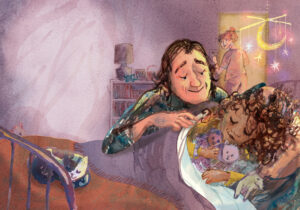
Coorie Doon: A Scottish Lullaby Story by Jackie Kay and illustrated by Jill Calder is published by Walker Books, priced £12.99.
A new novel from A. L. Kennedy is always cause to celebrate, and Alive in a Merciful Country is a a great reason to run right to your nearest bookshop. David Robinson finds the novel ambitious, full of imagination and deeply human.
Alive in a Merciful Country
By A. L. Kennedy
Published by Saraband
On the verge of lockdown, Anna McCormick is teaching her Year Fives at Oakwood Primary School all about Rumpelstiltskin. They’ve made masks, wondered whether it would be possible to spin straw into gold, and worked out what kind of dance he might perform as he sets the princess the seemingly impossible task of guessing his name – which, as you might remember from your own time in Year Five, is the only way for her to avoid having to give him her first-born child.
A. L. Kennedy, herself the child of a primary school teacher mother, makes sure that Anna has no doubts about the importance of her job: ‘I am the person who keeps your society working right from the start, who tries to make sure it isn’t full of broken people.’ Working at Oakwood Primary (motto: ‘There’s always a bright side – we just need to find it’), living in a Victorian coachyard flat she adores in central London, she has a spectacularly good relationship with her 19-year-old son Paul, who matches her for both idealism and banter. Then there’s her website designer boyfriend Francis; even someone like Anna, a habitual worrier, knows that this is love. On their first night together, she confides to her diary, ‘it’s as if you’ve had an open cupboard door swinging back and forth while you walk about and now it’s comfortably closed and snug, and nothing important will fall out, not ever again.’
Happiness, two kinds of unwavering love, a job rooted in hope: this isn’t normal A. L. Kennedy territory. Where has all the nuance gone? The layers of pain? The caustic social commentary? The emotional complexity, the wry, self-aware, pared-down stories we’re used to her sending spinning like a fairground waltzer?
They’re all there, it turns out, lying in wait in that sentence I began with. Because back in the 1980s, long before Anna McCormick became the undoubtedly excellent primary school teacher she now is, she was in a group of radical clowns, musicians, street theatre performers and acrobats who went under the collective name of the OrKestrA. They were the kind of troupe you’d see playing in Hunter Square on the Edinburgh Fringe, more Merry Pranksters than any kind of serious revolutionary threat to society. That didn’t, however, stop them being infiltrated by a police undercover agent. He has many aliases, but here we’ll just call him what Anna calls him most of the time – Buster.
Buster busted up the OrKestrA. True, he had charisma and was good at his role in the troupe as the deadpan silent film star they nicknamed him after, but he betrayed Anna on every level: he was never who he said he was, and his whole life – and his relationship with her – was a lie. Now, all these years later, when the country is under Covid lockdown, he sends her an unsigned letter in which he confesses to all the various deceits – and far, far worse – that he subsequently committed.
Separately then, both Buster and Anna are looking at and writing up their past, the way so many people did in lockdown, trying to make sense of their lives at a time when time stilled and the future looked fuzzier than ever. For Buster’s narrative, not only are the typefaces different, but so is the language. When Kennedy first shows us what has happened to him, it’s already 2016 and (we later learn) he has spent decades living under assumed identities. It takes the reader a while to realise this. At first, all we know is that he has disguised himself as a security systems employee in order to assassinate a plutocrat in his mansion in the New England woods. Kennedy makes him think in a way which is more than half robotic:
‘The breeze kicks sudden wicked. We are in a cold snap since two days past and the final autumn foliage rags are curled in on themselves and murdered with the new chill and dropping thick on the ground. I am cold but do not make this personal because then my skin will form memories and skin memories are hard to shift.’
At this stage, because Kennedy has still left the cupboard doors of her plot swinging back and forth, the reader’s brain is starting to fizz, almost as if we are seeing two completely different films at the same time – say, Sally Hawkins in Happy-Go-Lucky for Anna and Michael Fassbender in The Killer for Buster. The exploded text in the Buster section (‘foliage rags’ etc) adds that extra frisson that only a novel can do, forcing us to become more attentive to his storyline, although the more used to killing he gets, the more ordinary his language becomes.
Buster takes on and discards identities as a vigilante at will, killing some very obvious Bad Guys (that New England plutocrat was also a sex trafficker). We follow for all the obvious reasons: a) will he get found out? b) what links the victims? but, most of all, c) what’s a serial killer doing in an AL Kennedy novel in the first place?
Already, though, she has told us. Or rather, Anna McCormick has told the Year Fives of Oakwood Primary. That story about Rumplestiltskin, she said, has been around for not just hundreds of years but thousands (4,000: Dr Google agrees). It’s something we all need to know: that the way to defeat all monsters is by knowing who they really are.
Stiltskins, or monsters, are all around these days, not least in post-Brexit Britain, which as Anna points out in her diary, is ‘a little triggering for people like me’. A little? To Anna, the spy cops were only the start of it. Arts funding cuts were made ‘because chaos is profitable and worshipped in myths about genetic superiority’. These days, caring enough about other people ‘to organise food for the hungry, or to advocate for breathing, or clean water or similar luxuries will mean you automatically anticipate surveillance and malign interventions.’ Education ‘is on a Strasbourg goose process – forcing the low-grade corn and keeping them caged and docile.’ Then there’s Twitter, which mainly consists of ‘enticing mistakes that will eventually drown out everything that’s true’. The police don’t help, what with their burglaries of ‘troublesome households, political households, questioning households – burglaries that were cop intrusions and feral surveillance squad intrusions and messing with your head intrusions for cop fun.’
To Anna, Covid is a Stiltskin playground. ‘They kill us for not being them and to make themselves feel special, but they dress it all up in the pseudoscience of mass infection and dreams of genetic superiority’. Still, at least Oakwood Primary isn’t a state school, so they can all wear masks ‘because no health minister can bully us. He picks on council kids.’ Even when the government insists that teachers wear masks, Anna says, it’s just another Stiltskin trick.
Much of this is her obvious paranoia, seeded by Buster’s betrayal, but some isn’t. Either way, Anna can’t show any sign of despair to her young charges. She may be convinced that, outside of her own cocoon of love, she is living in ‘an age of fury and Russian roulette’, but the world has to be made better than it is, and Year Five at Oakwood Primary is as good a starting point as ever. So as well as telling them about Rumplestiltskin, she also tells them a story based on a hadith collected by Imam Muhammed al-Bukhari in the ninth century about a man who has murdered 100 people. He can’t be forgiven, he is told, unless he reaches a merciful country. There is such a country, but it is hard to get to, and the murderer has only just reached its border when he dies. His body is only halfway across that border, but God moves the whole world to make sure that all of it is safely inside the merciful country, where his sins can be forgiven.
Of course, writes Kennedy, there has to be justice. But there has to be mercy too ‘because the acting out of mercy cleans and saves us all.’ Hence the novel’s title, which for most of its 408 pages is heavily ironic. It might be hard to imagine now, so far our society has fallen so far from where it should be, but in the merciful country, even Stiltskins can be forgiven.
Alive in the Merciful Country by A. L. Kennedy is published by Saraband, priced £18.99.
ALSO ON BOOKS FROM SCOTLAND
-


Saltwater: A Midsummer Ghost Story by Elaine Thomson
‘The very thought of those grey faces made my skin grow cold.’
-

‘An Odious Campaign’ by Rob McInroy – Why a 1936 By-Election Still Resonates
‘This enraged the locals and he came close to being run out of town on several occasions.’
-

‘‘That’s right, Bobby,’ he growled. ‘I haven’t seen you in – well, since you decided to kill me.’ ‘
-

David Robinson Reviews: Solitary Agents by David Goodman
‘This is very much an up-to-the-minute story of spycraft, positively revelling in all the things tha …
-

The Savage Landscape by Cal Flyn
‘It is their resistance to the intrusions of the outside world − culturally, economically, environme …
-

The Shortest History of Scotland: A Q & A with Murray Pittock
‘We need to be better aware of that to understand the challenges and achievements of the past, and t …
FEATURED AUTHOR:
Angela Jackson

On publication of her debut novel, The Emergence of Judy Taylor, Angela Jackson was named one of UNESCO City of Literature’s emerging writers. The novel won Edinburgh International Book Festival’s First Book Award, and was also Waterstones Scottish Boo …
FEATURED PUBLISHER:
Sunono Publishing Ltd

Sunono is an Arabic publisher established in the UK. We publish our books in Arabic and in English. We publish children’s books with the approach to extend our work to introduce adult books and novels. In 2020 and 2021 we won the Sharjah Translation Gr …