


In the 1990s, Julian Evans fell in love and married in Odesa, and has had a decades-long relationship with the city ever since. His memoir is an compelling blend of the political and the personal, providing insight into the relationship between Russia and Ukraine whilst offering a beautiful portrait of one of the world’s most unique cities. We hope you enjoy this extract.
Undefeatable: Odesa in Love and War
By Julian Evans
Published by Scotland Street Press
24 November 2022
After twenty-four hours, the blackout already feels normalised. It feels usual to get into a Bolt, be driven along unlit city highways without traffic lights, feel my way along the blacked-out narrow lane at the back of Ira’s building and fumble open her garden gate. Vadym is in Ira’s kitchen with Seriozha and Oksana, Dima and Felitsia, and Felitsia’s new puppy, a baffled-looking long-haired chihuahua. The gas is working and Vadym and Dima are cooking a mountain of river crayfish, twice as many as it will be possible for the seven of us to eat. Bought alive at Privoz that morning, they are dropped one by one into the big pan of water flavoured with dill and other herbs. Yesterday’s strike has failed to take away a single element of the evening. The room is lit by a car battery on top of a kitchen unit and connected to LED strips, artfully stuck to the wall to light the table under the window and the cooking area, and to confirm the fuck-you-Putin-we’re-having-a-party atmosphere.
We start with Vadym’s samogon, an amber-coloured homemade spirit with a smooth, and I suspect untruthful, character. Rapidly conversation turns to the war, but it seems it wants to skirt around it at the same time. There is not a consensus. There seems to be discomfort about being a Russian-speaking Odesan or even a Russian-identifying Odesan. Some guests, despite hating Putin, want to ‘just get it over’.
‘These are obstacles we need to overcome,’ someone says in Russian. ‘We need to have peace again.’
‘It’s President Zelensky’s fault.’ Vadym says, ‘He’s a very good actor, so he plays the role of president very well, but he’s a bad president.’
‘Why do you say that?’ I ask.
‘He’s a bad leader for Ukraine.’
I try again. ‘Can you explain why?’
‘We want peace. He shouldn’t have let the war happen.’
This feels like a high bar of criticism, given that President Zelenskyy had little chance of knowing Putin’s true intentions or, even if he did, of discouraging them. I guess that most of the guests just want the president to solve their anxiety and discomfort, to make this horrible thing that is happening go away.
‘What do you think?’ Oksana asks me.
‘Of course I don’t like the war at all,’ I say. ‘But I believe Putin has to be defeated. I don’t think there’s an alternative. If he is not defeated, would people in Odesa like to see themselves ruled from Moscow?’
‘Ukraine doesn’t like Odesa. That’s the problem,’ Seriozha says.
Felitsia says sharply, ‘Julian, you live in England. You have a ticket home. You don’t live in Ukraine, you’re not Ukrainian. So you can’t say what Ukraine or Ukrainians should do.’
‘You’re right. But Odesa and Ukraine changed the course of my life. Odesa is part of my past and present. I admire that Ukraine is also fighting for Europe’s future and stability.’
I sense no one wants an argument. I add, ‘I believe Putin is at war with Ukraine because he’s afraid of what Ukraine has achieved as a democratic state, and economically. He sees your country as a threat to Russia.’
Odesa is historically majority Russian-speaking. But beneath that fact, many Odesans identify with Russian culture more than Ukrainian. My implication that Russia is inferior produces a courteous silence. I try to lessen the tension by offering a toast to my mother-in-law, Alla, who died of cancer two years ago and whom everyone here knew and loved. It’s still awkward. This is an evening of warmth and generosity held in my honour, but it’s weighed down by unexpected ambivalence.
I have to leave, to beat the eleven o’clock curfew. As I go, Ira pushes a big foil box crammed with cold raki and samphire salad into my hands, along with a battery torch–table light. ‘Don’t worry. We’re friends here. Nobody was offended. Everyone can say what they think.’
The Bolt drops me at Rishelievska. I go around the corner past the black frontage of the hotel on my way to the three floors of freezing fire-escape stairs. I hear Ilya’s voice behind me.
He’s grinning. ‘We have light! And lifts are working.’
Undefeatable: Odesa in Love and War by Julian Evans is published by Scotland Street Press, priced £24.99.
David Robinson discovers Scotland’s literary scene is in good hands with the shortlisted authors in the 2024 Saltire Literary Awards First Book Prize.
Night Train to Odesa
By Jen Stout
Published by Polygon
The Department of Work and Pensions Assesses a Jade Fish
By Nuala Watt
Published by Blue Diode Press
Remember, Remember
By Elle Machray
Published by Harper North
The Old Haunts
By Allan Radcliffe
Published by Fairlight Books
Fragile Animals
By Genevieve Jagger
Published by 404 Ink
I saw Jen Stout talk about Night Train to Odesa, her book of reportage from Ukraine, two days after it won the Saltire First Book of the Year Award. She was being interviewed by Gavin Esler at the first-ever St Andrew’s Book Festival in London – appropriately enough, given that he is the patron saint of Ukraine as well as Scotland – on St Andrew’s Day.
The judges praised her book – the only non-fiction one on the list – as an ‘accomplished and beautiful work, blending journalism, memoir, history, art’, and indeed it is, but it deserves a harder-edged appreciation. I’ll start off with Stout’s journalism. In these days of denuded media budgets, setting out on a career as a freelance foreign correspondent – never mind going to Ukraine – is an act of bravery in itself, especially for someone unable to rely on the Bank of Mum and Dad.
Growing up on Fair Isle and Shetland, Stout didn’t have that particular advantage, though in her fifth year at Lerwick’s Anderson High School, an inspirational Russian teacher sparked her love of the language and a school trip to St Petersburg sealed her ambition to work as a journalist in Russia. As she told Esler, she was inspired by the journalism of Anna Politkovskaya, who was assassinated on Putin’s birthday in 2006, and dreamed of working on Politkovskaya’s old paper, Novoya Gazeta. In November 2021, when she took up a fully-funded scholarship in Moscow, this finally looked feasible. Three months later, when Putin invaded Ukraine, she set off to cover the conflict without a) institutional backup b) security or c) money.
Night Train to Odesa is vivid, passionate and unfailingly empathetic, but doesn’t shy away from historical and present complexities. For years, she points out, Ukrainians had looked to Moscow as a supplier of cultural excellence; now it was a supplier of shells being aimed at their homes. On the other hand, while there was delight in Odesa at the sinking of the cruiser Moskva (whose guns could have levelled the city), there were still those (often elderly, their lives full of memories of the USSR) who still quietly mourned the deaths of their fellow Russian-speakers.
Revealing such complexities – like the linguistic ones implicit in the nationwide drift away from Russian and towards Ukrainian – doesn’t mean Stout has any doubts about the rights and wrongs of the conflict. Even while still in Russia, she had been appalled by casual imperialistic attitudes towards the Ukrainians, and she has similar contempt for those on the British Left who say that the war is all NATO’s fault and Putin can be easily appeased. ‘We know what the Russians will do,’ she says. ‘We’ve seen the mass graves.’
Nuala Watt’s debut collection, The Department of Work and Pensions Assesses a Jade Fish, is no less impressive. In it, blindness and partial blindness aren’t metaphors but lived experience. Watt, who is partially blind (although able to read print) and has cerebral palsy, studied for a PhD at Glasgow University on how poetry deals with visual impairment – and concluded that it doesn’t. And because she could hardly find any realistic depiction of partial blindness, she wrote her own. ‘I basically gatecrashed poetry,’ she says.
Dealing with a box-ticking, blinkered bureaucracy is, it seems, a sadly inevitable part of disability. In her collection’s titular poem we see how Watt is assessed by officialdom:
How often do you lose consciousness?
Exactly how much of your life is a mess?
Can you make a cup of tea?
We cannot pay you
Other poems in the collection try to make visual sense of a blurred world, describing the point at which it disappears, and even uses comedy to explain the intersection of partial sight, epilepsy and dyspraxia. Again, these are never less than intelligent and engaging, with a clear delight in trying out a whole variety of poetic forms. But more impressive still are those poems in which Watt writes about pregnancy and motherhood.
Intimate and personal, they compel empathy. Take ‘Pregnant and Squint’, in which she sardonically points out that, for someone with disability, pregnancy might be ‘a holiday from awkwardness’, or ‘You and I Go Shopping’, in which a 10-minute trip to the local shop with her daughter to buy an Easter egg is revealed to be so fraught with risk that she put it off for years. Both poems wrongfoot the reader with breathtaking aplomb, while showing the epic in the everyday, breaking down cliched images of (partial) blindness, and rebelling against notions of victimhood. This insistence on creativity despite all the obstacles bureaucracy and unthinking strangers place in her way runs throughout her poetry and is – presumably – among the reasons the Saltire judges called Watt’s poetry ‘groundbreaking’.
‘If one man can rule an empire why can’t one woman bring it down?’ If I’d been publishing Elle Machray’s Remember, Remember, that line half-way through the novel is the one I’d have lifted to put on its cover. It’s pithy, tantalising, and truly reflects the treasonous gunpowder plot at its heart.
We’re not talking Guy Fawkes’s failed effort of 1605 here but a counterfactual one in 1770 which originates in the mind of Delphine, a young black woman born on a Caribbean slave plantation who has escaped from her master. The novel opens with her watching her brother Vincent fight in a boxing match at London’s Theatre Royal. If he wins, he is told, he will be a free man.
It’s not too much of a spoiler (page 13 out of 377) to reveal this doesn’t happen, but by the end plenty of other things have: murders, riots, and corruption for starters, with no shortage of high politics, illicit love affairs, smuggling and assorted double dealing. The main thrust of the plot, however, is whether or not Delphine will bring down the British empire by blowing up the Palace of Westminster. And if you think you know the answer to that already, remember that Machray is working in a genre in which fiction isn’t hammered down with historical facts and the past is every bit as fluid as the present.
That said, the best alternate historical novels (Fatherland, The Man in the High Castle, SS-GB) spin out from a factual core. Here that is provided by the landmark 1772 Somerset v Stewart court case, which effectively ended slavery within England. Machray adapts this to a plot that flamboyantly explores how much Delphine is prepared to risk in the abolitionist cause.
Allan Radcliffe’s The Old Haunts, a wonderfully understated and evocative novel about grief and love, could hardly be more of a contrast to such epic imaginings. Jamie, a gay art teacher in his thirties, is on a week’s holiday with his partner in the Highlands trying to find a place he stayed years ago with his loving parents.
Plotwise, not much more happens. It doesn’t need to. Not only can Radcliffe paint ultra-realistic portraits of his characters, but he possesses that far harder skill – rare in debut writers – of making his readers care about them.
Growing up in the flat above their Edinburgh newsagent’s shop, Jamie realised he was gay at a relatively early age. He kept quiet about it, the way everyone he knew as a teenager did, and the way the government at the time encouraged through Section 28. Yet only now, after his parents’ death, does he count the cost of that silence. Did his parents, for all the love they showed, ever really know him? Was he in turn, everything he could have been for them, not merely embarrassed as he showed them round the London flat he shared as an art student?
So yes, there’s a whole atlas of roads not taken here, but a lot more too. Whether through his skill at slipping his story back and forwards across the decades, from Jamie’s teenage yearnings to his joking, confident, sexually fulfilling relationship with his partner, Radcliffe turns regret into compassion. There’s empathy for every one of his characters at a level that is the mark of a true writer.
In Fragile Animals by Genevieve Jagger a tall, tattooed taxidermist called Moses from Aberfeldy meets Noelle, a self-harming poet and hotel cleaner on a week’s holiday in November on the Isle of Bute. On Page 28, Moses casually tells her that he’s a vampire. Don’t worry, he adds later, I’ve never killed a human.
I’m new to vampire fiction, never having read any of the 30,000 books Amazon has in its ‘vampire novels for adults’ category. Whether it’s their predictability (watch out for mirrors, sunlight garlic etc), dodgy sexual politics, or my own failure of imagination, I’ve never felt the need.
Moses is, however, isn’t a traditionally handsome vampire so much as a dirty, withered and grotesque one, and I was relieved to find that not only does he fail to get up to much serious vampiric business but Noelle is hardly cast in the traditional female-victim role either. Instead, because he doesn’t make any demands on her, she comes to terms with the mistakes she has made in her fraught adolescence and begins to face up to her future.
Put like that, though, Fragile Animals sounds rather bland. It’s not – and though it hardly lives up to some of the advance praise (‘Shirley Jackson meets The Wasp Factory’) there’s enough dark intensity about Jagger’s prose to make one want to read whatever she writes next. And though this First Book shortlist was every bit as wide-ranging, innovative and challenging as you might wish, that is the one thing that all these talented writers have in common.
Night Train to Odesa by Jen Stout is published by Polygon, priced £17.99
The Department of Work and Pensions Assesses a Jade Fish by Nuala Watt is published by Blue Diode Press, priced £10
Remember, Remember by Elle Machray is published by Harper North, priced £16.99
The Old Haunts by Allan Radcliffe is published by Fairlight Books, priced £7.99
Fragile Animals by Genevieve Jagger is published by 404 Ink, priced £10.99
Lorraine Wilson has been making a name for herself with her dystopian folk-fantasy novels, and her latest book once again shows why she is a talent to watch. Here is an extract from We Are All Ghosts in the Forest.
We Are All Ghosts in the Forest
By Lorraine Wilson
Published by Solaris
The boy awoke just as the sun began to fall towards the village. At this angle, it caught the contours of the dead houses and in the corners of their eyes, the greened, broken angles became the faces of the lost. Stefan sat beside Katerina on the bench, chamomile and lavender a cool sea around them as he leaned his head against the wall. She was watching the faces of her baba’s long dead neighbours shifting in and out of cohesion in the long shadows, but turned to study the boy instead. It was strange how he could move from a child to a young man with the angle of his chin. Now, leaning back, eyes slitted against the light, the bones of the man he would be were clear, the way he would be more capable of stillness than most.
Fleetingly, she imagined how she’d frame the shot if she still had her cameras and if they still worked, but the habit of seeing the world through a lens was distant now, and risked resurrecting memories of a day she’d rather not think about. She didn’t know why the thought had come to her at all, only she had been dreaming again recently, the past haunting her sleep. One chicken and then another and then the whole flock discovered them then, distracting her and fussing softly beneath the bench and being steadily ignored by Stefan. Perhaps he thought these were ghosts, too, or was so used to ignoring things that it would take conscious choice to see. Which would be a problem, here.
‘There are some things you need to know,’ she said eventually. The butterflies were settling into the last sunlit grasses to bathe before the dark, the boy tilted his head to show he was listening.
‘One: the forest has worse things than ghosts.’ She paused. ‘The rumours are right, your average ghost doesn’t last long in there, but only fools go in looking for a cure from digital infection. The forest eats ghosts, but the things living in the forest are hardly going to turn down a wandering human, infected or otherwise.’ The marram hen climbed gracelessly into her lap and Katerina smoothed her warm speckled feathers slowly. The hen crooned.
‘Two: you work otherwise neither of us eats. Three: I don’t know what you’re used to, but the dead houses here are different to urban dead spaces.’ The boy rolled his head against the brick, his eyes on her questioning. ‘In the cities, the biggest risk of the ghosts gathering in abandoned spaces is them starting fires, yes? Getting into the wiring and frying everything. Well here there’s less explosions, more… hunger.’ She thought of the storytime ghost in the meadow. Story ghosts made the best searchers in some ways, so much more willing to hunt out different endings, but the worst in others. They were more aware, strained harder against their broken edges.
Stefan frowned.
‘Were you ever warned against talking to strangers?’
He nodded, perhaps aware of the irony.
‘The ghosts that have gathered in these dead houses… there’s rarely enough wiring left for fires but instead there’s centuries of hunger and hardship and change crammed into a handful of digital fragments. It makes some of them greedy. They are like the guy promising puppies, alright? Or the stranger saying he’ll take you to your mum.’
Stefan flinched, the sun painting his pale skin the same colour as his eyes, and he’d burn, she realised. She’d need to watch for that, and it wasn’t something she was used to having to think about. She stifled a sigh and turned to watch the falling sun, the restless shadows that would be starting to gain mass about now. ‘First job,’ she said, rising, the marram hen falling earthward in a flurry of wings and indignation. ‘The garden boundary.’ She lifted a bag from beside her feet. ‘Witch hazel ashes. I want you to scatter them along the fence line while I check the rest.’
He did not reach for the bag, so she grabbed one of his hands and set it within his palm. ‘If you don’t understand, then ask. But you do a job I’ve set you to. Yes?’ He nodded and straightened, but hefted the bag higher and raised his eyebrows expectantly.
‘Dry wood doesn’t conduct electricity, so it repels most wandering ghosts. The fence line itself is strong enough really, but the ashes are a useful reinforcement.’ She smiled at his expression. His glance at the low fence then the open sky. ‘Yes, I know this is a three-dimensional problem. It’s just a reminder that this house isn’t theirs. It’s about manners. You’d be surprised how many ghosts have them.’ She did not wait long enough for him to think through the implications of that statement. ‘I’ll check the house. You get on, now.’
We Are All Ghosts in the Forest by Lorraine Wilson is published by Solaris, priced £18.99.
Billy Connolly once said ‘there is no such thing as bad weather, just the wrong clothing’. David Robinson finds writer Helen Moat determined to appreciate the dark days of winter despite dreading it in previous years.
While the Earth Holds Its Breath: Embracing the Winter Season
By Helen Moat
Published by Saraband
Officially, according to the astronomical definition, winter begins with the solstice of 21 December and lasts until the spring one on 21 March. Meteorologists disagree. They simplify things a bit, so they make winter start on 1 December and end on the last day of February.
I think they’re both wrong. Winter surely begins in November. Thermologically speaking, November is one of our three coldest months. Most of our trees have already shed their leaves. Nature is shutting down rather than, with the coming of longer days, starting up – like crocuses poking their heads out of the earth in late January – and actively planning ahead for spring. Bleak midwinter is surely what you can expect to find in mid-December, around the time we’re singing carols about it.
Whenever it happens, though, bleakness and winter are forever entwined. If autumn is a season of mists and mellow fruitfulness, winter is all too often a time of emptiness, fatigue and seasonal affective disorder. Or at least, as she outlines in her book While The Earth Holds Its Breath, it always has been so for travel writer Helen Moat.
Every year for as long as she can remember, she writes, the coming of winter meant spiralling down into anxiety. The cause and parameters of this aren’t clearly defined. Sometimes, it is ‘a feeling of being a shadow of myself, flimsy and ethereal, not quite solid … drowsy, dozy, disengaged’; at other times it is altogether more debilitating. But although she writes about wanting to push away ‘an internal darkness’, and ‘learning to deal with feelings of abandonment, rejection and judgement’ and ‘feelings that weighed me down like a stone’ and although all of these feelings always surface with the onset of winter, that’s where her self-analysis ends.
In this respect, While the Earth Holds Its Breath has a useful counterpoint in Katherine May’s 2020 international bestseller Wintering. Like Moat, May draws links between literal and metaphorical winter, examines how different cultures get through the year’s darkest months, and gathers her experiences under the chapters with the headings of winter months. But the differences are stark too. While anyone reading Wintering could tell you precisely what discontents May was wrestling with (illness, change of job, worries about her son), Moat reveals comparatively little about herself. The proof copy I read, for example, doesn’t even mention that she and her husband now live in Angus.
Against that, there’s no denying that Moat’s book has the more dramatic opening. She is on a travel writers’ freebie trip to the Finnish winter sports resort of Kittilä, which is within the Arctic Circle and has been led away to try ice fishing on a frozen lake. It’s -20C, she is sitting on a small camping stool above a hole in the ice, holding onto a small fishing rod. She doesn’t catch anything.
Instead of feeling cold, depressed, or any of the other emotions that she has hitherto most associated with winter, she experiences altogether different emotions:
‘I’m taken back to an existence before memory, a time when I floated gently in amniotic fluid, womb-dark and safe. Something primeval is happening to me….. I feel adrift from myself and somehow anchored to the frozen land and to the arch of sky surrounding me, as if held in a snow dome … In the stillness, the whitened trees and indigo-blue sky whisper to me. Flittering thoughts ease out; I have become one with the ghosted landscape.’
Winter, in other words, has become its opposite: a comfort, something to cherish. Just as Finnish Laplanders apparently spend as much time as possible outdoors in the dark depths of winter – and love it – so, she resolves, will she. Not only that, but she will write about it, noting what works for her and what doesn’t. She also resolves to keep a gratitude diary, celebrating not only winter, but friendships, food, travel and everything that helps to get her through its darkest days.
So when she and her husband visit the Welsh town of Laugharne in their campervan on a rainy October day, instead of feeling down, she
‘gave myself up to the energy of the tides, the currents in the estuary, the cold rain drizzling down my cheeks, the edge-or-winter coastal air sharp on my face. There was rapture on this shore, a feeling of joy, a coming to, an awakening I experienced every time I looked out at sea.’
It’s not just the sea: the Peak District moors, memories of cross-country skiing in Switzerland, forest-bathing in Japan, night-time rambles with neighbours – anywhere nature can dwarf her can also bring joy. But so too can the friendships she makes along the way, or the discoveries of other ways of living. The Japanese, she finds out on another freebie trip, wouldn’t dream of talking negatively about winter: it’s just one season that balances the others and life must be lived in harmony with all. Then again, she thinks, visiting friends who have settled in an Andalusian village, isn’t their life the perfect answer to the winter blues too?
All these places provide different triangulation points for Moat’s own study of ways of wintering. Unlike May’s book, the gratitude diary format dominates. Sometimes Moat’s determination to enjoy winter slips and there are cold, rainy days when she does indeed stay under the duvet, cursing her lack of resolve. As the period she is writing about encompasses both the pandemic and the war in Ukraine, there is plenty to temper her optimism.
The gratitude diary approach has its limitations, just as a newspaper would which only concentrated on good news: if you’re only looking in one direction, you tend to find what you’re looking for. But as Moat’s book is just looking for joy in the bleak midwinter, what’s the harm in that?
While the Earth Holds Its Breath: Embracing the Winter Season by Helen Moat is published by Saraband, price £12.99.
Who doesn’t love an international spy thriller? And in Adam Oyebanji, we have an excellent addition to writers of that genre. We spoke to him about his forthcoming release, Two Times Murder.
Two Times Murder
By Adam Oyebanji
Published by Severn House
Hi Adam, welcome to BooksfromScotland and congratulations on the upcoming publication of Two Times Murder. Could you start by telling us a wee bit about the book?
Absolutely! You’ve caught me on a good day because some of the early reviews have just come in and they’ve been very kind. And now I’m thinking I might not be absolutely terrible at this! Anyhow . . . the book:
Greg Abimbola is many things. He’s Black, British and fluent in Russian. He’s a snappy dresser, a reasonable teacher, and an unenthusiastic sports fan. But most of all, he’s exceptional at keeping secrets. Like, who he really is, and the things he’s done.
Determined to keep his head down after helping solve a murder in the school basement, Greg fears a trap when Sergeant Rachel Lev of the Pittsburgh police corners him in his apartment. Because his refusal to take credit isn’t modesty, it’s a survival tactic.
But Rachel is here on another matter entirely. She needs his help. She’s lead detective on the homicide of an unidentified man fished from the Allegheny River. With clues scant, and surrounded by colleagues who’d love to see her side-lined, Greg is her final roll of the dice.
Greg has no choice. He knows more than he’s saying about Rachel’s mysterious corpse. To add to his troubles, a school trustee plunges to his demise after a heated board meeting. Both deaths come with potentially lethal consequences. If he doesn’t find answers, and soon, Greg Abimbola might be the third man on the autopsy table.
The book is the second in the Quiet Teacher series, following 2022’s A Quiet Teacher. How was the experience of writing a sequel? Did it come easily to return to the world of Greg Abimbola, or did you suffer from any of the usual second-book syndrome?
Hmmm. It helps if you don’t know how to count. Or, more accurately, if you don’t know where to count from. Two Times Murder is my second Greg Abimbola book, but it’s my third published novel: A Quiet Teacher was my second, after Braking Day, my debut, which was, in turn, my fourth attempt at writing a novel. I’m sure I must have had second book syndrome; it’s the when of it that I’m less sure about.
What I do know is that second-book syndrome was not a factor in Two Times Murder. Once I’d plotted it out, it was a joy to write. The plotting, admittedly, was a bit tricky. There is some carry over from A Quiet Teacher but I wanted to write something that stood on its own two feet. Writing something that would appeal to old and new readers alike took some noodling on my part, but I like to think I managed it.
As well as writing the Quiet Teacher series, you are also a science fiction author. Could you tell us a little bit about how you approach genre – do you consciously write within certain parameters, or do the novels emerge in these styles more naturally?
The secret to staying in the right genre lane is pretty simple: don’t write about Lorentz time dilation in a murder mystery. Unless, of course, your murderer is fleeing the scene on a sub-light vessel travelling at relativistic velocity. . .
Truthfully, I just like to tell stories, usually with a mystery and some vivid characters at the heart of it. Real world or deep space or somewhere in between, it’s all the same to me. I just write. What I’m really interested in is the people. People are people. If you go back in time and read Aristophanes, say, or Shakespeare, the characters they write about are instantly recognizable in the present day. Given that past is prologue, it’s a fair bet that 24th century homo sapiens will be just as messed up as we are. So, if you’re focused on character, writing a present-day murder mystery or a warp-speed space opera feels pretty much the same. Pretty much. The big differences, I think, are that in sci-fi the mystery doesn’t have to be a murder, and in a “proper” mystery, you begin at the end: everything thereafter is working backwards to figure out how the ending came to be.
But mostly it’s just telling stories and having a blast.
As part of your career, you have lived all over the world including the United States, Lagos and London. How much of a role has that experience played in the construction of the kaleidoscopic Greg Abimbola?
A lot! I lived in Pittsburgh, where Greg teaches, for five years: my office was in the building on the extreme left of the book cover. I’m bi-racial: Scottish and Nigerian, but I have an English accent, so people think I’m from there. Greg is bi-racial: Russian and Nigerian, but speaks with an English accent, so. On a deeper level, kaleidoscopic is a good word. Moving around as much as I have gives you multiple perspectives on pretty much everything: the objectivity of the outsider, I suppose. I leaned into that pretty heavily when writing Greg. He’s a lot more ruthless than I am, though!
Are there any other authors of mystery novels, crime fiction or otherwise which you drew upon when writing the Quiet Teacher series?
Only in the sense that I love old fashioned whodunnits with a hint of the locked room about them. Greg is my homage to Agatha Christie and John Dickson Carr. Two Times Murder is a genuinely fair play murder mystery. If a reader solves it, I’m delighted. And if they don’t, I want them to go back through the pages saying, ‘Aha, now I get it!’
Finally, what is one thing you hope readers gain from reading your work?
The most important thing is that they enjoy a good, brain-teasing whodunnit. Beyond that, that diversity doesn’t mean having to eat your greens. It’s an opportunity to stand in someone else’s shoes for a while and have some fun. Like changing seats in a train just for the hell of it. The journey’s the same but the view is subtly different. And who knows? Next time you buy a ticket, maybe that exact same seat will suit you even better.
Two Times Murder by Adam Oyebanji is published by Severn House, priced £21.99.
As the nights get darker earlier, we readers find it the perfect time for stories that make us jump, shake and dive under the covers, and the latest novel by horror specialists, Haunt Publishing, Bethnothinged by Alvar Theo, absolutely fits the bill.
Benothinged
By Alvar Theo
Published by Haunt Publishing
I had intended to only walk with him for a while and make sure we separated before we neared my home, but then we got to talking. He asked the usual sort of stuff like my name and then why the hell was that my name. There was, of course, a story behind said name, but I changed the subject in case it set me off. I asked him about busking. That went on for a while. Then out of nowhere he asked me if I wanted to hear a story.
‘What kind of story?’
We were just a couple of streets away from my place. I would have felt guilty about having him walk that far, but he seemed to be enjoying my company. That was a fun little first for me.
‘It’s a bit of a spooky story.’
‘Sure.’ I figured it was safe, seeing as I would be having a chemically induced sleep that night.
‘There’s this terrifying monster called The Nothing.’
‘That’s what I’m afraid of.’
He looked up, confused.
‘Nothing.’
His laugh sounded forced.
‘What does it do? Eat you?’
‘It’s probably more accurate to say that it consumes you. It picks isolated people like the elderly or the homeless. Once it takes you, it has you, body and soul. It feeds on you.’
‘What’s it look like?’
‘The people it takes. It can wear their faces. That’s how it gets close to people in the first place. It needs to know that you’re all alone, that no one wants you. Then it pounces.’
‘How do you fight it?’
He shrugged. ‘I guess you just have to find somebody to want you.’
‘Well, that’s me shit out of luck.’
He flashed me a weak smile. He was giving off a weirdly intense vibe, staring at the floor and brooding.
‘But then again, I’m not elderly or homeless so I should be all right.’
‘I hope so,’ V said, far too seriously for the conversation I thought we were having.
We came to the start of the bungalow row, and I had enough sense to stop there rather than let the nice stranger see exactly where I lived.
‘This is me.’
V stopped and looked around. I got the impression that he was surprised, like he’d spaced out and not realised how far we had walked.
‘Do you want some bus fare to get back to town?’
He shook his head. ‘No, I’m staying out of town for the rest of the day. I don’t want to chance running into Ginger again.’ He smiled down at me. ‘Take care of yourself, Mx Mask.’
‘You too, Mr V.’
I waited for him to walk away first. It had been nice to talk to someone. Obviously, I had spent some time with Doris, but it wasn’t quite the same thing as talking to someone roughly my own age who I actually had some things in common with. Plus, I hadn’t been constantly watching out for signs that he wasn’t okay and needed my help.
I went inside and tried not to let my imagination run away with me. He was homeless. I most likely wouldn’t be able to find him again even if I went looking. There was zero reason to assume he wanted to make friends with some random person anyway. I just needed to write it off as a pleasant encounter with a person I was never going to see again and let it go. I was too old for making a new friend; I’d missed the boat on that one.
When I entered my bedroom that evening, I found the wig head wearing make-up. Lipstick was smeared over her mouth and her eyes were blacked out with mascara. I had no memory of doing that, but I’d certainly done crazier shit when I couldn’t sleep. Plus, I could recall finding Nan’s make-up when I was looking for nail varnish.
Instead of dwelling on my nocturnal nonsense, I took a huge shot of the night-night drugs and passed out somewhere around nine. No staring into space, no driving myself crazy. Just sweet, blissful nothing.
Benothinged by Alvar Theo is published by Haunt Publishing, priced £12.00.
We are eagerly awaiting the final instalment of Graeme Macrae Burnet’s Inspector Gorski Mysteries, and so, to whet our appetite, we spoke to its author (and translator!)
A Case of Matricide
By Graeme Macrae Burnet
Published by Saraband
Hello Graeme, a hearty congrats for the publication of A Case of Matricide. Could you tell our readers a little bit of what to expect from the novel?
Thanks. A Case of Matricide is the final part of the Georges Gorksi trilogy, my sequence of crime novels set in the unremarkable French town on Saint-Louis. Here we find Gorski (the local chief of police) living with his aging mother and trying to untangle the connections between the appearance of a mysterious stranger in the town, a elderly woman who believes her son is trying to kill her and the death of a local factory owner. It feels quite action packed to me, but as with the other novels in the trilogy (The Disappearance of Adèle Bedeau and The Accident on the A35), my main interest is the impact these events have on the central characters. Oh, and there’s also a fair amount of boozing.
This is the last book in your Inspector Gorski Mysteries. How does it feel to say goodbye to a character and a place, Saint-Louis, when you’ve spent such a long time in their company?
I’ll definitely miss mentally inhabiting the streets and bars of Saint-Louis. And of course I’ve become very attached to the character of Georges Gorski, but this is definitely the time go our separate ways.
What drew you to small-town France as a setting for your crime fiction?
I’m fascinated by the drama that lurks behind everyday events, the tensions and resentments that arise in local bars or workplaces. That interests me just as much, if not more, than something violent or obviously dramatic like a murder. So I think I was drawn to Saint-Louis precisely because it seems like a place where nothing overtly dramatic would ever happen. Also I come from a small town myself, so perhaps Saint-Louis is a kind of surrogate for my feelings about these kind of places.
Georges Gorski is seen as a simple, undynamic man, but always has good instincts and character judgement. Did you want to say anything in particular about unshowy intelligence with his creation?
It’s probably true to say that Gorski is not very dynamic – in his police work, he certainly values procedure over flashes of inspiration or hunches – but I’m not sure I’d agree that he’s simple. Actually, I think he’s quite a complicated character, burdened by insecurities and guilt and regret about episodes in his past.
Your Gorski books always seem to explore characters that have difficulty in coming to terms with disappointments or inadequacy. What do you want to explore in coming back to these themes?
I never approach a piece of work with the idea of ‘exploring themes’. I try to inhabit the locales and characters and follow the trajectory that takes me on. If certain ‘themes’ arise or recur, they do so organically from this process rather than through any intention on my part.
You always have interesting framing devices in your novels, and with the Gorski mysteries you do this with the creation of the ‘author’ Raymond Brunet. Why do you like to do this?
It seems perfectly natural to me. I always find myself (as a reader) asking where did this text come from? Or, how do we have access to this characters thoughts? So, on the one hand, these devices are just a way of addressing such questions.
With regard to the Gorski novels and their author Raymond Brunet, with the first book I simply felt that what I was writing was a translation – the characters would have been speaking French to each other, and to a certain extent I was attempting to write in the style of a mid-twentieth century translation, using certain slightly archaic pieces of vocabulary to try to achieve this.
Having set this device in motion (that Raymond Brunet was the author of the books), I wrote The Accident on the A35 and A Case of Matricide very much from his point of view, expressing his worldview. The two books are fictionalised versions of events in his own life – a sort of metafictional autofiction.
Are we allowed to ask about what’s next for you as a writer? Do you think you would commit to another series of novels? Do you fancy tackling another genre?
I have a plan for a fairly hefty project that will take a big chunk of time to write, but I’m keeping it under wraps for the time being. I can’t see myself writing another trilogy, but who knows. I don’t really think beyond the next project.
What books have you enjoyed in 2024? What are you reading at the moment?
I just read Forbidden Notebook by Alba de Céspedes which is a masterpiece. I’ve had a sneak preview of Kate Summerscale’s The Peepshow. I love Summerscale’s work, and this re-examination of the 10 Rillington Place case is utterly fascinating. I also enjoyed David Greig’s Columba’s Bones, in Polygon’s Darklands series, which has the best opening chapter I’ve read in years!
A Case of Matricide by Graeme Macrae Burnet is published by Saraband, priced £14.99.
If you’ve yet to make an aquaintance with Skye McKenna’s Hedgewitch series, then look no further: BooksfromScotland is here to offer an exclusive extract of book 3 in the series, Seawitch. It’s perfect reading for youngsters and the young at heart that need to know what it takes to become a witch . . .
Seawitch
By Skye McKenna
Published by Hodder Children’s Books
A Trail of Biscuit Crumbs
Cassandra Morgan was hunting for a book. She had been chasing it for the better part of the afternoon and had managed to track it down to the Cookery section, where it had taken refuge amongst goblin recipes for toenail pie and pondweed soup, and faery syllabubs of moonshine and may blossom. With a candlestick in one hand and a butterfly net in the other, she stalked between the shelves, peering over the dusty spines of the volumes that sat in ordered rows and were, for the most part, behaving themselves.
A flutter of pages on one of the higher shelves caught her attention and Cassie scrambled up a wobbly stack of books to get a closer look.
‘Cassandra, would you come down from there before you break your neck?’ called a voice from below her. ‘It’s giving me vertigo just looking at you.’
‘You’re a cat, Montague, you’re meant to be good at climbing. Perhaps you could lift a paw to help me catch it?’
‘I’m a familiar, not a common mouser, thank you very much,’ said the grey cat, licking a spot on his shoulder. ‘If you wish to endanger your life looking for the . . . what was it again?’
‘Skald’s Glossary of Faery Poetry,’ said Cassie, teetering on the pile of books and steadying herself against the dusty shelf. There, in the shadows, she glimpsed a fat yellow spine. With her face pressed against a row of books, she stretched her arm towards it. Her fingers brushed the book’s cover just as it was whisked away from her, vanishing down the back of the shelf.
‘Cabbages and codfish!’ Cassie swore, borrowing a favourite expression of Mrs Briggs, the Hartwood housekeeper. She was beginning to wonder if the book was cursed – enchanted somehow to evade her. Then again, it wasn’t the first book that had given her trouble lately. In fact, every book she had wanted that week had gone missing, even those she’d seen just hours before.
Widdershin’s Bookshop was chaotic at the best of times. There were far more books than could fit on the shelves and many were heaped on desks and chairs, arranged in haphazard rows, or stacked in towers and piles like the one Cassie was currently teetering on top of. This made finding the book you wanted something of a challenge under ordinary circumstances, but Cassie had been visiting the bookshop and browsing these shelves for over a year now, ever since she’d arrived in the village of Hedgely. It was her favourite shop on Loft Street, and she had recently begun working there part-time, helping Widdershin with deliveries of new books after school and coming in on Saturdays to catalogue the stock. She was saving every penny she earned to buy a set of the Encyclopaedia Enchantia from Mercator’s Magical Mail Order catalogue. These volumes promised to concisely cover every subject a young witch needed to know, all alphabetically arranged and carefully indexed. Cassie was sure that it would help speed up her training – there were still so many things she had to learn to get her Sapling and Sterling pins and prepare for the Witch’s Licence examination. But it wasn’t just about passing tests and earning badges, Cassie needed to become a fully trained witch so that she could find her parents.
Her mother, Rose Morgan, had gone missing eight years ago. Cassie now knew that Rose had travelled through the Hedge, the vast enchanted forest that marked the border between Britain and the land of Faerie. She also knew why Rose had gone – she’d been searching for Cassie’s father, a man called Toby Harper, whom Cassie had never met. Cassie had no idea what had happened to her parents in that enchanted land, whether they were still alive, trapped and unable to get back to her, but she was determined to find out. To do so meant crossing the border herself, and for that she needed to master the practical arts of witchcraft and prove herself capable of facing the dangers of Faerie.
This was the first time that Cassie had been left in charge of Widdershin’s shop on her own. It was the May half-term and Widdershin had gone to Rutland to attend the estate sale of a rather famous witch who had died, leaving behind a collection of rare and valuable grimoires which the hob shopkeeper was eager to get his hands on. Cassie wanted to show him that she could be trusted to manage the shop while he was away, and that meant catching this annoying book and figuring out who or what was behind its disappearing act.
‘Can you smell anything, Montague?’ called Cassie.
‘While my senses may be far more acute than your paltry human ones, that does not mean I can detect one book among thousands,’ said the cat. ‘They all smell the same, anyway, of dust and mouldering paper.’
‘This book is new,’ said Cassie, peering down the back of the shelf where the book had disappeared. ‘It still smells of printer’s ink and binders glue and—’
‘There, behind you!’ called Montague.
Turning carefully on the spot, the pile of books wobbling beneath her, Cassie scanned the shelves. ‘Where did you see it?’
‘Over there, on the shelf across from you, amongst the history books.’
Cassie raised her candle, the light glittering on three fat volumes about the Spriggan Revolt and a biography of Queen Mab. There, on the top shelf, facing out – bold as brass – was Skald’s Glossary.
Cassie frowned. It was just out of reach. If only she had her broom! Clutching the Cookery bookcase for balance, she leaned out into the aisle, reaching towards the history books and trying to angle her butterfly net just-so. It hovered above the yellow glossary when there was an ominous creaking sound.
A second later, Cassie found herself hanging in mid-air as the pile of books collapsed beneath her. A dark shadow loomed over her and the bookcase she’d been clinging to fell towards her, raining recipes. Before she could cry out, she was buried under a pile of books.
‘Are you alright?’ asked a voice, as Cassie pushed aside a heavy cookbook and pulled herself out from beneath the bookcase which had, thankfully, come to rest against its neighbour, saving Cassie from being squashed completely flat.
‘Yes, no thanks to you, Montague, you could have warned—’ she broke off mid-sentence as she saw it was not her cat familiar who had spoken, but a boy. She did not recognise him. He was a little shorter than Cassie, with curling wisps of brown hair that stuck up at the back, and dark, serious eyes. He had not offered her a hand but seemed rather to be hiding something behind his back. A book, she guessed. Something he didn’t want her to know he was reading.
Well, he was still a customer, Cassie reminded herself, scrambling to her feet and dusting her clothes. ‘I’m sorry about this, I’ll be with you in just a moment.’
She raised her net and saw, with a sense of triumph, that she had managed to catch the glossary after all.
‘You’ve got a bogle in here, you know,’ said the boy.
‘Pardon?’
‘A bogle. I saw a trail of biscuit crumbs when I came in – that’s always a clue. We had one in my tad’s office last year, it used to steal chocolate digestives and change the dates on the desk calendars to confuse everyone. They like to play tricks – hide things you’re looking for. I suspect this one is having a good laugh about this,’ he gestured to the avalanche of books from which Cassie had emerged.
‘I know what a bogle is,’ said Cassie, although to be fair, she had not noticed the biscuit crumbs. She would have to make some faery traps and try to catch it before Widdershin got back. ‘Were you looking for something?’ she asked, changing the subject.
The boy flushed, and the colour went all the way to his ears. ‘I was . . . that is . . . Have you got anything on ancient witches?’
Cassie turned to the mixed mountain of history and cookery books with dismay. ‘Yes, but it might take me a while to dig it out.’
‘Never mind,’ said the boy. ‘What’s that you’re reading?’ he pointed to the yellow book Cassie was clutching.
‘It’s a glossary, you don’t read it exactly, you use it to look things up.’
‘What sort of things?’
‘Here, I’ll show you.’ Cassie led the boy around the collapsed bookshelves to Widdershin’s desk, an item of furniture which was perpetually buried under open books, scrolls, receipts, letters, broken pens, pots of ink and assorted papers. Cassie picked up a little green chapbook titled The Wanderers. She handed it to him.
The boy tucked whatever he was hiding into the back of his belt, freeing his hands to take the book.
‘Poems?’ he said, thumbing through the pages.
‘Just one poem, actually. There’s a verse on each page but I’m pretty sure they all go together.’
‘What’s it about?’
‘That’s what I’m trying to find out. See this verse here…’ She took the book back and flipped to the first page, reading aloud:
‘Seven rode over the starlit hills,
From the land of youth they came,
Bearing each their grammarye
From the halls of fair Elfhame.’
‘Grammarye means magic,’ Cassie explained. ‘It’s related to grimoire – that’s what we witches call our spell books. And I think Elfhame is another name for the land of Faerie, but I wanted to be sure.’ She handed The Wanderers back to him and picked up Skald’s Glossary to check.
The boy flipped through a couple of pages and read out another verse:
‘The Healer of the gentle heart
raised aloft the wishing cup,
From whose brim the waters flowed
that every dying soul would sup.’
He frowned. ‘Each verse seems to describe an item… a treasure.’
‘Yes, ancient faery treasures. I found it in the library at Hartwood Hall, where I live with my aunt. I think my father was reading it, researching the treasures, before he… left.’ Cassie wasn’t quite ready to explain her family history to this stranger. ‘The first two – the key and the spear – I’ve already seen, but there’s more: a cup, a ring—’
‘—but who are the Wanderers?’
Cassie shrugged. ‘That’s the mystery. I haven’t been able to find anything else about them.’
‘Except there’s obviously seven,’ said the boy. ‘And each is associated with one of these treasures.’
‘I’m still trying to decipher all the archaic words,’ said Cassie.
A grandfather clock sounded from the depths of the shop, breaking their conversation with five deep chimes. It was closing time.
‘I have to go,’ said the boy.
‘All right, well if you come back tomorrow afternoon I should have excavated the history section by then…’
But the boy shook his head. ‘I’m only visiting for the day.’ He gave The Wanderers back to Cassie and rushed away between the bookcases, heading for the door without so much as a ‘goodbye’. Just before he left, he stopped and placed something on a little table.
‘No manners at all,’ said Montague, leaving his place by the pot-bellied stove. ‘Not so much as a by-your-leave, why, a young gentleman should…’
But Cassie wasn’t listening to the cat. She went straight to the little table and picked up the book the boy had left. It was a slim black volume with a swirling silver triskele on the cover. She knew it immediately because she’d bought her own copy on her first visit to Widdershin’s. It was The Witch’s Handbook.
Seawitch by Skye McKenna is published by Hodder Children’s Books, priced £12.99.
Jenny Colgan is one of Scotland’s leading novelists, bringing readers warm, funny and uplifting romances that are addictive and unique. To celebrate the publication of her latest novel, Close Knit, we asked Jenny to tell us her five favourite novels from her favourite women writers.
Close Knit
By Jenny Colgan
Published by Hodder & Stoughton
Middlemarch by George Eliot
It’s got this reputation as being starchy and difficult and it isn’t at all, it’s gossipy and romantic and thoroughly engrossing. Honestly, do yourself a favour just let yourself get lost in it.
Cold Comfort Farm by Stella Gibbons
Everyone feels this novel is special to them, it always feels like you’ve just discovered it. So funny and joyous and lovely.
Standard Deviation by Katharine Heiney
One of the funniest, most human novels ever written. Everyone who reads it just loves it to death.
The Long Drop by Denise Mina
Scotland is full of crime writers, and I think Denise is amongst the very best: this thrilling, true life crime story is absolutely sensational.
The Vanishing Act of Esme Lennox by Maggie O’Farrell
This is just one of the saddest books ever written; I have never forgotten it. Maggie writes on all sorts of subjects but I think this is her masterpiece.
Close Knit by Jenny Colgan is published by Hodder & Stoughton, priced £16.99.
Hannah Lavery is Edinburgh’s current Makar, and in her latest collection, Unwritten Woman, she explores the city and gives a bold and vital call for us to see the woman in the stories we read and tell ourselves. Inside these pages she gives a stunning retelling of Robert Louis Stevenson’s The Strange Case of Dr Jekyll and Mr Hyde through the eyes of the women in the story. Here is an extract from the collection’s opening pages.
Unwritten Woman
By Hannah Lavery
Published by Polygon
The Strange Case of Dr Jekyll and Mr Hyde the Unwritten Women
its spine runs us through. he tells me
it’s the truth of this city. i see her
in the margins. wonder
what she knew
Dramatis Personae
enfield
utterson
poole
dr jekyll / mr hyde
witness / the poet
agnes / the cook
annie / the insurgent
girl / the wounded
maid / the soldier
mother / the fallen
sarah / the dreamer
conscience / who waits
the madwomen / who have
always known
the rising panic. say hello to your buried phantom. ready yourself to take the
bitter pill. steady yourself until the alarm & next door’s early start signals
you survived it all. the rising panic. say hello to your buried phantom. ready yourself
to take the bitter pill. steady yourself until the alarm & next door’s early start signals
you survived it all. the rising panic. say hello to your buried phantom ready yourself to
take the bitter pill. say hello to your buried phantom. ready yourself to take the
bitter pill. steady yourself until the alarm & next door’s early start signals
you survived it all . . . his rising panic. dance with your buried phantom. show
early signals you survived it. all your rising panic. say come in to your buried
phantom. give yourself the bitter pill. steady rock steady insomnia & next door’s
early start signals you survived your rising panic. say hello to your buried father.
ready yourself to take the bitter pill. steal yourself until the alarm & next door’s
early start signals you’ll survive it all. say hello to your buried girl. ready yourself
to be the bitter pill. steady yourself until the alarm says steady yourself & next
door’s scream signals the rising panic. hello to your buried self. take bitter pill.
until the alarm. steady. steady yourself until the alarm & next door’s early start
signals you survived it all. the rising panic. say hello to your buried phantom.
ready yourself to take the bitter pill. steady yourself until the alarm . . . steady yourself
until next door’s digging signals you won’t survive. the rising panic. say fuck.
fuck it. phantom says hello. take the bitter pill . . . ready steady . . . the alarm.
early start signals the rising panic . . . say steady yourself. take the bitter pill. the
next signal is the rising panic . . . say hello to your buried phantom . . . ready yourself
to take bitter pill . . . steady your hand . . . rid yourself . . . until the alarm & next
door signals . . . you survived it aw . . . the rising panic . . . say hello to your buried
phantom . . . ready yourself to take bitter pill . . . steady . . . steady yourself . . . until the
alarm & next door . . . hi . . . signals you’ll survive the rising panic . . . steady
. . . be the bitter pill say hello . . . say hello . . . the rising panic. say hello to your
buried phantom. ready yourself to take the bitter pill. steady yourself. until
the alarm & next door’s early start signals you survived it all. the rising panic.
say hello to your buried phantom. ready yourself to take the bitter pill. steady
yourself. until the alarm & next door’s early start signals you survived it all.
the rising panic. say hello to your buried phantom. ready yourself to take the bitter
pill. say hello to your buried phantom. ready yourself to take the bitter pill.
steady yourself until the alarm & next door’s early start signals you survived it all.
the rising panic. say hello to your buried phantom. ready yourself to take the
bitter pill. dance with your buried girl. say come in. say hello to your buried phantom.
ready yourself. steady their rising. be the bitter pill . . . say hello . . . say hello . . . say hello . . .
‘. . . and through the muffle and smother of these fallen
clouds, the procession of the town’s life was still rolling
in . . .’
poem of the passing,
of the way he stood
in the street. the night
taking him in.
spilt lip
on the turn. spoons of sugar
laid waste; the uneaten tray.
warring welt
springing fae scurrying rats, searching
fur new ship, settling fur drowning.
torn slip
piling the fire wi more wood, never able
tae throw the shakes; the cold creep,
creeping
up the backstairs.
oh, my son.
what are you?
counting the pile in the carpet. noting
the quality of veneer. straining
tae see
the mountains.
mercy. too distant. a memory.
to ask for. prostrate on the pavement.
in rage. frae amongst the dust. in skin
shed. in blood. the squall
hauls heavy . . .
frae the rot, frae the truth;
under the perfume,
the women.
Unwritten Woman by Hannah Lavery is published by Polygon, priced £10.99.
Each year, the Association of Scottish Literature publish an anthology of New Scottish Writing, and this year’s collection, Dont. Even. Ask. Too. Hot. is, once again, full of gems in prose and poetry, in English, Scots and Gaelic. Here is the powerful story that gives the anthology its name.
‘[A BILINGUAL DICTIONARY OF LOSS & MOURNING WEAVED WITH FRAGMENTS FROM A JOURNAL]’ taken from Dont. Even. Ask. Too. Hot.
Edited by Kirstin Innes, Chris Powici and Niall O’Gallagher
Published by Association of Scottish Literature
Ioulia Kolovou
[A BILINGUAL DICTIONARY OF LOSS & MOURNING WEAVED WITH FRAGMENTS FROM A JOURNAL]
Extracts A to E
[Prologue – Fragment 241019]
One month, two weeks, and three days have passed since that cold grey evening, grey September, grey streets, grey motorways – M8 ‘the friendly motorway’ not so friendly-looking just a few metres away from the entrance of the Royal – grey buses, underpasses, people rushing home after the last final shop of the day to tea and to TV. And inside, bright lights, too bright but not inside the ICU, where I see you, for one last time I see you. On your deathbed. I sit at your deathbedside. Deathbedside manner. Manner of speaking.
It still surprises me how much we people, we poor people, we poor wee people, whippoorwills, how we fear death and its apparatus and its very name.
D.E.A.T.H.
Don’t. Even. Ask. Too. Hot.
Scalding. Singeing. Scorching.
During the terrible years and months and weeks and days before, while R. was alive and he suffered and we suffered I often wished for death to come, for him, for me, for the whole world. In my head I composed funeral orations. His. Mine. The world’s. A strange consolation. Like putting a full stop at the very last sentence of a book. Like writing The End after days and weeks and months and years of hard labour. Prison. We were all prisoners then. When R. was alive and alcoholic and abusive and we suffered I fled the flat and I walked in the streets and everything looked as if it was made of iron, heavy, oppressive, unyielding. I put one foot ahead of the other, trudging on, this is it, this is how it feels to be in a hard labour camp, this heavy treading under unimaginable pressure. Composing his funeral oration is my head was a source of some comfort and relief. But now that he is dead –
I think of death and it is scary and sad, like when a terrified wife’s trying to appease an alcoholic husband. A terrified child trying to appease a violent father. Someone who was not always like that. Someone we loved and lost and found and lost.
Anakomidē
(n.) A harvest of bones.
Three years after the burial, the bones of the dead are dug up in the presence of close family – those who can bear it – and a priest. They are washed in wine and water, wrapped up lovingly in a white linen cloth, chanted over, blessed. (‘How can this small thing be his fine head?’ my mother wondered, holding my father’s skull, unknowingly evoking Shakespeare.) Then they are placed in the ossuary, in the company of all the other bones of ancestors, of friends who went before them, of fellow citizens, of strangers. They will stay in that company for eternity. Until a voice calls them to rise, and flesh and skin and hair grows back on them, ready for life eternal. Or, in another version of the future, until they are ground to dust and absorbed back into the elements, in the centuries and in the millennia to come, which is as good as eternity, I guess, for us humans, whose days are short as grass, as flowers in the field.
[Fragment 010919]
- is in hospital, dying, apparently. I saw my sister-in-law’s message at 1:30 a.m.; I was going to bed later than usual. I called her back just before 2 a.m. and we spoke for an hour. She’s staying at the Premier Inn in the city centre, near City Chambers.
Here’s the gist of it:
He was taken to hospital last Saturday and has been in there for a week, between the high dependency unit and the ICU. So far, the diagnosis is respiratory pneumonia and encephalitis. Kidneys and liver have given up. But his heart is strong, and he may yet live, although his quality of life will be very low, vegetative, more or less. They are not expecting him to recover this time; yet he may. I’m thinking of R. in a hospital bed down the road, unconscious and twitching in his encephalitis-induced sleep, the colour of mahogany, fighting for – or against – his life.
I have been expecting this phone call. Now that it’s come, it feels more like fiction than reality, a script someone wrote for some people who are not we.
Bury
(v.) To tuck the dead in bed.
Antigone, the eponymous character in the Greek play written and performed for the first time in 441 bce, dies because she refuses to leave the body of her brother unburied. Declared an enemy of the state, he has been left to rot out in the fields, a tasty treasure for dogs and vultures to find. But Antigone defies the explicit orders and buries her brother in secret. The first time, undetected. Everyone believes it’s a rebel group defying the King. The second, when she returns to complete the rites, she is caught.
How did she manage to bury him, twice, no group of hardened rebels but a girl alone against the law? She covered his body in handfuls of thin dust, she poured libations three, wine and milk and water, she wailed bitterly and tore her hair and clothes. With those acts, she performed the prescribed ancient rites, she rendered to Those Below what was theirs. For those acts, she died.
The verb for bury in the ancient text is kryptein = to hide under the earth. That’s where the word crypt comes from. A hiding place for the dead.
Elephants also bury their dead, covering them in dust.
[Fragment 020919]
I stay with R. for about an hour.
It is a strange, unreal experience to be with him in the same room and see him again after eight months. The last time we were in a room alone, he tried to strangle me, dishevelled and delirious, wild strangers lurking behind his eyes. This time the sight is not scary, not upsetting, quite the opposite, good after years of pure badness. I suppose this has something to do with the fact that he had been alcohol-free for nearly two weeks now. His skin clear from ulcers, his hands and feet soft, his fingernails long but white, not a trace of black, his beard and hair cut short and washed.
They care well for him in hospital. The unclean spirits went out. But the mark of death is upon him: his skin is thick, waxy, a deep tawny yellow, like jaundice – his liver is completely cirrhotic now. He looks a little like a prophet, all high forehead and deep-set eyes and aquiline nose and sharp cheekbones, venerable in spite of the tubes and drip feeds sticking out of his head and hands and body like tendrils.
He is peaceful, that’s why he looks good to my eyes, if pitiful in his total weakness and dependence on the machines (eighty per cent of his oxygen comes from the machine). Gone is the wild and evil look; the legion that had taken possession and peeped out of his eyes have gone; he is beyond their reach now.
Charon
(n.) Proper name, pronounced Khāron. Also Charos, or Charontas. A personification of Death. In European folklore he’s the Grim Reaper, a skeleton with an enormous scythe. In Ancient Greek mythology, Charon is the ferryman who takes the dead over the Lake Acherousia, the Black, Joyless Lake, to Hades, on a journey of no return. Coins were placed on the eyes of the dead for their fare. There is a funny story by Lucian of Samosata about a dead penniless philosopher who tried to trick Charon into returning him to the world of the living, since he did not have the fare to travel further into the world of the dead.
In the centuries after Antiquity, in Greek folk songs, Charon, who is now known as Charos or Charontas, is a splendidly dressed rider on a gigantic black horse in gold and silver harness. He has a wife, Charontissa, and children, the Charontakia. The Charon family house is filled with all the wealth in the world, which inevitably ends up there. Charon is merciless: he snatches people, babies off their mothers’ arms, young brides off the altar, strong young men, the old and the sick. He makes no distinctions of age, rank, wealth: a true egalitarian. He takes the dead, indifferent to their pleas and cries, on a miserable ride to the Underworld, where he makes them servants and slaves in his household. Sometimes they try to argue with him, but he is not as naïve as Lucian’s story makes him out to be. The World Below is the place from where no one returns.
In a Medieval Greek epic, a hero called Digenes Akritas, the strongest man of his era, fought Charon in single combat on a threshing floor made of marble. The fight went on for three days and nights. After a valiant fight, Digenes was thrashed on the marble floor.
[Fragment 030919]
I dream of people who are dead or lost to me as if they were dead. I had to walk through the sea to reach them. A cluster of sea urchins just under the surface of the water, black and spiky and perfectly round; I picked my way carefully through them, stepping on the slippery stones.
No news from the hospital. The last update, last night at around 9 p.m., was that his temperature was up a little. When I tell Mama, she says that this is a very bad sign. Bad for whom? I know what Mama thinks: it’s the best for everyone, including R. himself, that he dies. It will just be formalising something that has been happening for a long time now. The man we knew and loved died years ago. But what does that even mean? He’s still living, and he may yet come out of the hospital alive. It won’t be the first time that someone who’s been written off is snatched back from Charon’s teeth. Only, is that R. or the usurper who lived in his place these last several years?
Let me not beautify the past because R. is ill in hospital, possibly dying. He was good and loveable once. He had all the best intentions in the world. He loved me and A., he really did. But love could not conquer his self-destructive compulsion. The loving, caring, sensitive, funny, talented man was gradually replaced by the cruel, demented, selfish, soulless spawn of chemical dependency and addiction.
I tried to explain to A. what was happening to his dad using the plot of the Invasion of the Body Snatchers. He seemed to get it, and I’m sure he’ll look the film up. He’s interested in all sorts of pop culture lately, and he knows much more than I know. I hope it helps him to make sense of it all. Because I can’t really.
On the way to his guitar lesson in the East End, we passed the Royal, and again on the return home. It was dusk by then, and I showed him where his dad was, just a few metres away from us, in an ICU bed. I made up another story about our imaginary pets, the dog Brasidas and the cat Aristeides, who bear the names of the Spartan and Athenian rivals from one of the great wars in Antiquity and speak in human voices and are involved in all sorts of comical situations. I first began to make up those stories for him when we walked to his school in the morning, having tiptoed out of the flat like cat burglars to avoid waking up R. and setting off the madness. Then I would tell him another story at bedtime in his room, where we both slept with a chair jammed against the door to keep us safe during the night. Our imaginary pets kept us safe and sane throughout the terrible last two year of R.’s vertiginous descend into Hades. We laughed our way through that horror. In these stories, the world became a light-hearted, sunny, kindly place, where we could laugh and find relief from the netherworld into which R. was plunging and pulling us along.
Laughter saved us; we still laugh. To see the funny side of even the darkest situation is a gift. It’s one of the things they always said about A. at school: how much he enjoys jokes, puns, and banter; how they love to see his smile light up his face.
I hope we laugh for a very long time still; I hope we always find things to laugh about. I hope that the sense of fun and of the ridiculousness of most things, which softens the heart and makes forgiveness so much easier, never leaves us.
Dream Visions
Two days before he died, my father had a dream vision. He saw that an angel of the Lord came to him holding a scroll, like the ones holy figures are holding in Greek Orthodox icons. The angel showed him the scroll and tore it up and said: This is the contract of your debt. It is now forgiven. You are free.
My father took this to mean that he was absolved from his bondage to addiction. A smoker and drinker throughout his life from his early teens until nearly the end, even though he suffered from debilitating heart disease, he decided that he should die a free man. So he went into hospital – my mother and his doctors were begging him to do this for a long time but he had refused – because that was the only place where he would not be able to drink or smoke.
He was in for two days. The third day, he suffered cardiac arrest. When the doctors rushed in to resuscitate him, he made a signal to them not to. He said: ‘Can’t you see he’s already here? Saint George is here to escort me out.’ He was smiling and his face was bright and happy when he died.
‘Your father was – extraordinary,’ the doctor told my other sister, who wasn’t present at the moment of his departure, later. ‘I’ve never witnessed anything like that before.’
Dream visions and other visions that we would probably call hallucinations or vivid dreams now were nothing extraordinary for people who lived (or still live) in what we call the pre-modern era. Those visions were from heaven – or from hell. Patristic texts mention dream visions of temptation by demons. Contrary to the common prurient belief, those were not mainly sexual (even though the most famous are, which says more about the audience than the storytellers), but nightmares of sadness and despair. Most people who report dream visions in the country of my birth usually see angels, or saints, or the Virgin Mary. The faithful are protected in sleep. But for most of us, dreams are the rendezvous point where we meet the dead we loved and lost.
[Fragment 050919]
On this day, at ten minutes to seven, R. died, peacefully, free from bondage to alcohol, reconciled with the people who loved him best, clean and fresh and innocent like a baby. I was sitting next to him, holding his hand throughout, and his sister was sitting there too, and the hum of the cricket on the radio – he never missed it when alive – and it was sweet and bitter to see him go quietly, like a lamb, and all was forgiven.
No reproach or bitterness left.
Good night, R. Goodbye. I only weep because this is goodbye forever, because there is no place in this world where I can ever find you again.
Dust
(n.) The earth, ground in fine grains.
We all end up dead, dust upon dust; the earth is straining under the weight of so many dead people; the ground is made of bones ground in the great mill of time. No one remembers most of the people whose remaining particles make up the earth on which we step and which will eventually hide us. And if some are remembered, what does it matter to them now?
Eis Hadou Kathodos
(tr.) Descent into Hades, Journey into the Underworld.
Inanna. Orpheus, Herakles, Theseus. Odysseus. God, demigods, heroes made that journey to the place whence nobody returns. They all went willingly, albeit not happily, looking for someone, or something. A person, a dog, information. They all came back, some successful in their quest, some unsuccessful. Some barely escaped with the help of a divine adviser, others had to provide an exchange, someone who would be taken back there in their place.
In the Christian tradition, there is a time between Crucifixion and Resurrection when Christ is dead. But this death, exactly like all the dead in Greek folk tradition, is not nonexistence. It is a journey to the Underworld. Greek Orthodox iconography does not depict the Resurrection, as opposed to the Western tradition, in which Christ pops up from a tomb, like Jack-in-the-Box, amidst discarded tombstones and tumbled soldiers. Instead, the only icon that truly traditional Greek churches will display at Easter is known by the descriptive title Eis Hadou Kathodos (interpretatively translated into English as The Harrowing of Hell), in which the focus is on the epic journey and what happens there. Christ, dressed all in white inside a glory (= an almond-shaped pod) of star-studded, brilliant light, is descending into a dark, rocky, cavernous realm. On his right and left are groups of huddled people, crowned kings, bearded philosophers and prophets, common men and women, all looking scared and startled, as if awoken from a deep sleep to face a wondrous and terrifying sight. Christ extends his arms and grabs the hand of a very old man – Adam – to his right and a very old woman – Eve – to his left, pulling them upwards. The crowds are hanging on to Adam and Eve’s robes, and they are all pulled up towards the light. Beneath Christ’s feet are the broken gates of the Underworld, an assortment of keys and locks lying useless on the ground. A wild-haired, bearded man, Hades himself, is sitting nearby. His dejected posture, elbow on knee, hand cupping his chin, is the semiotic representation of suffering or distress in Byzantine iconography. That, and the mournful, resigned expression on his face signify acceptance of his defeat.
And yet, traditional laments from all over Greece, from The Iliad and The Odyssey to demotic songs, still speak of the place whence nobody returns, totally unconvinced about that victory.
Dont. Even. Ask. Too. Hot. is edited by Kirstin Innes, Chris Powici and Niall O’Gallagher, and published by Association of Scottish Literature, priced £9.95.
David Robinson finds himself falling in love with the Shetland Isles all over again reading Jen Hadfield’s beautiful and brilliant memoir of her time living there.
Storm Pegs: A Life Made in Shetland
By Jen Hadfield
Published by Picador
Dünnerseitentraurigkeit, I’m going to call it: that melancholic realisation that you have, between right-hand thumb and finger, only a short chapter left to read of a book you have enjoyed. And if only Google Translate did Shaetlan as well as German, I would be able to suggest an even more precise description of the effect the final chapters of Jen Hadfield’s latest book is likely to have on a reader.
Storm Pegs: A Life Made in Shetland, the first book Hadfield has published since the April announcement that she has won a £140,000 American literary award for her poetry, is a potent mixture of lyricism and precision. Some of the precision comes from Shaetlan itself: this is a dialect that has words for which there is no equivalent in English, like da ar’ris ‘the last weak movement of a tide before still water’ or whaarm, for ‘the edge of an eyelid on which the eyelash grows’, a cornucopia of nouns for describing wind, fog and weather, and a whole mini-vocabulary of workaround nouns that fishermen used while at sea to avoid annoying the Nose sea god Aegir.
Hadfield first realised the range and potential of the dialect in a booklet she was given while on a visit to Fair Isle in May 2005. The booklet – anonymous, incomplete – was a reprint of a 1945 hardbound dictionary, A to P, An Old Record of FAIR ISLE Words With Phonetics. It changed her life. A’, she read, ‘All, everything.’ Aanda, ‘To keep a boat in one position against wind and tide.’ As she turned the pages, something unlocked within her. She was in Fair Isle as a writer-in-residence, but the thought of settling down on the Northern Isles hadn’t yet crossed her mind. In truth, she had writer’s block. Yet the more she read of A to P, the more it dissolved, like sea-mist in the sun.
Oddly, perhaps, for a book with a sub-heading that at least hints at memoir, Storm Pegs hardly tells you anything about the pre-2005 Hadfield. Fair enough. She’s modest, with a lot to be immodest about (youngest poet to win the TS Eliot Prize, to say nothing of the Windham-Campbell Prize she’ll be picking up at Yale in September). ‘But when A to P fell into my hands,’ she writes, ‘it felt like I could suddenly, like a bee, see a brand-new spectrum of colours’.
At first, it was Shaetlan itself that turned the key: its human scale, its inherent poetry (pipper, to shake, sprikkel, to flounder, as a fish out of water or a woman in her lover’s arms). But then it became the place itself that made her want to live there. Yes, she sometimes felt a bit of a fraud, a sooth-moother from Cheshire and Edinburgh, Glasgow and Strathclyde universities coming up and falling viscerally in love with, it seems, everything about the archipelago’s unforgiving landscape. But just as, when you’re in love, the past and the present disappear and you live in an endless present, so it was here: driving over a hill, with Burra in front of her in the mid-distance and Foula hovering magically on the horizon, she caught herself swearing softly, continually, under her breath at the impossible beauty the islands she was now learning to call home.
Once moored in her own caravan, on a long-term project to build a house on Burra, she set about obsessively exploring her surroundings, come stormy hell or high water or often both. Her neighbours probably thought her mad, the way she headed off at all times of the day, no matter the weather, for no discernible purpose. She, though, was in her element(s): place was always central to her poetry, but there was so much to explore, to fit into (new) words. ‘I stopped writing love poems to unavailable men and started writing love poems instead to ootadaeks’ [adv: outside the hill dykes, used metaphorically to mean a place that isn’t someone’s normal place of abode]. ‘Praise poetry was all that I could write.’
She has a poet’s eye for detail, spotting for example, ‘a jellyfish, like a fat nightie, plump and pulse by’, while ‘the spray reveals brief blink rainbows, like secret writing, sharp and clear as lemon juice’ yet this sometimes tips over into the wildest lyricism: ‘Approaching the equinoxes,’ she writes, ‘it becomes apparent that where we really live, in Shetland, is inside a rainbow, writ large in upwellings of colour, wrung out in floods of light. Surrounded by lochans and the changing sea, birled about by changing weathers, we live inside the prism; appearing and disappearing with the flexing sun.’
But if it’s language and landscape that unlocks Hadfield’s commitment to Shetland – and I defy you to find a more compelling example of what it feels like to fall in love with a place – its people play their part too. The wild swimming women splashing about in the bioluminescent summer-night sea. The folk musicians, so impossibly talented and yet grounded and self-deprecating. The neighbours stopping for a yarn or quietly dropping off a bag of herring. The friendships that made her not want to leave in the first place.
Oddly, even though I’m a townie and will be one till I die, I can understand all of this. Years ago, I found myself staying at the Fair Isle croft the poet and singer-songwriter Lise Sinclair shared with her boatbuilder husband Ian Best. There’d been a book launch in the island’s village hall, and the fiddler Chris Stout had come back with us. In the candlelight, with an audience of no more than half a dozen, a small folk music session began. To my shame, I can remember nothing more of it other than it was the most magical evening I have ever spent among strangers.
Lise is mentioned right at the start of Storm Pegs, which is dedicated to her memory, along with that of Yell artist, polymath and former GP Mike McDonnell. I knew both of them, however briefly, just as I know at least another dozen writers, musicians and artists from the islands – a higher proportion than from almost anywhere else in the country, and certainly from anywhere with a population of less than 23,000. If Shetland were to make a case for being the most creative part of the country, I’d find it difficult to disagree.
Certainly right now it’s the least dark part of the UK, with no actual night and just over an hour of twilight. In Storm Pegs, Hadfield writes about walking up a hill with a neighbour who wants to see if the sun will set with a Green Flash. (I’ve never seen that phenomenon, so I look it up on the internet.) The neighbour doesn’t actually witness a Green Flash, but instead he points out the noctilucent clouds, which are, he says, quite rare because they are very high up and reflect the sun’s rays from the other side of the world. I look that up too.
I carry on YouTubing, and suddenly there is Lise Sinclair. It’s 2010 – the year I visited her and Ian – and some Norwegians sailors have filmed a folk music session at her croft. Maybe one of her sons had come back from Norway in a boat Ian had built: I vaguely recall something about that. Anyway, she is singing, playing guitar and flute, and apart from the fact that it’s daylight, it reminds me of my time there and what I loved so much about Shetland: that the people I met were so kind, generous, interested and interesting, obviously resilient (sailing from Norway, anyone?), somehow not as stuck in their own little worlds as we townies are, a bit more freed from timetables and routine, the way you are when you can’t fly back to the mainland if the wind on the island’s airstrip is more than 20 knots or so.
There’s a man straight in front of the camera playing the guitar. I’ll never forget his face, but Storm Pegs tells me his name: Neil Thompson. He was the skipper of The Good Shepherd IV, the ferry from Grutness to Fair Isle. As the island finally hove into view over the bow, I was vomiting copiously over the stern. Neil came down from the wheelhouse, and put his arm round my shoulder. ‘Don’t worry,’ he said, ‘these waters’ll get anyone. I’ve seen admirals in the Real Navy get as sick as dogs. You’ll be fine.’ Which not only was the kindest thing anyone could have said to me at the time but something I have never forgotten. If anyone knows him, I’d be glad if you pass that on. Ditto for Ian Best. Remember those noctilucent clouds, splendidly illuminating the night sky from the sunnier side of the earth? In a way, that’s how I remember my stay at his croft.
Finally, back to Neil Thomson. For 20 minutes on the YouTube clip I can see him strumming away, setting the rhythm for the elderly violinist to his left and the accordionist in the corner of the room. To his left, there’s Lise, as talented and beautiful as ever, though she died three years later of a brain tumour aged just 42. But Neil Thompson isn’t just an important stranger in my own life. He matters to Jen Hadfield too. Because when she came over to Fair Isle on The Good Shepherd IV, he gave her the copy of A to P that kickstarted her career as a poet.
‘People have asked me quite often what made me move to Shetland,’ she writes, ‘but that peerie book was at the very start of it all.’
Storm Pegs: A Life Made in Shetland by Jen Hadfield is published by Picador, price £18.99
It’s that time of year when you will be packing your suitcases ready to head off somewhere lovely to relax. If you’re staying in Scotland or flying out further, here are some book recommendations for you to consider . . .
Firstly, it’s time to go back to St Kilda for another thrilling tale of forbidden romance.
 The Stolen Hours by Karen Swan
Publisher: Macmillan / Contemporary Fiction
Paperback / ISBN 9781529084436
The Stolen Hours is the second book in Karen Swan’s Wild Isle series that takes in the final years of life in St Kilda before the island was evacuated. Here, Mhairi Mackinnon is betrothed to businessman from Harris, her father no longer able to have her under his roof. What should be a simple arrangement turns complicated when Mhairi falls deeply in love with someone else. When word comes that St Kilda is to be evacuated, the lovers are granted a few months’ reprieve. But will a summer of stolen hours together just lead to more heartbreak . . . ?
We stay with romance and a classic enemies-to-lovers story from the bestselling Julie Shackman.
 The Bookshop By The Loch by Julie Shackman
Publisher: One More Chapter / Romance
Paperback / 9780008614317
Lexie Dunbar is a book lover. And her favourite place in the world is her local bookstore, Book Ends. So when she hears that it’s going to be sold, Lexie decides she needs to do something to help. Enter the grouchy-but-gorgeous artist Tobias Black who has other plans. As sparks fly, can Lexie and Tobias work together, or will opposing ideas get in the way of them finding their very own happy ever after…
Now, a time-travelling love story that will have readers’ hearts lift, break and skip a beat!
 The Echoes of Us by Emma Steele
Publisher: Mountain Leopard Press / Romance
Hardback / 9781802795332
Robbie and Jenn are meant to be. They’ve finally reconciled after eight months spent apart and both know that, this time, it’s forever. But forever might not be as long as they think. As a truck hurtles towards their car on their way home, Robbie is thrown back into Jenn’s past and he finds himself spectator in the most important moments of her life. Can he right the wrongs in their past? Can he get to the bottom of what drove Jenn away eight months ago? Most importantly, can he change their present in order to save their future?
Next, a tale of a Scotsman living La Dolce Vita in small-town Italy, yet still has hankering for the rain-soaked streets of Glasgow!
 The Newspaper Man by David Belcher
Publisher: Into Books / Contemporary Fiction
Paperback / 9781738514915
Tony Moscardini has given up his career in journalism on the mean streets of Glasgow for fulfilment in photography and film-making, and true love, in Italy. When he is invited back to his home city, he jumps at the chance – but will he find on his return to Glasgow? Old foes? New adventures? Overwhelming temptations?
The circus is in town and the locals don’t know quite what to do. Roll up for a Dionysian dazzler of a novel!
 Freakslaw by Jane Flett
Publisher: Transworld / Horror Fiction
Hardback / 9780857529541
It’s the summer of ’97 and the Scottish town of Pitlaw is itching for change.
Enter the Freakslaw – a travelling funfair populated by deviant queers, a contortionist witch, the most powerful fortune teller, and other architects of mayhem. It doesn’t take long for the Freakslaw folk to infiltrate Pitlaw’s grey world, where the town’s teenagers – none more so than Ruth and Derek – are seduced by neon charms and the possibility of escape.
But beneath it all, these newcomers are harbouring a darker desire: revenge.
For those who love short stories is the latest collection from a master of the form, Kirsty Gunn.
 Pretty Ugly by Kirsty Gunn
Publisher: Rough Trade Books / Short Stories
Paperback / 9781914236419
Contradictions, oppositions, enigmas, provocations, challenges – Kirsty Gunn’s stories embrace the complexities of human existence with strength, imagination, rationality. She is not afraid of ‘reading and writing ugly’, of real life, and leaves the reader exhilarated.
Looking for a feelgood story? Then may we present this fantastic debut . . .
 Bucket List by Russell Jones
Publisher: Polygon / Contemporary Fiction
Paperback / 9781846976544
Dot is a lonely pensioner. Max is a young offender. But a chance meeting in their local park changes everything for this unlikely duo. Then Dot wins the lottery, and Max helps her make a bucket list of all the things she’s always wanted to do but never had the chance.
The pair gradually realise that it’s not just expensive gadgets, fast cars and fun fairs that make them happy. And that the secret to living a rich life isn’t money . . .
Murder, Mayhem, Manipulation – here is a gothic thriller you won’t be able to put down!
 The Burial Plot by Elizabeth MacNeal
Publisher: Picador / Historical Fiction
Hardback / 9781529090949
London, 1839. With the cemeteries full and money to be made in death, tricksters Crawford and Bonnie survive on wicked schemes and ill-gotten coin. But one blistering evening, their fortunes flip. A man lies in a pool of blood at Bonnie’s feet and now she needs to disappear.
She finds a position as a maid in an eccentric family’s grand house and starts to realise that she may not have found this place to hide by accident . . .
We stay with deceit and duplicity in bygone eras with this fabulous Edinburgh-set mystery . . .
 Murder Ballad by Lucy Ribchester
Publisher: Black and White / Historical Fiction
Hardback / 9781785305375
Edinburgh, 1791. Isobel Duguid and her friend, the famous castrato Clessidro, are stars of the Edinburgh Musical Society. One night a note arrives from the mysterious Mrs Abercorn, regarding Isobel’s most notorious song, The Fiddler’s Wrath. It’s the tale of a prima donna who died of heartbreak after her husband committed murder and was sent to the gallows. Isobel is intrigued, but her investigations uncover a once buried secret.
Here, we travel to Florence for more espionage escapades from the CWA Historical Dagger-winning author D V Bishop.
 A Divine Fury by D V Bishop
Publisher: Macmillan / Historical Crime Fiction
Hardback / 9781529096538
Florence. Autumn, 1539. Chasing a suspect in the rain, Cesare Aldo discovers a horrifying scene beneath Michelangelo’s statue of David. Lifeless eyes gaze from the face of a man whose body has been posed as if crucified. It’s clear the killer had religious motives.
When more bodies appear, Aldo believes an unholy murderer is stalking the citizens of Florence. Watching. Hunting. Waiting for the perfect moment to strike again . .
Next we take you to Victorian Glasgow for tale of secrets, scandal and shame. . .
 The Secrets of Blythswood Square by Sara Sheridan
Publisher: Hodder & Stoughton / Historical Fiction
Hardback / 9781399701570
Glasgow, 1846. When Charlotte Nicholl discovers that the fortune she has been bequeathed by her father is tied up in a secret collection of erotic art, she is faced with a terrible dilemma: sell it and risk shaming her family’s good name or lose her home.
An encounter with Ellory Mann, a talented working-class photographer newly arrived in Glasgow, leads Charlotte to hope she has found not only someone who might help her, but also a friend. Yet Ellory is hiding secrets of her own – secrets that become harder to conceal as she finds herself drawn into Charlotte’s world.
A wondrous tale of bonds forged between two men pitted against each other on a remote island during the Highland Clearances.
 Clear by Carys Davies
Publisher: Granta / Historical Fiction
Hardback / 9781803510408
Ivar leads a life of quiet isolation until the day he finds a man unconscious on the beach below the cliffs. The newcomer is John Ferguson, an impoverished church minister sent to evict Ivar and turn the island into grazing land for sheep. Unaware of the stranger’s intentions, Ivar takes him into his home, and in spite of the two men having no common language, a fragile bond begins to form between them.
Against the backdrop of the Highland Clearances this is novel that explores solitude and connection with generosity and crisp lyricism.
Next, a tale of trauma, the power of kindness and the wonder in the natural world.
 Lost People by Margaret Elphinstone
Publisher: Wild Goose / Contemporary Fiction
Paperback / 9781804323175
Margaret Elphinstone brings us a short, lyrical, and fable-like story that follows Rue, a young casualty of war, who has lost everything – identity, family, home and community. Still, a connection with the living world is forged, and Rue finds the courage to rediscover hope and meaning. Kathleen Jamie, our current Makar calls the novella a ‘gem-like wisdom-tale of perfect clarity and depth.’
Now, a visionary, audacious eco-thriller by the bestselling and McIllvanney Prize-winning Manda Scott!
 Any Human Power by Manda Scott
Publisher: September Publishing / Dystopian Thriller
Hardback / 9781914613562
As Lan lies dying, she makes a promise that binds her long into the beyond. Fifteen years later, her teenage granddaughter, Kaitlyn, triggers an international storm of outrage that unleashes the rage of a whole betrayed generation. For one shining fragment of time, the world is with her. But then the backlash begins and soon she and those closest to her find themselves facing the wrath of the old establishment, who will use every dirty trick in the book to fight them off. Nothing less than the future of humanity stands in the balance.
We move onto an irresistible, mindbending tale of magic and adventure – and a novel about the wonder of books!
 The Book of Doors by Gareth Brown
Publisher: Bantam / Fantasy Thriller
Hardback / 9781787637245
New York bookseller Cassie Andrews is not sure what she’s doing with her life. Then a favourite customer gives her an old book – a book that bestows extraordinary abilities on whoever possesses it. And because this book is worth killing for, Cassie is now in danger. Who can help her escape from the nameless evil that now hunts her? You’ll be racing through each page to find out!
Next, we find ourselves in the fantastical, underwater world of Tiankawi in a must-read novel inspired by East Asian mythology and folk tales . . .
 Fathomfolk by Eliza Chan
Publisher: Orbit / Fantasy
Hardback / 9780356522395
Welcome to Tiankawi – shining pearl of human civilization and a safe haven for those fleeing civil unrest. Or at least, that’s how it first appears. But in this semi-flooded city, humans in their towers peer down to the fathomfolk – sirens, seawitches, kelpies and kappas – who live in the polluted waters below. For half-siren Mira, promotion to captain of the border guard means an opportunity to help her downtrodden people, but when rebel violence erupts she has big decisions to make for her own survival.
Can’t get enough of the sublime world-building in Fantasy? Here’s another fast-paced, thrill ride with witches, monsters, and an honourable detective.
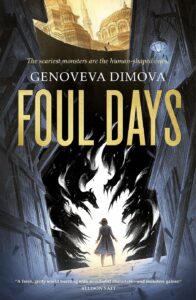 Foul Days by Genoveva Dimova
Publisher: Wildfire / Fantasy
Paperback / 9781035420995
As a witch in the walled city of Chernograd, Kosara has plenty of practice with the creatures that cause problems. There’s only one monster she can’t defeat: her ex, the Zmey, known as the Tsar of Monsters. Betrayed by someone close to her, Kosara’s only choice is to trade her shadow – the source of her powers – for a quick escape. And she only has twelve days…
On the look out for a new favourite detective? It’s time to acquaint yourself with Solanki and McQueen.
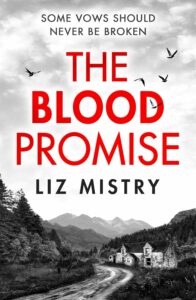 The Blood Promise by Liz Mistry
Publisher: HQ Digital / Crime Fiction
Paperback / 9780008686451
Imogen Clark wakes up on her 16th birthday to find her parents dead at the breakfast table, along with a message from their killer. When Solanki discovers the connection between the killer and the stalker who has been following her for years, she is forced to confront the dark past she was desperate to keep hidden. She must stop at nothing to solve the case, before she becomes the next victim…
Time now for a little bit of peace and quiet, and love for the natural world . . .
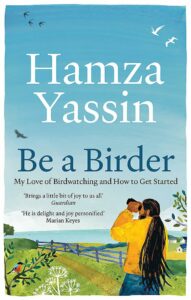 Be a Birder by Hamza Yassin
Publisher: Gaia / Nature Writing
Paperback / 9781856755108
If you’ve always wanted to find out the joys of birdwatching, the wonderful Hamza Yassin takes you through his most memorable encounters with his favourite winged creatures as well as sharing hints and tips for becoming a Twitcher yourself. Once you start looking for birds, and with Hamza as your guide, your world will be forever changed.
In those restful moments on holiday, sometimes its poetry that is what is needed to create that magic moment. Here is a debut collection perfect for reflection.
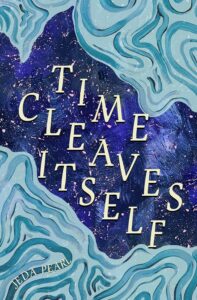 Time Cleaves Itself by Jeda Pearl
Publisher: Peepal Tree Press / Poetry
Paperback / 9781845235888
Landscapes and bodyscapes are brought into focus through lenses of race, illness, disability and womanhood. Ancestral languages of Scots, Patois, Geordie and English critique ableism, colonialism and Scottish exceptionalism; they ask ‘Who gets the trees?’, honour Caribbean and Scottish heritages and move from the bed as universe to fantastical and science-fictional imaginings.
And here’s some recommendations for your youngsters.
Keedie is a brilliant and much-anticipated prequel to Elle McNicoll’s award-winning and bestselling A Kind of Spark.
Keedie by Elle McNicoll
Publisher: Knights Of / YA Fiction
Paperback / 9781913311988
Here, we follow Addie’s big sister Keedie as she approaches her fourteenth birthday with twin sister Nina. As Keedie feels her connection to Nina shake, she becomes closer to – and more protective of – her younger sister Addie in a tale that celebrates kindness, justice and being true to yourself.
This page-turning thriller is sure to get your kids interested in Scotland’s bloody past!
 The Boy, The Witch, and The Queen of Scots by Barbara Henderson
Publisher: Luath Press / Middle Grade Fiction
Paperback / 9781804251317
12-year-old Alexander Buchan was once content, training as a falconer at Strathbogie Castle in Huntly. But when his Earl sends him to Edinburgh to the court of the newly arrived Mary, Queen of Scots, the boy finds himself lured into a world of intrigue, terror and treachery. Alexander knows right from wrong, but how can he hope to outwit his master’s murderous messenger?
Heart of a tiger, strength of a dragon, body of a … schoolboy? A thrilling action-adventure series with the magical power of the Chinese Zodiac.
 Clash of the Dragon Masters: Tiger Warrior by Maisie Chan
Publisher: Orchard Books / Middle Grade Fantasy
Paperback / 9781408371008
It’s time for the ultimate battle! The Dragon King has stolen the coin that gives Jack the magical powers of the zodiac animals. Is the Tiger Warrior finished? Or is it time to fight dragon with dragon?
We end where we began, back in St Kilda with a picture book that celebrates the island’s history and culture.
 Not the End of the World by Talya Baldwin
Publisher: Birlinn / Picture Flat
Paperback / 9781780278889
This is a true story, with stunning illustrations, about a real place. A place hidden behind the waves. The Vikings saw it in their dreams, and sometimes sea birds call its name. It’s a dot on a map. The blink of an eye. The beat of a wing. Storms and songs and stickleback stop by on their travels.
This is St Kilda. A tiny group of islands; an archipelago: Hirta, Boreray, Soay, Dùn. They call them The Islands at the End of the World.
Following Kate Foster’s bestselling and award-winning debut, The Maiden, is her next novel, The King’s Witches. She tells BooksfromScotland her experience of ‘the difficult second novel.’
The King’s Witches
By Kate Foster
Published by Mantle
If I had to describe the defining moment of writing my first novel, The Maiden, it would be tucked up on my sofa in mid-pandemic lockdown, totally unsure of the changing world outside but creating a whole new world on the page and finding peace and joy in the process.
Writing The Maiden gave me comfort and control over my own imaginative world at a time of uncertainty, so I was utterly thrilled to get a two-book deal and excited to begin book two.
But the defining moment of writing that book, The King’s Witches, is completely different. By then, The Maiden was making its way out into the world, and it was becoming a bestseller. I was juggling author success (a lifelong dream!) with my full-time career as a journalist, two teenagers, a bulging diary, public talks, signings, and a house move.
As my deadline for delivery of The King’s Witches loomed, my defining moment was ignoring the manuscript altogether, putting my laptop away whilst trying to manage my changing life. And that was not a single moment; there were many of them.
Now, with The King’s Witches making its own way into the world, I will happily admit it has not been the easiest of deliveries. There are many problems a writer faces whilst attempting book two.
You have years to write your debut novel. You can take as long as you like, and change your mind over and over again. But if you are serious about a career in writing, you realistically only have about a year and a half to write your second one.
The Maiden was not an easy write, but it was a fast one. As soon as I had decided to go for it and try a full manuscript, the story came rushing at me. The characters (most of them) emerged fully-fledged. It was a giddy, invigorating ride of a write that I think is reflected in the story.
My dream, I suppose, had been to see it in a bookshop. But The Maiden also went on be longlisted, shortlisted and win awards, and I still can’t believe it. I have been utterly fortunate, and I am hugely humbled by the fact so many readers have enjoyed it. It has been a life-changing privilege.
But that meant writing a second book that might live up to expectations was not just a struggle. It was a fight.
I had a very clear vision for The King’s Witches and was determined to deliver that. I absolutely love books about historic witch trials and have read some remarkable, inspiring novels like The Familiars, The Mercies and Cunning Women. I wanted to put my own twist on a story about Britain’s cruel past and go back to its origins, the North Berwick Witch Trials.
I suppose that was the thread that got me through. Having that very clear vision of why that story was important to me and why the characters, some of whom are based on real people, matter.
Being a novelist has also helped me develop my journalism. Publishing The Maiden helped me understand what it is like to be interviewed, to see at first-hand how other industries and professions work: to learn skills like sales and marketing, PR, SEO, and public speaking. These skills were all being developed with The Maiden, yet still The King’s Witches was struggling.
The break came, as all my writing breaks come, with an intense few days where all I did was write. I did not cook proper meals, I did not really go out, I did not really speak to anyone. It was short and unpleasant but ultimately gave me a push through to the end of a manuscript. Once I had done that, shutting out the world and the voices and other people’s expectations, the story flowed.
My novels centre on the inner lives of women. They are generally first-person deep-dives. I have learned I can only achieve this by cancelling the noise and tuning into myself.
Fortunately, my third novel, The Mourning Necklace, has been a relatively straightforward experience. It is inspired by the incredible true story of Maggie Dickson, who survived her own execution in 18th Century Edinburgh. I have almost written the entire first draft in five months. I was able to spot mistakes early and not go down rabbit-holes, I kept the plot lines simple and clear, and I let myself simply enjoy the experience, and letting it all just flow. For what could be a better privilege than bringing a story to life.
So yes, the ‘difficult second novel’ syndrome is real. Most writers experience it. But when I hold my second novel in my hand, I am so glad I eventually opened my laptop and powered through it.
The King’s Witches by Kate Foster is published by Mantle, priced £16.99.
Shona Sandison is back in a second outing from author Philip Miller. The intrepid reporter, newly redundant, is unsure of her next steps when she attends a friend’s wedding. In this extract, she comes across something far worse than the drunken banter at the reception.
The Hollow Tree
By Philip Miller
Published by Polygon
It was time for her to sleep.
She draped the mislaid jacket on an empty chair, then headed up the two flights of stairs to her room. Her legs ached. There must be a lift, she thought. She paused on the worn red carpet of the first landing. The little pebble had shifted in her pocket. She took it out. In the glow of the wall lamps, she could see it was green – green as a broad bean, streaked with a kind of silver. It was impermeable, complete and smooth, like a tiny planet plucked from deep space. She decided to keep it.
She reached a long, dimly lit corridor that smelled of lemon carpet cleaner. The noise of the party receded into distance and night. Some doors had names painted on them: HUGHES, ELIOT, WORDSWORTH, TENNYSON, PATERSON, BERRYMAN, MORGAN. Her bedroom was untitled. It was just room 27. She leaned against the wall, fishing out her key card.
But she did not open the door. She was suddenly distracted by a stream of sharp air against her face. A chill. She looked to the end of the corridor. A fire door was slightly open, and, beyond it, a metal staircase. What was out there? The battlements, the flags and the towers. The view across the darkness of Argyll.
Pale light fell on her door – it came from across the corridor. A door was ajar. She thought she heard something: a clumping noise, footsteps, a kind of moaning. But she could not tell where it was coming from.
‘Hello?’ she called tentatively. She looked left and right, but there was no one around – just the distant bass thump of a song pulsing from the bar.
Shona moved a step forward into the open room. The door, she noticed, had a name printed on it: SORLEY MACLEAN.
She saw a bed and a faint light from the bathroom.
‘Hi,’ she said. ‘Anyone here?’
She thought she heard another moan, and then a deep, long sigh. Raucous laughter suddenly rang out from downstairs.
She took another step into the room. The bed was made, a backpack on the floor beside it. A book lay open on the dressing table. It had been ripped; half a page hung loose and jagged like torn flesh.
With a kind of mental flinch, Shona realised something was on the bedroom floor. She moved closer and could see, spelled out in pebbles and stones, the words: THE RIGHT PATH.
They glimmered with liquid. She bent down and touched a pebble with a fingertip, which suddenly darkened. It was blood.
There was a clanging noise from the hall – the rasp of metal on metal. She moved out to the hall as quickly as she could. In the doorway that led to the roof, something like a ribbon fell into view. It pooled on the floor in a puddle of shadow. She moved to the stairs, as if in liquid, as if in a dream.
There were smears of blood on the wallpaper, lit by a skelf of light. The air seemed to move, like the shimmering around a bonfire. On a metal step lay a pair of silky suit trousers, empty and collapsed. On the next step up, a single sock. Shona moved up the staircase, and the night air was suddenly upon her face, a breeze pulling at her hair.
She reached the top, the battlements low, no higher than her waist.
‘There is no time,’ a flat voice said.
She looked to her right, and a naked man stood at the edge of the tower.
His white skin glimmered in the light thrown from the garden, from the hotel, from the moon. He was looking out into the night, to the dark mountains and the invisible sea.
Shona found herself unable to move – one hand was on her stick, the other was outstretched, as if she needed to hold the air. She saw her fingers, her hand open, clutch at nothing.
The man turned around. His hands were dark with blood.
On his chest was a tattoo that dropped down from his shoulder blades to his waist: a circle of the letters of the alphabet in deep black, and the numbers 0 to 9. Yes on his left shoulder, No on his right.
‘Say yes to no,’ he said, arms outstretched.
‘No,’ she said weakly.
He nodded. His eyes closed.
He cannot fall. She felt a deep surge towards him.
‘Hey, pal, come on, why don’t you come to me? Come down, come inside,’ she said, in the warmest, most reassuring voice she could muster.
His lean naked body stood between battlements. His face was blank, his eyes closed. She realised it was the pale man who had been drinking alone at the bar. It was Viv’s friend.
‘It’s Dan, isn’t it?’ she said.
‘Ask Sorley,’ he said. He opened his eyes. They looked past her. Then he stepped back, into space. Into the night. He dropped from view.
Shona hurried to the edge and saw the end of his fall, the tumbling over, the hurtling into darkness.
There was a loud, wet noise – of solidity meeting softness, of a sudden human breakage. A brief silence – as deep as a sea – and then shouting and a single yelping scream.
His body lay face down, tangled and broken on the hard stone. He was facing the cold earth, the line of the neck dislodged. Legs and arms askew, like the broken branches of a leafless tree.
The music played on, for a while, as doors opened and people gathered. Then the music stopped. And then there were human voices, and the sounds of the deep night, and the murmuring of a small group gathered around the body of Daniel Merrygill.
The Hollow Tree by Philip Miller is published by Polygon, priced £9.99.
James Oswald’s Inspector Maclean has been solving crimes in Edinburgh for a good few novels now. As the thirteenth book in the Inspector Maclean series hits the shelves, we ask the author how he keeps his writing exciting.
For Our Sins
By James Oswald
Published by Wildfire
How to keep things fresh after your series hits the terrible teens.
For Our Sins is the thirteenth book in my Edinburgh-based Inspector McLean series. As I write this, I am nearing the end of the first draft of an as yet untitled book fourteen. A fifteenth book is in the very earliest stages of gestation deep within the little-used recesses of my brain. That’s a lot of stories for one beleaguered detective inspector to carry, so just how does an author go about keeping the books fresh and interesting after writing so many?
The short answer is I wish I knew! Perhaps it helps that Tony McLean as a character has been with me a very long time now. His first appearance in one of my stories goes back as far as 1992, when I was trying to carve out a career as a writer in comics. I invented him as the policeman who could see ghosts in what was a somewhat gothic, Edinburgh-set tale that 2000AD magazine decided was not up to scratch. I suspect they were right.
McLean came into his own in my first published novel, Natural Causes, but that wasn’t the first book I’d written, nor Tony’s first outing in prose fiction. He’d appeared in a couple of other rubbish novels by then, and a half dozen short stories I’d written to try and get an idea of who he was. Some of the other recurring characters first appeared in those short stories too, like Grumpy Bob, Dagwood and Chief Superintendent Jayne McIntyre.
In short, before Natural Causes came out, I had known McLean for a long time. I’d established a lot of the dynamics behind his team, his private life, his past and the kind of Edinburgh in which he lived. That’s probably the only reason I was able to take the success of the first novel and build on it as swiftly as I have done. While Natural Causes and The Book of Souls were both already written when a publisher picked them up, the eleven books that follow on from them (with a twelfth in progress) have all been written in the past ten years.
It’s not easy though, as that number creeps up, to keep things new and interesting. I’ve introduced more characters – Madame Rose, Emma Baird, Mrs Saifre and Janie Harrison to name just a few – and we’ve said goodbye (or good riddance) to some others. Each book is its own story, with new villains and supporting actors to drive the thing along, too. It’s important with series fiction to strike that balance between the old and the new – enough explanation to keep first time readers up to speed without boring those who’ve been along since the start of the ride.
I made the mistake early in the series of trying to stretch a significant plot arc over more than one book. Emma, Tony’s long-suffering partner, went travelling (possibly accompanied by the soul of Tony’s long-dead fiancée, but let’s not give too much away), and was out of the picture for almost all of books four, five and six. She sent him postcards from all parts of the globe, which kept him sane and maybe protected him from the worst kind of temptation, before reappearing at the end of The Damage Done just in time.
It was the kind of story arc that works well in comics, where the episodes arrive every month or week. Less successful when played out over almost two years and three books, I had many complaints about the unresolved plots and managed to annoy quite a few readers. Lesson learned; series fiction might mean recurring characters, but each book needs to be its own thing.
I’ve always had the main arc of each book told from McLean’s viewpoint, with occasional short scenes from the point of view of the victim or the killer just to break things up a bit. One other way of injecting a little novelty into the stories is to tell them from a different point of view, and so I decided to introduce a second narrative character – Janie Harrison – in All That Lives. Without too many spoilers, Tony’s missing for a large chunk of the second half of that book, so it was kind of necessary.
Nobody complained, and I found I quite liked writing for Janie, so I gave her even more to do in For Our Sins, including a memorable scene with a rather too handsy senior officer. It helped open up the story to new ways of telling and gave me a different perspective to work from. I should probably have done it earlier.
But in the end, the best way to keep a series fresh is both the simplest to say and the hardest to carry out. Try to write the best book you possibly can. If readers enjoy what you’ve written, they’ll keep on coming back for more.
For Our Sins by James Oswald is published by Wildfire, priced £20.00
David Robinson is impressed by the ideas, language and storytelling in Ajay Close’s latest novel.
What Doesn’t Kill Us
By Ajay Close
Published by Saraband
The most shocking moment in The Long Shadow, ITV’s recent drama series about the five-year hunt for the Yorkshire Ripper, comes (spoiler alert) right at the end. Peter Sutcliffe has been caught, tried and sentenced and the police inquiry into what went wrong is just beginning.
Two officers are shown into the major incident room. Pinned to the wall in front of them are over 30 photofits, dating back to 1972, based on descriptions given to the police by women whom Sutcliffe had followed, attacked or left for dead. The colour drains from the investigators’ faces as they realise that nearly all of them are, very clearly, the same man. ‘Some of the women weren’t listened to,’ the (female) policewoman explains.
What women can, should, and actually did do in a society in which they are not being listened to is at the heart of Ajay Close’s novel What Doesn’t Kill Us, which is set in West Yorkshire at the time of the Ripper murders. Like David Peace’s Red Riding Quartet, it takes the core of the case and gives it a fictional spin: this time into a story, not of police corruption but of feminist radicalisation. In Close’s novel, as a man the media have called the Yorkshire Butcher carries on his killing spree in the background, the women in a feminist collective at 109 Cleopatra Street, in the inner Leeds suburb of Chapeltown, are working out how to fight back.
But how? This, remember, is the Seventies. Sexism isn’t just everyday but everywhere institutionalised. Benny Hill is on the box, Bernard Manning at the microphone, and builders wolf-whistle and catcall passing ‘dollybirds’ without a second thought. No-one seems to know any lesbians, and women at work are tolerated at best and ignored and insulted at worst, all fading to invisibility in middle age. Young or old, violence against them is commonplace. ‘What do you call a woman with two black eyes?’ goes one so-called joke of the time. ‘Nowt. She’s been told twice already.’
Liz Seeley, a policewoman who is a lowly part of the hunt for the Yorkshire Butcher, moves in with the Cleopatra Street collective in Chapeltown after she has been given a black eye by her boyfriend. There, she meets the kind of people she had never met before – most prominently, the charismatic, self-assured feminist intellectual Rowena, who is the other pivotal figure in the novel.
While a male detective interrogates errant husbands about their use of prostitutes (‘It’s all right, we’ve all done it’) in the living room, Liz is in the kitchen talking to their wives; a compromising enough job made unbearably so, and then she is tapped up by Special Branch to report on anything illegal her new flatmates get up to.
And there is, potentially, a lot to report. As the Cleopatra Street commune fleshes out what feminism ought to mean, Rowena makes the case for meeting male violence with a violent response of their own. Of course, they will lead ‘reclaim the night’ marches and lead demonstrations outside cinemas showing porn, but why shouldn’t they go further? What’s wrong, for example, with a bit of revolutionary justice against the local pimp? Or a carefully targeted firebombing? (Close’s 2015 novel A Petrol-Scented Spring deals with the repercussions of one such Scottish suffragette’s arson attack.)
For me at least, What Doesn’t Kill Us would fall flat on its face if it didn’t also show the excitement of ideas, if we couldn’t see why, looking back, Liz would see the year she lived on Cleopatra Street as the happiest of her life. This is where, though keeping quiet about what she actually does for a living, Liz finds togetherness, where her feminism blooms, where the balance between the world as it is and the world as it ought to be shifts and the potential for a more fulfilling future comes into focus. More than that, it becomes obvious. In one speech, Rowena asks a crowd of women to put up their hands if they have ever been raped by a stranger. Five do. No-one raises their hand when she asks if anyone has been raped by someone they know.
‘”Let me put that another way. Have you ever had sex with a boyfriend, or husband, or just a male friend, when you didn’t want to?”
An electric shock ran through the room. So many hands.’
The speech Rowena goes on to make, like Gloria’s ‘It is impossible to be a woman’ monologue in Barbie, has a power that is rooted in specificity, and indeed impossible to argue against. But Rowena takes the fight against male violence even further. If men won’t change, women should cut themselves off from them. The Lysistrata solution. No more (straight) sex.
Until I read the Afterword of Close’s novel, I’d never heard of the Leeds Revolutionary Feminists or the arson attacks on local sex shops at the time. Ditto with the Political Lesbianism pamphlet on which Cleopatra Street’s ‘Whose Side Are You On?’ pamphlet calling for a sex strike is clearly based.
Conveying the excitement of such ideas, and what they are a reaction against, is hard enough; showing how and why they mutate as part of the commune’s group dynamics is even harder. Somehow Close manages to do both at the same time as well as – and this is the really tricky bit, the fourth ball to juggle – indicating how easily those ideas might stray towards the absurd, as when Rowena indicates that a truly feminist collective wouldn’t have a male cat as a pet, never mind accepting as a commune member the mother of a young boy. One final point: although Close, like me, has probably spent more of her life in Scotland than her native West Yorkshire, she has its speech patterns and slang down to a tee. I have rarely (if at all) seen this done better.
She has the Seventies down pat too. Many of us who were young then look back in embarrassment at some of the attitudes we then had, even if we weren’t completely racist or male chauvinists. And without for a second suggesting that gender equality is even close to being achieved or that relations between men and women are hunky-dory, it would be hard to argue that both are vastly better than they were back then.
As well as telling a good story, What Doesn’t Kill Us made me think. Who or what, I wondered, made the biggest positive difference in relations between the sexes between then and now? Was it a woman, and if so who? A politician I’ve heard of like Barbara Castle, wielding power through legislation? Or – and this is the thought I’d never had – a feminist in a Leeds commune drawing a revolutionary line between what she would put up with and what she no longer could?
What Doesn’t Kill Us by Ajay Close is published by Saraband, price £10.99.
Len Pennie is an up-and-coming poet worthy of your attention. Her focus on feminism and celebration of the Scots language give her poems both a wonderful playfulness and a frank, honest look at the world around us. She is also a brilliant performer of her work with a growing online following, and we hope you enjoy this taster from her first collection, Poyums.
Poyums
By Len Pennie
Published by Canongate
I’M NO HAVIN CHILDREN
I’m no havin children, A’m gonnae hae weans;
an ye’ll can ask whit A cry them, no what are their names;
an they’ll be gettin a piece, no a wee packed lunch;
an they’ll be haein a scran, no having a munch;
they’ll fanny aboot, they willnae waste time,
an when they scrieve their wee poyums, A’ll mak sure they rhyme.
A’m no havin children, A’m gonnae hae weans,
who’ll be gowpin an bealin when they’ve goat aches an pains;
an instead of don’t worry, A’ll say dinnae fash;
instead of stand your ground, dinnae take any snash;
ma weans’ll be crabbit, no in a bad mood;
and they’ll greet, no cry, when their day isnae good.
A’m no havin children, A’m gonnae hae weans,
wae a prood ancient language crammed in their wee brains;
an whenever life tells them their English is bad,
A’ll tell them the hassles that their mammy had,
an A’ll say ma maw’s words till the day that A’m deid:
Ye’ll be awright, hen, ye’ve a guid Scots tongue in yer heid.
Watch Len perform I’m No Havin Children
I’m no havin children- a poyum by Len Pennie (youtube.com)
LITTLE GIRLS
The little girl stands on a knife-covered ledge,
Dancing till blood starts to drip from its edge.
She’s been licking her wounds since the first time she bled,
Getting judged for each thought she commits in her head.
She’s been starving herself since she started to eat,
Connecting the dots of her heart’s every beat.
She’s been swimming from fishermen hiding their net,
And running from wolves that deny they’re a threat.
And the men chime in, ‘Silence girl, don’t make a fuss,
I’d never do this, it’s not all of us.’
To drown out her sorrow, the male chorus sings,
‘It’s only a few, you’re imagining things.
You’re making this issue seem worse than it is;
It was only a comment, a gesture, a kiss.
It was meant as a compliment – please take a joke,
Don’t bite the hand groping you, savour each poke.’
And the girl learns the axis on which the world spins
Is powered by people who relish their sins.
So, she keeps her head down and she learns how to live,
To be quiet and not take much more than they give.
Cause the fragile knife edge she must constantly walk
Dictates every word she’s permitted to talk,
Each mouthful is measured, each glance not too sly,
Lest she melt off her wings just from touching the sky.
And she’d love to exist as the person she knows
Lives inside of her mind, but her agony grows.
As she slowly but surely resigns herself to
Being smaller and using far less than they do,
Being meeker and not taking up too much space,
Being careful to always remember her place.
But the little girl vows that the curse will be broken,
She’ll break down the barriers, leave them wide open:
For the daughters of little girls you wouldn’t hear;
For the children of women you silenced with fear;
For our mothers we’ll sing till the screams rip the air;
We are the little girls you couldn’t scare.
Watch Len perform Little Girls
Little Girls- A poyum by Len Pennie – YouTube
THE MUSE
Gin A scrieved ye, they’d cry me a liar; gin A sung ye,
A’d be telt A’m wrang;
A poyum wid seem convolutit, an ye sure wouldnae fit in a sang.
Yer image wid bleed through ma canvas, an charcoal wid smudge
oan yer hert;
A cannae find words the way you can; A wouldnae ken whaur
tae stairt.
A sat doon tae scrieve ye a poyum, an A didnae ken whaur tae
begin,
Ye’ve scribbled aw ower ma sketchbook – maisterpiece wae the
lines coloured in.
The poetry breenged out ma coupon, the leid flew awa fae ma
tongue,
Cause A dinnae hae words tae describe ye; the wee sang ae oors
lies unsung.
A dinnae hae words fur a sonnet, when ye’re here A ken not
whit tae say;
Ye’re infinity aw in an instant, worth much mair than some auld,
cheap cliché. A am bound by the words that A’m lackin; ma poyum’s aw A hae
tae give, But A cannae find words tae write ye, no lit you can mak poetry live.
And yer haunds craft sic beautiful music, and ye capture ma soul
in a sang,
Yer harmony played oan ma hertstrings, and ye write like ye’ve
never been wrang.
I hope ye enjoyed ma wee poyum; it’s no much but it’s aw that
A’ve got;
A could scrieve till aw words loose their meanins, dae ye justice
A simply could not.
So, A’ll gie ma wee hert tae the paper, fill the page wae the
words that A choose, Ye’ve inspired much mair than a poyum, noo ma smeddum cries
you its new muse.
Watch Len Perform The Muse
The Muse- a poyum by Len Pennie (youtube.com)
ADDRESS TAE THE LEID
Fair fa your honest, sonsie face,
wha hinks ae Scots as a disgrace!
A leid that’s meant fur lesser hings,
No there tae lairn:
A leid well-kent by mony fowk
That does nae hairm.
Ahint keyboards the wee troll hides;
Abuin yer soul the hatred bides;
Yer words are nocht but draps ae rain
Agin ma heid,
Taks mair than dubs aw filled wae pish
Tae droon me deid.
We ken the rot yer souls contain,
Wan single leid within yer brain;
A look upon ye filled wae shame,
But dinnae fash,
The Scots leid maun strive oan in spite,
Ae aw yer snash.
Then, word fur word, Scots willnae dee:
Ma time and tongue aw A can gie,
And gie it aw A will until ma final breath.
Oor poyums will be said by bairns
Lang past wur death
Is there that troll wha sneers in shame,
Or cries me mony a hatefu name,
Or seeks tae cause me muckle pain
Fur whit A dae,
Looks down wae sneering, scornfu view
On whit A say?
Poor devil! See him ower his screen,
His grammar neat, his English clean,
He fechts fur country an fur queen,
But doesnae see –
If abdy’s gonnae look his way,
It isnae me!
But mark the chiels wha speak the leid,
Wha ken it’s livin, never deid,
An ken it’s fit fur aw the time,
No special days;
An sees the puir wee hypocrites,
Oan 25ths and Hogmanays.
Ye Pow’rs wha’re wae me every hoor,
Gie me smeddum that ye cannae smoor,
Auld Scotland wants nae linguaphobes
Wae a hatefu heid;
But, if ye wish her gratefu’ prayer,
Follae ma leid.
Watch Len perform Address Tae The Leid
Address tae the Leid- a Poyum by Len Pennie (youtube.com)
Poyums by Len Pennie is published by Canongate, priced £14.99.
In 2023, The Kavya Prize was awarded to unpublished writers of colour who are Scottish by birth, residence or inclination. BfS are thrilled to share some of the writing that was recognised by the judges. Here we publish extracts from the joint winners’ pieces.
Q Mannivan
An Extract from The Physics of It
You’ve been thinking of old homes lately: You’ve been thinking of old homes lately:
an insatiable loneliness, Delhi in an an adolescent insomnia, your mother
air-conditioned bedroom with large putting you to sleep (despite her own
windows overlooking parched fields that desires for rest), in a single bed against the
shimmer in the June heat. You’re eating a wall in a small room lit ochre by an old
spicy paratha (the cook was trying to kill incandescent bulb hanging from the centre
you) on the edge of a bed (two separate of the ceiling, naked and round. She
frames wedged together, creaky), watching stacked pillows on the other edge so you
a cowherd graze livestock between wouldn’t fear falling. You wondered how
incomplete brick homes that remained, one falls (asleep), the physics of it – why
forever, incomplete. This memory too is an otherwise reliable gravity, when you
incomplete. These homes no longer exist. needed it most, ceased to exist.
You’re dressed in her clothes, she brought Amma sang the Kanda Shasti Kavasam, an
you your red plastic plate along with hers old Tamil hymn to the gods that began
and sat next to you with her brown hair in with a desperate prayer to protect a child:
two low pigtails, wiping her washed hands its body, its eyes, and its skin. She sang it
on an ex’s oversized boxers that she’s with a high tone rocking back and forth,
wearing, dipping into mango pickle your patting you softly on your arm over your
mum packed for you on every visit home favourite blue chequered blanket. Amma’s
(whatever home meant to you then). a lot like her. Consistent, warm, safe.
The cows moved as one: fluid, trickling The song moved to more violent threads. It
through the landscape, flowing to the asked that the gods protect your arms, your
corners and then back to the source again. cheeks, your inner organs, your neck, and
The sight vaguely resembled a lava lamp your teeth. It moved viciously, violently,
spread out flat, like mercury toy gifts that alongside this honey soft whisper, the
came heavy with the fear that should the tender eyes that your mum’s singing
glass break, should the liquid metal do brought even when loudly sung. Every
anything but remain distant and note echoed as if arriving tired and weary
inaccessible, if it were to cease being from a long journey, from a place a great
visual and turn tactile, you would be distance away, unreachable but for this
sullied. moment.
There was that familiar silence between us The room, once familiar, took different
after a difficult night, the kind of weight shapes and assumed different colours, as if
that knew separation was inevitable but the night itself was reshaped by her voice.
also that we didn’t want to leave, that Towards the end, the hymn prays for
should the quiet have its moment then, we ghosts, devils, strangers, and bad men to
would have another day; two frames fear you. ‘Make them all afraid of me /
wedged together, creaky. You remember Make them roll on the floor in fear / Make
this but you cannot remember her, at least them shout loudly and get mad / Tie them
not as well. tight / Break their hands and legs.’
It’s 2022 and the University College Union It’s 2020 and you’re one among many at
(UCU), the primary academic trade union night time at India Gate, New Delhi, a
in the United Kingdom, is failing in its towering monument underneath which a
bureaucracies, the NHS is in crisis, the PM ceremonial flame has burned for decades
is xenophobic, autumn is fading into mourning the India-Pakistan War, around
winter, and the Queen is dead. You are at a which thousands of protestors have
UCU rally at the Dundee City Square, gathered to oppose an Islamaphobic and
speaking amidst colleagues gathered from discriminatory citizenship act. The flame
Palestine, Egypt, Azerbaijan, and even mourns only the Indian soldiers killed. The
further, England, and they ask you to demonstrators read part of the Indian
speak about what a university is, what it Constitution out loud, asking what it meant
means to you. You pause and wonder. to be a citizen of a country, this country.
A few days later, you’re invited to debate A few days later, the police wise up,
with a professor from Westminster against station themselves a mile before the
a BBC journalist at Parliament Hall in St protest site, and detain you before you
Andrews, Scotland. The topic: This House even arrive. They lift you (one per limb)
Believes that the UK Must Impose straight out of the rickshaw while the
Sanction on Rwanda. You and your partner media takes photographs, and deposit you
are arguing against the motion and your into their van. You start an Instagram Live
case is easy – sanctions without a viable stream, and ask a policewoman in broken
opposition party that can assume power Hindi, ‘Where are you taking me?’ She
are historically and logistically ineffective, says nothing. You ask her if she has a
they affect working class people, and they notice justifying the detention. She smiles.
seldom force regimes with control over ‘You’ll see in a moment.’ You smile back.
resources to cease this control. You have no control, and you’re afraid.
You perform an arrogance you learned as It’s your first time in police detention, and
an undergraduate debater, to conflate, a friend who’s a lawyer joins you inside
stretch, logicize, and analyse every after failing to convince the station
possible angle and also be funny. You say: officials to release you. He came largely
‘Well now that the monarchy is losing since his girlfriend insisted he leave his
steam, its public funds should be workplace and offer me help, although he
repurposed for Rwanda and other African knew such detention rarely lasted for
countries affected either directly or longer than until evening. You’re
indirectly by European imperialism. These powerless in the face of this love and deep
are not ‘aid’ packages, but reparations.’ down, there’s guilt and uncertainty.
You pause after the statement, for dramatic Everyone is worthy of love, yes, but not
effect, but receive hesitant applause amid everyone is worthy all the time for all love.
looks of dread. You realise that you failed You wonder – whose love is it that holds
to notice a member of royalty seated in the your safety? Yours, his, or his girlfriend’s?
crowd who then, in not altogether You remember feeling that yours was a
unexpected anger, scowled at you for the collateral safety: a lucky privilege,
rest of the night. You lose the debate. unearned, undeserved, and passing.
Jinling Wu
Extract taken from Cocoon
You are a little surprised to see her at the reading of your own book. She comes in late and sits in the last row. She is in blue jeans and a white shirt with coffee in hand, like an ordinary housewife. Only when you look at her delicate intelligent face, you recognise her. Until a decade ago, she was one of the most important writers in the publishing world, the kind that made plain paper expensive. She has ten books under her belt. Every single book is a bestseller. It was rare for a writer to have this kind of energy and consistently outperform her peers. You are, unfortunately, the kind of writer who started many titles but never finished a single book. But you do read ferociously. Hence it was convenient for you to become a critic. Now you have finally accumulated something that resembles a real book with many small pieces you have written for papers throughout the years. But you know that it is broken from within. The only reason it is being published is that you are living in a good time in an affluent country and there are sufficient resources to satisfy your needs to be seen. It will never become a hit in the market. In a few years, you will find it in a deserted corner of a second-hand bookshop for 50p but looking new. Considering your advanced age, it is likely to be your only book. Now you see your favourite writer in your own book launch in your home city. You do get something good in life after a long lonely journey, don’t you?
You two live in the same city, you in your small apartment in the city centre, she in her mansion in the suburb. The last time your paths crossed was ten years ago at an event at a book festival while she chatted about her latest publication. You sat in the audience, unknown. Then everyone heard about her affair with an old-time friend. It didn’t surprise you, that a charismatic writer would have an affair. The scandal itself didn’t really affect her pathway to the market. You imagined she would come up with something about a modern-day witch hunt, a poignant albeit sexy new romance, or a soul-searching personal tale. But instead, nothing has come out under her name ever since and she has been completely invisible for a decade. Yet she is here, at your book launch. You would not trade such an opportunity for a lottery win. You read the piece you feel most proud of and wait for curious inquiries. There are quite a few questions but none from her. You are a little disappointed but not at all surprised.
You are surprised to see her at the afterparty, though. She stayed because she was spotted by a nosy agent at the reading and became as involved in a long conversation. You brave yourself to talk to her and you dare to ask her if she remembers your name from the paper. She confirms that she has read your reviews of her books. You are thrilled to know she remembers you. You force yourself again to ask if you could sit down with her to have an exclusive interview. She considers it for a minute and agrees on the condition that you two will chat, but whether the content can be published will depend on how it goes.
You are thrilled to be able to see her again. The ordinary days of the next month are suddenly filled with excitement. You treat yourself with glittering things you usually find no reason for. You even giggle at the bus driver’s bad joke like a teenage girl. It feels nice to be giddy and alive.
You carefully dress for the meeting. When she shows up, you are so nervous that you spill the tea on your dress. She comforts you with a gentle squeeze of your hand. You are moved by the ordinary side of her, far from the intimidating arrogance and narcissism she is famous for and has been much criticised for. You carefully take in her look with her pearl drop earrings, pink silk blouse, and soft white leather shoes. You imagine your readers will be interested in these details. Her skin is so supple that she would look a lot younger than you without the white hair. You start your interview by asking how life has been for her in the last ten years. ‘Like everyone else: with some joy and a lot of worries.’ You ask what kind of worries and she brushes it off with a breezy ‘like everyone else’s’. You feel the urge to quickly change the topic as her gaze drifts away to other people sitting in the tea room. You ask whose books she is currently reading. She tosses out a few foreign names you have heard about but have not read. Then she mentions another few you have read and loved, too. You push further to ask about her relationship status. She refuses to provide any substantial details other than that she is still with the same person. She is most enthusiastic about her recent travel. She depicts her trip to a hot chaotic Mediterranean city with ordinary words but they make you feel like you are traveling with her. You can almost breathe in the unpleasant vehicle exhaust, feel the frustration of not knowing when to cross the road among the chaotic traffic, and then get totally carried away by the orange blossom and magnificent architecture after entering a narrow door opened up on one side of a small lane. Your eyes become the state-of-the-art movie camera on a meandering dolly. You are absorbing the visuals with the highest definition and a soundtrack that is masterly created. You do not doubt that you are in a movie with the most exciting screenwriting behind it. The screening stops when she gets tired and pauses to sip her tea.
You think it is probably a good time to ask the difficult question: Is she still writing? Why is she no longer publishing? ‘I don’t feel the need to write on paper.’ She says, ‘I talk more nowadays, to my friend.’ You do not seem to understand it. So you decide to share the ailment that has bothered you for decades and ask her advice on how to stay productive as a writer. She looks at you in your eyes for a beat and says slowly: ‘I see you made a lot of effort for today’s interview and I thank you for taking me seriously. But do you take yourself as seriously as me, or any of the other strangers you write about?’
Her question catches you off-guard. You are flustered and excuse yourself to the restroom. In the restroom, you examine yourself in the mirror. You have the same bob cut as you had twenty years ago because you are afraid of looking edgy or simply different. You wear a dress with too many colours that make you look like moving wallpaper. You paint blush on your cheek to please your guest but in fact, you are more animated when you are not in makeup. You’ve cocooned yourself into a cliche. Your writer’s block is not a block. It is a hideaway. It lets you make yourself invisible. You struggled to be seen by others for so many years. But the reason for that is you do not wish to see yourself. You choose your shelter in the darkness. You approached her for the light but you have been burned by the light she exudes.
When you get out of the bathroom, you see her paying the bill. She needs to catch dinner with her partner. You squeeze her hand to thank her for meeting you. Her hand is cool and soft; it doesn’t burn.
After the meeting, you take a detour to visit your favourite bookstore to pick up the expensive notebook you’ve always wanted, thinking maybe the book you just published will not be your only one in this world.
The Rituals of Eating
Lao Zhuang is a chicken farmer. He doesn’t eat chicken. In the same town, the pig farmer Da Liu doesn’t eat pork. Da Liu’s brother Xiao Liu, a beef farmer doesn’t eat beef. When the three farmers meet, they eat vegetarian meals. In the poor old days, they used to eat vegetarian meals because it was too cold to go spearfishing in the river in winter. Their wallets have bulged up since two decades ago. Nowadays, they drive tough off-road cars and wear expensive fur coats. But they can not make themselves eat the meat that comes out of their own farms. They don’t trust meat from any other farm, either.
In the restaurant, the three farmers are waiting for their lunch. When the waitress comes in to serve their usual vegetarian meal, Lao Zhuang sighs. Da Liu asks what is on Lao Zhuang’s mind.
‘My daughter is coming back from the UK. I don’t know what kind of food I can give her to eat.’ Lao Zhuang’s daughter Xiao Zhuang resides in the UK. It will be her first visit in a decade.
Da Liu nods sympathetically. Xiao Zhuang is the pride of the town. She is the only person from this town who has made it to one of the best universities in this country.
‘I know a place’ said Xiao Liu.
At dinner time, Xiao Liu drives them to a cottage near the ravine. Near the road, there is a sign that says ‘wild chicken feast’ next to a photo of a colourful bird. A crow perched on the eaves flies away when the car roars in.
They sit down. An old lady serves them tea. There is no menu on the table.
‘We only do chicken hotpot. Would you like it very spicy, medium spicy, or mild spicy?’
‘Very spicy,’ said Lao Zhuang.
The old lady retreats to the kitchen.
Half an hour later, a fragrant boiling dish is served in a polished copper pot. Chopped chicken with bones pops up and down in the rich brown broth strewn with red chilli peppers and coriander leaves.
Lao Zhuang lifts a piece of chicken with his chopsticks and sends it into his mouth. He chews carefully. After that, he selectively eats more vegetables than chicken.
After dinner, they take a stroll to visit the chicken coop. Under the dim yellow light, three striking chickens with iridescent sheen are resting in the coop. Lao Zhuang walks close and looks carefully at the chickens. The chickens stare back at Lao Zhuang.
Lao Zhuang’s face sinks.
‘What’s wrong?’ Asks Da Liu. ‘
This is a scam. They are not real wild chickens.’
‘How do you know?’
‘You see, when I look at them, and they look back at me, there is no suspicion, no disease or anger in their eyes. They are not afraid of me. They must be expecting me to feed them and caress them.’
Da Liu nods. He is impressed by Lao Zhuang’s knowledge.
‘This is not acceptable. I will go back to ask for a discount to get some of your money back.’ Xiao Liu is indignant.
‘No need to hold grudges. It is bad for business.’ Lao Zhuang pats Xiao Liu’s shoulder.
Xiao Liu scratches his head for a second and puts up his forefinger: ‘How about eel? Rice field eel is the best.’
‘Don’t you worry about the fertilisers and insecticides?’ Said Da Liu.
‘There is a way to deal with it. You leave them in clean water for three nights before cooking. It will clear out the toxin.’
The next day, Lao Zhuang goes to the market and buys a bucket of eels. He transfers the eels to a bigger bucket at home and adds clean water. He puts the lid back and leaves a small gap for air.
At night, Lao Zhuang’s wife wakes up from sleep to go to the bathroom. She screams when something clammy crawls onto her feet. Lao Zhuang is woken and rushes to the bathroom. He finds nothing suspicious and blames his wife for the false alert. Then he goes to check the basket. The lid is still on, but the bucket is empty. He realises the clammy thing that crawled onto his wife’s feet was the eel from the bucket. His wife dreads the clammy creatures wandering around and leaves home to stay with her parents. Lao Zhuang lies awake in bed waiting for the eels to return. But they never come back.
Earlier in the issue, we published the joint winning pieces of the 2023 Kavya Prize. Here, we present extracts from two highly commended pieces.
Theresa Munoz
Extract taken from Hummingbird
I’m in British Columbia’s Okanagan Valley, northwest of the Canadian Rockies. We’re in the desert, with lime green cactai and signs of rattlesnake warnings.
There’s six of us: my partner, his sister, her husband, my sister and her husband. We’re at a winery in a picturesque town called Oliver. We line up for a selfie with the desert in the background; the sands are dark red and mud brown, like roadside pottery. The winery also has luxury rooms and an outdoor pool with teal-coloured water that ripples. It’s one of those places where every detail is minutely curated, down to the crispy sourdough toasts you eat in between wine tastings.
In a few days, my partner and I are getting married in front of my family and our friends. We had our first wedding in Edinburgh, Scotland, where we live and work. Tipsy from the tasting, I go into the gift shop. That’s where I see it, a small stuffed hummingbird. It’s shiny as a dragonfly, green like old velour tracksuits and with a barn red chest. His eyes are little apple seeds. I buy it for my Dad, because I know he loves hummingbirds and would imagine, in his way, this inanimate object having a kind of inner life. My only worry is a forecasted storm coming from the north, blowing though our lakeside wedding in a few days’ time. This day was almost exactly two years before my Dad dies. Now I miss having worries like that; simple and selfish.
***
The summer before lockdown my dad dies from complications of lung cancer, which he had been battling for over a year. One Thursday in August, in the ward at Surrey Memorial Hospital, he is given the news (falsely optimistic, in turns out) he may only have a few months left. His doctor is a kind Turkish man, and who holds his palm. Dad takes a minute to digest this. His eyes briefly go upwards, his black hair falls like a drifting leaf across his forehead. He grows thin, like a melted candle. ‘I understand’, he says. ‘Oh boy, oh boy’, he says, in that gentle way he has.
It’s a very beautiful day outside, which is frustrating. The doctor leaves and it’s just my Dad and I. I stand over his bed and feel bad for crying. Dad smiles at me and says ‘ow’ as my tears fall on his snowflake-patterned gown. He says suddenly, ’When I go, I will always be with you’.
‘Dad, I think that’s from the Lion King’.
He pauses for a second. ‘Oh yeah’, he starts laughing. And we laugh some more.
***
During the time my dad is ill, I travel multiple times from Scotland to Canada, drinking coffees and eating pallid sushi in airports, looking hopefully at departure boards. That summer in Vancouver, I stay with my parents at home. I also stay some days in the hospital when he contracts an infection. Dad moves around the building like an envelope, from ICU where he was first admitted, to a private room, and then to a recovery ward, where he is expected to come home. I ride the escalators up and down the hospital, waywardly following teams of serious-faced medical staff, like the rear of a parade.
I sit with him and chat, bending his straws to his sparkling water. I bring him outside food everyday. I try to bring things he’ll eat: soft shrimp dumplings, spicy fried rice, fluffy pancakes with maple syrup, pretzels slathered with cheese and tomato sauce. Like everything with my dad, the food is a mix from two continents; the polemical of sweet and fluffy, syrupy Canadian food; to tried & true ethnic delicacies. His favourite drink becomes a caramel iced coffee, which is probably feeding the cancer, but he smiles and says ‘ah’ after he drinks it.
Night is quieter. Night times in the hospital is like living inside a robot. All kinds of beeps and wires and the whole building buzzes with a kind of sad, frantic energy.
***
The next day, the Friday, he eats a tiny bit of soft taco. My mom is there as usual. Dad tells me to go home since I’ve been there all day. He says ‘Be safe, I love you’. He sometimes gets a bit stressed if there are too many people around, so I agree to leave. Okay, Okay, I say to no one in particular as I walk to my car in the corner of the parking lot. I sit for awhile, for no real reason.
I don’t know how I missed being there when he died. It seems like a cruel twist of fate, since I had been there all summer. On Saturday, I wake up get a phone call from one of my sister’s. She says that the doctor has changed his mind; Dad may only have a few days. ‘You should come today’, she says.
I drop my phone after we click off. It gets lost in the white bed sheets, which fold like an ice cave. I have this resistance to go to the hospital, unsure of what I will find. Finally we leave. My husband and I stop for gas, and he gets out the car to pay. My sister calls. I notice there are three missed calls while we were driving because the phone was on silent. She says, ‘I’ve just been to see Dad’. Me: how is he today? She pauses for a long time. She says, ‘You don’t know’.
And she tells me Dad passed away, maybe an hour ago. She says it really fast, or maybe I just hear it fast; there is lots of blood rushing in my ears. I’m still sitting in the car. And everything in my vision tilts sideways, the hoses of the pump, my view of the car wash windows; my entire sightline in fact goes into slow, gesticulating atoms, the whole world just hums.
***
The first six months of grief is what I want to talk about. That’s because the first six months are the worst. What people don’t tell you is that grief is an occupation, full of questions and trails. It’s akin to taking on a new hobby, or rather, a passion; you end up devoting a considerable amount of time tending to your grief.
After the funeral, to which only his very loved ones came, I feel very numb. Afterwards, I watch seals play in the harbour of Horseshoe Bay, looking at their dark button eyes. I ask my partner when Dad will be back. I am fully convinced that this is a possibility. I imagine that Dad is just on a trip, maybe circling the globe on a cruise ship and will be back soon. Sometimes my partner kindly says ‘Christmas’, which is just a few months away. Most often he’d promise, ‘soon’.
***
When we get back to Edinburgh, I’m someone else. I like watching car chases and crashes on tv. I like the feeling of spinning. I like crossing the street at the wrong time, I liked going for runs in Holyrood Park in the dark, I like to drive fast down the motorway. I feel closer to the world in a way I haven’t for some time. Taking the train, I get wildly excited about seeing deer rush over a field, or a rabbit trampling over heather in the fields – this to me feels exciting, the evidence of blood rushing in one’s body.
I feel drunk all the time (though I’m not). I laugh harder, I find things funnier, at times I laugh at other’s jokes hysterically and friends smile at me nervously, like what is the matter with you. People tell me their grief stories too, after finding out I lost my dad. I don’t notice the tears until they drip off my chin. I feel the sun to be brighter when it creates bars over my window. I’m intrigued when I get blood taken; for the first time I don’t look away from the plunging syringe. I feel the seasons change – I begin to notice the leaves gathering at my doorstep and when the tap water tastes colder and buzzes in the mouth.
I’m not sure why I feel so emboldened. For the entire time my Dad was sick, I felt like I was living under a lid, trying to keep everything under control. Now that I knew the worst could happen, I no longer cared.
Tae Song
Extract from 1986
Cho Sanghoon & Park Youngho
February 2013: The Demilitarized Zone
Sanghoon Cho slowly yujacha from a tumbler as he peered through the lens of his camera. Before him was the stretch flat land that divided the peninsula, the south behind him and the north on the horizon. The air was cool and crisp.
Two red-crowned cranes and their adolescent chick descended from the sky and landed on a patch of snow. Grus japonensis. Graceful ballet dancers who always knew how to avoid landmines. Sanghoon smiled. The second crane family he had spotted since six a.m. that morning.
Sanghoon adjusted the focus of the lens. He heard the soft crunch of snow and he looked up to see a water deer staring curiously at him from about two metres away.
‘궨찮아, 궨찮아, I won’t hurt you,’ he told the deer. As he took another sip of his yujacha, the water deer seemed to scoff at the fact that Sanghoon was not sharing his citrusy tea. Sanghoon’s mobile phone began to buzz and the water deer scurried away.
‘Ah, 미안해,’ he called after the deer. Sanghoon hastily silenced his phone and returned his attention to the cranes.
Through the lens of his camera, the family of cranes came into sharp focus. He began to snap photos, one after the other. As Sanghoon watched the chick closely follow the steps of its mother and father, his mind wandered to Halmeoni. As a boy, he watched in amazement as her nimble fingers folded a crane from a single square of paper.
‘We were taught these in Japanese school,’ she told him. Halmeoni explained that in those days, everyone went to Japanese school where they called the teacher sensei, had Japanese names, and sang the anthem of the rising sun. Sanghoon still felt puzzled by Halmeoni’s memories. Although she taught Sanghoon how to fold paper cranes, the taste of barley and millet still made her cry and she broke out into a huge grin when presented with a can of Spam.
The chick began to squawk and Sanghoon zoomed out his lens to see that it was being approached by a large, grey, bouncy shape. Far too big to be a duck, too short-necked to be a goose, and the way it toddled along meant there was no it way it was hawk. The creature was about a meter tall, with a strong, round body and wings too fragile to take flight. It had a curved beak with a black tip.
No, impossible.
The creature that Sanghoon was watching looked exactly like a dodo. Raphus cucullatus.
Completely forgetting the crane family, Sanghoon zoomed in as closely as possible and began to furiously take pictures of this mysterious grey creature. The creature waddled absentmindedly around the crane family until Sanghoon paused to rub his eyes in disbelief and confusion. When he peered through his camera lens once more, the creature was gone.
When Sanghoon would later show the photos to his professors, they would laugh in his face and tell him it was a poor attempt at a hoax.
‘Ah, that’s a good one! You almost got me, Cho Sanghoon!’
When Sanghoon would insist on the veracity of the photographs, he would become the laughing stock of Seoul National University. Sanghoon’s academic colleagues tsked and jabbed their fingers at the same detail in the photos over and over.
Come on, daehaksaeng. Even if it was a real dodo, it would never wink at the camera like that.’
May 2014: Bukchon Hanok Village
Every time Park Youngho checked the news, the situation became increasingly horrifying. Although the nation was initially told that the children had been rescued from the ferry, it was later revealed that nearly all the children were still trapped inside. Hundreds of parents gathered in a school gymnasium. Screaming, sobbing, fainting. Parents throwing punches at Coast Guard officers. The Vice Principal of Danwon High School found dead. Families screaming to the sea. The first bodies returned to shore covered in white sheets. Parents shrieking in the identification tents. He couldn’t get these images out of his head.
Youngho weaved through the narrow alleys of the hanok village, the roosters scuttling behind him. A flurry of cherry blossom petals and crimson leaves fell onto the cobbled path.
‘Park Youngho, wait for us!’ chirped the bejeweled rooster.
Cafes, sujebi restaurants, stationery shops, and displays crammed with earrings and phone charms whizzed past his peripheral vision. Youngho could not remember the exact location of the old wooden door engraved with a turtle, but today he had to find it.
The door he was searching for appeared recessed in a brick wall, with no other shops around it. Before he could knock, a voice said:
‘Please come in, Park Youngho.’
The door creaked open. Youngho looked down at the roosters. They shrugged.
Youngho entered a large room with pine floors and pine walls. Seated at a table on the floor was a woman in a blue robe.
‘Are you a mudang?’
The woman nodded.
‘Why do you seek my services?’ the mudang asked.
Youngho was unsure of how to respond. The mudang patted the cushion next to her, and the roosters scurried over to it and made themselves comfortable. The mudang stroked the feathers of the stone rooster, her eyes fixed on Youngho.
‘Please have a seat.’ The mudang motioned to the cushion on the opposite side of her table.
Youngho sat cross legged and gazed at the curls of incense surrounding the room.
You seem troubled by intrusive thoughts,’ the mudang observed.
Youngho nodded.
‘Here, have a refreshment.’
The mudang passed Youngho a Chocopie and a can of Chilsung cider. Although this wasn’t the type of snack he’d expect to get from a mudang, he bowed in thanks, opened the can, and took a sip.
‘He’s upset about the Sewol-ho,’ the stone rooster told the mudang.
‘Yes, I can see that,’ the mudang agreed. ‘Park Youngho, you are not alone in this feeling. 우리 나라 사람들이, we are all grieving. You know that, right?’
Youngho felt tears in his eyes.
‘For some of us, this is a new pain. For others, this may bring back painful memories,’ the mudang continued.
Youngho gulped hard and tried to avoid the eyes of the mudang.
‘Perhaps for you, Park Youngho, it is a tortuous combination of both.’
And for the first time since the ferry disappeared beneath the waves, Youngho began to sob. He cried because he didn’t understand how God or Joseph Smith or Instructor Jeon could allow a world to exist where three hundred kids could die in the blink of an eye. He cried because the Bible, the Book of Mormon, and the Everlasting Pastor’s manifesto lacked an explanation as to what the children did to deserve this. He cried because there was nothing he nor God nor Joseph Smith nor Instructor Jeon nor this shaman could do to bring those kids back. He cried because God, Joseph Smith, and the Everlasting Pastor had taken away his little brother and even though eight years had passed, it still hurt so much.
The mudang sat patiently as Youngho weeped, stroking the roosters with fingers covered in gold rings. Three hours would pass until Youngho felt too exhausted to cry any longer and when he emerged onto the streets of Seoul, the sun was beginning to set. The roosters pecked at Youngho’s shoes and began to lead him home.
ALSO ON BOOKS FROM SCOTLAND
-


Saltwater: A Midsummer Ghost Story by Elaine Thomson
‘The very thought of those grey faces made my skin grow cold.’
-

‘An Odious Campaign’ by Rob McInroy – Why a 1936 By-Election Still Resonates
‘This enraged the locals and he came close to being run out of town on several occasions.’
-

‘‘That’s right, Bobby,’ he growled. ‘I haven’t seen you in – well, since you decided to kill me.’ ‘
-

David Robinson Reviews: Solitary Agents by David Goodman
‘This is very much an up-to-the-minute story of spycraft, positively revelling in all the things tha …
-

The Savage Landscape by Cal Flyn
‘It is their resistance to the intrusions of the outside world − culturally, economically, environme …
-

The Shortest History of Scotland: A Q & A with Murray Pittock
‘We need to be better aware of that to understand the challenges and achievements of the past, and t …
FEATURED AUTHOR:
Chris McQueer

Chris McQueer is a Scottish writer and spoken art performer. With extensive use of the Scots language, his writings are dark comedy and surreal humour. He is best known for his two published collections of short stories Hings and HWFG. He released his …
FEATURED PUBLISHER:
Main Point Books

Main Point Books was established in 2023 by Jennie Renton and Madeleine Mankey as a publisher of alternative poetry. As publishing freelancers, Maddie and Jennie sought to pool their skills and expertise to bring projects that excite them to life. Base …