


Jenny Colgan is one of Scotland’s most prolific novelists. BooksfromScotland caught up with her to chat about her latest release, The Summer Skies.
The Summer Skies
By Jenny Colgan
Published by Sphere
- Congratulations on the publication of your latest novel,The Summer Skies. How do you greet each new publication day? Does the writing life still give you butterflies?
Actually for me it’s usually a day before, if someone gets one delivered early or they’re early out on the shelves- there’s always one somewhere- and I’ll hear from people and that’s exciting/ terrifying! But it’s always lovely to have a shiny new book out there. They never quite feel like mine. Normally I also look at the acknowledgements to see if I’ve missed anyone out. I have always missed someone out. Then the publishers send me a box of them, and half of it I leave outside the door so people from the village can come and help themselves, and half go to the cleaners at the local hospital. Nurses get lots of presents, cleaners not so much and they work so hard.
- Can you tell readers what to expect fromThe Summer Skies? What prompted you to write a stand alone novel rather than carrying on with your various series of books?
Well I always like to have a new story to come to. I was in the Museum of Flight in East Lothian with my son and saw information about the women who flew tiny planes between the Northern islands of Scotland and I was instantly very very interested in that, it seemed interesting to me. We took a plane to Barra, where you land on the beach, and that was very exciting.
- You have a foreword in your book where you warn readers that the flying information inThe Summer Skies is flawed. What are your thoughts on balancing research and keeping a story roaring along?
Oh I know, piloting is SO difficult to understand, I didn’t realise how complicated it is before i got into it! I did have lovely pilots helping me out but yeah, I constantly sacrificed good flying technique. The story and the characters are far more important! What happens in the novel is more or less possible given the laws of physics, just highly unlikely. I don’t know why I’m apologising, I took my kids to the last Fast and Furious film and they flew a car to the moon.
- Your books are usually described as comedy romance novels, and, in the last year, romance has really rocketed in attention and sales. What do you love about the genre? And why do think it’s having a particular resonance at the moment? Why do you think it works so well on social media platforms too?
Love stories are incredibly important stories we tell about who we are and what made us. Choosing who you’re going to spend the rest of your life with is one of the most important decisions you will ever make. And I think post lockdown was really interesting because if you had a partner you spent so much time with them and either thought, yup, this is cool, or no, this isn’t enough, and if you didn’t, quite a few people decided they wanted one. SO I think that’s why it’s particularly popular at the moment, but it’s always been popular. Romance outsells crime 2:1. It doesn’t get half the attention though! Also I write kind of feelgood novels and I think they’re popular for obvious reasons. The real world is quite scary enough. But also I think the news focuses so obsessively on the terrifying and the worst case scenarios whereas I think loads of people are like the people in my books- decent people doing their best. The news is worse than real life and my books are maybe slightly nicer in that they always have happy endings, but they’re both valid ways of looking at the world!
- There has been such a groundswell that there are now going to be two romance festivals in Edinburgh this year, and you’re involved in them both. Do you think festivals that welcome romance readers and writers are a long time coming?
OH I hope so, and I hope we manage to reach out to readers that maybe feel snooty literary festivals aren’t for them, because this really is for all kinds of reader.
- The first festival coming up is First Dates, in conjunction with Lighthouse,on the 25th June, where you will be headlining. Are you looking forward to it? What are your thoughts on their tagline, taken from Adrienne Maree Brown, ‘Feeling good is not frivolous, it is freedom’?
That is a brilliant line. I am very excited about the First Dates festival and I am so thrilled we are partnering with Lighthouse, who as well as being a brilliant bookshop, are about love in all its forms; diverse, queer and inclusive, and there is that side to romance too. It is absolutely not just boy meets girl, we want to welcome absolutely everyone.
- Later in the year there will be another women’s fiction festival run in conjunction with The Edinburgh Bookshop in October. Do you have any clues yet on those festivities? Anything that you’re allowed to share?
Only that it is going to be fun, informal, lighthearted and you should definitely come.
- It was also really lovely to see how booksellers reacted to The Christmas Bookshop novel, particularly John Kay’s in Victoria Street renaming themselves for the festive period. How do you feel when bookshops get behind your work in that way?
It was one of the most amazing things of my life. Loads of people I know would go up for a look or people would send me pictures. I walk my dogs down that street every morning and I would go and look at it more times than you can imagine. I have about 1000 pictures of the dogs posing in front of it! I don’t normally write about ‘real’ places, so to actually see it there was a huge highlight in my career.
- And I expect there is no resting up for you. What’s next for you writing-wise?
I am writing a book about knitting, even though I am very bad at it and can’t heel a sock properly. Althought to be fair I am better at knitting than I am at flying planes, so it’s definitely worth a go.
The Summer Skies by Jenny Colgan is published by Sphere, priced £14.99.
If you’re travelling around the Scottish islands, a trip to Iona Abbey is a must. But if you can’t make it in person, you can at least sample the food they offer visitors with this marvellous cookbook. Below is a recipe of their scrumptious chocolate pudding.
Iona Abbey Cookbook
By Anja Jardine
Published by Wild Goose
Chocolate puddle pudding with orange and cardamom
(optionally GF and DF)
Another Abbey favourite – I inherited the recipe when starting to work as the cook. I have since added some orange zest and cardamom to the mix, which makes it taste a bit more exotic. Leave these out if you want the original flavour. Best eaten freshly baked from the oven!
Serves 4
The sauce:
90g soft brown sugar
25g cocoa powder (not drinking chocolate)
200ml hot water from the kettle
The cake:
90g salted butter (or dairy free spread and a good pinch of salt)
90g caster sugar
Zest of one medium large washed orange
½ tsp of freshly ground cardamom seeds (slightly more if already ground)
2 eggs
1 tsp vanilla essence
25g cocoa (not drinking chocolate)
90g self-raising flour (wheat or gluten free)
Preheat oven to 180 C (350 F) static/160 C (325 F) fan/gas 4-5.
Grease a 16 cm diameter/length deep (leakproof) baking tin or ovenproof dish.
Mix all the above ingredients together for the sauce in a jug or bowl. Set aside.
Cream butter and sugar with an electric whisk on highest speed for 2 minutes until pale and creamy. Add eggs, one by one, then the vanilla essence, orange zest and cardamom, while mixing.
Put the mixer aside.
Sieve flour and cocoa into the bowl, then fold into the mix with big movements, using a spatula or spoon, until just combined. Turn into the prepared tin.
Pour the chocolate sauce over the sponge mix, put into the oven and bake for 20-25 minutes or until a skewer comes out clean.
Serve immediately with yoghurt, ice cream or cream.
Though best served straight from the oven, if you would like to pre-make it and reheat it later, use only half of the sauce for baking, and reheat for 10 minutes in a preheated oven at 150 C (300 F)
static/130 C (265 F) fan/gas 2 with the rest of the sauce poured over it.
The Iona Abbey Cookbook by Anja Jardine is published by Wild Goose, priced £16.99.
James Crawford explores the places others overlook in his latest book, a book that is both fascinating and beautiful. Here, he introduces us to his aims in making his journeys and writing his Wild History.
Wild History: Journeys into Lost Scotland
By James Crawford
Published by Birlinn
How can history be wild? Well, in one sense, it can’t. Wilderness – true wilderness – means somewhere unaltered by human activity. Today, very few wild environments can be found anywhere on Earth. And arguably, even where they can, the scale and extent of human-influenced climate change has filled the very atmosphere, or seas, or soils around them. This is the product of the Anthropocene, the ‘human time’ – the name that has been given to our newest geological era, conceived to acknowledge that the presence and influence of people is no longer just something written on the surface of the Earth but has become woven irrevocably into the very fabric of the planet.
Scotland long ago lost any claim to true wilderness. Since the end of the last Ice Age, some 10,000 years ago, this land has been moved through, occupied, cut up, cut down, dug out, built on and entirely changed. No parts – even those areas that are perceived as the most ‘extreme’ or ‘remote’ – have been left untouched by people. What has happened to our landscape is an accumulation. Of interventions, of events, of life. It began with hunters stalking their prey north and killing and cooking on land that we now call Scotland. In the process they left behind simple piles of shells and bones in rubbish pits known as middens – fish bones, deer antlers, hazelnut kernels. The scorch marks of the millennia-old fires that they lit, the hearths that they gathered around, have persisted, in the depths of the loam, all the way up to the present day.
As time passed, these traces – so faint and fragmentary at first – built inexorably. Much was destroyed or erased or lost. But not everything. The not everythings from one era merged with the not everythings from another. The fires stopped moving, the walls around them grew solid, the accumulation intensified and accelerated. Ploughshares started to rip up the ground. Axes – and a colder, wetter, windier climate – began to clear the forests. Bit by bit, communities overspread the land, turning the wilderness to their own ends.
The result is that, today, we live entirely among the physical impression and presence of the past. Often it emerges in the shapes of our towns and cities; in the ways our fields look; in the bare reaches of our sheep-wandered hills and moorlands. Just as before, so much has been destroyed or erased or lost. But at the same time, the list of the not everythings from successive periods has grown vast. Some have even been afforded special status, segregated from the present to be offered up as preserved, curated ruins and tourist attractions; even adopted as national icons. A handful receive millions of visitors each year.
But the majority do not. Rather, they exist in a state of continually fading obscurity, spread out across those parts of the landscape which people once knew, but now, largely, don’t. They are what this book is about. The un-curated and the ignored, the unfiltered and the abandoned. Those places that are not wilderness, but rather feel post-human: the shadows of people’s lives in the landscape, sometimes growing faint, but still persisting. They are what I mean by ‘wild’ history. History set adrift, let loose, let go. History, in some sense, set free. Just there: overgrown, overlooked – and increasingly untamed.
A few years ago, I began travelling out into the landscape to see some of these sites for myself. They include a 2,500-year-old hole in the ground found on a lonely knoll in Sutherland, leading down into what may be Scotland’s oldest surviving basement. Colossal ancient border markers delimiting the boundaries of long extinct kingdoms. Drowned roads and fading drove roads. Beached shipwrecks and rhododendron-choked modernist wrecks. Medieval deer traps and prehistoric cattle ranches. Lost valleys and lost villages. Pictish ‘cities’, Viking boat-burials, a shrine to the goddess of winter and a stone circle surrounding a three-millennia-old lightning strike. A Roman signal station, a concrete hermit’s castle and the regrowing ruins of a cathedral made of trees. A moorland on the cusp of the Highlands that once served as a surrogate for Gallipoli. Five miles of beach and tidal sands studded with the bone-bleached uprights of over 2,000 wooden poles.
Perhaps more than anything else, I want my book to be an invitation. An invitation to see for yourself just how much of the past still lives with us in the present. An invitation to explore the unexplored and make pilgrimage to the lost and overlooked. An invitation to ‘use the country itself, as its own map’ – and to see where it will take you.
Here are some of the places you can discover:
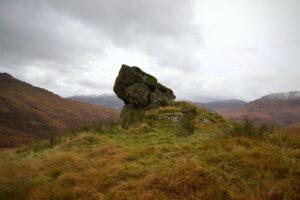
Clach na Briton, Glen Falloch – a colossal ancient border marker delimiting the boundaries of three long extinct kingdoms
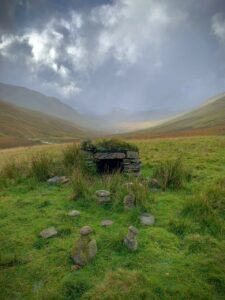
Tigh na Cailleach, Glen Lyon – a still active shrine to the goddess of winter
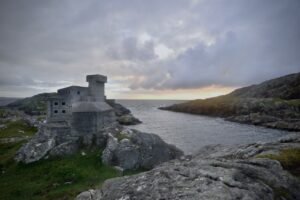
Hermit’s Castle, Achmelvich Bay
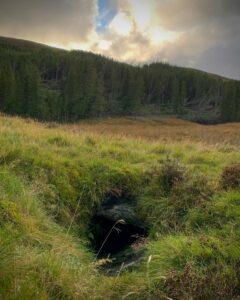
Cracking Souterrain, Sutherland – a 2,500-year-old hole in the ground found on a lonely knoll in Sutherland, leading down into what may be Scotland’s oldest surviving basement.
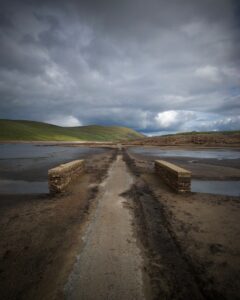
The Old Fish Road to Ullapool, revealed beneath the waters of Loch Glascarnoch
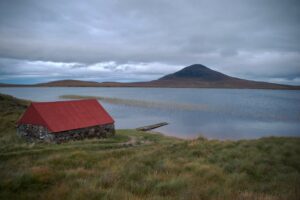
Ben Griam Beat, Sutherland – the site of Scotland’s highest hill-fort? Or perhaps the ruins of a prehistoric cattle ranch, abandoned due to a cooling climate over 3,000 years ago
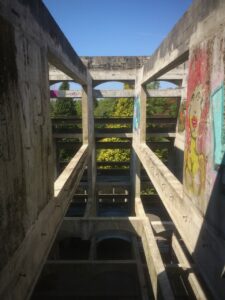
The modernist ruins of Cardross Seminary
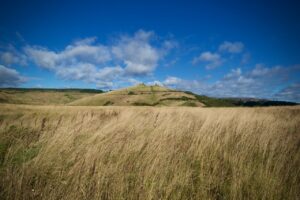
The ‘lost village’ of Lassodie in Fife, a one time coal mining community that has been completely erased and now partially ‘re-wilded’
Wild History: Journeys into Lost Scotland by James Crawford is published by Birlinn, priced £22.00.
Can we define the ‘Scottishness’ of Scotland’s architecture? Frank Arneil Walker sets out to answer this question in this ambitious and stunning book that tells the history of Scotland in a unique way. Here, BooksfromScotland shares some of the photography found in the book, a glimpse of the treasures inside.
Mousa to Mackintosh: The Scottishness of Scottish Architecture
By Frank Arneil Walker
Published by Historic Environment Scotland
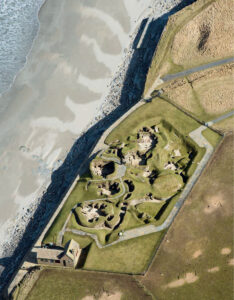
Skara Brae, Orkney
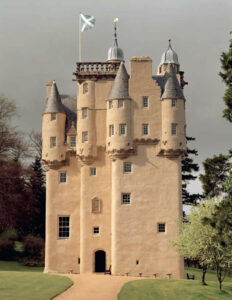
Craiglevar Castle
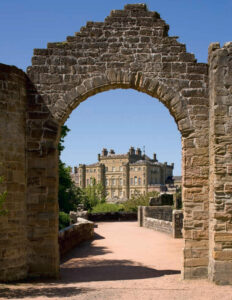
Culzean Castle
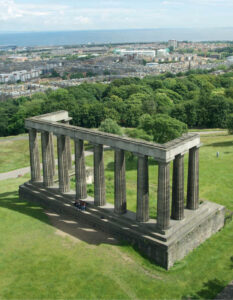
National Monument, Calton Hill, Edinburgh
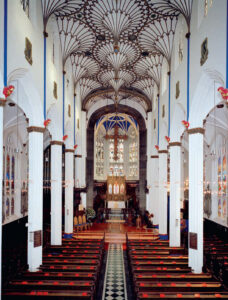
St John’s Episcopal Church, Edinburgh
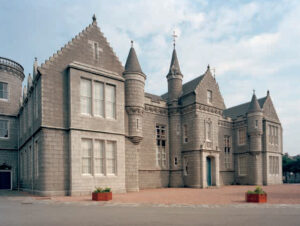
Aberdeen Grammar School
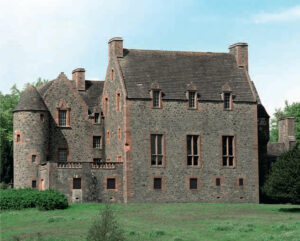
Formakin House
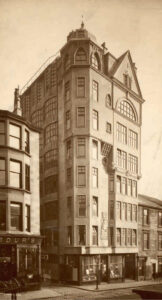
The Lion Chambers, Glasgow

The Broom Estate, Whitecraigs

Tower of Empire, Empire Exhibition, Glasgow
Mousa to Mackintosh: The Scottishness of Scottish Architecture by Frank Arneil Walker is published by Historic Environment Scotland, priced £30.00.
Be More Dog is a warm and wonderful tale, written by Caroline Crowe with marvellous illustrations by Carlos Vélez. And though it is a book for children, Caroline tells us here that the joy of being more dog is a great life lesson for us all!
Be More Dog
By Caroline Crowe, illustrated by Carlos Vélez
Published by Floris Books
The Joy of Being More Dog!
Joy is such a powerful word. There are lots of synonyms you can use, but I don’t think any other word captures that feeling of unbridled happiness in the moment. Write it or say it out loud and you can’t help but remember a snapshot in time when you were filled with that emotional sunshine.
I wrote my latest picture book, Be More Dog, during the Covid lockdowns in the UK. It was an anxious time and it was often difficult to remain positive. One day I looked up from the table where I was working and noticed our family dog, Oka, lying in a small patch of sun on the floor of our sitting room. He’d found a bright spot and was just enjoying the moment. It was that image that sparked the idea for Be More Dog: a reminder that even in the most difficult times there can be moments of light, and we need to try to stop and appreciate them.
I think, especially as adults, we sometimes get caught up in focusing on bigger events and the happiness or excitement they might bring. The pace of modern life is fast and it’s easy to forget to appreciate all of those other less conspicuous moments that make up our days – the promise in the smell of freshly baked cookies or the exhilaration of riding a bike downhill with the wind in your face.
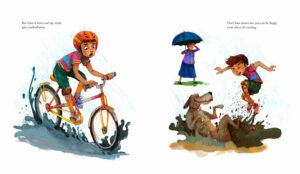
It’s often something that children are better at than grown-ups. There’s a scene in the book where it starts to rain and Sam, the dog in the story, encourages his young owner to splash in a giant puddle with him. There is magic in the illustrations that Carlos Vélez created for this book. They totally capture both dog and owner embracing the joy of the moment. I think as we get older we can become too focused on the consequences of things like jumping in puddles – muddy, wet clothes! – but maybe children and dogs see the possibility for joy first.
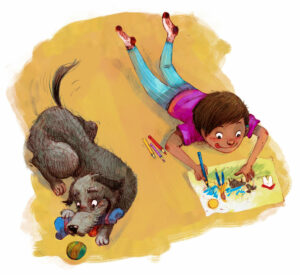
The other page in the book that always makes me smile is the image of Sam and his owner each doing something that makes them happy while they wait for Dad to come home. It’s a reminder that joy doesn’t have to be loud and showy. There is also joy in the quiet moments, like reading a great book or in the case of the young character in my story, drawing a picture.
Lastly, but perhaps most important, there is the joy that comes from making other people happy. Dogs have an absolute knack for gifting happiness and it’s something Sam teaches his young owner about. I hope that reading the book inspires children and grown-ups to recognise and reach for the little moments of joy in their day. Our four-legged friends are champions at finding it in the smallest of things and we could probably all do with being a bit more dog!
Be More Dog by Caroline Crowe and Carlos Vélez is published by Floris Books, priced £12.99.
Jamie Jauncey looks back on the life and work of his great-great-uncle in his latest book. David Robinson talks to him about having such a pioneering historical figure in his family.
Don Roberto: The Adventure of Being Cunninghame Graham
By Jamie Jauncey
Published by Scotland Street Press
When he was 23, James (Jamie) Jauncey found himself in the presidential palace at Buenos Aires, looking up at a portrait of a handsome, bearded man astride a fine black stallion. The man in John Lavery’s portrait, wearing a broad-brimmed hat and a gaucho’s cape, and seemingly at one with both his horse and the empty landscape of the Argentinian pampas, was his great-great-uncle, RB Cunninghame Graham, ‘a fantastic combination of Don Quixote and Sir Gawain, Indiana Jones and the Lone Ranger’.
Even stripped of hyperbole, Cunninghame Graham’s life had the kind of width and verve that seems impossible now, and was rarely matched in either the nineteenth century, when he co-founded the Scottish Labour Party, or the twentieth, when he was the founding co-president of the SNP. Consider the evidence. Here is a descendant of the Earls of Menteith and the first MP (a radical Liberal; the Labour Party did not then exist) to declare himself a socialist in the House of Commons. A writer of 30 books – including one which ‘broke the mould of travel writing’ and one which told the story that became the film The Mission – who also tried his hand as a Argentinian rancher, a Uruguayan horse trader, and took his wife on a dangerous 600-mile mule train to Mexico. A maverick who took up the cause of Irish republicanism and was jailed for defying the Home Secretary’s ban on a demonstration in Trafalgar Square, who supported Scotland’s striking miners and campaigned for an eight-hour working day. His friend, the novelist Joseph Conrad – who dedicated Typhoon to him – once wrote that by comparison, he felt as though he had lived his whole life in a dark hole.
When he stood in front of Lavery’s portrait half a century ago, Jauncey felt he knew everything he needed to know about the man Argentinians knew as ‘Don Roberto’. He was, after all, the family’s great hero, especially to his mother, who remembered him fondly from her own childhood and who also wrote a biography of him.
‘His name was forever on my mother’s lips so he was there in our childhood, offstage but somehow very present, and he assumed a kind of mythic status. She told us so many stories of him – about his time in Argentina, the story of Bloody Sunday (the violent 1887 Trafalgar Square demo at which he was beaten by police and arrested), and of how he was captured in the Atlas Mountains, and so on.
‘I didn’t feel any obligation to live up to him, but when I reached my sixties, I realised that I couldn’t any longer live with this two-dimensional colossus in the family landscape. I wanted to demythologise him, to find out what he was really about and what he was like as a person.
‘There are already five or six biographies, though the first two were almost written at his own behest. And it’s not really that the other got things wrong so much as that I felt I could tell the story through a slightly different lens.’
Jauncey admits that his book isn’t the result of long years poring over primary sources in the archives (which in any case were shut because of the pandemic). Instead, it is a personalised quest to come to terms with a larger-than-life ancestor, and Jauncey’s reflections on his own life as a writer (he has five novels to his name), traveller, and a family member that also adds depth to his portrait. While some biographers seem to strain every sinew to present an image of their subject as consistent, Jauncey leaves room for complexity and contradiction.
Even his parents’ attitude to Don Roberto differed wildly, he points out. ‘My father was a small-c conservative, a diligent jurist who liked to be out of the spotlight. Robert loved the spotlight, and so to my father he was both dangerous politically and had an extravagant personality. Yet to my late mother, Robert was glamorous and kind and she hero-worshipped him. Her own biography (Gaucho Laird, by Jean Cunninghame Graham, 2005) is a semi-fictionalised version of his life and yet she barely mentions Robert’s nationalism at all and I think she thought it was just a pose, an aberration. She wasn’t of a generation able to take it seriously.’
Jauncey harbours no such doubts. ‘You have only to read the speeches to sense the depth of his connection with Scotland,’ he says, pointing out that the Scottish Labour Party under Keir Hardie was committed to home rule – a policy it only dropped in 1927, when Don Roberto became active in the national movement.
‘What convinces me that he wasn’t fooling around in his politics is that, right from the start of his career, he was a humanitarian. In South America he had seen people living in desperate conditions and had been deeply touched by it. When he came back to Scotland and saw the conditions the miners were living in, he realised that a Liberal government, funded to some extent by the mine owners, was never going to take their cause on board, so he determined to do something for them – which is why he pressed for an eight-hour working day.’
Mavericks like Don Roberto fascinate because they stand outside of their own time. Reading Jauncey’s biography makes clear why he was able to do this: Robert’s father’s mental illness, the debts into which this plunged the family, and Robert’s own failure to make his fortune – all of this gave him a mindset at variance with so many late Victorian values. His marriage to the rather wonderful Gabriela (to my mind an even greater maverick) proved the point: ostensibly born in Chile to a French father, in reality she was a probably a Yorkshire teenage mother who ran away to London and then Paris to work either on the stage or possibly as a prostitute. As James Robertson points out in the foreword, the story of Robert’s marriage ‘is so romantic that it would hardly stand scrutiny as a novel’.
But even though mavericks fascinate, we’re never quite sure of them. And that, says Jauncey, is the reason that Don Roberto isn’t as recognised today as he should be: we find him just too hard to place. As an example, he mentions his journey, disguised as a Turkish doctor, to a part of Morocco forbidden to foreigners, during which he was briefly imprisoned by a local warlord. When Mogreb el Aksa was published in 1898, Conrad hailed it as ‘the travel book of the century’, while Hugh MacDiarmid later described it as ‘one of the best books of travel ever written’.
‘There’s a genuine mystery about the whole journey,’ says Jauncey. ‘Did he go there for the hell of it – because he often did do things for no other reason. Or was he spying for the British government and reporting back to Sir Arthur Nicholson, his distant relative who was then the permanent under-secretary for foreign affairs, what the tribes were up to in southern Morocco? Or was he on a commercial enterprise? All are perfectly possible.’
One of those would, I suggest, knock on the head the idea that he was an anti-imperialist (for which, I should add, there is also plenty of evidence). ‘It would’ Jauncey agrees. ‘But this is where he is fascinating because he is just so full of contradictions.’
In his book, he lists some of them. Don Roberto was, he writes ‘the aristocratic socialist, the Scottish laird with the manners of a Spanish hidalgo, the hard-riding dandy, the romantic realist, the cosmopolitan nationalist; the progressive who deplored the effects of progress, the visionary antiquarian, the anti-imperialist, anti-racist admirer of the Spanish Conquest, the moderniser with one foot in the past, the disdainful writer of literary prefaces who could chatter easily in Scots with his tenants …’
When he looked at Sir John Lavery’s portrait of Don Roberto, Jamie Jauncey saw a singularly interesting person with hardly any of these complexities. Fifty years on, his own fine portrait of one of the most fascinating Scots of his era contains them all.
Don Roberto: The Adventure of Being Cunninghame Graham by James Jauncey is published by Scotland Street Press, priced £24.99.
Mixing travel writing, history and memoir, Iain Maloney’s latest book, The Japan Lights, not only offers insights on Scotland and Japan, but on the author and his subject, engineer Richard Henry Bruton. We asked Iain to tell us more about his unique travelogue.
The Japan Lights
By Iain Maloney
Published by Tippermuir Press
The Japan Lights is your first travel memoir since the acclaimed The Only Gaijin in the Village, published in 2020. In their own ways both books attempt to integrate Scotland with the unique culture of Japan. How did the experience of writing this book differ? And did it, as you note in the Introduction, ‘raise more questions than it answered’?
The Only Gaijin in the Village was very much a book about myself and my experiences, the culmination of 15 years living in Japan summed up in one narrative, which meant the next book necessarily had to be something different. People were asking for Gaijin 2 but I knew that was impossible—I’d used up all my good anecdotes for a start! I came to Japan when I was 24 and published Only Gaijin when I was 40. It was a book in which I was looking backwards and drawing conclusions whereas The Japan Lights is much more about the present and the future (strangely, for a book that is partly focused on the 19th century). The writing process was hugely different as a result: Only Gaijin involved pulling together all my anecdotes, my experiences, then sitting in my office and shaping it into something, but this was much more of a traditional travel book in that I actually had to go to all these remote corners of Japan on planes, trains, cars and boats, meet people, find out things, search for stories. At least, that was the original plan: Covid hit right as Only Gaijin came out and I was turning my attention to Brunton and his lighthouses. Writing a travel book during a lockdown was… challenging. That changed the book in fundamental ways. It also made it more interesting in a sense, for me, because I didn’t know how it would end. It was an adventure in the proper sense, a journey into the unknown.
In the historical figure of Richard Henry Brunton you situate a clear connection between Japan and your homeland. However, the symbol of the lighthouse has a literary significance too through the family of Robert Louis Stevenson. In what ways do you find lighthouses a useful symbol in connecting the two disparate cultures that are so central to you?
In both books I draw parallels between the cultures of Scotland and Japan but that’s really what all immigrants do: I’m approaching the point where I’ll have spent as much of my life in Japan as in Scotland, so in a sense the person I am today is a synthesis of living in those two cultures. That said, there are obvious connections that jump out—island nations, closeness to the natural world, a history of innovation and ambition—but there are also interesting contrasts: for example, Japan considers itself a small nation that wants to be a major power while Scotland really is a small nation that is comfortable with that. It’s when considering lighthouses and sea travel more generally that one of the most interesting differences arises, and that’s our attitude to the rest of the world. Scots have always looked abroad for opportunity—for better or worse—and for most of our history the sea was a highway, a connection between us and everyone else. In contrast, for 250 years Japan deliberately closed itself off from the international community, fiercely and often violently protecting their isolation. The sea was a negative, a highway that brought nothing but trouble. The building of lighthouses in Japan is a strong symbol of that changing, a symbol of a new way of thinking. Lighthouses are warning beacons, but they are also welcome mats: when you’ve been at sea for months, the sighting of a lighthouse beam warms the heart and answers the question ‘are we nearly there yet?’ Building a lighthouse is like sending Voyager into the depths of space with images of humans and some cultural artefacts: it’s saying, ‘here we are, come say hi.’
In the book’s introduction you identify an important shift in the way we view coastlines – from entries to the world to boundaries, edges. What can we learn about history by resituating our understanding of coastlines as the main points of departure and arrival?
I think it’s less about what we can learn about history but what we can learn from history to inform the present, which is always the fun part of history for me. We’re living through an isolationist period, a period of national retrenchment when walls literal and figurative are being erected around the world. At the exact same time, migration is increasing for a variety of reasons—war, economics, climate change, the entirely predictable fallout of globalised capitalism—and that’s only going to continue. As the climate emergency worsens (to take a justifiably pessimistic stance, since target after target is being missed and we may already have passed the point of no return) and millions more are displaced it’s going to inevitably force a rethink of the idea of what a nation is. So many people think of their country as a castle with high walls, battlements and a drawbridge that can be pulled up. This is particularly pronounced in places like Britain and Japan, island states surrounded by water: a literal moat. The water is a barrier between me and you. I like to think differently, to flip that. The sea is a bridge, a highway, the connection between us. In the past, if you wanted to go from Aberdeen to Edinburgh, you went by sea: it was easier, faster, often safer than going over land. The coastline in this sense is analogous to a kerbstone, the edge of the road rather than a barrier to another world. If you think of the North Sea, for example, as a street with houses off it—Scotland, Norway, Denmark—then the world opens up in a positive, friendly way.
Overshadowing every sentence in the book is the legacy of the 2011 Tohoku Tsunami, which caused such devastation along Japan’s eastern coastline. On top of this, COVID-19 hits during your five-year pilgrimage. Would you describe this as a book about tragedy, or about resilience?
Like all national disasters, the memory and legacy of the Tohoku triple disaster is behind everything in Japan, and we are still working through systemic and governmental failures: tragedy and resilience are two sides of the same coin. Humanity has always found ways to pick itself up and rebuild after tragedy and seeing that with my own eyes was humbling and inspiring. But I’d say this book is much more about fragility than tragedy or resilience. Tragedy for many of us is usually something that unfolds on our TVs, to other people, in other places. We are all guilty of falling into the ‘out of sight, out of mind’ trap, of thinking that the worst won’t happen to us. Travelling around the coastline, seeing the lighthouses which are symbols of human fragility against the power of nature, and then travelling to Tohoku and seeing the literal scars of the tsunami, seeing towns where the oldest building was built a decade ago, it brought home to me how easily everything could change in an instant. An earthquake, an eruption, a tsunami, something we have absolutely no control over, no way to predict, no way to stop, could happen today. And that’s not counting the risks we are taking building nuclear plants on fault lines or pushing the climate beyond breaking point. In places like Scotland, where the climate is benign, where natural disasters are unthinkable, we’ve lost that sense people like Brunton had of being puny humans at the mercy of the elements. If we found some of that humility again, maybe I wouldn’t be so pessimistic about the outcomes of the climate emergency.
There appears to be a personal investment in your quest to learn about Richard Henry Brunton, to go beyond his work and try and unearth the man behind the lighthouses. Did you see yourself in him? And what do you think his story can teach us?
There were quite a few Scots who came to Japan once the country reopened—Thomas Glover being the most famous—and I came across Brunton while researching a series of articles on some of them. Something about him got under my skin in a way that the others didn’t. I think I do see potential similarities between us beyond the obvious factual parallels. Some of his character flaws are ones that I’m aware of in myself—a confidence that can turn into arrogance, a perseverance that can become overpowering—but the difference is that I recognise these flaws in myself and attempt to change or mitigate them. He didn’t: he was right and everyone else was wrong. He was a stereotypical stubborn Victorian, not much given to self-analysis or admitting weakness.
What really hooked me on him though was something I examine in the book, the question of whether our negatives should cancel out our positives. As I was writing this book people around the world were discussing whether you can still enjoy an artist’s work when you find out they have committed crimes or hold reprehensible beliefs. Can we really expect our heroes to be perfectly flawless beings, literal saints with not a blemish or stain? How far should we go in calling out misdemeanors and where does forgiveness come in? Brunton was, even by the standards of his time, racist. The things he said about the Japanese in his writings are hugely offensive. He was a difficult man to like and he made many enemies amongst the foreign community in Yokohama. By the end, no one wanted to renew his contract or offer him a job, forcing him to leave Japan before he wanted to. But no one questioned his genius as a civil engineer, and the Japanese Coastguard today laud him as a hero, a man whose efforts saved hundreds of thousands of lives and are still doing so. That dichotomy in his character is what fascinated me about him: he embodies the argument raging today, a flawed man who did great things. He wasn’t a saint or a villain, he was a mess of a human, like the rest of us.
Do you have another pilgrimage lined up in the future – and another book?
I went on a very different kind of pilgrimage to Seattle just before Covid and wrote what I’m calling my Nick-Hornby-midlife-crisis book about grunge music, mental health, and growing up in Scotland in the 90s. I’ve yet to convince publishers that there’s a market for it, but I will persevere. I’m working on other things and as always going in multiple directions at once—poetry, science fiction, a literary novel—but I’m still looking around for the next non-fiction/travel project. It has to be the right idea though. This book took six years from lightbulb to publication, and that’s a long time to spend with one man, pursuing one idea.
The Japan Lights by Iain Maloney is published by Tippermuir Press, priced £9.99.
Sometimes, comfort and escape is not what a reader wants when heading to the beach. For those readers interested in horror and explorations on the body, Heather Parry is a writer to watch. Following on from the success of her novel, Orpheus Builds a Girl, comes an unsettling but brilliant short story collection, This Is My Body, Given To You. Here, we share one of her stories, ‘The Small Island’.
This Is My Body, Given For You
By Heather Parry
Published by Haunt Publishing
The Small Island
There has been a blight about these islands. Their grain has ceased growing; their livestock no longer breeds. Fields lie flat and the hills are barren, devoid of new life. As the last of the mature animals are slaughtered and rationed out, the future holds a horrifying uncertainty.
On the larger island, the people are reaching desperation. Angry seas have kept them from the mainland for too long. Each time they send out a boat, it comes back terrified, or sinks while still in view. The remaining people are afraid to try again. And so, for the first time in a hundred years, they are looking to the smaller island. The small spit of green that is lush with sheep and teeming with generations closed off from the rest of the world. The island that, as their grandparents told them, held witchcraft and sorcery and the horror of humanity.
Aboard the boat – the best they have, though it creaks beneath the weight of its small crew, and rocks with the gentlest wave – the youngest and strongest of the community’s men tie knots and plug leaks. They hammer wood to wood, pull tarpaulin and secure it. The others stand at the tiny harbour and watch them as they work.
It is ready, the captain-of-sorts announces to his uncertain crew. It’s time.
A girl runs forward, a creature somewhere between a child and a woman. She is going with them. She has always wanted to be more than the place she was born in. The girl’s mother knows better than to protest; the crew find that there is little point in it either. A life jacket is handed to her. She straps it on and sets herself down at the front of the boat.
The crossing is difficult and strained by the same indignant seas that have kept them from the mainland. But the distance is much shorter. They could have done this journey many times before. They did not.
There is no port on the smaller island. No harbour or jetty. A vast beach is their only welcome. They navigate the rocks and take the boat into the shallow waters. Two of the younger men go to haul their bodies out of the boat and into the sea, but the captain blocks their path with his outstretched arm.
Wait.
They look up across the sand and over the grass and up to where the village begins, where houses hundreds of years old still stand with thatched roofs. They look to the buildings beyond, the small church and the meeting hall. They see not a single movement; not a breath.
Why don’t you jump ashore and see, the captain says to the girl. Why don’t you take a wee run up that beach and tell us what you find.
They push her onto shore, a tester, a little yellow bird without her cage. She runs from the water, over dunes and up the gentle incline. She goes willingly, an adventurer.
The fields are empty. Amongst the buildings she finds nothing but death. People that have dropped seemingly in an instant. Bodies at desks and in kitchens, bodies intertwined and bodies alone.
She runs back to the water, the sand moving under her feet, and finds that the boat is further out than it was before.
A plague, she says. There is nobody here left alive.
The captain hauls the anchor back into the boat. Paddles slip into the water and they begin their escape. The girl runs forward, made slower by the sea.
You’ll have breathed it in, says a younger man. You’ll have caught it.
Another says, We can’t let you bring it back.
There is silence, then. Silence from her and from the men who leave her. Silence because there’s nothing to say.
She stays amongst the dunes for three days, shivering and starving and clinging to hope, running up to the village only to drink water from the well. On the fourth day she accepts that they are not coming, and makes her home amongst the dead.
She steps around their bloated forms, pink foam escaping from their noses and parted lips. She searches their houses for what might sustain her. It is a week before the canned foods and pastes and butter and cream run out. Another of stomach cramps and the rotten corpses of rats and snails. Of chewing the straw from roofs and hallucinations of beef. Of glances at the reddening, rictal bodies scattered about the floor, as if abandoned in an abattoir.
It is the twenty-first day of her abandonment when, free of tears and resolute, she takes a handsaw from a tool shed and slices the biceps off the largest man she can find. Those that have fallen outside are colder and better preserved. She is so hungry she barely thinks of the morals. She builds a fire and rubs the muscle with salt and sits it to smoke and cook and become delicious.
She devours it within minutes. She is human again. She sleeps full.
The next morning, the brightness of the day wakes her. She strips naked and heads down to the water, her bathtub, and takes herself into the frigid sea. She runs hands over skin and goosepimples and feels a swelling under her fingers. From elbow to shoulder she has grown; not on both sides. Only one. She brings her arms out of the water and flexes the left. The bicep rises, strong and round and firm. She grasps it with her other hand. She grins.
There are two dozen dead outside the croft buildings and tiny homes. With her new strength, she uses her left arm to flip them over, to uncurl them from their poses, to tear them from one another. She appraises them. Blood has pooled; teeth and nails drop from fingers and gums. Yet each body has its own benefits. A pair of round buttocks, large feet, strong shoulders. She first takes the lips of a woman at her sink. A knife will do this; two slices and it’s done. She fries them up in oil in a pan. They slip down with ease, and she sleeps. The next morning, her face is heavier. She finds a cracked mirror. There they are, full and red and hers.
She takes calf muscles and forearms and the glutes. She takes daintier ears and longer fingers and breasts twice the size of hers. She pops out two gelatinous masses, barely clinging to their shape, from the body of a teen. The next morning, when she wakes, she has the blue-grey eyes she’s always wished for.
She is strong. She is powerful. She can run and bend and move and lift and swim just as she wants to. She spears fish from the still-living seas, and grasps eels, and holds her breath to dive for scallops. She hears the absence of her people every day, but she no longer cares.
She shears a cock from the groin of every dead man. She lines them up, five in total, and imagines them turgid. She looks for girth and length and erectile tissue. She swallows one whole, holds back a retch, and goes to sleep with a smile on her face.
The next morning, she wakes with a weight between her thighs. It sits in front of her vulva. She thinks of the things she always thinks of at night, and it grows and swells and brings sheer delight. She has chosen well. She is perfect.
The boat comes after three months. She hears it from the hillside. Wrapped in blankets to hide her new form, she strides down to the beach where they sit still metres from the shore. They are afraid, again. She lets them speak.
We need you, says the captain. We want you back. We can’t handle the shame. There is one word that he does not say, and she notes it.
Go home, she thinks. I am happy here. But she does not say it. Instead, she runs her gaze over sturdy hands and firm hips and brows that sit heavy over eyes.
There is life here, she says. Things growing. Things that have sustained me. Come and see.
She waits a while. They do as she tells them. She takes them one by one around corners, into dark rooms, to show them something. She wrings their necks, smashes their skulls with rocks, stabs their chests with cold pokers. She picks over flesh and sinew and muscle and marrow, waiting for the next boat to come to rescue her.
She takes the parts that she wants, and leaves the rest to rot.
This Is My Body, Given For You by Heather Parry is published by Haunt Publishing, priced £9.99.
Staying with horror, It Came From The Closet is an essay anthology that takes a look at cinematic horror history told from the perspective of LGBTQIA+ writers. Here, the anthology’s editor, Joe Vallese, writes of how looking at horror through this lens brings a new richness to the genre.
It Came From The Closet: Queer Reflections on Horror
Edited by Joe Vallese
Published by Saraband
It’s hard to deny that horror movies can be, well, pretty fucked up. And yet, I and so many other queer people somehow can’t help but find immense guiltless, unironic pleasure in them. We’re titillated by the genre, even when it actively excludes us from the narrative—or, worse, includes us only to marginalize, villainize, or altogether neglect us…
So then, how are we to think about the complicated relationship between the queer community and the horror genre? How can we find such camaraderie in the very thing that so often slights us? As a still-closeted, still-horror-obsessed teenager in the late ’90s and early ’00s who did not yet know anyone who was out, I worried over this incongruity, fearing that somehow my wires were even more crossed than I knew. Was my affection for horror just some residual self-loathing, a sorry attempt at maintaining that bit of machismo I credited to myself while in my brothers’ company? Did I need to shed my boyish bloodlust to make room in my brain and heart for more heady, urgent, queer pop culture? Worse still, did my chatty, encyclopedic, know-it-all-and-dying-to-share-it zeal for horror actually give my secret away? Thinking about this self-induced anxiety embarrasses me now, but when you’re always hiding in plain sight, you second-guess every move you make, every word you utter, every passion you claim.
It wasn’t until I stumbled upon AOL chat rooms and Internet forums solely dedicated to horror that I discovered just how deep queer affinity for the genre runs. I was astounded by how many regular posters proudly identified (from behind avatars and witty handles) as LGBTQIA+, and was floored by how masterfully they explicated what they saw as queer coding in many of their favorite movies…
I eventually came to understand that, while I was busy fretting over whether being gay would displace me from connecting with the films I loved most, queer affection for horror was actively being claimed, recontextualized, and integrated into the culture and community—and, like most things touched by queerness, horror becomes more textured, more nuanced, and far more exciting when viewed through a queer lens.
Though the current horror landscape is slowly (slooooowly) telling more queer-centered and -adjacent stories, we largely remain tasked with reading ourselves into these films we love, to seek out characters and set pieces that speak to, mirror, and parallel the unique ways in which we encounter, navigate, and occupy the world. In this way, It Came from the Closet is very much the anthology of my cinephilic dreams: a collection of eclectic memoirs that use horror as the lens through which the writers consider and reflect upon queer identity, and vice versa. These essays don’t draw easy lines between horror and queerness but rather convey a rich reciprocity, complicating and questioning as much as they clarify. The powerful and diverse voices in this collection reckon with trauma, shame, grief, loss, abuse, race, discrimination, parenthood, familial structures, religion, disability, illness, art, love, and so much more. While these essays spotlight each writer’s singular queer perspective, their respective representations and analyses of ‘the Horror Film’ serve as a kind of universal connective tissue between them and their readers.
It Came From The Closet: Queer Reflections on Horror edited by Joe Vallese is published by Saraband, priced £14.99.
David Flanagan is back with another amazing adventure with Uncle Pete and TM, this time in the arctic, searching for a lost polar bear. It’s another cracker sure to get young readers flying through its pages! Enjoy the extract below.
Uncle Pete and the Polar Bear Rescue
By David C. Flanagan
Published by Little Door Books
‘What’s that in the sky up ahead?’ TM suddenly shouted to Uncle Pete, pointing from her seat in the plane. ‘It looks like smoke!’
It was smoke, the thickest, blackest, nastiest looking stuff you can imagine. There was a trail of it snaking up through the cold, clear Arctic air. The smoke hung in the blue sky, like someone had smeared soot across it.
Uncle Pete turned the plane to try and avoid the black smoke, and TM coughed and coughed when they flew through the horrible dark clouds of it.
‘Where’s it coming from?’ spluttered Uncle Pete.
TM peered over the side of the plane, trying to see where the smoke began.
‘Look!’ she yelled to Uncle Pete. ‘A ship! It’s coming from a ship!’
Sure enough, far below the plane, there was an enormous dark ship moving fast through the ocean. Icebergs just bounced off the front of the ship, so it was obviously very strong.
The ship had ten huge funnels, all belching out black smoke into the air. There were big cranes along its deck (which is what the floors on a ship are called), and some other mysterious objects that were all covered up. Uncle Pete felt a bit nervous about going closer, but he had to find out what had happened to Berg’s family. And he wanted to see what was under those covers on the ship’s deck.
‘Let’s take a look!’ he yelled to TM and Berg. ‘Hold tight!’
Trying to avoid the clouds of black smoke billowing from the funnels, Uncle Pete dived the plane towards the ship, roaring around it in a big circle.
The ship had a name, painted on the back in big white letters. It was called THE HUNTER.
‘It looks very suspicious indeed!’ shouted Uncle Pete to TM and Berg. ‘I’m going to fly a bit closer and have another look at what’s on the deck!’
Secretly, he wondered if Berg’s family were being hidden under those covers, but he didn’t want to say anything to his friends just yet.
Uncle Pete turned the plane back towards the ship and flew much nearer to it so he could see if there were any clues about what it was doing.
Berg’s nose twitched as they got closer to the ship.
‘I can smell my family!’ he yelled. ‘I can definitely smell them! They’re on that horrible looking ship!’
Just then, three angry looking men burst out of a big metal door on the ship, shouting and pointing up at Uncle Pete’s plane. They didn’t look very happy, or very friendly. The men ran to the mysterious shapes on the deck and pulled off the covers. Uncle Pete gulped when he saw they’d revealed some big guns.
The men started turning the guns towards Uncle Pete’s plane and then… BANG, BANG, BANG! The guns shot at them!
Now, lots of dangerous things had happened to Uncle Pete on his explorer adventures, but he’d NEVER been shot at before. He was completely shocked! Uncle Pete was always peaceful and kind, and hated when people shot animals, or each other.
‘Uh-oh!’ shouted Uncle Pete, ducking down in his seat. ‘TM! Berg! Get your heads down!’
Uncle Pete gritted his teeth and flicked the plane from side to side, trying to avoid all the bullets being fired at them from the ship.
TM was absolutely furious. “How dare you!” she yelled at the men on the ship, though they couldn’t hear her. Then she had an idea.
‘Berg!’ she yelled. ‘Grab some tins of beans and let them have it!’
Berg opened one of their rucksacks and pulled out six tins of beans. Uncle Pete turned and twisted the little plane towards the men on the ship and, just as they passed over the blazing guns, Berg threw the tins of beans over the side.
The tins flew through the air, clonked two of the men on the head and knocked them out. They fell in a heap on the ship’s deck. But this just made the third man angrier, and he spun his big gun around and began blasting away at Uncle Pete’s plane again.
‘This is too dangerous, even for us!’ Uncle Pete said to TM. ‘I think we’ll need to go and get help!’
Just as he was talking to TM, a bullet from a ship’s gun tore a hole through one of the wings of the plane. Uncle Pete managed to keep it flying, but he now definitely thought it was time to get out of there.
‘HA!’ shouted TM over the side of the plane. ‘It’ll take more than that to stop us!’
But then another bullet hit the engine with a loud THUD. The engine spluttered and stopped – stardust poured out of the hole in the engine making a long sparkly trail across the sky.
‘Uh, oh!’ said the three friends all at once.
The two men who’d been knocked out by Berg’s bean tin bombs were getting up rubbing their heads. They cheered when they saw the stardust trail from the damaged engine, and the little plane beginning to dive towards the ocean.
‘We’re going to have to jump out!’ yelled Uncle Pete, hoping he’d packed his parachute and not his dirty washing, just as he’d done by mistake on his first adventure with TM. He’d made sure he’d put a parachute in the back for Berg and he’d made a tiny little one for TM, too, just in case they got into a bad situation. And this was definitely a bad situation.
Uncle Pete and the Polar Bear Rescue by David C. Flanagan is published by Little Door Books, priced £6.99.
Robin Scott-Elliot is an acclaimed writer of children’s books. His latest release, Sweet Skies, is a brilliant tale of a boy in post-war Berlin who dreams of being a pilot but is fighting to survive in a battle-weary city. In the extract below, Otto witnesses the victorious US pilots coming to the city’s rescue.
Sweet Skies
By Robin Scott-Elliot
Published by Everything With Words
Chocolate was falling from the sky. Otto watched it fall, head back, mouth open, and if he’d been able to tear his gaze away, he would have seen that every child gathered at the end of the Tempelhof runway was a mirror image. Every head with every shade of hair colour, red to blonde to jet black to brown pigtails and yellowy stubble like a cornfield after harvest, was tipped back, mouths open as if in hope the chocolate might float straight in.
It was like watching parachutists leap from doomed planes, except the parachutes started small and stayed that way. They were handkerchiefs after all. Soon they could make out the bounty hanging beneath them and, as if someone had barked a command, eager arms stretched skywards.
They’d arrived early as Ilse instructed and argued about where the best spot would be. In the end they split up. Karl hopped and hauled his way up the rubble mountain, giving him the best view to direct Otto and Ilse in their candy collection mission.
There were more children gathered than the day before. As Ilse predicted, news of the candy drop had spread (it was an impossible secret to keep). Ilse was close to the fence, where most children gathered. They clustered together, moving this way and that like a flock of starlings, trying to estimate where the parachutes would land.
Otto was at the foot of the mountain, but the noise of the plane engines meant he couldn’t hear Karl’s shouts. It was the waving crutch that caught his eye. Karl was pointing to the cemetery. Otto looked up again. Karl was right, several parachutes were drifting that way.
Otto leapt over the ragged wire fence. The cemetery was one of the new ones dotted across the city – this is what happens after wars. The graves were wooden crosses, hammered into the ground in ragged rows and fighting a losing battle against straggly bushes and weeds. There was not a lot of time for looking after the dead when staying alive was such a full-time occupation.
A few others followed Otto, noticing Karl’s direction. They eyed each other, like runners at the start of a race… how quick is she? He looks slow? Why’s he looking over there? Because here comes one. A makeshift red parachute was nearly down, attracting every eye in the cemetery. Which meant Otto wasn’t looking where he was going and tripped over a loose brick. He sprawled forward, head just missing the cross of a tilting grave marker.
He was up again in seconds, but his fall was enough for a girl of about his age, hair pulled into a ponytail and a fierce look on her face, to leap and catch it. She clutched it to her chest and spun round to face the others. The red handkerchief parachute made it look like she’d been wounded.
‘Mine,’ she snarled, a declaration accepted at once by the others, not least because several more parachutes were about to touch down.
Otto saw one hanging from the corner of a cross and ran. A boy tried to trip him but he jumped over the outstretched foot and dived for his target, yanking it off the cross and pressing it to his chest as he rolled into a ball ready for the other boy’s attack.
But like the girl – who was sitting on a grave marker staring at her chocolate bar as if she couldn’t believe what was happening – he was left alone. Finders/keepers was the Kinder Code: the unwritten rules between children trying to make their lives among the ruins of the adult world. Besides, why fight over one chocolate bar when plenty others were falling from the sky?
Otto rolled onto his back to catch his breath. Above him was another parachute, heading right for him. Chocolate falling from the sky. How ridiculous. He was laughing as he scrambled to his feet and reached one hand for it and didn’t stop laughing even as another boy leapt across him and grabbed the precious package.
The laughter spread, a happy infection, and as they darted after the parachutes, beneath the shadows of the Skymasters, child after child began to catch it, even as they pushed and shoved and leapt and dived for the chocolate from the sky. The cemetery was full of laughter.
When it was done, Otto, who’d forgotten a bag, scrambled up to Karl’s vantage point with his booty rolled up in the front of his baggy old jersey. It was his father’s and he had to roll the sleeves up to reveal his hands. He dropped his treasure in front of Karl and pulled himself out of the tangle of jersey. It had been chilly when he left home before the sun was up. He was hot now, sweating, and still laughing, although it was more of a gasp for breath.
A last plane roared overhead and a last mini-parachute dropped. They watched it flutter down into the upstretched hands of a small boy dancing a jig in anticipation. Otto scanned the skies then switched his attention to the ground.
Over the fence in the airfield, lorries were rushing to the parked planes. The unloading began at once; sacks were humped out of the planes, collected by groundcrew and lifted into lorries. Once the planes were emptied, their engines spluttered back to life and the ch-ch-ch-burrrrr of propellers jerked them forward.
Otto waved as the first Skymaster rose towards them from the runway. He could make out the pilots in the cockpit, caps jammed on tight by their headphones, dark glasses in place, setting a course for their home base far away in the safety of the west.
Otto kept waving, Karl joined in and below them the rest of the children did too. A number flashed into view on the plane’s fuselage – 712 – and as it did, the wings waggled. Otto raised both hands to the sky and yelled in delight. He was still yelling and punching the air when the next plane took off and that too waggled its wings as it flew over.
‘Where’s your bag? What did you get?’ Ilse’s face was red from the climb up the rubble and her parachute-chasing.
Otto ignored her first question and pointed at his jersey. On it lay three bars of chocolate.
‘One each,’ he said.
Sweet Skies by Robin Scott-Elliot is published by Everything With Words, priced £8.99.
Red Star Over Hebrides is a unique book where Donald Murray looks back at his childhood in Lewis through prose, poetry and song inspired by the deep-rooted social and cultural connections of the island with Russia and the Baltics. He explores aspects of Hebridean life, such as the fishing industry and crofting land raids with the stories of literary giants such as Dostoevsky, Gogol and Tolstoy. Below, Donald remembers a dominant community figure.
Red Star Over Hebrides
By Donald S. Murray
Published by Taproot Press
From ‘Capone and Dostoyevsky’
Hypocrisy is a dying art in these islands. Every weekend, there’s a queue buying scratchcards and DVDs at the local shop. ‘Give me those lucky dips, Martin,’ they announce to the shopkeeper. Or, ‘I’ll take this film. And that one,’ they say, placing the empty cases on the counter. ‘I need something to pass the time on a Sunday afternoon.’
Duncan Macdonald – the church elder that some twenty years ago we all knew better as Capone – would have stood for none of that. A tall powerful figure in his grey overcoat and hat, his eyes had the sharpness of a gannet’s gaze. For all that he was in his seventies, one look would have been enough to terrify the likes of Martin, his hand sweeping over these goods like Jesus chastising the moneychangers in the temple. ‘What do you mean selling stuff like that? It may do a lot for your profits, but it won’t do much for your soul!’ And then his glare would swirl round his fellow-shoppers. ‘Gambling! Breaking the Sabbath! What do you mean by doing such things?’
One time I was on the wrong side of this look was a few short weeks before he died. A young student, I was reading Crime and Punishment near the back of a crowded bus when he came to sit beside me.
‘What’s that you’ve got there?’
I told him.
‘Now tell me … Do you ever spend time reading the Bible? I bet you never spend much time doing the likes of that.’
I smiled weakly in response. There are some people with whom it is a waste of breath to quarrel.
Yet in his youth, Capone never spent much time studying the Bible. If rumours are to be believed, he was never still long enough to lift the Good Book. Instead, he would be scaling rocks on the shoreline; balancing on one leg or combing his hair while standing on a stone outcrop that jutted out a hundred feet over the ocean and daring others to follow his example.
‘I bet you couldn’t do that.’
He would clamber on the roofs of the village blackhouses too, blocking the chimney with a large flat stone or a piece of turf or wood. As the inhabitants ran from their smoke-choked home, he would be hiding behind a nearby wall, trying to choke down his own laughter.
‘I bet they don’t know what’s happened to them.’
‘I bet …’ Even in his years as a church elder, this phrase would be like a nervous tic on his lips. ‘I bet you don’t think often of your salvation … I bet you don’t read the Bible like you should…’ In the years before he found the Church, however, these words were more than habit. They clicked continually on his tongue as he played cards and dice with the men with whom he worked on the Hydro schemes in places like Cannich, Cluanie and Glencarn. Phrases like ‘I bet’, ‘I raise’, ‘Ace of Hearts’, and ‘Jack of Diamonds’ formed part of the only common language of their camps.
People from the battered ends and edges of all over Europe learned to use it. There were Highlanders and islanders; poor Irish from the ragged coastline of Donegal—coming from communities where steady work was rare and intending to return when things had changed. And then there were those known as the ‘Poles’ – the displaced men of not only Poland but also countries the others never knew existed – like Lithuania, Ukraine, Estonia. Unlike the West Coasters and Irish, they had been forced to surrender many of their dreams of return. Looking over their shoulders at nations lost either to bloodshed or tyranny, they had little choice but to try and begin new lives on the strange and alien landscape they had chanced upon.
For all their differences, the groups had much in common. In slow and faltering English, they could each tell stories about the frailty and precariousness of life. Poverty and weakness had helped to make them that way; the sound of money in their pockets – crisp notes and coins – a more comforting rhythm than the pulse of their hearts. Only a good wage in their hands could grant them a short spell of security, a time of calm and ease.
The author Capone caught me reading, Fyodor Dostoevsky, would have known much better than me how they felt. Never from a rich family, his father, murdered by serfs, left little for his widow and children. This turned the young Fyodor into a radical—so much so that he was imprisoned for political reasons by Tsar Nicholas I. He made, too, an early, disastrous marriage to a widow who suffered from consumption and had a son from her first husband. He was also involved with a magazine banned by the Russian government. A short time later, his wife and brother died. At one stage, he even had to pawn his clothes for food.
And throughout all this, there was gambling. The gaming tables at Weisbauden in Germany. The spinning roulette wheel. Roll of dice. Cut of cards. Eyes shut and hoping for a glimpse of luck. A change of life. It was the same with the men in the hydro camp. The boredom of isolation. Stench of sweat and grime. The prospect of poverty when this spell of work came to an end. All this made them gather nightly at a table in the centre of their hut; the words ‘I bet…’, ‘flush’, ‘pontoon’, ‘I raise…’ never requiring any translation for this multinational group of men whose blackened fingers stained the cards within their hands. As they coughed up the dust of earth and boulder that had gathered in their lungs, the pile of coins gleamed brightly. To have it in their fingers meant the oblivion of whisky. Or another kind of oblivion—a new life that would help them escape the horrors of the old.
Red Star Over Hebrides by Donald S. Murray is published by Taproot Press, priced £14.99.
Sally Magnusson has brought readers another exceptional novel of historical fiction. We caught up with her to find out more about her writing and reading.
Music in the Dark
By Sally Magnusson
Published by John Murray
Congratulations Sally on the publication of your latest novel, Music in the Dark. Could you tell us a little bit about what readers should expect from it?
I hope what they’ll enjoy in it is a love story in later life, in which two people hurt by life find healing and joy. And also thatthey’ll discover new things about the role of women in resisting the Highland Clearances – and the cost of that resistance.
Your novels are all set in the past, in different times, in different locations. What is it that draws you to write historical fiction? How do you choose your times and places?
I love stories. I am endlessly fascinated by history. And I’m always drawn to the atmosphere and feel of place. So when I have a good story – especially one that excavates the experience of women from the vacuum that is the historical record – and a good place to set it, that’s me on my way.
Do you read a lot of historical fiction too? Do you have recommendations of your favourites from this genre?
I do read a lot of historical fiction. I am Hilary Mantel’s number 1 fan. When it comes to The Clearances, Neil Gunn and Iain Crichton Smith are shining beacons from the last generation.
Music in the Dark is set at the time of the Highland Clearances, a significant moment in Scottish history. What did you want to bring to readers in exploring this period?
I wanted readers to feel what it was like to grow up in a Highland township as a talented girl who composed songs and had been well educated in the local parish school as well as being mentored by the Free Kirk minister, Rev Gustavus Aird (a real historical figure who championed the people of Strathcarron). I wanted them to understand the kind of community these townships were, and what it meant to lose it. I wanted to introduce them not just to the appalling violence with which the women of Greenyards were treated by the police in March 1854, but to the aftermath in the years and decades that followed What happened to these women afterwards with their head injuries and their bright dreams crushed? I want readers to think, but above all to feel their way into the minds and hearts of these people – men too – who are only a few generations away from us all. Jamesina’s later life in Glasgow and then Rutherglen, where the novel is set over the course of one night 30 years after the events in Strathcarron, is inspired by the life of my own great-grandmother.
Your main character, Jamesina Ross, is also a writer. Did you feel a kinship in writing a character who wants to bear witness too?
Yes, her love of words is something I identify with, and the way Latin has stayed with her through the decades, as it has done with me, and did too with my mother, who lost a lot when she succumbed to dementia in her later years, but never her Latin. And yes, I wanted Jamesina Ross to be concerned with bearing witness, because that mattered to people then and it matters now, as much as ever.
It is also an intimate story of love found later in life. How do you tackle writing emotional vulnerability?
I feel my way into the character and try to be honest. I’m attracted to ambivalence and nuance – the fact that people can feel one way one day, one hour even, and something different the next. I like characters who can be irritable and grumpy … I identify with them.
What are your favourite love stories in fiction?
Goodness, there are lots. Sebastian Barry’s Days Without End leaps to mind. I also like love stories that don’t involve romance, like the one between Shuggie Bain and his mother.
What are you looking forward to reading next?
I’ve just finished Birnam Wood by Eleanor Catton. May need to give myself a laugh with some Dickens next – Birnam Wood has quite an ending.
Music in the Dark by Sally Magnusson is published by John Murray, priced £16.99.
David Robinson finds the beauty of church, art, and community in Peter Ross’s latest travelogue, Steeple Chasing.
Steeple Chasing: Around Britain by Church
By Peter Ross
Published by Headline
At the last four funerals I have been to, there hasn’t been a single hymn. I shouldn’t be too surprised: the growing unpopularity of Christian rituals of death is one of the signs of our times. As an example, consider this: direct cremations (no service, no mourners) used to be almost unheard of – even murderers and paupers got some sort of ceremonial send-off into the afterlife. Now they account for one in four of all funerals.
That’s how we are with death these days: increasingly, we’re giving it the cold, secular shoulder. We don’t want religious funerals in churches or chapels (none of my last four were), so the numbers have dropped by 80 per cent in the last decade. Bad news for the clergy and undertakers is good news for supermarkets and off-licences: according to the Co-op – which conducts 100,000 funerals a year – 21 per cent of us feel that the wake is more important than the funeral service.
So where does this leave Britain’s churches, those great traditional portals on the infinite? If we have lost faith in Christianity so much that we don’t even want to use its rites at the one moment when they might offer consolation, what’s the point in keeping churches open in the first place? As congregations dwindle and roof repair bills rise, can they ever be anything more than a costly irrelevance?
Such questions are at the heart of Peter Ross’s Steeple Chasing, an ecclesiastical echo of his graveyard explorations in A Tomb With A View, which went on to win the 2021 Saltire Non-Fiction Book of the Year award. The titular pun indicates that this is to be a journalistic journey: with 16,000 Anglican churches in England alone, anything other than an impressionistic survey of British Christianity’s ebbing sea of faith is impossible. For all that, his book is never less than fascinating, and even though some of its stop-off points are familiar (Lindisfarne, Durham, St Paul’s Cathedral), his chapters on the wooden angels guarding the medieval hammerbeam roofs of so many East Anglian churches, the Great East Window at Gloucester, Stanley Spencer’s painting The Resurrection of the Soldiers at Sandham in Hampshire, and the medieval mural The Ladder of Salvation of the Human Soul at Chaldon in Surrey have inspired me to add them all to my bucket-list.
Ross isn’t a believer himself, but his journalism has always been marked by the kind of deep empathy that makes this irrelevant. More than that, he knows where the core of a good story lies, and has a nose for the telling quote. So at Pluscarden Abbey, a monk tells him ‘I sometimes think it would be nice to have a wife. Or even a pair of socks’ and that matters every bit as much as the details of the monks’ centuries-old rituals. At Southwark, he tells the story of the cathedral cat’s meeting with the late Queen (‘This is Doorkins Magnificat, Ma’am’) so well that I found myself watching the service of thanksgiving for its life. He tracks down effigies so life-like that they could be horror film extras, talks to steeplejacks about working on buildings that sway in the wind, and tells a story about a Norfolk man who stopped satanists using the local village church and then – in a scene that could come straight from JL Carr’s A Month in the Country – uncovers 11th century paintings of angels on its nave walls.
At London’s St Martin-in-the-Fields (‘Refugees Welcome’) he helps serve meals to the homeless and needy in a chapter that goes on to offer one possible defence of keeping churches open in a post-Christian age – that the role they play in mental health counselling, addiction support groups and so on is, according to Treasury figures, worth a cool £55.7 billion. One does, though, suspect that his heart really isn’t in this purely utilitarian argument. The real value of churches, he maintains, is that they hold the past and present, decay and use, in a rare balance, that their buildings have a poetry and spirituality about them that only intensifies as they come under threat. As the head of a charity dedicated to rescuing such buildings points out, ‘These buildings transcend time. They are the spiritual investment and the artistic legacy of generations and a community’s greatest expression of itself over centuries.’ In France, all church buildings older than 1905 can, in theory, claim state aid for repairs. In Britain, where some 2,000 churches have closed over the last ten years, and where the Heritage Lottery Fund no longer has a special section to deal with churches, they are a lot more vulnerable.
Not all are. As Richard Holloway points out, visits to cathedrals are on the rise. That’s understandable: they are, after all, awe-inspiring in scale even now, as well as being vast repositories of our history – the crypt at St Paul’s Cathedral is nothing less, says Ross, than England’s Valhalla. (Did you realise that the cathedral it replaced after the Great Fire of London was once the world’s biggest? Me neither).
In my own experience, the one church where past and present dissolve into each other most completely is Old St Paul’s in Edinburgh, of which Holloway was once rector, about which he wrote so compellingly in his memoir Leaving Alexandria. Ross does it full justice too, helped by excellent interviews with both Alison Watt, whose superlative painting Still hangs above the altar in the church’s Warrior’s Chapel, and Holloway himself. Personally, it’s art, not faith that imbues the place with such a deep sense of spirituality: the depth of Watt’s art and Holloway’s own writing, or the story I’ve heard him tell of his predecessor as rector, a double Military Cross winner in the First World War who was known for his compassion towards the poor and vulnerable.
Buildings like Old St Paul’s seem to stand outside time in a way that would make perfect sense to quite a number of people Ross interviews. At Durham, the aged guide talks about St Cuthbert and the Venerable Bede as though they are both still living; at Lindisfarne, the former curate of the church next to the priory, tells him that as far as she is concerned Saints Aidan and Cuthbert ‘are just as alive as we are, though in a different state’. And although I wouldn’t go quite so far, I do think that knowledge of the past can, by making us aware of the fleetingness of our own lives, can gift us, however briefly, a sense of timelessness. Of all the reasons for taking up the hobby of what John Betjeman called ‘church-crawling’ – which Ross, tongue only slightly in cheek, suggests ought to be as popular as Munro-bagging – this is, I suspect, the one that chimes the loudest with him: that nowhere else do the past and present slip so easily into each other.
Although not quoted in Steeple Chasing, John Betjeman articulated similar thoughts in the poetry he wrote while serving as the press attache to the British High Commissioner in Dublin in 1941-3, especially those poems written while wandering round increasingly dilapidated graveyards in Church of Ireland country parishes. His poem ‘Emily in Ireland’, for example, ends like this:
There in pinnacled protection,
One extinguished family waits
A Church of Ireland resurrection
By the broken, rusty gates.
Sheepswool, straw and droppings cover,
Graves of spinster, rake and lover,
Whose fantastic mausoleum,
Sings its own seablown Te Deum,
In and out the slipping slates.
The slates slip, the family is extinguished, yet the poem is written in the present tense. The faith of the mausoleum’s builders – and, presumably the accompanying church – still sings out. Maybe the sea of faith is these days just a tideless, emptying pool, but as long as those buildings are there to remind us what it was, our horizons widen retrospectively across centuries, and we can imagine what faith must have felt like even if we no longer feel it ourselves. Peter Ross, I am certain, would completely understand.
Steeple Chasing: Around Britain by Church by Peter Ross is published by Headline, priced £22.
Mother Sea is an evocative fantasy-tinged novel about an island community facing extinction. BooksfromScotland got in touch with author Lorraine Wilson to ask her to tell us how she created her fictional world.
Mother Sea
By Lorraine Wilson
Published by Fairlight Books
Building An Island
My new book, Mother Sea, was my first time inventing a country. It is a real world story set on a fictitious island in the Indian Ocean. I’m hardly the first author to create new land for the purposes of storytelling, in fact I am writing this just days after a friend and fellow Scottish author, Nicholas Binge celebrated the publication of Ascension – a book about a mysterious new mountain appearing in the Pacific Ocean. But where in Nick’s book the island is an unknown threat, my island needed to feel like home. Despite a perhaps unfamiliar setting, I wanted it to feel both very real and beloved. Why? Because writers are mean, and I wanted the threats to my island to hit the reader as hard as they do my characters! But also because I wanted, in Mother Sea, to be drawing lines of connection and commonality between me and you, whoever you are. I wanted to speak to the things that we share – the climate fears and the familial ties, the familiarity with grief and the need to belong.
So how do you go about building an island? There were two strands to my research. The first was rooted in my ecologist background – I simply approached it as an exercise in island biogeography. If an island existed roughly here east of the Seychelles, what might its geology be (I took liberties with tectonic faultlines!), and what species might have colonised it? And of those, which would have become endemic? This involved a lot of looking at field guides and photos from my time in the region, and sighing wistfully!
This island also had to be able to support a small community before the establishment of trade though, so I tweaked the geography a little to enable a degree of agriculture. I looked at the crops grown on other small islands and the culinary uses of regional plants, until I was happy my ship-wrecked ancestors would not starve. Here then was an island ready and waiting for its people.
But before I could give the island its people, I wanted first to understand those commonalities I mentioned. To look at all the ways islanders around the world are unique and yet also share similar veins of mythology and culture. I’ve been lucky enough to live, work in, or visit a lot of remote island or coastal areas, from Iceland to Tierra del Fuego. I’ve done bird transects through semi-desert limestone karst and Shetland’s peat bogs, I’ve sat in the dark counting nesting sea turtles on white sand beaches and returning storm petrels on rocky shores. I’ve lived in tents (with additional pythons in one instance), warden’s cottages, bothies and raffia-roofed school huts; speaking to people in my second language, my third and fourth and fifth in rapidly descending degrees of fluency, and still managed to feel thoroughly at sea with Orcadian.
So how did this help me? Well, it gave me a starting point to an awful lot more research on island mythologies, the history of colonialism in island nations, the gender roles of multi-gendered societies, farming adaptations to coastal ecozones, and more. And through all of this, two common strands began to appear, neither of them very surprising: First, the prominence of the sea in mythology – goddess figures or trickster shapeshifters like Scotland’s own Sea Mither and kelpies – beings that encompass the dual nature of the sea for the communities that depend on it as both their richest resource and greatest danger. And second, communalism over individualism. When your lives are lived at the mercy of the sea, you need one another, and so societies shape themselves around a core of mutualism and of individuals adapting themselves to the roles their communities need. It’s a pattern still evident in Scottish island communities, I think, as well as in many of the other islands I have known.
These two aspects formed the frame around which I grew my island society. Its initial seed was from the tragic history of a real island called Tromelin where a French trade ship carrying enslaved people was wrecked, and, to cut a long story short, the French crew escaped and the previously-enslaved survivors lived for another fifteen years before rescue. I asked myself what might have happened to a similar ship wrecked on a different island that was not rescued, but instead flourished. With the sea as a goddess and community as the heart of society, with the wider tides of colonialism sweeping the region and the seasonalities of seabird eggs, mangoes, storms … how might this group of people grow into a nation?
I decided very early on that I wanted my society to be matrilineal, and the normalising of a third gender was never even in question. So they evolved into a people led by Mothers – in the form of the sea and their elders, taught by the Sacere – their history keepers, and watched over by their ancestors entombed in the cliffs above. They are a community who understands that they are only a part of the island, as important as the hermit crabs and the sooty terns, less wise than the endlessly curious geckos. But that they are also a part of the world, feeling the tug-of-war of the benefits the outside can offer even whilst they suffer the climate toll exacted by the outsider’s greed.
It’s a far cry from North Uist or Papa Westray, but I hope that the worries and dreams of my islanders resonate. We are not as far removed from the issues they face as we might think, and perhaps Mother Sea might bring us that tiny bit closer still.
Mother Sea by Lorraine Wilson is published by Fairlight Books, priced £14.99.
Lynsey May’s debut novel, Weak Teeth, is a brilliant, relatable story telling the tale of Ellis and the life she has known crumble around her in one long, hot summer. In this extract, Ellis bluffs her way through a meeting with HR just after her break-up and a bad trip to the dentist.
Weak Teeth
By Lynsey May
Published by Polygon
A tooth is a sacrifice, a charm. It is a tool for survival. It is a perfectly natural part of the human organism. It is a tusk. A hunk of bone-like substance that protrudes from the flesh. Horrifying, if you think about it too deeply. And right now, Ellis can’t stop thinking.
A spa packages spreadsheet is up on her screen alongside an article about how dehydration can amplify tooth pain. Hearing footsteps to her left, Ellis hits minimise so the spreadsheet is front and centre. Alison walks by without stopping.
There are messages from Lana on her phone, asking if she’s found out any more about Trevor. As if there’s anything she can do. It’s just like Lana to try and drag her into a fight when all she wants is to curl up and lick her wounds.
It’s time for her meeting with Gabrielle. Only HR and a couple of senior managers have rooms of their own. Gabrielle’s is the smallest. It has a window into the main office, but the white blind is always down. Ellis knocks, nervously, and waits to be called in.
Gabrielle’s office has been prettied up with copious pictures of her children. A desk lamp, either brought in from home or specially requested, casts a buttery light on a handful of thank-you cards. Ellis wonders if she’s written them herself.
‘Ah, Ellis. How are you feeling?’
‘Much better, thanks.’
‘Good, good. Grab a seat, and let’s get this tidied up.’
Ellis does as she’s told.
‘Fabian put you down as having a cold. Is that right?’ Gabrielle’s pen is black, matt and weighty. She wields it with pleasure.
‘Well…’ Ellis told Alison it was nothing infectious.
‘But I have it that you were at a dentist’s appointment that morning?’
‘Yes, I got a filling and then I wasn’t feeling so good.’ Sweat prickles along the edge of her lip.
‘So it was something to do with that? Should I change the entry?’
‘It’s not that. I… it’s just that it’s personal. He’s not my supervisor and—’
‘Is there something else you want to share with me?’ Gabrielle says.
Maybe she should tell the truth. At least they’d know why she looks like death warmed up. Gabrielle is so poised, so perfect, and is looking at her so expectantly. The thought makes her stomach lurch.
‘Is there anything we can be supporting you with? Is it work-related? I can see we haven’t had your three-month review yet, but if there are any problems at all, please do feel free to share. We want you to be happy here.’
‘I’m sorry if I’ve seemed a little distracted.’
‘Something going on at home?’ Her voice is treacle, her gaze as warm as a TV mom’s and twice as fake. She is hungry for Ellis’s failures.
Panic pulls Ellis’s thoughts into a vortex. They’re keeping an eye on her. They’re not sure she fits in. She should tell them about Adrian, but if she does, she’ll start greeting. She knows it. God. Lana would never let herself get in this mess. She’d have been honest right from the off. No, she’d not have been cheated on in the first place. Not Lana.
‘It’s my sister. Her husband… he slept with someone else. They’ve split up. It’s all a big mess.’
‘Oh, how awful.’
‘And she has twins. They’re only toddlers. She’s gutted – we all are. We thought she might…’ Ellis’s eyes obediently grow damp, and Gabrielle reaches out a hand to place over one of Ellis’s. She has long, pointed nails. Ellis imagines one sliding into a vein.
‘How’s she doing now? Will she be okay?’
‘We hope so. Sorry, I feel like I shouldn’t have said anything.’
‘No, no. Don’t you worry about last week’s absence. I’ll put family emergency down on the form. Any time you need to talk about it, you know where I am.’
Ellis nods gratefully. Gabrielle gives her hand one last squeeze on the way out. Everything Ellis said will be typed up and saved.
She checks her phone. Another message from Lana. Paranoia floods in. The phone was locked and silent. There’s no way she could have pocket-dialled. Lana can’t have heard her lie. Ellis thumbs the message open. It’s a photo of a muscular grey-blue body and a set of great, chomping teeth. A pacu fish.
No deep sea creature, no animal, frightens Ellis more than the pacu. From behind it looks just like the sort of innocent fish that might brush a leg as it paddle-dabbles around a loch. With its mouth closed, it’s just a blunt-faced nothing. But when its jaws open, the pacu becomes something else. An unholy chimera, a fish with a set of human teeth.
The first time Lana sent her a photo of one, Ellis assumed it was Photoshopped. It was too uncanny to be real. But her sister sent another and then another until Ellis was forced to investigate. The trawl through a page of search results revealed more horrors: pacus had a second layer of teeth behind the first.
Lana hasn’t sent a pacu picture in years. Ellis thought she’d forgotten about them, she should know better. She has to reply. If she doesn’t, Lana will only send more. Ellis has already memorised the picture against her will and is imagining fingers, ankles even, clamped in the jaw of this awful beast. A body pulled under the surface. She shivers. Another message pops up.
Didn’t know Adrian had taken up swimming.
Ellis’s cheek twitches. Lana’s on her side: that’s worth the toll of seeing this fish. Guilt swims alongside its blue body; Ellis evades. Lana would swallow Gabrielle and her false concern up in two fierce bites.
Weak Teeth by Lynsey May is published by Polygon, priced £12.99.
Nadine Aisha Jassat follows her brilliant poetry collection, Let Me Tell You This, with a book for children, The Stories Grandma Forgot (And How I Found Them). BooksfromScotland chatted with Nadine about some of her favourite books.
The Stories Grandma Forgot (And How I Found Them)
By Nadine Aisha Jassat
Published by Orion Children’s Books
The book as . . . memory. What is your first memory of books and reading?
Much like Nyla, my protagonist in The Stories Grandma Forgot (And How I Found Them), when I was a child I loved my local library, and would go almost every day after school. I read nearly the entire children’s section, and from there moved on to the crime section! I can still remember the covers and pages of some of the novels I borrowed again and again so clearly, and even, years later, hunted down a second-hand copy of one of the editions I loved the most. It now sits pride of place on my shelf as a reminder of the child I was, the books I treasured, and what libraries mean to me in my journey as a writer and reader. I wrote in It’s Not About The Burqa that I was a ‘daughter of stories’, and this is true – but I am also a child of libraries, and so its no surprise that they take centre stage in The Stories Grandma Forgot.
The book as . . . your work. Tell us about your book The Stories Grandma Forgot (And How I Found Them). What did you want to explore in writing this book?
Writing the novel began with two things: wanting to write about a young, mixed girl who wanted desperately to understand herself and who she was, and wanting to write about a granddaughter and her grandmother with Alzheimer’s. Both of these came from within me: from the child I once was filled with questions I had to figure out on my own, and from the adult poet seeing her own grandmother’s experience with Alzheimer’s. The Stories Grandma Forgot came into being in the longing in both those experiences, and it is a novel about love, family, community, legacy, and how to define ourselves for ourselves, and say ‘this is who I am’. And, of course, it is a novel about stories.
The book as . . . inspiration. What is your favourite book that has informed how you see yourself?
Andrea Gibson was a great early influence in my journey as a poet. I have their books on my shelves now, however it was their performances on YouTube that I watched, back when I knew I had stories to tell, but didn’t know how to tell them. Their poetry told stories with so much heart, in such beautiful clever ways, just like how I wanted to, but hadn’t thought I could. It expanded my understanding of what poetry was and could be, and with it expanded the possibilities for my own journey, opening a door to where poetry became something that I could step into and make my own.
The book as . . . an object. What is your favourite beautiful book?
I am very lucky to have some gorgeous books on my shelves, but one in particular that always stands out is Sophie Anderson’s The House With Chicken Legs, whose rose gold foil started my love of metallic foils many years ago!
The book as . . . rebellion. What is your favourite book that felt like it revealed a secret truth to you?
I think I’ve learned secret truths from the books that I’ve written – the process to me feels like a conversation with myself, and ones in which I learn as I go. Let Me Tell You This taught me how much voice was central to my journey. The Stories Grandma Forgot taught me that there were whole worlds and characters hidden within me – and all I had to do was believe in myself, and have fun, to write them. Both books are rebellions in their own way, whether for the stories they tell, or how they tell them – and both exemplify my belief in the power of poetry to tell stories.
The book as . . . a destination. What is your favourite book set in a place unknown to you?
Anyone who follows my Instagram book reviews knows how much I love YA fantasy. One of my absolute favourites of the genre is Sarah J Maas’ A Court of Mist and Fury – I feel completely transported in the magic and beauty of the world she’s created. I think we must never forget the fun of reading – the joy of curling up and the hours disappearing away, the ‘just-one-more-chapters’ at midnight. It is sustaining, restorative. Maas’ world gives that to me.
The book as . . . the future. What are you looking forward to reading next?
I am deeply excited for Juno Dawson’s The Shadow Cabinet – and doubly so that she’ll be doing an Edinburgh event chaired by Katalina Watt! I’m also excited to read The Grief Nurse by Angie Spoto – it sounds such a brilliant, intriguing concept (and has that beautiful metallic foil I’m so fond of!). Scotland’s poetic talent is phenomenal – and in particular the writing of Mae Diansangu, Nasim Rebecca Asl and Roshni Gallagher has blown me away. You can find some of Mae’s writing via the National Library of Scotland’s Fresh Ink archive, and Nasim and Roshni’s pamphlets Nemidoonam and Bird Cherry were both recently released with Verve. I’m excited to see what these poets do next, and I can’t wait to read more from them.
The Stories Grandma Forgot (And How I Found Them) by Nadine Aisha Jassat is published by Orion Children’s Books, priced £7.99.
One Button Benny is our favourite fun robot who is garnering fans all across the country with each adventure he embarks upon. His latest escapade sees him come face to face with a grumpy dinosaur after too much energetic dancing! Here, author Alan Windam reads from his latest book, guaranteed to try out your own robot dancing!
One Button Benny and the Dinosaur Dilemma
By Alan Windram, illustrated by Chloe Holwill-Hunter
Published by Little Door Books
One Button Benny and the Dinosaur Dilemma written by Alan Windram, and illustrated by Chloe Holwill-Hunter is published by Little Door Books, priced £7.99.
We all know Victor Frankenstein and how his story turned out, but what of his great-neice, Mary, outspoken, outsider and keen to make her mark? C. E. Mcgill has written a hugely enthralling re-imagining of Mary Shelley’s iconic novel, and here we present an extract where Mary remembers a moment in childhood.
Our Hideous Progeny
By C. E. Mcgill
Published by Doubleday
But I wallow. I mean only to explain here that I cannot recall a time before I knew I was a disgrace – though it would be many years before I understood precisely why. An ill-gotten child is a faulty cog; living testament to the fact that rules are not always followed, that sons and daughters cannot always be controlled, that men and women do not always couple as we might think they should. Shame breeds fear, and fear breeds goodness, morality, better behaviour. Such is the hope.
Except that sometimes – as I can attest – shame and fear beget only anger instead.
I can recall with perfect clarity the first time I knew that. I was five perhaps, or six. Young enough that I had not yet been sent to school, though old enough to be curious about it. I would peer through the gates as my nursemaid and I walked into the village, watching the children laugh and scream and push each other into puddles. It must have been a Saturday that day, however, for the schoolyard was empty as we passed on our way to the shore. It was early spring, far too chilly to paddle, but I still loved playing treasure-hunter, filling my pockets with stones and shells which my humourless nursemaid would inevitably make me empty out before we left. And it was there, in the shadow of the pearl-white cliffs, that I found it.
It was a small thing, dark and lustrous as mahogany, resting atop a pale boulder as if simply begging to be found. I spotted it from a dozen paces away and picked my way closer, rocks slipping and clattering beneath my feet. When I retrieved it and held it up to the light, I saw that it was shaped almost like a piece from a game of draughts – a squat cylinder marked on both sides with subtle rings like the inside of a tree. The top and bottom were not quite flat, but slightly concave, fitting perfectly between my forefinger and thumb. It was lovely; not as beautiful as some of the other stones I had found on the beach, nor as colourful as sea-glass, but fascinating in its singularity.
‘What’s that?’
I swivelled upon my heel. Somehow, so absorbed was I in my new treasure, I had not heard him approach – a local boy, two years my senior, whose name I could not recall; Tim or Tom or Thomas, perhaps. What I could recall was this: that I had seen him earlier that week in the schoolyard, pushing another boy to the ground. That he had laughed as his schoolmate spat dust, and run away with the boy’s hat and his spinning top. That this was a boy who took things.
My gaze darted up the beach to where my nursemaid stood, joined now by another, the two of them absorbed in conversation. They were too far for me to call to, and even if they had not been, I knew my own nursemaid’s opinion on trinkets I found on the beach. She would not help me.
‘It’s mine,’ I blurted, my heart a drum. I watched his face sour.
‘I only asked what it was.’ He stepped closer, eying my closed fist. ‘Did you find a penny?’
Of course; I should have realized. His clothes were shabbier than mine. The woman with him was likely not his nursemaid, but his mother. He was the son of a shopkeeper probably, a butcher or a baker. He had little, but (I felt at the time) I had so much less – no mother, no proper place in the world, no means of driving him away. All I had wanted was this, this odd little stone, and yet I would not be allowed it.
I gave him one last warning as I shrank back, legs pressed against the boulder behind me – ‘It’s only a stone, go away !’ – but he ignored me and pressed forth, a greedy look in his eyes. He stretched out his hand and that was the final spark that lit the flare.
I bit him.
Hard.
The less said of the hour that followed, the better. I was punished, of course; screamed at by my nursemaid and my grandmother both. The thing I remember most clearly is my nursemaid’s hand around my wrist, her fingers pressing hard enough to bruise, the bared-teeth grimace upon her face as she hissed at me: ‘What the devil is wrong with you?’ And my unspoken reply: I do not know.
Our Hideous Progeny by C. E. Mcgill is published by Doubleday, priced £16.99.
Amelia Dalton is following up her action-packed Mistress and Commander with another adventure travel memoir, Pages From My Passport. We caught up with her to hear more about her new book.
Pages From My Passport
By Amelia Dalton
Published by Sandstone Press
Congratulations Amelia on the publication of your latest book, Pages from my Passport. Could you tell us a little bit about what readers should expect from it?
An entertaining account of exploring remote places with a specific purpose, rather than to have a break or a good time. Readers will be transported to unknown destinations in distant countries. The book has little about the usual aspects of travel, such as hotels, restaurants, or planes; it is a series of adventures with each chapter a story of a different country, describing exotic seashores and tiny villages discovered when I was employed to replicate exploring the archipelagos and remote islands of Scotland’s intricate west coast. Researching from the Arctic to India, I needed to find unknown and unvisited places to offer our passengers unexpected experiences and unusual destinations with curious wildlife, interesting architecture or idiosyncratic small museums.
Most people would be daunted by the kind of travelling you organise. What gives you your fearlessness?
I am not at all fearless, but I am determined and can be politely, I hope, stubborn! Lee Durrell once said ’It’s difficult to say ”No” to Amelia.’ I regard this as a huge compliment. Persuading someone they do want to open up their private palace or solving the difficulties of bringing people onto a beach in Madagascar to visit a village is the kind of problem solving I like.
What draws you to the lesser-known places? What does travel mean to you?
I love introducing people to places and experiences they would not have come across on their own. For myself, I am interested in wildlife, plants and geology – and I simply love a new experience. It’s a privilege to experience different cultures, foods and beliefs and find out what influences and shapes peoples’ lives.
You write about your misadventures with humour and a light touch. Do you think this is a key ingredient for an adventurer?
A sense of humour eases many a long day. A vital aspect of travelling is an ability to see the ridiculous, combined with a sense of curiosity. Misadventures, rather than actual disasters, are usually more interesting than successes and become entertaining stories.
What advice would you give to more cautious travellers about getting more adventurous?
Do your research really well before you arrive somewhere remote. It will make the unknown seem less daunting if you have an idea of the history, the local culture and how and why people live there and what makes the place tick. Small manageable steps which you can expand as you feel more comfortable, rather than leaps into the unknown.
Do you read a lot of other travel memoirs? Who would you say influences your writing?
I like to read about a country or place whilst I am there. In June I will be in the Western Isles again so will re-read Bella Bathurst’s The Lighthouse Stevensons. Recently I was in Sulawesi and the Moluccas and enjoyed reading Nathaniel’s Nutmeg by Giles Scott as well as the rather daunting scientific account The Malay Archipelago by Alfred Russel Wallace. I will re-read Jan Morris’s Sultan in Oman a wonderful, highly entertaining book, before my next tour there in early 2024.
Where are you planning to travel this year?
2023 will take me back to St Kilda (weather permitting!) to Oman, Italy, France and, if I am lucky, again to Madagascar and the outer Seychelles. The St Kilda archipelago is truly extraordinary, powerful and dramatic. It is an edgy place, so remote, with a fascinating history, scenery and unique wildlife
Pages From My Passport by Amelia Dalton is published by Sandstone Press, priced £14.99
ALSO ON BOOKS FROM SCOTLAND
-

Saltwater: A Midsummer Ghost Story by Elaine Thomson
‘The very thought of those grey faces made my skin grow cold.’
-
‘An Odious Campaign’ by Rob McInroy – Why a 1936 By-Election Still Resonates
‘This enraged the locals and he came close to being run out of town on several occasions.’
-

‘‘That’s right, Bobby,’ he growled. ‘I haven’t seen you in – well, since you decided to kill me.’ ‘
-

David Robinson Reviews: Solitary Agents by David Goodman
‘This is very much an up-to-the-minute story of spycraft, positively revelling in all the things tha …
-

The Savage Landscape by Cal Flyn
‘It is their resistance to the intrusions of the outside world − culturally, economically, environme …
-

The Shortest History of Scotland: A Q & A with Murray Pittock
‘We need to be better aware of that to understand the challenges and achievements of the past, and t …
FEATURED AUTHOR:
Julia Kelly

Julia is a mother, writer and teacher. She has been longlisted for The Mslexia Novel Prize, The Exeter Novel Prize, Penguin WriteNow and the Bath Novel Award. In 2021 she won the Blue Pencil First Novel Award. Having grown up in a house without televis …
FEATURED PUBLISHER:
Fruitmarket Publishing

Fruitmarket is a free, public space for culture in the heart of Edinburgh, providing inspiration and opportunity for artists and audiences. We programme, develop and present world-class exhibitions, commissions, publications, performances, events and e …