


David Robinson connects the influences, the history and the intriguing plot points in David Goodman’s latest espionage thriller, Solitary Agents.
Solitary Agents
By David Goodman
Published by Headline
Two successful films, a bestselling book and an award-laden musical heading to Aberdeen, Edinburgh and Glasgow later this year: whatever form it takes, the story behind Operation Mincemeat seems to strike a chord with everyone. Wily Brits outfox Nazis in 1943 by planting fake invasion plans on a corpse: what’s not to like?
If all of this sounds suspiciously like the plot of a spy thriller, that’s because it was. In 1937, Sir Basil Home Thomson – fascinating chap, knew Robert Louis Stevenson in the South Pacific, interrogated Mata Hari - wrote a thriller called The Milliner’s Hat Mystery. In it, false plans are put on a dead body which is allowed to fall into enemy hands. Ian Fleming, future creator of James Bond but then assistant to the director of naval intelligence, liked the idea. Asked in 1939 to come up with a list of ways of deceiving the enemy – the so-called Trout Memo in which he compared wartime deception to fly fishing – Fleming came up with 54 suggestions. The dead body carrying fake invasion plans was number 28.
Before I climb out of this particular rabbit hole, it’s worth pointing out how easy coming up with a counterfeit identity used to be. A letter and photo from a loved one, a briefing about bogus invasion plans, maybe stubs from a theatre show on the same date as the military briefing (in Operation Mincemeat, a 1943 show at the Prince of Wales Theatre at which the teenage Morecambe and Wise made their London debut) : all were easily concocted or obtainable. The wonder is that the Nazis didn’t try the same trick on us.
And now? Well, if you’re trying to hide the fact that you’re a spy, the people you need to fool will most likely be able to follow your digital footprint back for at least a decade. And that’s just the stuff you know about. Beyond that is everything you have inadvertently put out on the internet – all the information collected passively from websites, apps, advertisers and data brokers, through cookies, tracking pixels, device fingerprinting and data mining.
This profusion of metadata is a massive problem for the continuing existence of the spy thriller. A lone spy photocopying secret plans in Moscow commands our attention; data analysts staring at computer screens in MI5’s London HQ do not.
David Goodman has clearly given the matter some thought, and in his debut novel A Reluctant Spy – winner last year of both the Debut Prize at Bloody Scotland and the McDermid Debut Award at the Theakston Old Peculier Crime Writing Festival in Harrogate – he came up with a possible solution.
He calls it the Legends Programme and it works like this. Suppose you are a trainee banker or a computer programmer, or work in some profession or other that might well be of use to the UK’s intelligence network. Once you have passed a few background checks you may never have known about, you get the old tap on the shoulder and a civil servant asks you whether you would be prepared to do something for your country. You won’t be put in any danger, you’ll be told, or at least nothing that can’t be easily handled. All you have to do is to allow your identity – that 20-year digital footprint, solid enough to fool any enemy – to be temporarily borrowed by a very real MI6 agent.
In A Reluctant Spy, that was exactly what happened to Jamie Tulloch, an executive in a software sales company. Except, as he found almost straight away when he came upon the murdered body of his handler, that bit about not being put in harm’s way wasn’t exactly true, and he had to finish the mission himself despite not having any training in spycraft. Foiling a rogue Russian general’s dirty bomb plot, however, turned out to be a lot more exciting than his nine-to-five job in the tech company. To his own surprise as much as that of his MI6 handlers, he turned out to be good at the spying business, and although he goes back to that job in the tech company for the next ten years, he can’t help thinking back to those few days of derring-do in Zanzibar.
This is where Goodman’s follow-up novel, Solitary Agents, begins – with Tulloch resolving to return to the Legends Programme – only this time not as a trainee but as a handler: a proper spy not a reluctant one. First, though, he has to pass an extensive SIS fieldwork test called Red Poacher. For this, a small team of wannabe spies are dropped off in the Highlands with three weeks in which to prove that they can infiltrate three high-value military targets. Another set of wannabe spies – Blue Team – has to stop them, although to make it realistic, they are not told which three out of 15 potential UK targets have been chosen. Told in short narrative bursts from multiple points of view, this is quite gripping – a sort of cross between Race Across the World and Traitors.
What gives Goodman’s latest novel its twist - and this is hardly a spoiler as there are still 300 pages to go - is what happens in Rosyth. Tulloch has managed to take a photo of himself in the conning tower of a decommissioned submarine at the base – thus ticking off the first of his missions – when he hears a shot and sees one of his Red team colleagues fall on the ground as if dead. Surely, he thinks, Blue Team are carrying the need for realism too far? But who are the black-clad team of four people who briefly capture him? Are they CIA? Rogue operators? If someone has indeed been killed, as Blue Team suspects, why is the whole exercise being allowed to continue? If he does have any doubts, Tulloch shrugs them off. He is determined to succeed, and so proceeds to the next target, where he is captured by Blue Team. They tell him, after he survives a prolonged interrogation, that he has passed this test, but now has a new mission.
At this point, it is fair to say, there is quite a gap between what the reader knows is happening and what Tulloch is piecing together. Maintaining that gap requires storytelling of craft and ingenuity, yet Goodman’s plot never stops piling on the action, flashing forwards and back between hunters and pursuers, and widening the storyline until it becomes of geopolitical import.
Goodman makes a few nods to the spy novel’s past – one of the would-be agents on the evaluation exercise called Fleming is nicknamed 008, and the brass plate on SIS’s Human Resources Annex, in a possible allusion to John le Carré’s real surname, reads ‘Cromwell Associates’. But this is very much an up-to-the-minute story of spycraft, positively revelling in all the things that tech can do: gait analysis, thermal imaging, software that can send a marked pixel and identify where a message is opened, drone surveillance, and all manner of computer hacking.
For all that, the through-line between Operation Mincemeat (dead people used as cover stories) and Solitary Agents (living people used as cover stories) isn’t too hard to discern. And although I enjoyed Goodman’s narrative panache, my own next mission will be to search out Sir Basil Thomson’s The Milliner’s Hat Mystery, which is where it all seems to begin. This was the seventh in his Inspector Richardson series: forgotten now, it was praised by Dorothy L Sayers and many other Golden Age crime writers for its attention to detail. Because it inspired Operation Mincemeat, which successfully diverted many German troops away from Sicily, and because my dad was in the Eighth Army which then successfully invaded Sicily in July 1943 before moving onto mainland Italy, and because he survived the war and married my mother afterwards, there is even a chance – how big or small we’ll never know – that I might even owe it my life.
Solitary Agents by David Goodman is published by Headline, priced £20.
Raveheart is Graeme Armstrong’s second novel, set in a dystopian near-future Scotland where there is a government clampdown on electronic music. His hero, DJ Turbo sets up a rave resistance, determined to save their music scene, and the country itself. We spoke to Graeme Armstrong about the tunes that inspired the novel.
Raveheart
By Graeme Armstrong
Published by Fourth Estate
1. Hardcore Vibes – Dune (1995)
My cultural obsession and journey towards writing my second novel, Raveheart, started almost 25-years ago. Understanding the ’00s ‘Baby Raver’ generation means appreciating that while Gen-Z may be the so-called ‘Digital Natives’, Millennials were the true ‘Digital Adventists’ – the first teenagers to be unleashed online with seemingly infinite power at our fingertips. The films Human Traffic and Kevin & Perry Go Large set the tone. My early exposure to rave was at home through transmission on new technologies – broadband internet, Windows 2000, MSN Messenger, Limewire, and a new video-sharing website called YouTube. The Gen-X dance pioneers laid the road, and their scene was being documented and shared to us wide-eyed youngsters ready and waiting for our chance to experience the rapture in our own way. The PC-DJ revolution was beginning in Scottish teenage bedrooms, unleashing thousands of bootlegged underground tracks and creating a unique subculture. Then came The Time Capsule ice disco in Coatbridge, with its resident spinner laying down Paffendorf, Pulsedriver, Flip & Fill, Lasgo, and Ian Van Dahl on vinyl from a neon-lit booth in the corner. Good clean fun – at least for a while before the days of the young teams and territorial tribalism took over. I knew this was the perfect setting for my new tale. ‘Hardcore Vibes’ was one of the first tracks I heard sitting with my best mate on his family PC – where we would illegally download and burn hundreds of early sounds to CDs, then scribble on them with permanent markers: GRAEME’S RAVED UP MIX! They truly were wonderful days…
2. Gamemaster – Lost Tribe (1997)
The Trance revolution started in the latter half of the 1990s, spearheaded in the Balearic Holy Land of Ibiza which demanded an annual pilgrimage to those of age and persuasion. It was here this sublime genre found its home in the island’s superclub culture and spread into mainstream rave consciousness. We would make our own journey to the White Isle later and, admittedly, missed the best years. The widespread proliferation of Methylene-Dioxy-Meth-Amphetamine (MDMA) and other mind-altering substances paved the way for this definitive change in sound. Trance music is aptly named – its euphoric anthems, often progressive and uplifting, mimic the sensation of the Class A drug, creating those eyerolling, arms to the sky rhythms. Illegal – absolutely. Dangerous – without doubt… but many, myself included, chose to ignore the warnings to sample these forbidden fruits which became synonymous with this genre and era. Substance abuse isn’t the main theme of Raveheart – but does represent a Catch 22 scenario and complex moral debate beyond the novel. It dances with the drugs debacle and seeks to inform to reduce harm in an appropriate (and entertaining) way – neither condemning, nor glorifying drug use – but giving the cold, hard facts. These chemicals produce sensations people recognise as pleasurable, but there are serious ramifications for some, not to say the threat of death. Capturing this in a literary work can be fun, but must be handled with due care. It’s unlikely the culture and music would exist without the accompanying illegal narcotics, but these dangerous chemicals have brought regular controversy and occasional tragedy to a scene which claims to want a drug-free culture. Is this lip service or a genuine sentiment? I’ll leave that to adult readers to make up their own minds. I’ve lived drug and alcohol free for more than a decade and it was the best decision of my life, after years of abuse and eventually a nasty addiction. True gamemasters just say naw!
3. Elysium Plus – Scott Brown (2002)
Fantazia: Clash of the Titans. Braehead Arena, Glasgow, September 27th, 2007. This big hall rave event was unofficially a Rezerection reunion and an attempt by legendary organiser, Ricky Magowan, of Colours fame, to reunite the original event’s line-up for another lap around the sun. It just so happened to be 16-year-old Graeme Armstrong’s first major rave event. Scott Brown headlined, and I remember clearly ‘Elysium Plus’ being played, that powerful familiar tune creating universal excitement and ripples of devotional movement throughout the sea of colour before me. During the Noughties, Scotland was in the midst of a rave renaissance. Me and my friends went to tens of major events, drawing some of the world’s most renowned talent: Tiëtso, Ferry Corsten, Showtek, as well as plenty ’90s pioneers back in the mix, such as the late, great Mallorca Lee of Ultra-Sonic fame, an Ayrshire lad who created the culture we came to know and love with his unmistakable energy, passion for the tunes, and sound as f**k personality. The sacraments of the rave religion were as follows: pre-party in a mad scheme gaff dressed in weird and wonderful outfits, magical bus tour with tunes blaring (curated to correspond with the line-up), then into the belly of the beast for 9-12 hours of non-stop hardcore sound and demonic dancing. Then the ill-advised afters, and invariably missing school/work on Monday. What goes up… must come down. These parties lasted days and we truly stretched the stratosphere. Our time had finally come to enter the arena.
4. FTS – Showtek (2007)
Nothing lasts forever. The Hardstyles rebellion had begun and EDM was on the march. Trance’s days were numbered. It’s hard to believe it while you’re neck-deep in your specific moment, but it’s as fleeting and ephemeral as the chemical sensations which define the sensory experience of rave. The pioneers before us called us ‘Baby Ravers’ as a pejorative; we listened to high-tempo, hamsters-on-helium sounding vocals with cheesy Eurodance and Makina beats. This felt like a corruption of the early sounds as Piano House became Happy Hardcore and Bonkers, evolving into the likes of Scooter and the Clubland generation – us. When Showtek released Today is Tomorrow, their debut album, on the Dutch Master Works label in 2007, my mate introduced me to it and we sat on a Sunday night, hungover and coming down as this new, harder sound pulsed out the old beat-up stereo speakers. Era-defining tracks like ‘Party Lover’, ‘The Colour of the Harder Styles’, and the ultimate defiant track, ‘FTS’, were included. The winds of change were blowing. Showtek became gamechangers, brilliant showmen, and regulars on the Scottish scene in the ’00s. This fist-pumping anthem was an easy choice for the first of over 300 tracks I curated for Raveheart. The music tells the story as we descend into our cultural coup d’état. But don’t worry, for those not totally fanatical or even au fait with rave jargon, Raveheart is a classic hero’s journey filled with dystopian tropes. Our hero, DJ Turbo’s mission is simple: save the rave and liberate Scotland from an ultra-nationalist regime which has swept to power, with a flagship ‘cultural cleansing’ policy that includes the total outlawing of electronica. Raveheart is a love letter to rave reverence, and a political parable inspired by a fragmented and turbulent geo-political world beyond. Glowsticks and Tam o’ Shanter bonnets at the ready.
5. Stomp Your Feet – Hannah Laing, Marlon Hoffstadt, Caroline Roxy (2026)
Time, tide, and tunes wait for no one. My final track pays homage to the Scottish nu-gen in their seemingly unstoppable trajectory from digital infancy to world domination. The global Techno scene is thriving with new, vibrant talent and has found its Mecca in Berlin. Scotland has much exciting talent forging their own way too: Ewan McVicar, Mha Iri, Franck, Big Miz, Aisha, Laüz, La La, EVA, Will Atkinson, MISS FRENXH, David Rust, Jude Bradshaw, ASLØ, DIØR, Adam Shaw – and many others. Raveheart cherishes rave’s genesis and pathfinder legends, but pays due respect to the new cultural custodians and creators. It’s a tough industry to break through in, but one thing’s for sure: Scotland produces some of the most genre-defining music and top rave personalities who often lead the charge. Perhaps the most obvious current example is Dundee native, Hannah Laing, who started DJing in Ibiza as a teenager in the famous Highlander Scottish bar. Within a few years she was playing as a resident in Hï, starting her own label ‘Doof’, taking her iconic ‘Good Love’ to No.7 on the UK Singles Chart, and creating a major festival in Camperdown Park, Doof in the Park. This year, headliners such as Armin van Buuren and Paul van Dyk are scheduled to appear. Needless to say, my ticket has been secured for months. Hannah’s latest track ‘Stomp Your Feet’ is said to be inspired by her own movement behind the decks. For me, it symbolises electronica’s never-ending evolutionary cycle. Rave shapeshifts, but one thing remains a constant: our Alba homeland will always have a part to play in this scene. Wild crowds chanting an intoxicating incantation of ‘here we f**king go!’, taps aff, arms and Saltires held high, and our energy of rebellion – all makes for an electric atmosphere. Scotland the rave!
Raveheart by Graeme Armstrong is published by Fourth Estate, priced £16.99.
David Robinson finds the common ground with Kapka Kassabova’s latest book, Borrowed Land: A Highland Story, with her backlist books set in the Balkans.
Borrowed Land: A Highland Story
By Kapka Kassabova
Published by Jonathan Cape
Kassabova’s writing isn’t about visible geography as much as it is about invisibilities of place – history, folklore, culture, and everything else that links people with the land on which they live. In some parts of the planet – that part of southern Bulgaria she explored in her 2023 book Elixir, for example – the bond between humans and nature still exists. ‘People in the Mesa basin knew suffering,’ she wrote, ‘but they had something precious – the forest. Everything was still connected – peaks, people, plants.’
When she left her home in the Highlands to research Elixir in 2000, it wasn’t clear that you could say the same thing about Scotland. In 2011, when she moved from Edinburgh to live by the Beauly River with her partner Tony, it had seemed paradisical. Within a few years, all that had changed. A gravel quarry near their cottage was rapidly expanding and Scotland’s largest power substation right next to it was about to come online. That meant pylons marching across the mixed forest they loved to walk in. A large swathe of it was felled in the first spring of the pandemic, and more followed.
As she explained at the start of Elixir, the noise of that quarry, the hum of the electricity wires, and the destruction of nature all around her, made her long to get away. Southern Bulgaria – her native land after all, though she was born and raised in Sofia – beckoned. She needed to find out more about its herbal remedies, folk medicine and the healing power of nature. An elixir is a cure, and Scotland had left her needing one.
And so to Kassabova’s new book, Borrowed Land. As before, it opens with a map. As before, there are places on it that we may know: Glen Affric, Glen Strathglass, Glen Strathfarrar, and Struy, where their rivers meet. East of Struy, though, she opts for English translations of Gaelic – Talorgan’s Village, River of the Monks, The Monks’ Place, The Crossing Place etc. These are the places that mean or meant most to her, and only at the end of the book does she give their names by which most of us would recognise them.
The map on the book’s opening pages is different to those in the Balkan Quartet in one important way. Its legend, or key, is divided into two sections. The first is labelled ‘The Land’, and on it we see the Caledonian woods of Glen Affric, drovers’ roads (the only ones marked), a fair scattering of stone circle remains, burial cairns, hill forts, and all the villages, castles, and peaks. There’s also a symbol for nature reserves, although I can only find one: maybe that’s the point.
The second part of the map symbol key is marked ‘Industry’, and this is where the 20th century- and particularly the 21st – comes in. Here, drawn as straight and wide as motorways, are the hydro tunnels blasted through the mountains between the 1940s and 1960s – the 9km one from Loch Morar, the 6.4km one to Loch Millardoch, the 5km one from Loch Affric, along with the dams and accompanying power stations. Here too are the planned power stations and battery energy storage system, various switching or converter stations and all the wind farms that feed into them. Next to the turbine symbol is a small number showing how many turbines (up to 230m in height) there are. The numbers are vast.
That two-page map poses the question that lies at the heart of Borrowed Land. Can all this industry be placed on some of Scotland’s most scenic landscape without ruining it for future generations? Given that Kassabova takes her book’s title from the North American saying ‘We don’t inherit the land from our ancestors; we borrow it from our children’, her answer is obvious. We might be decarbonising the grid, she argues, but we are ruining the land in the process.
The latest tranche of what she calls ‘wastelanding’ began with the Beaulieu-Denny line and the mass of speculative wind farms built that same decade at a cost of 17 million felled trees on public land alone. But the ‘extractive mindset’ spread like a disease. Their neighbouring forest, a model of woodland diversity where 150 species used to live, was cut down in nesting time, its Pictish cairns destroyed, to clear the war for a bigger quarry. They thought about moving to a croft near prehistoric hill forts above the valley but it was bought by a developer who started another quarry. Power started flowing through the pylon-supported wired over their cottage, humming ‘like permanent tinnitus’. Transmission amped up to 235 volts. For the first time ever, Kassabova started having migraines, along with feelings of vertigo, and of wasting fatigue.
The pain is real because the love of place is real. Kassabova dedicates her book to ‘mo ghleann’ – my glen – (in Gaelic, she emphasises, an expression of affection rather than possession). Those personalised places on the map are where she has chosen to live, to buy her first house, to explore and understand. There was something about the glens that she could identify with, that reminded her of Bulgaria; the Cailleach of the Highlands wasn’t so different from the Baba of the Balkans, the people she met in the glens not too dissimilar to those of the Bulgarian highlands. True, the deracination of the Highlands went deeper because it had happened a full two centuries before it did in Bulgaria when entire populations were cleared from the land under Communism and forced to work in the towns. Landlordism, depopulation, property speculation – even, she insists, colonialism – have shaken the old bonds between the land and people. But they are, she insists, still there.
Her faith in that is deeper than my own, indeed it verges on the mystical, as when she imagines the last big drove of sheep between Cannich and Affric back in 1966, or Ronnie Burn, the first Munroist, striding over the hills from Kintail, or all the other stories she has heard about the long-ago people who lived in the glens loves, stretching right back to the 13th century monks who settled in what she calls Monks’ Place and we call Beaulieu or the Pictish Christians saint Talorgan (he of Talorgan’s Village on Kassabova’s map but Kiltarity on most others) before that.
She doesn’t, I think, need to go so far back. To my mind, the real value of her book is the way she gives a voice to those who continue to break that disconnect with nature. Many of them live off grid, like the family with a horse trekking business near Loch Affric, a woodsman near AIgas who uses an axe, not a chainsaw to fell trees, or man who lives in a shack near Beauly (‘I am the first person who has ever stopped to talk to him’) who tells her about his father’s life working on the post-war hydro schemes and sawmills. In such interviews as these, or ones with the ghillies, gatekeepers or under stalkers who tell her the secrets of her glen, she captures its essence perfectly.
It would have been easy for Kassabova to write a book with a wider focus. True, Beaulieu is a key hub on the Scottish network, with lines radiating north south, east and west from a power station planned for nearby Fanellan which will take up as much land as Glasgow Airport, but the energy infrastructure is being built on a scale we have never seen before. The 107-mile line skirting the east coast from Wick to Beauly via the peat bogs of the Flow Country is just one of them. Whether you think all of this is a necessary part of fighting climate change and securing energy independence or follow Kassabova in calling it ‘a ecological Culloden’, the battle has only just started.
Here’s an extract from Borrowed Land too:
Iain lives in the woods in a self-built house so fairie-like it has become a tourist attraction. Iain too is an attraction, with his hobbit looks, kilt with sporran and feathered beret. In summer, visitors drop in on their way to the falls, to see the woodsman and his creations. In winter, neighbours come to check up on him.
Radio music blasts from the shed. We admire his sun- struck garden that backs onto the dark forest: his arched bridges over the pond, the lilac trees. Iain comes out and smiles a practised smile. He is in wellies.
‘This is a catenary bridge. From Latin catena. How did the Romans make bridges? Inverted catenary. And the meaning of catenary?’ He tests us.
‘Padlock,’ I say.
‘Very good. Chain. Havenae seen you in a wee while,’ to Tony. ‘You look like Jesus these days.’
‘And you still look about eighty years old.’
Iain is pleased. He is ninety. Iain is known in the glen for giving his income to a family in Vietnam, his pension and any money that tourists leave in the post- box at the bottom of the driveway.
There’s no small talk because when I ask about Vietnam, he starts from the beginning. But soon we lose the thread of his story.
‘I was in a regiment. Then you join a battalion. I hated the army. The Korean War had just finished. Actually it never finished. It just stopped.’
The cuckoo clock goes off twelve times. He made it out of cherry wood. He made everything. Every door handle is a work of art. A table from red wood that shines like autumn.
‘Also called sequoia. Introduced from the United States by large estates. Hard wood is everything with leaves. Soft wood has needles. The best tree for building shelters is larch. That’s introduced too.’
His house is made from larch. Lots of things are traditionally made from larch. Wheelbarrows, horse carts, fishing boats, field posts, gates and cabins in the wood. Next to oak it’s number one for standing up to the weather. A set of rounded stools is made from yew and elm, with little drawers from sequoia. The stairs are oak. An ornate table from Caledonian pine.
‘I like beauty. I’m visual, like.’
He shows us the diamond stool, from sycamore, with diamond- shaped hollows inside the legs. It was made from cast-offs.
‘Ach, everything is made out of rubbish. I’m not clever, or strong, or lucky. Just curious.’
Something scurries in the roof: pine martens. They have moved in to keep him company while his girlfriend is away. The window frames are exquisite.
‘I knew these windows when they were a tree.’ All his lines are well rehearsed, but behind the hosting manner, there is pain and loss.
After Korea, Iain came back and set up a sawmill. A one- man organisation. He made good money. But he couldn’t stay put. In those days, you could buy a sailing ticket to Australia for £10. He told us that he spent a decade in Australia, had a child with a First Nations woman, then married another woman and had two more children with her. He worked as a builder and they moved from house to house, following his jobs. In his spare time he built their dream house. Later, it transpires that he fabricated two women out of one. His biography shifts all the time. The couple came back to the glen, back to the sawmill, and lived in a cabin. His wife went on walkabouts deep in the glen, but he didn’t tell us that, he only talked about himself. She’d walk out the door of the cabin with nothing but the clothes on her back and would be gone for two or three days. The odd person would see her and think she was lost, but she was getting to know the glen.
In his spare time he did up this place, which was then a roofless byre.
‘It was all temporary but I got carried away.’
The Australian house he’d built was on the edge of an Aboriginal reserve and they couldn’t sell it. They returned to Australia but became estranged, she sickened and died young, and once again he came back to the glen, and the children drop out of the story altogether.
‘You’re leaving already!’
Next time we visit, he has dressed for the occasion in full kilt regalia. He tells us about the time he and his friend the priest were walking along this road. It was around Samhain, the silent month of November.
‘The priest’s wife ran away with another priest. But that’s not the point.’
The point is, Iain and the priest were consoling themselves in the hotel bar and walking back along the road at twilight when a tall man appeared out of nowhere on the edge of the road. He looked at them. He was not of this reality, they could see through him – literally. Staggered, they watched him wade into the bracken and vanish.
‘Was he trying to tell us something?’
Or maybe he had popped into this reality to retrieve something. Like the truth. Since then, Iain always walks in the middle of the road and avoids the edges of things. Because the spirit world has its own ways.
Borrowed Land by Kapka Kassabova is published by Vintage, priced £22.
In Aphrodisia, Jean Menzies dives into the hidden history of women’s sexuality in Ancient Greece and Rome. Delving into the literature, art and artefacts of the ancient world, from sex toys to seduction tips to kink, the book centres women, their lives, and their desire. We asked Jean to tell us more about her fascination with the ancient world.
Aphrodisia: Women, Sex & Pleasure in the Classical World
By Dr Jean Menzies
Published by Monoray
Congratulations on your new book, Aphrodisia: Women, Sex and Pleasure in the Classical World. Why did you want to write this book?
Thank you so much! It feels like a long time coming. Some version of this book has been brewing in my mind for years now so I’m glad I was finally able to write it. I spent almost seven years studying for my PhD part time and my focus was on the way in which sexual violence against women was used as a rhetorical tool by political speech makers in democratic Athens. It was an incredibly worthy subject and I’m very proud of the work I did but it was also hard. Not just in terms of ‘doing a PhD is hard’, but constantly researching and writing about the sexual violence perpetrated against other women is hard. It’s impossible not to link it to the modern world and your own experiences as a woman. One of the escapes I found during this time, however, was romance literature. There I found depictions of positive relationships that centred women’s pleasure and I have to give those books some credit here. I went through my own transformation, becoming more comfortable with my own sexuality in my 20s, while i was also researching for my PhD. All of which made me more curious, even determined, to seek out the history of women’s pleasure. To look at how women viewed and approached their own desires, their own bodies, and their own sexuality, not how others did.
In a contemporary world beset by political and moral outrages, why do you think it is important to explore pleasure?
It’s a super interesting time to have written a book like this. We simultaneously seem to have more sexual freedom than ever before, while there has also been a rise in purity culture. It feels like we’re living in a constant push and pull between embracing sexual pleasure, and shaming people for experiencing something completely natural. Sex toys are easily accessible and romance books are selling like hot cakes yet every third post on social media seems to be calling women porn addicts for enjoying a sex scene in their literature. Obviously I fall on the more sex positive side of things. And so far I’m super lucky that the response to Aphrodisia has been positive too. Well, minus the one commenter on Instagram who claimed women only care about history if it’s about sex when I announced my book… I do expect detractors but they are also why I think this book is especially important. What writing Aphrodisia enforced for me is that sex is a part of life, but so too is pleasure. We have always had sex, and we have always sought out pleasure. As women in particularly, I think there is something incredibly empowering about embracing ourselves as sexual beings in a world that so often treats us as sexual objects. Our sexuality is our own and so to is our pleasure.
What do you think the study of antiquity gives to modern readers?
I love ancient history but I don’t think it’s unique, in that I genuinely believe all of history is incredibly important. The more we learn about our past, where we went right, where we went wrong, what has changed, the ups and downs, the more we understand the world we live in today and also where we might go next. On a personal level though, I am always blown away by the way individuals are able to connect with and find solace in the ancient world. A few years ago I wrote a short non-fiction book called All the Violet Tiaras, which is about the way in which modern LGBTQIA+ readers and writers explore their experiences and identifies through reimagining Greek Mythology and it felt incredibly powerful. We learn from history but we also find connection through history. To the past and to our present.
How did your enthusiasm for the classical world begin?
At home, in the library, and with my dad. I think like most kids at comprehensive schools in Scotland, we never touched on ancient history or classics in class. When I went to the open day at Edinburgh University I didn’t even realise ancient history was called classics and originally rocked up to the history stand where they promptly explained the difference – aha! So, I was really introduced to the ancient world through the media I was consuming. I obsessively read Asterix comic books from the library, I had a bunch of DK Eyewitness books on the Pyramids and Ancient Rome, my dad used to take me to museums in Scotland and abroad, and I honestly just loved Xena: Warrior Princess. This combo was what then pushed me to that history stand at the Edinburgh university and to apply to study classics after that. I’m happy to say I’ve never looked back.
Which classical author do you recommend to beginners? Which classical author has brought you the most pleasure?
Good question! We are incredibly lucky to have such a wealth of literature from both Ancient Greece and Rome; there really is a hundred options depending on what someone is most interested in. Philosophy? Check out Plato’s Symposium. History? Check out Suetonius’ The Lives of the Caesars. Poetry? I don’t think I can choose between Sappho or Homer – haha. But if I were to pick one book, one that I think makes for a fun accessible starting point as well as one that has brought me a lot of pleasure, it would be Daphnis and Chloe by Longus. This is one of the earliest examples of a fictional story written in prose – an Ancient Greek romance novel essentially. It’s funny, clever, and short. It can be enjoyed as a quick easy read or you can get academic about it and do a deep dive on its history and the history of its genre which will give you a whole new lens to appreciate it from.
Your first fantasy novel, The Lady of the Lake, has just been released in paperback too. Could you tell us how you approach writing fiction? How did you enjoy writing your first novel?
I adored it. I’ve wanted to write fiction since I was a child, scribbling in W H Smith notebooks my grannies bought me. The Lady of the Lake was a dream come true; it was also the perfect post PhD escape. I’d just graduated when I sat down to write The Lady of the Lake and it was like being woken up from the post-PhD malaise. I got to exercise my muscles as historian and researcher, immersing myself in Arthurian literature and medieval texts. I got to explore these stories from a female perspective as well as writing a sapphic romance plot line that made my bisexual heart sing. I also feel honoured that I was able to publish something that brought other people the joy reading fiction does for me.
How does your love for fantasy intersect with your love for ancient history?
I am a lover of most genres if I’m honest. Horror, romance, historical, sci-fi, mystery, but fantasy was definitly my first love. It’s a truly transportive genre. And even though it’s probably the farthest removed from reality in some ways, writing fantasy isn’t that different from writing about history. It requires a lot of research and planning and a lot of fantasy finds inspiration in historical periods or mythologies. In fact, isn’t fantasy just building on a long history of folklore and fairy tales? Using seemingly far-fetched tales to explore human experiences and the world we live in? I definitely find inspiration for my own work in these stories. I’m even working on a fantasy novel inspired by one of my favourite Scottish folk tales right now: Tam Lin.
What has been your favourite book you’ve read this year?
Can I pick a piece of fiction and non-fiction? If so, I think the best novel I’ve read this year was either Cleopatra by Saara El-Arifi or Paladin’s Grace by T. Kingfisher. For non-fiction, meanwhile, I can’t stop thinking about Minority Rule by Ash Sarker. It’s brilliant. Sorry, that was three wasn’t it…
Aphrodisia: Women, Sex & Pleasure in the Classical World by Dr Jean Menzies is published by Monoray, priced £19.99.
Colin MacIntyre’s beloved Mull inspires his music with the Mull Historical Society as well as his beguiling crime novels starring his policeman, Sergeant Ivor Punch. BooksfromScotland asked him to name his favourite places on the beautiful island.
An Island Burning
By Colin MacIntyre
Published by Black and White Publishing
Tobermory Lighthouse & ‘GOD IS LOVE’
This is secret Mull. If visiting Tobermory, you could walk to the famous yellow building on the seafront — the ‘Mishnish’ hotel and pub — and after a bit of lubrication, then continue to the end of the main street near where the Kilchoan ferry terminal is, and just beyond the slip, up on the rock face, you will see the words ‘GOD IS LOVE’ in big letters of white paint. This is not on the tourist trail. Everyone locally knows the folklore of these words and as a child I was fascinated with them. So much so, they have featured in at least two of my books to date. The story goes that a Minister was visiting the island over a hundred years ago and was walking the Tobermory Lighthouse path, which is above the letters, and his child fell off the path from the cliff edge to the granite rocks some fifty feet below. But, amazingly, survived relatively unharmed. Thereafter these words appeared in recognition of this apparently celestial intervention. Nobody in Tob knows who upkeeps the lettering. I have enjoyed fictionalising this story for my novels and have come up with an answer as to who has the white paint and brush. The walk up above to the lighthouse itself is also a stunning one along the north Mull coastline. About halfway along the walk the view opens out and you feel you are the only human alive. The lighthouse itself is a very peaceful spot and you feel you have really earned the view. Remember though, you have to walk back.
Tobermory Highland Games Field / Tobermory Golf Course
Two favourite places in one. The ‘Games field’ is actually on the golf course. This is a special place for me and my family. My dad and other family members had a strong link over 80 years with the Games. He and my uncles jumped so high and far in some ways they never came down. In fact my dad still holds some records 60 years on and I have fictionalised this field and made significance on the page of the sand pit. The golf course itself is a stunning links nine holes, situated high on the Mull coastline which has been admired by such golfing greats as Tom Watson. From anywhere on the course you can look out to the mainland and watch it watching you. Ben Hiant on Morvern sits majestic. It’s a view burned into my soul since childhood and one that now my characters inhabit too. It’s a challenging test of your game (but no bunkers!).
Calgary Beach & Mull’s Atlantic Coastline
Calgary is on the western, Atlantic, coast of Mull and is my favourite place on earth. It is a go-to spot for most Mull families and tourists alike. It has extra significance for me because I was also married there. My wife is a New Yorker so it was special to look out on the expanse between our two continents and, that day, briefly the ocean seemed to have shrunk to a handspan. I love standing and looking out from the sands to the almost symmetrical headlands and how all sense of time, urgency and the everyday, disappears. It has inspired me creatively too, in a song ‘Calgary Bay’ for which I recorded the waves. It was also the setting for my track ‘Somewhere In Scotland’ as well as the video for an early Mull Historical Society single off my debut album ‘Loss’, ‘Animal Cannabus’. In the first of my Mull Mysteries books, When The Needle Drops, it is also the setting for the book’s closing. My protagonist, Sergeant Ivor Punch, has a significant burial to make there relating to his childhood memories of the beach. From Calgary you can venture further around the Atlantic coastline to sleepy Ulva Ferry, and then on down to the Ross of Mull. The best drive on the island.
Tobermory Clock
The clock sits centre stage (page?) on Tobermory Main Street. Many know this seafront as one of the most picturesque in Scotland (Balamory etc!), but growing up it was just home. We didn’t know any different. Seafronts without coloured houses just seem dull by comparison. If you stand by the railings next to the clock on the seafront at the end of a sunny afternoon, when the ‘bustle’ has died down and the fishermen are coming in with catches, a certain kind of unique light always emerges; it is paradise. A seagull might even pass with a chip in its mouth. ‘The Clock’ is also the nickname of my protagonist and Mull sergeant, Ivor Punch, and the clock also featured in my debut novel. It was a teenage hangout and from the clock you are centre stage. It was originally commissioned by the Victorian explorer, Isabella Bird — who was the first western woman in many far flung regions of the globe, but who lived for a time in Tobermory — in honour of her younger sister, Henrietta. I have enjoyed writing each of the sisters into my fiction and adapted stage work. If you’re very lucky the fishermen might give you a bag of prawns too.
Aros Hall
The ‘Hall’ is where you feel the warm embrace of the Tobermory community. My current Mull Historical Society album is a series of collaborations with leading authors with me writing songs based on their significant rooms and photographs, and this would be my own favourite room. It has been central to the Tobermory community for over one hundred years. My Mull poet-banker grandfather used to chair the ceilidhs in the hall. It was also my first stage, with TRAX, my first covers band with family and friends. I nervously strummed the opening chords of The Clash’s ‘Should I Stay or Should I Go’ and I had never felt a buzz charging through me like it — and not all the audience were my cousins. I was playing my new (well, secondhand) 1978 Fender Telecaster, which just weeks before had been waded ashore to Mull by my dad, the late BBC Political & Industrial Corespondent, Kenny Macintyre, who had missed the last CalMac ferry on his weekly commute home. My uncle had had to boat it over to the Morvern mainland to pick him up, but due to low tide they couldn’t dock back on Mull. My dad was suited, holding the guitar aloft above the waves as though he’d just won Wimbledon. I wasn’t actually there to see any of this, I just imagined it. I’m returning to the Aros Hall on my June Mull Historical Society and book tour and so it will be special to be back there, with that guitar. Islands are all about community. I hope you might enjoy mine.
An Island Burning by Colin MacIntyre is published by Black and White Publishing, priced £9.99.
Grant McPhee writes in his new book, Caledonia Screaming: Scottish Punk: 1976 – 1977: ‘Punk didn’t need Scotland, but Scotland needed punk.’ The history that he uncovers in the book shows how these early days of punk were just what young Scotland needed to then build the independent music infrastructure that has seen our musicians thrive. But in the meantime, there was lots of gloriously messy music. Below you’ll find a little trip down musical memory lane . . .
Caledonia Screaming: Scottish Punk 1976 – 1977
By Grant McPhee
Published by Into Books
The Jolt: All I Can Do
The Cheetahs: Radio-Active
The Rezillos: Can’t Stand My Baby
The Drive: Jerkin’
Johnny and the Self-Abusers: Saints and Sinners
The Exile: The Real People
The Cuban Heels: Smok Walk
Caledonia Screaming: Scottish Punk 1976 – 1977 by Grant McPhee is published by Into Books, priced £20.
Barbara Henderson has been writing fantastic historical fiction for children, bringing Scotland’s past alive in an entertaining way. In her latest book, however, she travels outside of Scotland to Elizabethan England to have with the Bard. BooksfromScotland asked her about her passion for the good ‘ol days . . .
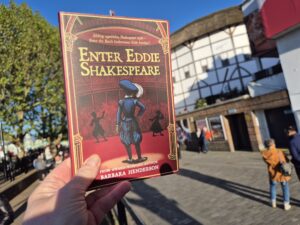
Enter Eddie Shakespeare
By Barbara Henderson
Published by Luath Press
Hello Barbara, it’s great to see you releasing another fantastic book for children, Enter Eddie Shakespeare. Can you tell us about it? And what inspired you to write this story?
It’s an historical adventure story about Shakespeare’s little brother Edmund who followed Will to London’s theatres. It was a throwaway sentence in Bill Bryson’s Shakespeare biography which alerted me to the fact that the Bard had a brother 16 years his junior. Who knew? A quick check of the dates and BINGO, that boy would have been 12 (ideal for a Middle Grade protagonist) when Shakespeare was first referred to as an ‘upstart crow’ by a jealous rival, Robert Grreene. Imagine my joy when I found out that Edmund Shakespeare was listed on his death as ‘a player in the burgh’ – an actor. I imagined him running away as a youngster to follow his big brother to the city.
Your books for children usually explore exciting events in history. What draws you to write about the past?
The past is both foreign and familiar. Children had no safety nets then – deadly danger was never far away. For adventure stories, that proximity to jeopardy is pure gold. I’ve always loved history – the fact that there are so many stories to be discovered beneath our very feet.
Your books are set in so many centuries! Do you have a favourite historical period?
I do love the Middle Ages with its chivalry, heroic endeavours, myths legends, not to mention all that spectacle and colour! But if the story is right, I can get excited about almost any period in history.
You often travel round the country visiting schools. What have you found about children’s relationship to history?
I find that story is the way in! If you tell children that they are going to learn something about history, it creates a distance. In a story, they learn to identify and sympathise with a character from the past. They realise it could be them. As a drama teacher, I often use roleplay, costumes and props during my school visits. It achieves the same thing – the distance between the now and the then just vanishes.
Are you a fan of Shakespeare? Did you always know you’d write about him at some point?
I think deep down I did know. I just needed to wait for the right idea. During my teacher training, I bought a print of a Shakespeare portrait at a charity shop on Edinburgh’s Clerk Street. I framed it and it has kept me company in every classroom I have taught in since 1997. I fell in love with Shakespeare at school – the combination of hugely exciting drama, knockabout humour and vivid, quotable, memorable snippets of wisdom… who wouldn’t love that?
Why do you think Shakespeare continues to remain so relevant to us now?
Being human hasn’t changed. We still have the same concerns: we seek love, meaning, recognition. Our flaws are what they were in the past: jealousy, vain ambition, pomposity, lethargy, foolishness, naivety. We still need laughter to balance the challenges of life. Shakespeare gives us all of that.
Which other historical fiction writers inspire you?
I love the work of Ally Sherrick, Susan Brownrigg, Jane Hardstaff, Lindsay Littleson, Victoria Williamson, Robin Scott-Elliot, Catherine Randall, Dan Smith…
What has been your favourite Scottish book this year so far?
I loved Rosemary Goring’s Exile: The Captive Years of Mary, Queen of Scots – and I am so looking forward to reading Shona Maclean’s The Cromarty Library Circle.
Enter Eddie Shakespeare by Barbara Henderson is published by Luath Press, priced £7.99.
Chantelle Streete finds that Lindz McLeod’s The Miseducation of Caroline Bingley, is every bit as entertaining and sharp a romance as the tale she seeks to celebrate.
The Miseducation of Caroline Bingley
By Lindz McLeod
Published by Carina Adores
What becomes of a Regency woman who has always been told she is too sharp-tongued, too forthright, and too unkind? That’s what Lindz McLeod seeks to investigate in her second Austentatious novel, The Miseducation of Caroline Bingley. Reimagining one of Pride and Prejudice’s most infamous secondary characters, McLeod places Bingley at the heart of a sapphic Regency romance that has just as much pride and prejudice in it as its source material.
The novel takes place almost immediately after Pride and Prejudice ends, with Caroline’s dissatisfaction over Mr Darcy’s decision to marry Miss Elizabeth Bennet over her. Seeking an explanation, Caroline confronts Mr Darcy, and he responds with what is, in effect, an itemised list of Caroline’s shortcomings. Among other reasons, he considers her to be vain, arrogant and suffering from a massive superiority complex. Most damningly, he tells her that if she continues as she is, she will never find a husband, and like many women of the Regency era, Caroline has always assumed that marriage is the ultimate goal and measure of success.
Determined to secure both a husband and a better reputation, Caroline embarks on what she dubs her ‘Great Endeavour’: a mission to become the kind of woman society finds agreeable.
Enter Georgina Darcy, Mr Darcy’s younger sister and the very model of refinement. Yet we come to learn that Georgina, too, exists under the weight of expectation. Outwardly, she is everything Caroline believes she must become (graceful, composed, and admired by every eligible bachelor in town) but this apparent perfection comes at a cost. Georgina has spent much of her life shaping herself around the expectations of others, particularly her brother, and suppressing her own wants in favour of what she should do. As she later confesses, she is ‘so tired… of being perceived as faultless.’ Where Caroline is criticised for saying too much, Georgina has been conditioned to say too little.
We then follow the pair through the trials and small triumphs of the ‘Great Endeavour’. Caroline’s attempts at self-improvement are often hilariously disastrous. She unintentionally terrifies a housekeeper by simply saying ‘good morning’, prompting Georgina to remark, ‘Yes, that would have done it. You’ve never said good morning to any of the staff before.’ McLeod uses these moments to great comic effect, while also showcasing the class tensions and ingrained behaviours that underpin the time.
The novel finds its real strength in the dynamic between Caroline and Georgina. Through their companionship, McLeod explores what it means to be a young woman that doesn’t adhere to society’s standards. Together, Caroline and Georgina question the rigid expectations that have always been placed upon them, and what kind of future they are permitted to imagine. The ‘Great Endeavour’, rather than teaching the girls how to navigate their space properly causes them to question these expectations, to reconcile who they are with who they have been taught to be. This reversing of expectations is reinforced where McLeod introduces new characters who broaden the social landscape beyond the Darcy estate. When Caroline (to her immediate horror) is confronted with those of lower status, and discovers that they too are amiable company, she’s again forced to confront her prejudices and dismantle what she has been raised to believe.
Caroline and Georgina’s relationship begins to shift, marked by lingering glances and a growing sense of ease in each other’s company. Georgina is more experienced than Caroline when it comes to exploring her sexuality, and Caroline doesn’t fully understand at first that she is experiencing attraction. McLeod handles this progression with care, allowing their feelings to emerge naturally from the trust they build, rather than forcing a sudden transformation.
Alongside their growing affection for each other comes an increasing awareness of the risks they face. The fear of discovery and the shame it would bring upon themselves and their families casts an ever-growing shadow over their relationship. Caroline questions why nothing ‘sparks’ when she imagines a conventional match, fearing that ‘something was wrong with her,’ while Georgina continues to carry the exhausting burden of perfection, knowing that she is ‘unable to make mistakes like a normal person, for the consequences of a fall from grace would be twice as hard.’ Yet, the two gain courage to imagine a different kind of life.
McLeod balances this emotional development with sharp and witty prose. Her writing is often laugh-out-loud funny, while still retaining the elegance of its Regency setting. She places the reader in familiar social situations (calls, visits, long walks, picnics) and infuses them with humour that transcends the time between the characters and the readers. McLeod also has a remarkable talent for crafting striking sentences, such as ‘Caroline opened her mouth to retort, found she had nothing loaded on the gun of her tongue, and closed it again with an audible snap of her teeth.’
The Miseducation of Caroline Bingley is a thoughtful, witty, and quietly subversive exploration of identity, expectation, and companionship. McLeod has fun with Regency mores, and her love and care for Austen’s characters is obvious, and a wonderful compliment.
The Miseducation of Caroline Bingley by Lindz McLeod is published by Carina Adores, priced £10.99.
Scottish publishers consistently celebrate all Scotland’s languages by releasing books in Scots and Gaelic. Here you’ll find highlights from the first half of 2026.
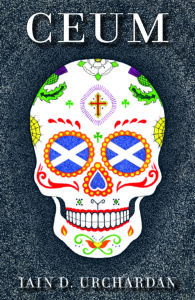 CEUM
CEUM
By Iain D. Urchardan
This second poetry collection by Iain Urquhart explores his thoughts on love, Gaelic, health, politics and world events. Gaelic and the Highlands are in his head, heart, veins, marrow, spirit, and some say, in his soul.
 Dàn nam Ban
By Ceitidh Chaimbeul
The debut collection from award–winning bilingual Gaelic English poet, singer and teacher Ceitidh Chaimbeul explores the stories of women of folklore, local history, family and her own experience as a mother.
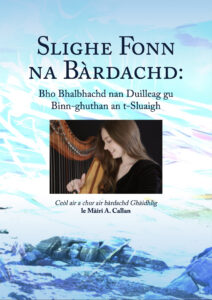 Slighe Fonn na Bàrdachd
By Mairi Callan
Mairi Callan’s project gives tunes to an extensive body of Gaelic verse that was composed to be sung but for which there are no known melodies. This collection sets out to give the bards a new voice and to share their stories.
Ròp is Mol
By Donnchadh MacGillÌosa / Duncan Gillies
Gillies is one of the best short story writers in Gaelic today, with previous collection, Crann-fìge, winning the Highland Book Prize in 2022. In Ròp is Mol Gillies creates a coherent and compelling world, by turns realistic, symbolic and infused with complex and fruitful images and characters, and his language is rich and fluent throughout.
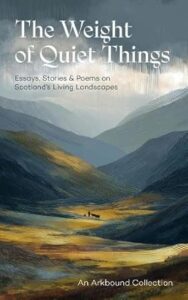 The Weight of Quiet Things
Edited by Arkbound
This collection of essays, stories and poems explores the deep, enduring relationship between the Scottish landscape and its people. These works — written in English, Gaelic or Scots — trace a Scotland shaped by labour, collective memory and inheritance of a land that can never be owned.
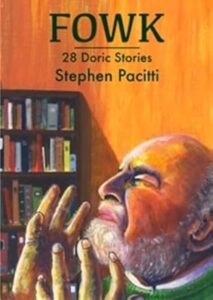 Fowk
Fowk
By Stephen Pacitti
Stephen Pacitti brings together twenty-eight vivid short stories written in Doric to capture the humour, character and emotional depth of everyday life in the North-East.
An Luingeas Dorcha air Fàire
By Tim Armstrong
This is Tim Armstrong’s second fantasy novel following on from his Saltire-winning Air Cuan Dubh Drilseach. After six years of hiding in thick forests that cover the surface of the Earth, Saul’s companion, Rìosa, has gone missing, and Saul suspects their sanctuary has been discovered…
 Dealan-dè
By Seonag Monk
In this gripping novel, we see 18-year-old Flòraidh transform her identity like a butterfly and join the war effort with her enigmatic friend Lavinia. Read as she climbs the ranks while trying to protect her true identity.
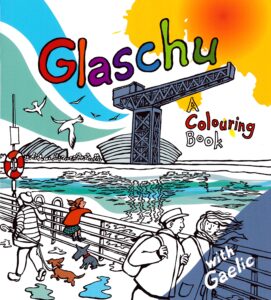 Glaschu: A Colouring Book in Gaelic
Glasgow: A Colouring Book in Scots
Colour along as you join Eilidh and her dog, Angus, as they take a trip around Glasgow. Choose both Scots and Gaelic editions.
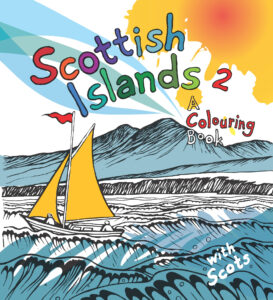 Eileanan Albannach 1: A Colouring Book in Gaelic
The Scottish Islands 1: A Colouring Book in Scots
Eileanan Albannach 2: A Colouring Book in Gaelic
The Scottish Islands 2: A Colouring Book in Scots
Fun and accessible colouring books that introduces Scotland’s islands through illustrations and writing. These are available in both Scots and Gaelic editions.
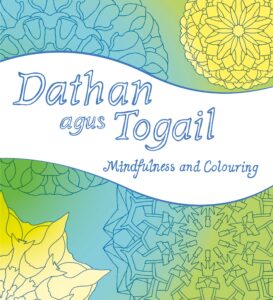 Dathan agus Togail
By Murchadh MacLeòid & Johnathan MacLeòid
Take a break from social media to discover your inner artist with this relaxing and engaging colouring book.
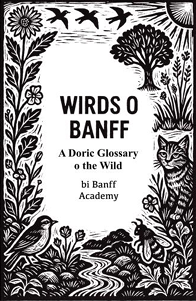 Wirds O’ Banff
By the students at Banff Academy
This richly illustrated glossary of doric words for birds, beasts, insects, and plants is a testament to the vitality of Doric as a living language, and shares the reflections, research, and creative responses of S3 pupils at Banff Academy, reconnecting language with landscape in fresh and meaningful ways.
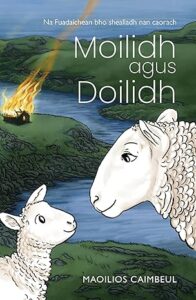 Moilidh agus Doilidh
By Maoilios Caimbeul
Join Moilidh, an orphan lamb, and Doilidh, a wise sheep and keeper of ancient tales, as they journey through a landscape interwoven with the heavy history of the Highland Clearances. As the sheep travel through Sutherland, the Isle of Skye and the Hebrides, Doilidh tells the stories passed on to her by her ancestors.
 Kali – Coocoora
By Aoife Kearney
Follow teenage honey badger Kali and she tries to find courage and become a real hero to protect her friends from a strange new kid at school.
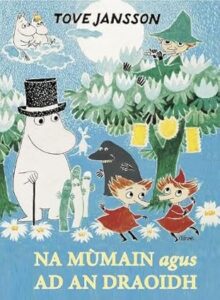 Na Mùmain agus Ad An Draoidh
By Tove Jansson, translated by Mòrag Anna NicNèill
Jansson’s first-ever Moomin story, introduces Gaelic readers to the beloved characters who have become icons of children’s literature, offering a glimpse of Moominvalley and the iconic Moominhouse. Our magic begins with the discovery by Moomin, Snufkin, and Sniff, of the Hobgoblin’s hat . . .
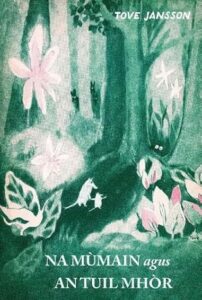 Na Mùmain agus an Tuil Mhòr
By Tove Jansson, translated by Mòrag Anna NicNèill
Discover Jansson’s uninhibited imagination full of love, kindness, and adventure in the face of environmental catastrophe. We follow the Moomin family as they search through forest and flood for long-lost Moominpappa, and a place to call home.
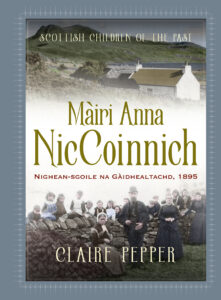 Màiri Anna NicCoinnich: Nighean Sgoile na Gàidheltachd, 1895
By Claire Pepper
Told through the eyes of nine-year-old Mary Ann Mackenzie, experience a vivid recount of a Scottish Victorian child living on Scoraig, where children went to school to be taught in a language they had never heard before.
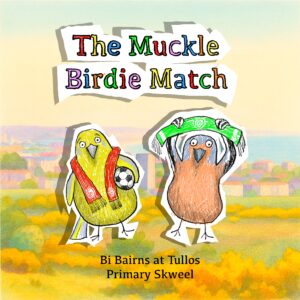 The Muckle Birdie Match
By Aaron Gale & Jackie Ross with the pupils at Tullos Primary
Students at Tullos Primary School came together to tell a tale of an unforgettable football showdown between Team Endangered and Team Common. With a designed field guide and habitat map, this book is sure to entertain every young Doric reader.
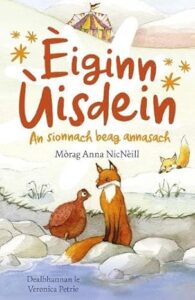 Èiginn Ùisdein
By Mòrag Anna NicNèill
Ùisdean the little fox that does not want to eat meet goes on a strange adventure after running away from home, where he meets unusual characters and learns that it’s okay to be different.
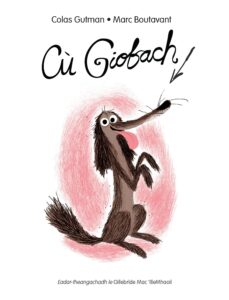 Cù Giobach
By Colas Gutman & Marc Boutavant, translated by Gillebrìde Mac ‘IlleMhaoil
Cù Giobach is a bestselling children’s book in France, now translated into Gaelic, about two furry friends living on the streets desperate to be cared for. Follow the ups and downs of their journey to find a loving owner.
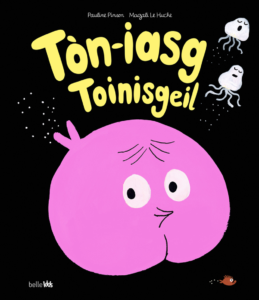 Tòn-iasg
Pauline Pinson, translated by Gillebrìde Mac ‘IlleMhaoil
In this charming book little ones will love, follow Tòn-iasg (or Butt Fish as he is known in English) as he finds friendship and realises that while everyone says he may look like a butt, he also looks like a heart.
David Robinson appreciates Donald S. Murray’s sense of history in his latest novel, The Loch of the Bees.
The Loch of the Bees
By Donald S. Murray
Published by Saraband
Just as copper is a good conductor of electricity and cotton a poor one, so some writers have a better sense of the past than others. By this, I don’t just mean that they might be able to reimagine what, say, a particular event a century or two ago might have felt like. That is indeed an impressive skill and, for writers of historical fiction, an essential one.
But the true masters of the art of writing about the past can imagine something else. As well as describing a historical event, they also have a sense of how the current of history also flows through their own fictional characters. This is a lot harder. If you or I had all the time in the world to research a particular historical event, perhaps we might be able to imagine precisely how it happened. But would we also be able to see how well or badly the past plays out in the minds of our characters? If, to extend my opening metaphor, it were somehow possible to show this – I’m thinking back to S1 physics lessons in how to measure the flow of an electric current – would they be copper or cotton?
This is, I think, the particular skill of Donald S. Murray. The past’s current flows through the characters in his fiction so strongly that it almost becomes the story itself. That was the case with his award-winning 2018 debut novel As the Women Lay Dreaming, in which he concentrated on showing how the trauma of the sinking of the Iolaire off Stornoway in 1919 unrolled across subsequent generations rather than just describing the disaster itself. Similarly, although ostensibly about the experience of twentieth-century Hebridean emigrants in North America, his 2024 novel The Salt and the Flame is at least as much about the emotional pull of the island – Lewis – they left behind. ‘The past,’ as Faulkner famously said, ‘isn’t dead and buried. In fact, it isn’t even past.’
This sense of history as something which continues to shape the present is never more clearly displayed than in Murray’s latest novel, The Loch of the Bees. Its ambition is epic: nothing less than reimagining the lives of people living on a fictional Hebridean island from the eighth century to the present through a series of interlinked stories. Few novels have such a sweep: even Adam Thorpe’s Ulverton, which reconstructs the unrecorded history of an English village, only managed the 300-plus years from Cromwell to Thatcher. The novel it most reminds me of is James Robertson’s News of the Dead, which chronologically mirrors Murray’s novel with scenes ranging from early Scottish Christianity to the Covid pandemic. Although it deals with similar themes, structurally it is completely different.
Murray’s opening chapters have a dreamlike quality. There has been a battle, and a wounded warrior on the defeated side throws away his shattered sword into the nearby Loch nan Seillean (the loch of the bees), named after the insects buzzing around the corpses around him. (We will see the sword’s broken hilt recovered over a thousand years later when almost everything else has been forgotten). The bees, people then thought, carried souls into the afterlife, or maybe they just told the survivors’ families of their relatives’ deaths: religion still leaves such things unclear, unformalised by dogma.
But because there has been a battle, a holy man wants to clear away the pain from the land, so he builds a beehive shieling on a crannog (man-made island) on the loch as both a ladder to heaven and escape from the world. The bees do not sting him, and he talks to the birds and animals, but when word spreads of his holiness and the local priests try to make the shieling a place of pilgrimage, he leaves it behind. Some people say he has been taken away by a friendly whale, others that he has been given wings and has flown away to another island where he is being fed honey by the bees.
In successive short chapters, usually edged with poems or snippets of fictional history, such legends gradually disappear from the island, though they live on longest among the moor-people who, as an incoming minister discovers to his horror, even in the nineteenth century ‘still worship the old gods of moon and water with far more fervour than they mouth their catechisms’. Though stories surrounding the shieling are still being told, the islanders are learning to do so in a different language, whether because they have been press-ganged into the Napoleon-fighting Royal Navy, forced to emigrate in the Clearances, or taught English at the new school in the nearby township in the 1880s.
Even the school’s English teacher, however, realises that his lessons somehow diminish the island. Telling the story of the siege of Troy, he yanks hard at the ear of a pupil who explains why he doesn’t want to learn this new language: ‘Like my grandfather, I fear if we all learn to speak it, we will lose our real tongue, our hearts and minds.’ Maybe the boy was right, he thinks to himself. Maybe, like the Trojans, they would all live to see their ‘familiar existence collapsing because a peculiar gift had been left behind’.
Murray steers clear, however, of painting his fictional island as a paradise. Those who emigrated from it, one Canadian minister admits in the 1920s, brought with them ‘more than a little self-righteousness as well as a narrow vision and a sense of guilt’. That trait is more than present a century later in the hellish neighbour to a couple who have moved to the island from Cumbria. And the book ends not only with the rediscovery of a potent link to the past but with a very real threat of ecological disaster.
All the same, there is enough in the novel to make you realise that the teacher was right about what was lost when Gaelic started to wither: after all, we have seen from the outset how, in the loch of the bees, the linguistic link to the land is part of not just communal but even spiritual history. But Murray also makes a subtler point about history too: that the way it filters down through the generations isn’t a pellucid and continually flowing stream; instead it also involves gaps, accidental distortions, and deliberate myths. Dealing with the kind of history that has never been written down, this is inevitable. We might know that the ruined shieling by the shore is something to do with a holy man long ago, but we’re not quite sure what. There might be a folksong about a sailor who returned from the Napoleonic wars and spent the night there before disappearing again but we’re not quite sure why.
These are the realities of how history flows through all of us, and Murray’s novel captures it perfectly. The late Allan Massie – no mean writer of historical fiction himself – hailed Murray as ‘one of the best and most enjoyable novelists writing in Scotland today’. If he had lived to read The Loch of the Bees, it would have only confirmed his judgment.
The Loch of the Bees by Donald S. Murray is published by Saraband, priced £10.99.
David Robinson speaks to Gavin Francis about his latest book, The Unfragile Mind, and his experiences as a GP that have informed his writing.
The Unfragile Mind
By Gavin Francis
Published by The Wellcome Collection
Go into the clinics of most American psychiatrists, and somewhere on their shelves you’ll usually find a chunky copy of DSM-5. In its revised edition, the 1,120 pages of the fifth edition of the American Psychiatric Association’s Diagnostically and Statistical Manual is supposed to define the latest frontiers of our knowledge about mental illness and how to treat it. In Europe, its equivalent is the sixth chapter of the online database, ICD-11.
At a time when between a quarter and a fifth of young people now suffer from a mental disorder and one in four adults are prescribed psychiatric medication, you might expect both of these manuals to be the very cornerstones of our collective fight against mental illness. Yet to Gavin Francis, the award-winning writer and Edinburgh GP, their rigid categorisation of mental illness isn’t particularly helpful. One day, he writes, it will seem ‘as overconfident as the old phrenology charts which claimed that human faculties could be gauged by the shape of the skull’.
His latest book – The Unfragile Mind: Making Sense of Mental Health – is, he tells me, ‘a call to reconsider some of the ways we think about mental ill health and do so with a bit more curiosity and humility. At the moment, a lot of people claim that we know that these conditions are facts of nature, whereas what we increasingly find, when we look into many of them, is that they’re aspects of culture, and vary hugely between cultures.’
Many people might not realise just how much of GPs’ time touches on patients’ mental health – Francis reckons between a third and a half of his appointments. In them, however, he seldom uses the diagnostic manuals. For one thing, he notices that they increasingly suggest that one syndrome might have a high risk of another when a) this might actually not be the case and b) would thus contravene the ‘Do No Harm’ principle of medical ethics. ‘Instead,’ he says, ‘I am much more likely to talk about my patients’ feelings and their suffering than their diagnoses.’
This doesn’t mean that he dismisses the mental health diagnostic manuals altogether: they might, he admits, have some value for research and in specialised hospitals, but less so ‘in the unfiltered, mild to moderate end of the spectrum of human unhappiness’ of the GP’s clinic. ‘Lots of psychiatrists,’ he adds, ‘share my concern that by widening the conversation about mental wellbeing so broadly, many people are starting to think of themselves with pathological categories of illness rather than difficulties in thinking or difficulties in the way they feel. This is making mental health services so stretched that when you have a severe, even life-threatening, mental health condition, it is harder to get seen.
‘There’s a wonderful memoir by a psychiatrist here in Lothian called Rebecca Lawrence. Her book is called An Improbable Psychiatrist. She has a severe mental health condition that waxes and wanes but it hasn’t stopped her in her career. She writes about this issue too: that sometimes there’s so much talk about mental health that patients really struggling with it become difficult to hear. It’s a real issue for me as a GP, trying to get patients seen in the system who are, for example, troubled with severe schizophrenia or schizoaffective disorder or bipolar disorder and for whom I can’t get proper support.’
Because of the numbers involved, much attention will inevitably be focussed on what Francis has to say about ADHD and autism, which he writes about in the last of his book’s 12 chapters. In it, he notes that referrals for adult ADHD psychiatric assessment in Edinburgh have recently gone from 3 to 25 per cent within five years due to metanosis, ‘a phenomenon in which one becomes aware later on in life that one’s characteristics might be accorded a clinical diagnosis’. In the US, 7 million children have now been diagnosed with ADHD, up from 2 million in the 1990s. These are huge numbers, as are those (some 3 per cent of the UK’s population) now affected by autism – so huge, in fact, that Francis writes that autism ‘has moved from being something best understood as a disorder into the territory of a common manifestation of the way in which humans think, feel and exist’.
‘Obviously,’ he explains, ‘there are extreme ends of the spectrum whereby you would see that this becomes a disorder. But in nature, there’s no cut-off line. Wouldn’t it be nice if our culture could be a bit more accepting of difference?’
Because we still know so little about the electrical, chemical and neurological processes by which our brains handle experience and emotions, Francis argues, we shouldn’t be so quick on the draw with our mental health diagnoses. ‘I’m simply asking that we approach that with a bit more humility, rather than pretending we understand it. Because, let’s face it, in 30 years’ time, the theory will be completely different.’ Surprisingly (to me anyway), he adopts a similarly sceptical attitude to claims that any one particular therapy is inherently more effective than any other. ‘It doesn’t seem to matter,’ he writes, ‘whether someone engages in family systems theory or Gestalt, psychoanalysis or CBT, or whether they access counselling through a specialist counsellor or a psychiatrist, a mental health nurse or a GP.’ Whatever the system, he adds, ‘it’s the connection with the therapist that matters, and how much that person demonstrates genuine engagement with your problems that is going to help you get better.’
The key word here is, I think, humility: with Francis, it is a necessary part of the job of being a GP, with its ‘uncommon privilege of seeing through the facades we hide behind’. It is also something he noticed in his best mentors, learnt himself on his extensive travels, or found in the work of others, like intercultural psychiatrist Dinesh Bhugra, who has pointed out that in many countries what we would recognise as symptoms of depression would not be medicalised at all.
I ask how, given each consultation at his clinic is only meant to last 15 minutes, he manages to reach the emotional depths required, and there’s a certain humility there too (‘It’s something I’m working on and will work on my whole life’). ‘Some people are very straight to the point and want to open up straight away,’ he says. ‘With others, it takes many appointments to gain their trust. Some people are really open to new approaches, others come in with a very fixed idea of what they think they need, what they want to get out of our consultation. I don’t have the luxury of choosing: I see everybody.
‘So some people might come in with a very particular idea of depression as a lack of serotonin in the brain, and they’re really keen on getting antidepressants from me. (In his book, he describes the once-popular theory that depression is caused by a deficiency of serotonin as a modern equivalent of the medieval theory of the body’s humours). I’ll chat to them, explore their ideas, concerns and expectations, and I’ll end up prescribing them some and they’ll benefit from it.
‘Someone else might say that they’ve just realised that their relentless, chronic low mood probably dates back to a period in their teens when they were kicked out of the house by their mother, and that was 50 years ago, but they’ve realised that they’ve lost the ability to trust people and that is the source of the problem. And with someone like that, I probably wouldn’t be suggesting straight away that we reach for a prescription, although it’s possible, but I would be starting to explore that and talk about what that means for them and whether they can use that insight to rebuild a sense of trust in people around them and look again at what they love, what makes them happy in life, what makes them feel as if they’re flourishing.
‘With someone who comes to me with, for example, worries that they have a bipolar illness because their moods are all over the place, I’ll ask them what they mean by that, and about what the pressures in their life in terms of secure place to live, secure happy relationships, whether they’re economically stable or precarious, whether they’ve got satisfying work or boring work that they hate – all these kinds of things are going to have an influence on whether they feel settled and at ease in their mind.’
In none of those cases, though, will Francis reach for a diagnostic manual. He’s not my GP so I can’t say this for sure, but based on this book – wise, informed, well-written, wide-ranging – he strikes me as being the very model of what one should be. ‘He is the best physician, who is the most ingenious inspirer of Hope,’ Coleridge once wrote, and ingeniously inspiring hope about a bleak subject is exactly what this book does.
The Unfragile Mind, by Gavin Francis, is published by The Wellcome Collection, price £18.99
Shona MacLean leaves behind her historical thrillers in her new stand alone novel, The Cromarty Library Circle, which tells us of a year in the life of a community in the Highlands in 1871. It will be a year when the political upheavals around the world affects the close knit twon and the lives they’ve always known. In this extract, we meet the committee that decides on the town’s library books, giving us a glimpse into the dynamics and personalities of Cromarty.
The Cromarty Library Circle
By Shona MacLean
Published by Quercus
‘I believe you are in receipt of the ladies’ selection, Mr Gilfeather?’
Mr Gilfeather nodded. He was in receipt of the ladies’ selection, all right. Miss Elspeth Rose had handed it to him in the street, as if presenting him with an overdue butcher’s bill. He proceeded to read aloud the list.
‘Lady Charlotte: De Bourrienne’s Memoirs of Napoleon.’ Willie Hossack snorted and Mr Gilfeather, while privately deploring anything associated with the Corsican, shot the man a look charged with forty years of contempt. Sir William asked whether he was quite certain that had been his wife’s choice. ‘I wonder whether she did not mean rather to ask for a biography of the Empress Josephine?’
‘No, no,’ he said. ‘Both title and author are written out quite exactly, and the translation recently brought out by Constable specified.’
Sir William said something to the effect that he would never quite understand his wife, and the listing of the ladies’ choices continued. Mrs Mackay had requested Sir Walter Scott’s Anne of Geierstein. It was the general apprehension of the community that the minister might not have his young wife entirely under his control. Rachel Mackay had been too clever for a lady’s maid and governess, and she might be too clever for a minister’s wife as well, but Sir Walter Scott could hardly be objected to.
Next came the choice of Miss Elspeth Rose. There would be no grounds for concern here: if something were to be disapproved of it would be Miss Elspeth who would do the disapproving. Her choice must be therefore, de facto, acceptable to all. ‘Miss Elspeth requests Mrs Hemans’ Records of Woman: with Other Poems.’
‘Heaven preserve us,’ murmured Farquhar Hossack from behind a copy of the Inverness Journal, ‘poetry! Don’t tell me the old bluestocking has discovered she has a heart. I had half-expected she would ask for Frankenstein.’
Willie Hossack coughed as if he had a beetle in his throat and Mr Fordyce hastened to fill the moment of awkwardness. ‘Miss Rose has made a fine choice, and I daresay that she has already read Mrs Shelley’s novel in any case.’
Dr Fraser turned to Farquhar Hossack. ‘No doubt Frankenstein is required reading amongst the anatomy students at Aberdeen, Fachie, if only as a warning against meddling with things that are better left alone.’
Farquhar lowered his newspaper. ‘You would have us remain in ignorance, sir?’
‘I would have our kirkyards left unmolested, sir,’ responded the minister.
No one in the room could have been unaware of what it was that Dr Fraser alluded to. The horrors perpetrated only three years since by William Burke and William Hare in the closes of Edinburgh were still fresh in the minds of everyone. How could they not be? Every week the papers continued to tell of suspected abductions and murders up and down the country, all to meet the insatiable demand for corpses of the anatomy professors that even grave-robbing could not satisfy.
The imputation was all too clear to Farquhar, who cast aside his newspaper and stood up. ‘Your kirkyards? It’ll be your pews that are unmolested, if you persist in your slavish devotion to superstition in the place of science.’ Having shocked the room, Fachie left, giving no farewells, even to his stupefied father.
Willie Hossack attempted to bluster something, but Mr Gilfeather ignored him and, as if there had been no unfortunate interruption, passed from the choice of Miss Elspeth Rose to that of her sister Anna, who had requested a copy of Miss Ferrier’s Marriage. The gentle amusement at this settled the company and threatened to start conversations, but Mr Gilfeather hurried on: Donal Deacon’s lobster boat would not wait in the harbour for ever. ‘Finally, we have the choice of Mrs Cameron, who has requested The Youth and Manhood of Cyril Thornton.’
On hearing his mother’s selection, Ludovic Cameron groaned.
‘Bear up, Ludo,’ murmured the schoolmaster, from behind the sofa occupied by his friend.
‘Bear up? Cyril Thornton is a cautionary tale of a young man who, a disappointment to his parents, neglects the studies for which he was sent away and learns some bitter lessons by a career in the army. He returns home, a little too late to be of any great use to those he left behind, but in time to marry the dependable girl he should have married in the first place.’
‘Perhaps,’ persisted the schoolmaster. ‘But Hamilton writes an excellent comic character. He’ll soon have your good lady mother in fine form.’ The sequence of looks provoked around the room by this remark suggested that the idea of the austere Janet Cameron being elevated to the condition of ‘fine form’ was not one that persuaded anybody.
Sir William hastily suggested moving on to the gentlemen’s choices.
‘For myself, I should say Croker’s Boswell’s Life of Johnson,’ he began, ‘if only to see whether there is anything in the controversy stirred up amongst the reviewers.’
‘Ach, they are all so tight in with the booksellers,’ said Dr Fraser. ‘They do nothing but puff their favourites and manufacture controversies. It’s all contrived in order to sell more books.’
This point conceded, the selections continued. Isaac Fordyce, predictably enough, requested the first two volumes of Moore’s Life of Byron; Dr Fraser, to general surprise, asked for Heber’s Poetical Works. Mr Gilfeather turned now to Ludovic Cameron. His assistant clerk at the bank could be relied upon to be sensible. Ludovic requested Basil Hall.
‘The Travels in North America?’ queried Willie Hossack, alert that mention was finally made of something he had heard of. How on earth had the fellow got himself in here? Mr Gilfeather wondered. And then Hossack himself was piping up that he would like The Aberdeen Magazine ordered on his behalf. On his behalf! It would be his wife who was after it, thinking no doubt that she might one day read of Fachie’s exploits amongst its pages. As if there weren’t enough periodicals brought into the reading room as it was. Mr Gilfeather did not waste time on quibbling, however, and with a sniff at Willie Hossack’s choice, wrote it down.
The Cromarty Library Circle by Shona MacLean is published by Quercus, priced £22.00.
David Robinson shows his appreciation for original and compelling characterisation in crime fiction.
The Cut Up
By Louise Welsh
Published by Canongate
To The Shades Descend and The Shadows and the Dust
By Allan Gaw
Published by Polygon
Sometimes, if they’re in a particularly diffident mood, you’ll hear crime writers say that theirs are the easiest novels of all to write. At the very least, they’ll say that about the opening chapters. Most, after all, start off with a body being found, then a detective has to be summoned, then the pathologist has to explain how death happened, then there’ll be a few suspects and hey, before you know it, you’re halfway through your first draft.
Yet if you actually study crime fiction, you’ll get a rather different story. If, for example, you are lucky enough to be taught by Louise Welsh on the MLitt course in creative writing at Glasgow University, she’ll teach you that crime fiction is never just about the crime. Other things – character, place, originality – matter at least as much, if not more. And as she shows in her latest novel, she practises what she preaches.
True enough, The Cut Up begins with the discovery of a dead body. But after that, just count the original ways in which Welsh subverts the genre. This all starts with the man who discovers the body. Tell me, for example, how many gay Glaswegian auctioneers you have already come across as lead characters in crime fiction. No? Me neither. Welsh’s Rilke is such a one-off that he can even get by without needing a first name.
Then there’s the mode of death. In The Cut Up, this is by means of a hatpin through the eyeball. Trawling through every novel known to Chat GPT, this seems to be quite original, although it does have a category for ‘Eye-Stabbing Deaths (Non-Hatpin)’. Welsh sharpens her plot even further by making the murder weapon the very hatpin which Rilke’s boss (and friend) has just been waving in front of the cameras of a daytime TV show, adding helpfully that medieval knights used to use stilettos like that to stab enemies through the eye once they’d been knocked off their horses.
The biggest act of subversive originality is, though, still to come. Not only does Rilke deliberately wreck the crime scene by retrieving the hatpin but he then puts it in the next auction. Someone buys it and … well, we’re off. The reader is hooked. Even if you hadn’t already encountered the wildly charismatic Rilke in Welsh’s debut novel The Cutting Room (2002) or The Second Cut (2022), you would surely be drawn in by such a bravura beginning.
But although Rilke subverts all the usual methods of serving justice, he serves justice all the same. The police – corrupt and so incompetent they don’t spot the murder weapon even when it is under their noses – can’t be relied upon. And though the story I’ve outlined so far only takes us to Page 39 and contains no spoilers, Rilke is so convincingly Sherlockian in thought and deed, and so arrestingly stylish (brogues and demob suits) that we somehow know that he’ll end up finding the murderer.
Already, then, Welsh has moved the story a long way from the plodding procedural opening I outlined at the start. It’s on a different track altogether. The crime itself is, shall we say, interesting, but Welsh wants more than that. She always has. I remember a scene in The Second Cut in which Rilke is driving his close friend Les, a transvestite ‘who looked like Nureyev might have, if he had survived HIV and given in to the occasional fish supper’ in the passenger seat and three queer acquaintances in the back, two of whom had just been to a pro-trans demo in George Square. The scene itself was well-written, but two things about it made it stick in my mind. First of all, I realised I had probably never read about a car full of five queer Glaswegians. Secondly, I wondered why I never had.
So when Welsh tells her MLitt students that crime fiction isn’t just about the crime, this is the sort of thing she has in mind. Without either frightening the horses or writing a gender politics tract, The Second Cut showed how Glasgow’s gay life had changed in the two decades since she began writing The Cutting Room in 2000. Back then, the campaign to repeal Clause 28 (forbidding local authorities from ‘intentionally promoting homosexuality’) was in full swing; in 2022, she began its sequel with a gay wedding and continued with Rilke taking full advantage of Grindr.
In The Cut Up, there’s a hint that Rilke still is on Grindr and there’s a fling with a trans man. Yet far more important (at least to the plot) than Rilke’s sexuality is his character. His loyalty to his friend Rose is the reason he retrieved the hatpin in the first place. For the sake of that friendship – even though she is going out with a police inspector – he risks everything. He may be unconventional, but in all other respects he fulfils Raymond’s Chandler’s requirements for an ideal protagonist to the letter as someone who is solitary, uncorrupted, and courageous, ‘who walks down mean streets but is not himself mean’.
Another queer crime-busting protagonist comes to Glasgow in Allan Gaw’s To The Shades Descend, which is just published by Polygon. Gaw, 63, winner of Bloody Scotland’s Crime Debut of the Year award in 2024, came to crime writing after a distinguished career as a pathologist. As the fourth in his Dr Jack Cuthbert series (The Shadows and the Dust) is out this month and the fifth due out later this year, his second career is clearly off to a flyer.
Now you may well think, particularly if you’ve read a lot of Patricia Cornwell, that a former pathologist like Gaw, who has run big research clinics and has amassed an intimidating amount of experience in his field, would want to go down the corpse-DNA-result crime-busting plot path. But no. When I talked to him recently, he gave me a number of reasons why he deliberately set his Jack Cuthbert novels in the 1920s and 1930s.
‘We are now in a position,’ he said, ‘where we can analyse and quantify any chemical in the world. Anything you’ve been poisoned with, for example, I can find – I don’t even have to think about it. In some ways, it’s a little bit too easy. I wanted to show pathology in a world where you had to work much harder to get this information, to make it much more observational, because all through history, medicine has always been about observation. We talk about physicians attending their patients – they sit beside them and watch them, and that’s the way doctors used to work, because it was all they had.’ With the discovery of DNA, much of that attentiveness – ‘which is fundamentally about trying to form a connection with another human being’ – has been lost.
Gaw then said two things I’ve never heard from any crime writer, least of all one with a new book to plug: first, that he himself hardly reads any crime fiction, and secondly, that ‘there are probably quite a lot of people who do who won’t like my books. They’ll think there’s just too much dithering about for them.’
By ‘dithering about’ Gaw means back story. But creating a complete character – from flashbacks to Jack Cuthbert’s schooldays and his early crushes on his fellow pupils, to facing the horrors of the Somme – was what drew him to writing in the first place. That, and showing the past as realistically as he could – not just of Glasgow in the 1930s, but also the embryonic form the science he has studied all his life was back then – alongside the attentiveness Gaw mentions to help solve crimes.
‘I wanted to write book about a character: an interesting, complicated, layered character, where you weren’t going to know everything about them at first, but rather like peeling back the layers of an onion, you’d learn more and more about them and become more invested in them.’
Having read my way into his series so far, I think he’s onto something, and not least because this clearly holds true for Welsh’s Rilke too. However, even though I have rhapsodised about the brilliance of The Cut Up’s opening, it is really the strength of Welsh’s characterisation that keeps my attention to the end. And although F Scott FitzGerald’s aphorism ‘character is plot, plot is character’ is drilled into anyone learning about crime fiction, if I was forced to pick between the two, I’d pick character every time. Wouldn’t you?
The Cut Up by Louise Welsh is published by Canongate, priced £16.99.
To The Shades Descend and The Shadows and the Dust by Allan Gaw are both published by Polygon, priced £9.99.
A Death in Glasgow is an addictive new addition to the Glasgow crime fiction canon. This extract sets the scene for our detective, the tormented Sergeant May Mackay.
A Death in Glasgow
By Eva MacRae
Published by Century
Holly knows she’s being followed. The baseball cap pulled down, hood up, face shadowed, but she knows. She keeps craning back over her shoulder, pretending to be on the phone. Maybe that’ll make them back off. But there’s no one she can call. Nobody will believe her; else they’ll say it’s her own fault.
Along Union Street, the pubs are emptying into the cold neon night. Shapes come barrelling into her, forcing her off the icy pavement into the path of buses and Deliveroo bikes.
Haw, hen, watch where you’re going.
The temperature’s plummeted. With her big coat on and her legs pumping like pistons, her hair’s sticking to the back of her neck while the beads of sweat freeze on her face. That last vodka, or three, is climbing up her throat. She can’t stop to chuck up. She’ll be caught and then what? I only want to talk.
I only want to give you a wee cuddle. I only want to . . . When she gets to Central station, there’ll be plenty folk around. A public place. Safe.
Suddenly, the station entrance looms on her right like an escape hatch and Holly bolts towards it, elbowing through the drinkers, tripping on some homeless guy huddled on the floor. The steps up are mountainous but she’s taking them two at a time in her platform boots. At the top, she risks a wee keek back. Nobody. Her guts unclench a fraction. Was she wrong? Was it just someone who’d been behind her for ages, going the same way? Dark clothes and a hoodie. Could’ve been anyone. What happened in the pub was a shock, made her think she was being followed again. She just panicked. Deep breaths, her therapist said. She tries now, but the cold and the vodka are getting in the way.
On the concourse, Holly is hoping for calm and bright, but the station shops are all shut. No families or commuters, only gangs of drunk lads. The high glazed roof that floods the station with light in the daytime now feels like it’s coming down to trap her like she’s a bug under a glass.
There’s a big bunch of lassies out on a hen night, and maybe she can stand with them for a bit till her heart isn’t thumping and the floor stops tilting. She staggers forward, her arm brushing a handbag. One of them turns and snarls at her – she’s after robbing me, get the fuck away you – and Holly body-swerves the group in case the mad cow and her pals decide to jump her.
The heels on her boots looked great when she was getting ready to go out to the pub, but now they’re a liability. The floor’s shiny white, slippy- wet. Like a cloud. Holly can’t see where to land her feet. She slides, arms cartwheeling like a one-woman flash mob starting a performance. The lads all start laughing – fancy a wee dance, darling – and shout how they could give her the horizontal boogie of her life.
Holly spins back, looking for the way she came in, getting her bearings.
This time, she’s sure. Their eyes lock. The choking sensation is back, she can hardly breathe.
Instead of coming straight for her, they’re moving round the edge of the concourse, cutting off her escape to the taxi rank at the other exit. She searches desperately for any station staff in their hi-vis – not the police, the bastards’d have her in the cells. But what’ll happen when they finally catch up with her? They’ll tell the staff she’s drunk (not a lie) and that they’re looking after her (aye, right) and they’ll get her home safe. The polis will always believe them over her.
Then it hits her through the fog in her head. None of her mates from college live on the southside. She was never planning on sharing a cab. The illuminated sign for platform 9 swings across her vision like a beacon. It’s on the other side of the concourse, further than she remembers. Always platform 9 to get home. Holly fumbles in her bag for her ticket, pulling it out in triumph. Can’t follow her through the barriers.
Holly sets off with her Bambi-on-ice totter and sees the gate coming towards her, and oh my God, it’s even open. Go. Quick. Get away. Too late she realises her mistake. If she didn’t need to swipe through the barrier, then neither will anyone else. She stuffs the ticket like a betrayal into her coat pocket and runs.
The surface is gritty and there’s a better grip, but the flares of her trousers are flapping against her legs like broken wings. Her bag slips off her shoulder, a weight pulling her backwards.
On one side of the platform is a forest of big green pillars studded with rivets like the stumps of broken-off branches. If she can’t run, she can hide. In the distance, out across the river, she can see the train snaking towards the station.
The end of the platform is in darkness. Holly dodges behind a pillar, telltale breath pumping out of her like a steam engine. She puts a gloved hand over her mouth, tastes the wool, breath hot in her palm.
The train is coming; big blocks of light speeding towards her.
She peeks out. There’s no sign of anyone. She’s done it.
The train will take her home. Relief floods through her and an intense bubble of laughter expands the tightness in her lungs as she steps out from her hiding place.
Suddenly, she feels someone behind her, like a panting beast.
Holly sprints for the train, hand out like it’s a bus and it’ll stop. If she can just make it stop, she can get on.
Holly! Holly! She turns before she can prevent herself and sees a face, twisted and angry. Over the screeching of the train, she hears her own screaming. A bright palm is coming through the dark to grab her. She’s caught and there’s nowhere left to run. Any second, the fingers will curl like claws, and it’ll be all over. She was daft to think she could escape. The train is close, but it’s too late. She’s shaking her head. Knowing what she says, what she is, doesn’t matter.
The hand keeps coming. But when it reaches the front of her coat, it’s not a grab. It’s a push.
A Death in Glasgow by Eva MacRae is published by Century, priced £16.99.
There’s a lot of buzz for Frances Crawford’s debut, A Bad, Bad Place, and its teenage protagonist Janey Devine. We got in touch with Frances Crawford to ask her to tell us about her favourite teenage characters in fiction.
A Bad, Bad Place
By Frances Crawford
Published by Bantam
Teenage protagonists have a special place in fiction, offering a view from the no-man’s land between childhood innocence and adult selfhood. The five characters I’ve chosen are by Scottish writers, perhaps hinting at a deeper search for national identity (to which the teenagers in the room shrug and sigh!)
Frank The Wasp Factory by Ian Banks (1984)
It is a testament to Banks’ stunning writing that we feel sympathy for a sixteen-year-old engaged in bizarre rituals, animal torture and murder. Frank is both disturbing and hilarious, and the twist at the end of his astonishing tale is mind-blowing. In a stroke of marketing genius, early book covers included negative reviews from stunned literary critics – exactly the kind of shock horror reaction teenagers revel in! For all Frank’s shocking behaviour, the novel raises questions about identity and gender which resonate even louder today. And you will never ever forget what happened to Eric.
Chris Sunset Song by Lewis Grassic Gibbon (1932)
Fifteen-year-old Chris grows to womanhood in this sweeping tale of post-First World War rural Scotland. The agonising choices facing teenagers are beautifully embodied in Chris’ struggle between emotion and intellect. Despite poverty and heartache, her distinctive goodness and connection to the Scottish landscape shine through. Underlining the encroaching changes to Scotland and the inevitable loss of war, the narrative never strays from Chris’ inner self. A beautiful portrayal of teenage life.
Janet O Caledonia by Elspeth Barker (1991)
When sixteen-year-old Janet is found dead wearing an evening dress her family are secretly relieved (first page revelation so not a spoiler!). An eccentric intellectual whose heart breaks for an injured bird but who cheerfully buries her baby sister, Janet is every teenager who yearns for individuality. Barker’s writing can shift from deeply comic to deeply moving within a paragraph, with imagery as surreal and strange as her protagonist. In a society which prizes conformity, we should all be more Janet!
Cora Only Here, Only Now by Tom Newlands (2024)
A compelling coming-of-age story set in a 1990s ‘manky wee hellhole’ of a town. Cora is neurodivergent, a term unknown in her world, and she fizzes with life, spirit and drive. Cora faces up to the deprivations around her with humour and courage, and embodies the way teenagers are shaped by and rebel against their background. The importance of friendships and alliances are authentically drawn, as is the hope of something better which burns in young minds. Cora’s voice is poignant, exciting and nuanced – she’s a teenager to root for.
Jane The Girls of Slender Means by Muriel Spark (1963)
Follows a brief period in a shabby but gentile boarding house during the Second World War. Jane is part of the group between ‘eighteen and twenty’ and like so many teenagers, is eager to make a serious mark on the world while also craving the beauty and social poise she believes she lacks. Spark is a master of bringing out the oddness in her characters, and Jane who is admired for her ‘brain-work’ also longs to be thin enough to accompany the glamourous girls as they wriggle through the bathroom window, slathered in margarine. From the outset, we know tragedy is coming, and this gives the novel Spark’s characteristic unsettling edge. But we have Jane, funny, smart and conflicted, to guide us to the devastating conclusion.
A Bad, Bad Place by Frances Crawford is published by Bantam, priced £16.99.
We at BooksfromScotland are very much looking forward to Jenni Fagan’s new novel, The Delusions. We are introduced to Edi, working in administration in the afterlife where she processes the newly dead. And when it looks like there is going to be a mass extinction event on earth, it looks like it’s going to get chaotic in Arrivals. We asked Jenni Fagan to share her thoughts on why the afterlife continues to compel.
The Delusions
By Jenni Fagan
Published by Hutchinson Heinemann
I have always been fascinated by what we can’t see, what we don’t know, even as a child the idea that this world was the only one, never made sense to me. What happens after death is one of the great mysteries of life and I never found an explanation in any religion that made sense as to what that might hold.
The soul is eternal is something that did make sense, the soul doesn’t exist solely within the confines of the body, once the finite part of our life on earth is done, the soul would then separate and go on. I have had a few near death experiences in life that supported this feeling for me, I can’t explain it in depth (or won’t) but it is what I believe.
We are linked to so many more ancestors than we could imagine. Their lives on earth somehow eventually brought us into the world. So all those stories behind us, all those periods of history, and all of those folks who have already passed are not a separate thing. When I was researching for The Delusions I thought about that a lot. How the human race in its totality is so much more closely aligned than we are divided, it is the structures of society that teach otherwise and it undermines humanity full stop I think.
When you lose people you love your relationship with the afterlife becomes more distinct. I don’t feel like the afterlife is so far from this one. In a city like Edinburgh which is so ancient you can feel the dead and the living cross by each other all the time, in our street names, our buildings, our traditions, in our homes.
As a writer you dip in and out of the eternal every time you write. Those words may disappear one day but so will the sea eventually. It doesn’t mean it wasn’t there, a living thing, an extraordinary force of nature! Our moon won’t always shine but other moons will. If I lived a billion lives I’d still favour the moon I currently see in the sky each night. When you meet a newborn or carry life, you can feel a link to something so much more than us. I like the idea that the soul truly is the only thing a human owns and that every act affects it, that when we pass that’s the only thing we are taking with us and it will be luminous or not dependent on how we lived our lives, I don’t think anyone is granted a consciousness to not have to one day face who and exactly what they are, it certainly doesn’t always happen in this lifetime and far too many get away with spending their life in delusion whilst causing great harm to others. I wanted to create a world where the soul holds the DNA of a human life and one day that will have to be evaluated for everyone.
The Delusions by Jenni Fagan is published by Hutchinson Heinemann, priced £18.99.
Dougie Payne, the bassist from Travis, has written a charming rhyming book for children, starring the wonderfuly scrappy Poochie Pete whose big feet gets him in a lot of trouble. We have a sample here of the tale and it’s delightful illustrations by Rachel Seago.
Poochie Pete and His Very Big Feet
By Dougie Payne; illustrated by Rachel Seago
Published by Little Door Books
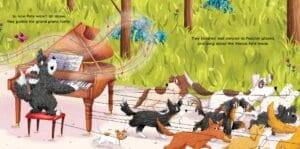
Poochie Pete and His Very Big Feet by Dougie Payne and illustrated by Rachel Seago is published by Little Door Books, priced £7.99.
Jim Crumley is one of Scotland’s best nature writers. His latest book, Symphonic, sees him visit places in Scotland and around the world searching for harmony in nature and asking how we can build a meaningful relationship with our planet. In this extract, he looks at the wonder and plunder of Everest.
Symphonic: Harmony in Nature and Why It Matters
By Jim Crumley
Published by Saraband
I dream of Everest. Who doesn’t who loves mountains?
Yet I never wanted to climb it. I was never cut out to climb it. Summits never enticed me. Even in the hard(ish) mountaineering phase of my life, it was always the company of mountains that beckoned; it was their take on the world I sought – that and the creatures that lived there, for these are the only true mountaineers. I have never seen Everest in real life. The closest I ever came to it is Switzerland. Yet I dream of Everest, and the sense of Everest percolates my dream. And the dream recurs, irregularly, but it does recur, a handful of times over perhaps forty years, the mountain seeking reacquaintance. The dream does not explain my presence, nor hint at what I might achieve there, except that it insists on the renewal of a bond. Even in my dream I don’t climb the mountain, I circumnavigate it: sunwise, always sunwise, so I move in harmony with the mountain. The dream insists on that too.
Black Elk, the famous holy man of the Oglala Sioux, had this to say on the importance of ritualising sunwise movement in a book called Black Elk Speaks (1932), written by poet John G. Neihardt based on conversations translated for him by Black Elk’s son:
You want to know why we always go from left to right like that. I can tell you something of the reason, but not all. Think of this: is not the earth the source of life, and does not the flowering stick truly come from there? And does not man advance from there toward the setting sun of his life? Then does he not approach the colder north where the white hairs are? And does he not then arrive, if he lives at the source of light and understanding which is the east? Then does he not return to where he began, to his second childhood, there to give back his life to all life, and his flesh to the earth whence it came? The more you think about this, the more meaning you will see in it.
*
I know about Black Elk at all because a woman in Austin, Texas, somehow came across two of my books, A High and Lonely Place (1990), which is about the Cairngorms, and The Heart of Skye (1994), which is a short collection of linked essays about the island. Having read these sometime in the mid-1990s, she sent me Black Elk Speaks because she thought I would be interested in what Black Elk had to say. She was right. I know nothing about her – we never met – and after my letter of appreciation for her gift, we did not stay in touch. Her great gift, though, was an awakening in me through Black Elk the idea that nature’s voice is the only common language the whole world knows, because the whole world IS nature. It has just echoed down the years one more time the moment I started to explain my dream’s insistence on a sunwise orientation.
Obviously, there is only so much faith you can place in a dream, even a recurring one that targets my affinity for mountain landscapes, but dream and real life share one common factor: I fear for Everest.
Everest is … was … should be … a sacred mountain. Long before Great Britain barged in beating empire’s drum, long before British surveyors realised they had the world’s highest mountain on their hands, it had two sacred names: Chomolungma in Nepal, meaning Goddess Mother of the Earth; and Sagarmartha in Tibet, meaning Goddess of the Wind. Indigenous sensibilities towards it over uncounted centuries honoured both the sacred and the female: Sir George Everest, after whom the mountain was clumsily re-named by the empire pedlars in around 1860, was neither of these things. But he was sensitive enough to think the honour was an unwise precedent, and he was right. The controversy would last for more than fifty years. Subsequent research suggests the surveyors wilfully dismissed the indigenous names, even denying that such names existed. Yet in the very early years of the eighteenth century, French Capuchin friars recorded the mountain’s name on a rough map of their travels, and that name was Chomolungma. So there is an argument to be made that the rubbishing of Mount Everest began with the British Survey of India the better part of 200 years ago, and the process continues unabated to this day. What characterised the acquisitive frenzy of empire building across the world by the European elite was the roughshod trampling of indigenous peoples’ sensibilities towards their own land, their own legend-making, their own place within nature’s limitless family of creatures and landscapes. That infinitely varied harmony wilted under a plague of discord.
The sacred mountain that was, and the profane one it has become, are symbolised for me by two twenty-first-century photographs taken three years apart. The profane Everest was photographed by Nepalese climber Nirmal Purja on 22 May 2019. It showed the final stretch of the south-east ridge leading to the summit crammed with more than 300 climbers, a jostling two-way queue of technicolour impatience, the summit of the world brought low by two different species of greed. One was the irredeemable ugliness of what Everest mountaineering has become, for it cares nothing for the mountain and everything for the bragging rights of the ultimate tick on mountaineering’s ultimate list. The other species of greed was the attitude of the authorities in Nepal and Tibet, not to mention the worldwide travel industry, which see in Everest only the goddess that goes on giving. Meanwhile, the squalor on the mountain is monumental. That photograph travelled the world generating headlines of disbelief and international disgust. Yet there was also a different species of anger within all those vested interests which cash in on Everest; anger that the truth had been told so graphically first on the front page of the New York Times, thence transmitted to the rest of the world in an instant. Behind that particular anger lay the fear that Everest would lose its colossal pulling power. Let’s hope.
Then, three years later, on this side of a pandemic during which hardly anyone travelled anywhere, American photographer Kittiya Pawlowski trekked into the Khumbu Valley, not to compound mountaineering’s restored post-pandemic profanity on Everest, but rather to seek out an encounter with one of nature’s most elusive creatures, knowing it was still alive and just about holding its own in the wider Himalaya. What she produced was an image of quite extraordinary beauty that restored to Everest at least the illusion of sanctity. The top 10,000 feet of Everest occupies three-quarters of the photograph, fleeced in great depths of snow, brilliantly sunlit, and raked by long diagonals of blue shadow. Its beauty and grandeur are restored, but only by distance: it appears unbesmirched by humanity’s detritus. But Everest is simply the photograph’s background, supplying context and atmosphere, not the be-all-and-end-all, not this time. The scene-stealer lurks in the deep shadow of a roughly triangular foreground, the photograph’s bottom right-hand corner. Somewhere around 18,000 feet on a flank of Pumori, tantalisingly lit, and occupying about half-a-square-inch of the whole image is the object of the photographer’s pursuit – a single snow leopard.
What Kittiya Pawlowski has achieved is nothing less than a vision of Chomolungma. Behold the sacred mountain!
One other thing about Everest and the dream. Circumnavigating the mountain was not a new idea when it insinuated itself into my decades-long preoccupation with what Everest has suffered at our hands, and then into my dreams. Those British surveyors were attempting their own version of it in the 1870s, deploying an admittedly ingenious method of circumnavigating the ban on almost all aliens in Tibet. The surveyors trained Indians disguised as religious pilgrims who were allowed in, and these men made notes on hidden scraps of paper and counted paces on prayer wheels. One such, Pundit Hari Ram, was reported to have ‘completed half a circuit in 1871, travelling in a wide arc north through Tibet from Darjeeling to Kathmandu’. That is one very wide arc. Some 112 years later, American climbers Jan Reynolds and Ned Gilette published an account of their own circuit, which they also split into halves, one in spring, the other in autumn. In total, it took them four months, and they walked 300 miles, all of it above 17,000 feet. They summarised it thus in a book called Everest Grand Circle:
‘We had seen Everest from all sides, and turned for home with a deep and intimate affection – a reverence – for the highest mountain.’
The words ‘deep’, ‘intimate’, ‘affection’ and ‘reverence’ are more or less unknown in the vocabulary of modern Everest mountaineers. Their absence is self-evident in the annual tonnage of stench and squalor that mountaineering inflicts on the mountain. Mountaineers leave it behind as a token of their disrespect and irreverence. Yet for thousands of years before mountaineering was invented, the native peoples of Tibet and Nepal had evolved their relationship with the mountain into that of an eternal goddess on the doorstep. Compare and contrast with Ed Hillary’s now famous celebratory greeting for fellow climber George Lowe as he and Sherpa Tenzing descended after their successful ascent in 1953:
‘We knocked the bastard off!’
Symphonic: Harmony in Nature and Why It Matters by Jim Crumley is published by Saraband, priced £14.99.
If you’re looking for an epic adventure on the high seas with a rag tag crew in a magical world inspired by south-east Asian mythology then Katalina Watt has provided! We caught up with her to find out more about her fantasical debut.
Saltswept
By Katalina Watt
Published by Hodderscape
Congratulations on the release of your debut novel, Saltswept. Can you tell our readers what to expect and what you wanted to explore in writing it?
Thank you! This is the first in a fantasy duology inspired by Southeast Asian folklore with queer main characters following a pirate, an acolyte, and a farmer on their quest of hijinks on the high seas. I wanted to explore eco-fiction and colonialism through a classic fantasy quest narrative and add elements of more contemporary fiction with classic things we love about the genre. There’s nature magic, courtly intrigue, and dark academia as well as swashbuckling, The world of the Earthsalt Duology is queer-normative, with disabled folks, and rainbow families with a cast of characters who are outcasts in various ways.
You come from a publishing background. How have you enjoyed the publishing experience from a writer’s perspective? Was it as you expected?
It’s certainly been helpful to understand the industry from the other side. It helps keep me grounded and remember that decisions are business as well as artistic ones and not personal to me or my book. I love the collaborative process and I’ve been lucky that my team and I can geek out about the specifics together. It’s important to remember that everyone is on the same team and wants the book to be the best it can be, but you have to get on the same page matching those expectations and realities. One of my favourite moments was recording the Acknowledgements for the audiobook, a real full circle moment for me having spent a lot of my publishing career in audio.
Why did you decide to set your fantasy adventure at sea?
A seafaring quest is the fantasy equivalent of a road trip. I have a curiosity and healthy respect for the sea. I don’t have seafaring experience but researching this book was so much fun and fascinating. I’ve always been obsessed with folkore around the sea and I think coming from two island nations – Britain and the Philippines, I’m interested in places where the economy and history is entwined with the land and sea. It can be bountiful – many people rely on the sea for their livelihood, but it can also be dangerous. I’ve got a morbid streak and found diving, particularly cave diving, captivating to research. People who work and live in and around the ocean are so admirable and brave from my perspective.
We have a bit of a soft spot here at BooksfromScotland for books that feature a ragtag bunch of protagonists. What were the challenges in handling a wide range of characters?
I wanted to challenge myself to write three different POV characters, all in first-person present tense, which is perhaps unusual for an adult fantasy novel. We follow Ris, a widowed farmer, Finlyr a rogue and a pirate, and Hanan who is a temple acolyte. I had an immediacy and could get right into the characters’ heads with clarity, as the cast start separately but come together. It was a challenge to identify whose perspective is needed at given points in the narrative, what secrets they’re hiding from each other, and what motivates them. There’s a lot of fun to be had playing with what the reader knows versus what the various characters know. The secondary characters were also great fun to write because we get little snippets of their insights but we never get to be fully in their heads.
You introduce your own magic system in Saltswept. Can you tell us more about creating this as part of your fantastical world-building?
In this world magic exists and is based on the idea of balancing energies in the natural world, but not everyone can use it. Those that can’t misunderstand and are afraid of magic. Those that can are called ‘gifted’, or more unkindly ‘touched’ and have a natural intuition for it, which can be awakened. When it is, they are taken to the temple of Aistra to train as an acolyte with the hopes of being chosen for the great honour of serving the monarchy.
From a craft perspective, I used a world-building bible which is adapted from a template as a basis for creating Paranish. It was useful to think about the macro and microscale of world-building, everything from the economy and climate to cultural norms, urban planning etc. In some ways it’s very liberating to create a secondary world in fantasy because you have a lot of freedom to choose and shape the world you want. But you also have to be intentional and cohesive with your choices so this feels like it could be a real place and so you don’t internally contradict the way your world works. It wasn’t only helpful for me with editing and writing the sequel, but also for my publishing team. It’s the iceberg where the reader only sees the tip, but all that ground-work is beneath the surface of the water and adds to the verisimilitude.
Why do you think fantasy has had such a resurgence over the last few years?
I think it’s a combination of escapism and activism. Imagining a different world or different way of living is what fantasy is about and always has been, and it’s wonderful to see more diverse stories in the fantasy sphere and mainstream support for authors who have not been traditionally represented in the book industry. Fantasy stories can be both cosy and intimate in terms of stakes – focusing on one person’s arc in one place for example, but it can also be epic in scale – and sometimes in the same narrative. I’m so excited for the future of fantasy; we’re so fortunate to have so many passionate and dedicated readers and authors in this community.
Who or what are your writing influences?
Garth Nix, Ursula Le Guin, J.R.R. Tolkien, Emily Brontë, Angela Carter, Sarah Waters, Toni Morrison, and Becky Chambers to name a few!
Are there any other speculative fiction books coming from Scotland’s writers that you’re looking forward to reading this year?
We are very blessed to have so many excellent speculative fiction writers and here is just a sampling of what’s on offer this year!
The Salt Bind by Rebecca Ferrier, The Inn at the Foot of Mount Vengeance by Chiara Bullen, Homesick by Rhiannon Grist, The Eynhallow Saga Book 2 by Heather Palmer, A Snake Among Swans by Hannah Kaner, In This City Where It Rains by Lyndsey Croal, The Cove by Claire Schultz, A Million Points of Light by C.L. Hellisen, Masquerade by L.R. Lam, The Haunting of Avis Lovelock by M.K. Hardy, The Mirrored Halls by Cailean Steed, Vervain Hollow by Catriona Silvey, Abyss by Nicholas Binge.
Saltswept by Katalina Watt is published by Hodderscape, priced £20.00.
On a cold, January day, wouldn’t we all like to be on a cruise on the Mediterranean? Maybe not if it means murder! Jonathan Whitelaw’s latest book, All At Sea, is a cosy crime caper that sees a captain of a ship slumped at the wheel with a knife in his back and two reality TV stars ready to go on the hunt for the killer. BooksfromScotland asked Jonathan Whitelaw to reveal his favourite sea-faring stories that inspired his setting.
All At Sea
By Jonathan Whitelaw
Published by HarperNorth
I have always loved the sea, ever since I was a little sprog. There’s something wonderfully endless about it, not to mention calming, soothing and all of those wonderful things. So it is, of course, natural, that I would set a murder mystery amongst the glistening blue waters of the Med. One of the requirements of being a crime writer, you get to do horrible things to and in places you love! Here is a list of five nautical favourites of mine to celebrate the launch (see what I did there) of All At Sea:
Moby Dick – Herman Melville
No list of sea related shenanigans would be complete without this epic. I recall reading it for the first time when I first went to university. It’s not the page-turning thrill-fest we’re all used to nowadays. But it paints character and setting perhaps better than most that have come after.
Death on the Nile – Agatha Christie
As a cosy mystery writer, I’m contractually obliged to mention Ms Christie at every turn. She is, after all, the guvnor-ess when it comes to golden age crime writing. And with good reason. While technically the action takes place on a river, it’s no less nautical for its plot and passion.
Jaws
I’ve opted for the movie version here, over the novel. Sacrilege, I know. But it’s purely through sentimentality. Many happy Christmas nights were spent gathered with my relatives watching the umpteenth rerun of Jaws on the TV, stuffed to the gunnels with turkey, ham and far too much chocolate. It’s such a summer movie that it always shone like a bright beacon in the bleak mid-winter of the festivities. And its portrayal of a deadly deep ocean off the coast of Martha’s Vineyard is so potent, I swear I can smell the salt of the ocean every time I watch it.
The Ocean – Led Zeppelin
Okay, I know I’m sort of cheating here as there’s nothing very sea-related about this song other than the name. A bit like the movie Moonraker and the original Fleming book. The ocean in this masterpiece is the crowd lapping up against the stage during Zeppelin’s 1970s pomp. But it has a catchy riff, some wonderful drumming and always takes me back to my carefree student days at Glasgow University.
Erebus – Michael Palin
I make no bones about how much of a hero Sir Michael is to me. A wonderful writer and all-round great bloke, his account of two expeditions made by the Royal Navy’s HMS Erebus to opposite ends of the planet is both riveting an insightful. Delivered with his usual aplomb and style, it’s a book that brings history to life in the very best way.
All At Sea by Jonathan Whitelaw is published by HarperNorth, priced £9.99.
ALSO ON BOOKS FROM SCOTLAND
-


Saltwater: A Midsummer Ghost Story by Elaine Thomson
‘The very thought of those grey faces made my skin grow cold.’
-
‘An Odious Campaign’ by Rob McInroy – Why a 1936 By-Election Still Resonates
‘This enraged the locals and he came close to being run out of town on several occasions.’
-

‘‘That’s right, Bobby,’ he growled. ‘I haven’t seen you in – well, since you decided to kill me.’ ‘
-

David Robinson Reviews: Solitary Agents by David Goodman
‘This is very much an up-to-the-minute story of spycraft, positively revelling in all the things tha …
-

The Savage Landscape by Cal Flyn
‘It is their resistance to the intrusions of the outside world − culturally, economically, environme …
-

The Shortest History of Scotland: A Q & A with Murray Pittock
‘We need to be better aware of that to understand the challenges and achievements of the past, and t …
FEATURED AUTHOR:
James McGonigal

James McGonigal is a poet was a lecturer in English at the University of Glasgow. He was, for many years, a close friend and confidant of the poet, Edwin Morgan and wrote an acclaimed biography of the poet, Beyond the Last Dragon, in 2010. McGonigal al …
FEATURED PUBLISHER:
NMS Enterprises Limited – Publishing
NMS Enterprises Limited – Publishing is the publishing division of National Museums Scotland. We produce lavishly illustrated catalogues for Museum exhibitions such as Catherine the Great: An Enlightened Empress and, in 2008, Silver: Made in Scotland, …