


Dàn nam Ban / Fate of Women is the debut collection from award-winning bilingual Gaelic English poet, singer and teacher Ceitidh Chaimbeul. It highlights women’s voices from across the generations, and explores themes of folklore, family, motherhood and cultural inheritance. Here is a sample from the collection.
Dàn nam Ban
By Ceitidh Chaimbeul
Published by Leamington Books
Bana-bhuidsich Allt a’ Mhuilinn
Duilleagan fuil-dhearga
nan laighe gu trom-uisgeach
fo ruaim bhalbh, nam measg
mnathan ciar-bhuidhe is ruadh.
Geugan bàna ri dìosgail
rabhaidhean dìth cead
ann an uspag na Samhna
sgeulachd lusgairean
ann an doire nam bochd.
Mac-talla nan taibhsean,
rionnach maoim is smùdan
dannsadh tron allt,
is gaoir chorcarach nan dithis
gun eucoir ach banalachd.
The Millburn Witches
Blood-red leaves
lie heavy-drenched
in silent anger, taints
yellow and amber women.
Naked branches whisper
warnings of intolerance,
in Hallowed breaths
stories of the healers
in Diriebught.
Echos of spirits,
shadows and smoke
dance through the river,
and the screams of violation,
two innocents – women.
An Taghadh Eile
’S tus’ as coireach, a nathair chòir,
chuir thu nimh na fuil
is shiubhal do bhriathrachas
fo mhìne a craicinn mus do thogadh dhi slighe peacaidh.
Nas tarrangaiche buileach an t-ubhal
is àirde a shlaodadh dha beul
nìor leig ann am Maitheas gum biodh beachd aice fhèin,
seach a sàsachadh leis na bha an dàn dhi.
Bhruadair i air iteagan brèagha air eòin fad às,
feur na bu guirme an gàrraidhean eile
’s i sgìth den mhil a bhlais i
an eanghlas Àdhaimh
Ach saoil, a nathair,
an robh i ga iarraidh –
ceum duirche a thaghadh
is e na thrìlleach fhàgail
an lorg beatha bhàin
fo ghrian a sìorraidheachd.
The Other Choice
You’re to blame, dear snake,
you poisoned her blood,
and your lexicon swept,
under the sheen of her skin, until
she could only take the path of sin.
The forbidden fruit was the greater allure
and lowering its height to her mouth,
heaven forbid she had an opinion of her own
discontent with the destiny laid before her.
She dreamed the fair feathers of far away birds,
the lush grass of other gardens –
sickened by honey and
swallowing Adam’s insipid milk.
But I wonder, dear snake,
if she wanted it –
to carve darkness’ path
and breach his monotonous peace,
abandoning her eternal perfection.
Fluraichean Buidhe
Bho thùs tha i air d’ aithneachadh –
d’ ainm daonnan air blas a bilean.
A sùilean làn de d’ ìomhaigh ghlan,
an dealbhan gan taisbeanadh dhi.
B’ e an turas seo a’ chiad athais
tadhal ort ’s air an eilean o chionn fhada.
Glamaig chumhachdail gun atharrachadh
le ceò a’ cumail an t-siabain bho na speuran.
Rubha na h-aiseig srònagach sa mhuir fharsaing
fo dhubhar bataraidh na maighdinn-mhara
Ach fhuaras flùraichean buidhe lamaisteach, calaisteach,
duilleagan grèiste a’ màirneadh na thachair.
Mar thaibhsear, a b’ eòlach air d’ àite tàimh
thàinig buatham brosnachail bhuaipe is
gun ghluasad, theann i ris a’ chloich
le tulchuis na h-òige is chuir i oirr’ pògag gràidh.
‘Tha gach cùis ceart, na gabh dragh,
gheibh thu flùraichean nas fheàrr a Ghanga.’
Yellow Flowers
From the beginning she knew you –
your name ever on her lips.
Her eyes bright-full,
your portrait revealed to her.
This journey was the first opportunity
to visit you and the island, in an age.
Glamaig, powerful and unchanged,
mist separating the sea-foam from the heavens.
The ferry point jutting into the wide sea
in the shadow of the mermaid’s battery
But we found yellow flowers, battered and wind-swept,
embroidered leaves reflecting what befell them.
Like a seer aware of your resting place
an inspired thought struck her and
without prompting, she approached the stone
with the confidence of youth and placed her tiny kiss on it.
‘Don’t worry, everything is as it should be,
you’ll get better flowers, Ganga.’
Bi modhail
Lìon caillich na suidheachain eile
nan suidhe gu dìreach is modhail.
Cnàmhan is anman a’ gleadhraich
le spèiread fhaclan.
Brògan grinne a’ seachnadh an t-sruth’
air gach taobh den trannsa.
Ginealaichean de bi modhail,
na cur car an gnothaichean –
cha robh am breith-bhriathar
na bu làidire na glocail shocair,
sùilean mall-rosgach is fiamh orra,
ag èisteachd ris an t-searmon ràpach.
Bu annsa leam rudeigin a ràdh ach,
a-rithist, mar as àbhaist,
cha d’ rinn mi dad
’s mi nam shuidhe gu dìreach is modhail
mar an ceudna
a’ speuradh os n-ìosal ri nèamh.
Be polite
Old women filled the other seats
sitting straight and polite.
Bones and souls shaking
with the strength of the words.
Neat shoes avoiding the stream
on either side of the aisle.
Generations of behave,
don’t cause a scene –
no word of judgement
just their tutting,
calm eyed yet awe-struck,
listening to the noisy sermon.
I really wanted to say something
but, again, as always
did nothing
but sit straight and polite
like the others,
swearing silently to the heavens.
Dàn nam Ban by Ceitidh Chaimbeul is published by Leamington Books, priced £9.99.
Does the Loch Ness Monster exist? Oh yes, and she’s a secret agent! In the very first graphic novel from Kelpies, the children’s book imprint at Floris, Secret Agent Nessie and her team of friends — genius inventor Bea the Beaver and quick-stinging Jelly the jellyfish — are on a mission to keep Loch Ness safe. Here, the team at Floris tell us more about the project.
Secret Agent Nessie
By Gary Chudleigh and Laura Howell
Published by Floris
‘I had a lot of fun writing for Jelly in particular,’ says Lego comics author Gary Chudleigh. ‘I took reference from every wee Glaswegian angry grandpa I knew. He’s bottled up lightning: always raring to go in order to help his team mates.’
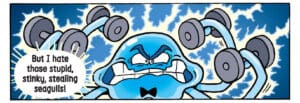
When a gang of squabbling seagulls pulls off a heartless fish-and-chip heist, Nessie and her W.E.T. (Water Espionage Team) pals spring into action. But what monstrous master plan is their bird-brained enemy plotting from the ruins of Urquhart Castle? Laura Howell, the first female artist to have a regular strip in the Beano, loved illustrating the feathered felons for the book. ‘I enjoyed making them look as gormless as possible!’ she said.
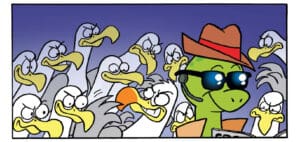
Chock full of water fights, bird puns, larger-than-life characters and at least one stolen tractor, Secret Agent Nessie is a laugh-out-loud, full-colour graphic-novel adventure perfect for children aged 6 and up.
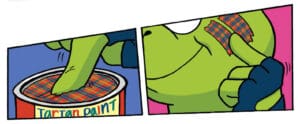
Gary’s favourite scene involves Nessie and friends coming together to take on the bad guys for the final showdown. ‘It’s my tribute to all the action movies I loved as a kid (and still do), and Laura drawing Nessie’s warpaint as tartan is the perfect touch.’
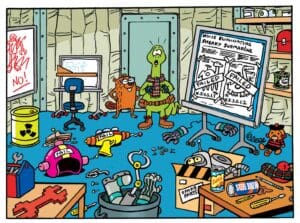
The W.E.T. (Water Espionage Team) have a secret base deep under the water of Loch Ness. The interior of Bea’s laboratory was a highlight for Laura – ‘It was entertaining to draw in all the details, but it’s also a pivotal character moment for both Bea and Nessie in the story.’
In a bold and wacky story full of twists, turns and puns, Gary hopes that children who read the book will learn that it’s okay to try something and fail, and that to truly succeed, they’ll need help from others. The ever-serious Laura hopes children will learn . . . to beware of angry chickens!
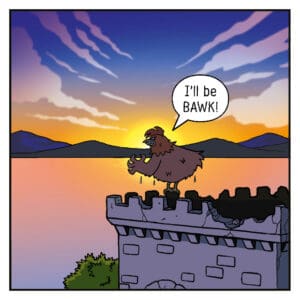
Secret Agent Nessie by Gary Chudleigh and Laura Howell is published, priced £7.99.
1593 was a dangerous time to be a healer in Scotland. The Wise Witch of Orkney is a pacy historical novel that tells the story of Elspet Balfour, suspected of witchcraft by the Earl of Orkney. Luckily, the queen has her summoned to Edinburgh to look after her while she is pregnant with James VI’s baby under the disguise of a lady-in-waiting. The subterfuge isn’t easy to maintain, and life at court is full of extra intrigue too. Below is an extract from the novel telling of Elspet leaving her beloved Orkney.
The Wise Witch of Orkney
By Anna Caig
Published by Black & White Publishing
Elspet throws open the deep wooden trunk in the corner of her one-room home and throws its contents into a pack next to her on the brushed earth floor. She’s sent Gillie and Broden to visit her friends, the Laird and Lady of Stenness, an hour away at the big hoose Skarravoe. If the Earl’s soldiers return, she doesn’t want her children to be here. She knows the laird and lady will keep them safe, and hidden if necessary, for as long as she is away.
‘The laird has some new paint colours he wants to show you,’ she said to Broden, holding him tight and breathing in the warm scent of his hair before turning to Gillie. ‘And the Lady of Stenness was telling me of a new astronomy book she wants to read to you. They’ll love to have you stay for a peedie while.’
Elspet knows she must leave immediately; the soldiers may return any moment. But there are some things she cannot leave behind. The trunk, decorated with twisted ornamental swirls, had been carved by her mormor. She wants to touch its whirls and spirals, feel the wood her grandmother had painstakingly sculpted, take comfort in her meticulous work. But she stops herself – there isn’t time.
Rummaging under a stack of blankets, she finds a pile of small, bulging cloth pouches and examines each one quickly before pushing them into the pack.
Margaret stands in the doorway, looking out down the lane impatiently. ‘Mistress Balfour, we must go now. My bluff won’t buy us much time.’
So it was a bluff . Was any of what Lady Margaret Livingston told the soldiers true?
‘I can’t leave without these plants.’ Elspet pulls out the last of the pouches and pushes them under her clothing at the bottom of her pack. ‘I’ve no idea what herbs you have in Scotland – I might not be able to do my work without these.’
‘You won’t be able to do anything at all if the Earl’s soldiers capture you.’
Elspet knows she’s right. ‘I’m almost ready.’
She looks into the trunk a final time to find her thick woollen travelling cloak. It may be summer but the year is already turning towards darkness, and she’s heard the winter lingers longer South. Th is cloak was Mormor’s too. She pulls it round her shoulders, hoping for some kind of protection.
What she’s really doing is stalling for time. She doesn’t want to go. Looking over at the pile of crumpled blankets on the bed set into the wall she shares with the children, her eyes swim with tears.
‘How will the laird and lady comfort them tonight?’ she says, more to herself than the glowering woman in her doorway.
‘Come on now. Children don’t need us half as much as we like to think they do,’ Margaret says, striding across the room and picking up the sack. She awkwardly wraps her arms around it and holds it against her chest.
‘Beatrix is waiting at the boat,’ she adds. ‘And I too have no desire to see the Earl’s men again.’
Elspet doesn’t understand any of this, but this is the path God has chosen for her, to go with this woman and use her skills to serve the Queen of Scotland. She follows Margaret out to the horses waiting under the hazel tree that stands like a sentinel outside her home. She glances down the lane; no one is coming. Not yet. She takes the pack from Lady Margaret and rests it on the saddle in front of her as she mounts the horse. They break into a gallop towards the harbour.
*
Elspet hears them as she follows the ladies up the boarding plank. Hooves, thundering down the hill to the small harbour on the Bay of Ireland where the ladies’ boat is docked, away from the many curious eyes in Orkneyjar’s busier ports.
More of the Earl’s soldiers have come this time. At least ten riders are drawing closer, an unmistakable figure on the leading horse. It is the Earl of Orkney – Patie has come himself.
Margaret has seen them too and turns to the men untying the ropes that hold the boat fast into the dock. ‘Hurry,’ she calls. ‘We must sail immediately.’
The sailor looks up. ‘That’s the livery of the Earl. We should wait and—’
Margaret doesn’t let him finish. ‘We will sail immediately, or you’ll see none of that fee you negotiated. I know very well it is far above the usual rate for this crossing.’
The man looks confused, as unused as Elspet is to hearing a woman issue orders at sea. But a full purse is a powerful argument, and he nods quickly before untying the last rope and stepping aboard.
The horses have reached the top of the slipway now. The Earl’s thin white face is clearly visible under his black peaked hat, his small eyes scanning the boat. Is he looking for me, or for Lady Margaret Livingston? Elspet wonders. Perhaps both of us.
As they move out into the bay and a gap appears between the boat and the dockside, Elspet sighs with relief. Patie and his men reach the waterside, their horses coming to a sudden standstill to avoid galloping straight off the edge of the dock and into the sea. Th e Earl’s eyes are trained on her, that strange brown so light it’s almost yellow. His lips curl in a sneer, showing his small teeth. Elspet shudders and instinctively takes a step back as the boat picks up pace. Th e further away they sail, the more Patie’s face becomes an indistinct blur, but ranyie pangs still stab Elspet’s stomach – that sneering expression, one she kens all too well, stays with her long after the dock has faded from view.
Beatrix looks at Margaret in panic. ‘The Earl of Orkney knows we’ve visited his islands. He knows we have Mistress Balfour.’
This clearly wasn’t part of the plan, then. Th e Earl of Orkney is the King’s cousin, an illegitimate one, but a cousin nonetheless – perhaps it isn’t surprising the women had hoped to avoid him.
‘It couldn’t be helped,’ Margaret snaps. ‘We knew the risk we were taking.’
‘What if he sends word to the King?’ Beatrix asks.
This is not an auspicious beginning to Elspet’s task. If the Earl of Orkney warns the King, this plan will be over before it’s even begun. ‘He will send men after me. After us,’ she says.
Margaret frowns. ‘How long will it take him to muster ships?’
‘A few hours at least. He’ll have to ride back to Kirkwaa, gather his sailing men and ready a ship.’
‘We’ll make for Durness then,’ Margaret says. ‘It’s a smaller port and he won’t expect us to go ashore there.’
Margaret goes to instruct the captain, and Elspet turns to look at the sea beneath them, calm today. The home she’s never left before slides further and further into the distance.
Next to her, Beatrix chats away without requiring any response. ‘We’ll have much time on our journey, Mistress Balfour. We will go to Dunrobin Castle first. We hope the Countess of Sutherland will help us prepare you for life at court before we travel to Edinburgh. You can teach me all about how you will treat the Queen, what plants and herbs you will use.’
Elspet turns her thoughts to what lies ahead but her foresight fails her; this is a situation beyond her imagining, the future shrouded in thick haar. If it wasn’t for the Earl’s men on her back, she would never have agreed to go with these ladies. Her heart is sore for her children before the islands have even faded from view. When will she return to them? Indeed, will she ever return to them? At least they’ll be safe at Skarravoe with the Laird and Lady of Stenness.
She shakes those thoughts away. She must believe she will see them again, or she’ll never be able to take on the task ahead.
Three orcns are playing in the boat’s wake below – their grey water-slick backs glistening where they catch the sunlight. Th ese are the creatures after which her island home is named – the subject of so many Orkneyjar tales: orcn selkies who shed their skins to come to the land and dance. Elspet must put on a new skin now, the skin of a noblewoman.
The Wise Witch of Orkney by Anna Caig is published by Black & White Publishing, priced £16.99.
When Joanne, a troubled woman, discovers her birth father was a serial killer, she’s forced to confront a terrible question: what if the darkness in her own soul is a direct inheritance from him? This is an intimate and chilling psychological thriller. In this extract we find Joanne at her adoptive mother’s funeral feeling like an outsider.
Original Sins
By Linda Duncan McLaughlin
Published by Into Books
I hide out in the crematorium loo, shaking, searching my bag for non-existent hankies and fishing awkwardly for the end of the loo-roll in the dispenser. Who designs these things? I can’t believe what I’ve just done. I know what they’ll be thinking: Always was an odd yin, right enough, but still, her own mother’s funeral… And there’s still the purvey to get through. I hear the door open and know it will be one of the aunts.
‘Joanne? Are you in here, love?’
It’s Mina. Best of them.
‘Yeah, I’m here.’
‘Thought you might be,’ she sighs. ‘I’m sorry you got upset there, pet, but listen – we need to get down to the hotel, and nobody’ll be able to move till we go. Your Aunt Annette’s getting a wee bit… Well, you know what she’s like.’
‘I’m just coming, Auntie Mina,’ I manage. ‘I’ll be out in a minute.’
‘Okay, love. I’ll wait for you outside.’ The door clicks shut.
I sit a moment longer, clutching my fistful of loo-roll scraps, listening to the silence. There will be a show of sympathy, of understanding, for what has just happened. But later the cabal will convene, condemning me for flouting the rules, for committing the worst possible crime, of drawing attention. This wasnae about her, they’ll say, it was about her mammy.
And they will be right. This is about my mammy – but not the one who’s just translated into smoke and ashes, wisping into the ether. This is not about Alice, the only mammy I’ve ever known, Mum, who took me in and brought me up as her own. This is about my real mammy, the one who gave me away when I was barely two months old.
When they find out that I’ve decided to try to find that one, the shit is most definitely going to hit the fan. I promised Mum that I would never try to trace my birth mother, and they all know that. But Mum is dead now and, all the way through her painful dying, at the back of my mind was the knowledge that at last I would be free to betray that promise. Even though the guilt of that betrayal will probably stay with me forever.
But I need to – have to – know who I am. Who I come from. If I don’t do it now I never will. And if that costs me all of the family I have left, then that’s the price I have to pay.
And that actually is quite funny, isn’t it?
*
The funeral purvey is everything I expected. The hotel is overwarm, over-chintzy, and someone has over-ordered the buffet: platters of sandwiches and sausage rolls and bright cakes are piled high on the tables. My one insistence had been on an open bar, and people are already well-furnished with pints and wineglasses and are chatting animatedly. The room hums with a rush of post-funeral relief.
At first, people tip-toe around me, unsure whether to speak to me or not. Mina sits me down at a table buttressed with cousins, and there is an awkward pause as we all look at each other. In recent years I’ve given up trying to keep track of exactly how many cousins I have; I don’t even know the names of some of the newer additions. And of course, technically, I’m not related to them at all.
Do I sound less than familial? Perhaps. And it isn’t necessarily just because I’m adopted – I know plenty of adopted people who have relationships with their families every bit as close as any blood tie could be. Not finding out till I was fourteen was a little traumatic, maybe, but hey, I was adopted in the 60s; they did things differently then, didn’t they? Mum and Dad thought they were doing the right thing, not telling me. They’d always intended to, they said, but somehow the right moment had never arrived; by the time it did, accidentally, I was just about old enough to handle it.
As a child I had wondered, of course, why I was so different. Why I hadn’t inherited the boldness, the temper, the sheer brawliness of my mother’s boisterous family. Or the dark good looks and humour of my father’s side. I was totally unlike my cousins: not in the least physically brave, hopeless at ball games, uninterested in their feuds and constantly-changing alliances. While they romped through urban jungles, I found my adventures in books; when I did well at school, they were both contemptuous and faintly intimidated. I was an alien, unable to join their tribe; finding out there was a perfectly good explanation for that was, in some ways, a relief. And as their juvenile teasing morphed into a darker bullying I built a wall of don’t-care bricks against it until it was strong enough to repel any attempt at attack.
I was a burr under their saddle, however. And the older I grew, the more spiky my defences, the more of an irritation I became. Staying on at school was bad enough, but going to university, and sponging off my parents, and thinking myself better than them, and moving to England (of all places), and landing a cushy, under-worked, over-paid job in some soft southern college? It just served to compound my crimes – and I didn’t care, in fact I welcomed the growing distance. And while they looked askance at my weird taste in clothes and music, I failed to hide my lack of interest in telly soaps and Z-list celebrities. A pity? Perhaps. Could try harder? Almost certainly. I did regret the lack of love between us, now that I was older and more forgiving – but it was equally too late to try mending those fences now.
Original Sins by Linda Duncan McLaughlin is published by Into Books, priced £11.99.
Elissa Soave’s third novel, Common Ground, sees her return to a character from her debut Ginger and Me: Germaine Hounslow. She is called upon to act when the allotment she manages is earmarked for a new development by the South Lanarkshire Council. In defending the allotment space she finds herself within a community that she didn’t know she needed. BooksfromScotland chatted to Elissa Soave about her heartwarming tale.
Common Ground
By Elissa Soave
Published by HQ
Hello Elissa, what can you tell our readers about your new novel Common Ground?
Common Ground is about a group of outsiders who each have a plot at the local allotments. Initially, they appear to have nothing in common and very little to do with each other but when the allotments are threatened with closure, they have to work together to stop that from happening. Before long, they discover that the allotments are not just plots of land, but a place to find community and connection. Set in Viewpark and Uddingston again, readers of my earlier novels will meet up with some familiar faces, notably Wendy and Irish Mary, as well as being introduced to a host of new characters who I hope they will find themselves rooting for. It’s my most optimistic novel to date, as it imagines a world where we can all share the same space, working towards the common goal of making that space fruitful for everyone.
This is your third novel now, do you now feel like you’re a dab hand at this writing and publishing game now?
Ha, if only! I still feel like a complete newbie and panic when anyone asks me about my writing process, wondering if I have one yet. I feel that I’m learning as I go, each book teaching me more and giving me a little more experience for the next one. Maybe if you ask me again in ten years’ time . . .
Common Ground is a wonderful tale of local resistance and community. Why are these themes important for you to explore as a writer just now?
I’ve always been interested in how community works, what makes a good community, and how is it that some people find themselves outside the community. These themes were also explored in my first novel, Ginger and Me, where Wendy desperately wanted to be part of a community and struggled to find her way in. Common Ground takes a different approach. It shows how people can come together to create their own community, and how being part of such an endeavour can promote happiness.
I think it’s pertinent to focus on these issues at a time when the idea of ‘community’ itself is under threat from all sides. Public swimming pools are closing, library hours are shrinking, men’s mental health sheds are being axed, pensioners’ clubs are shutting down. You could say this is an economic necessity but I see it as symptomatic of the prevailing ideology that individualism trumps collective wellbeing. And of course, the people most affected by this approach are those who can least afford to lose public services. It’s really a question of what kind of society we want – one in which the privileged have everything and the rest of us make do, or a community-based approach where everyone’s happiness counts.
Are you green-fingered? Does nature influence your creative work?
Green-fingered, no. In fact, some would say quite the opposite. I was lucky to have the advice of my father-in-law on the gardening aspects of Common Ground and we did have some good laughs about my ignorance in this area. For example, there’s a scene where I wanted a very colourful profusion of flowers so I googled flowers in shades of pink, red, purple, etc and added them to the scene. My father-in-law had to point out to me that not all flowers bloom at the same time of year. Ahem.
As to the influence of nature – and without going too Kate Middleton – I do believe in the healing power of nature and the outdoors. So, in the sense that all of an author’s lived experience feeds into our work whether we realize it – or admit to it – or not, then yes, nature does influence me. With the characters in this novel, most of whom are troubled or hurting in some way, I really think that working with the soil and nurturing plants in the fresh air and away from modern distractions, goes a long way to making their lives better.
In a novel with characters who are brought together by circumstance rather than familial connection, how you do decide and create your cast of characters?
What a great question! With Common Ground, I wanted to show that even when we think we are very different to others, at heart, humans share broadly the same experience. For this to work, I needed a whole range of diverse characters. So, the cast includes Kevin, a young man who is severely facially disfigured; Germaine, who has left behind a troubled past for a new start at the allotments; Mohid and Farah, who lead a seemingly perfect life but are hiding the reason for their heartbreak; and Isabel, whose husband, George has been diagnosed with early onset dementia. Outwardly, they are a group of individuals with very little in common, apart from their allotments, but by the end of the story, the group has had to work together towards a shared goal and discover that perhaps there is more uniting them than they think. I hope to leave the reader with a sense that there is joy in community and a place for everyone within that, and that collective wellbeing matters and is worth striving for.
What authors and books have influenced your writing?
James Kelman was, and remains, hugely inspirational to me. When you look around at the books doing well in Scotland today, you can see his influence everywhere – whether this is acknowledged or not. Janice Galloway’s The Trick Is To Keep Breathing made a big impression, as did Rachel Cusk’s The Temporary. This last book may seem surprising as it is set in an English middle class milieu, quite unlike my own novels, but this is the first time I recall reading about a young woman’s interior life (even though she was insufferable), and that was eye-opening to me. More recently, I have been a huge admirer of Anne Donovan’s work, I am in awe of the way she combines the tragic with the comic so effortlessly.
Are there any books from Scotland you’re particularly looking forward to reading this year?
Of course new novels from big names like Ali Smith and Douglas Stuart are reasons to celebrate. Also, if I can cheat a little on this question (because these are not strictly speaking new books), I was very excited to read that Polygon are to reissue seven new editions of the works of Agnes Owens. Owens is often described as one of Scotland’s most overlooked writers and I’m afraid I am guilty as charged. She is a writer I feel I should have read by now and I fully intend to put that right this year.
Common Ground by Elissa Soave is published by HQ, priced £20.00.
Devour Everything by Sarah Stewart contains poetry that celebrates all that life can throw at us and how we make it through – the mundane made heroic and sacred. Enjoy this sample from this defiant collection.
Devour Everything
By Sarah Stewart
Published by Tapsalteerie
Illusory
‘Behind the illusion of everyday life lies the reality of dreams.’
– Werner Herzog, Fitzcarraldo
In the way that you turn a corner on to a street
you knew when young and catch your breath:
its dimensions calcified, unchanged
in the way that a stuck door creaks open
to reveal a garden full of honeysuckle,
sheened with snail-slime, netted with cobwebs
in the way that orderly rooms, scrubbed clean,
lose their patina of interesting dirt –
watermarks, spilled ash, candlewax, bluebottles
in the way that your fingers will find the chord
on a piano, knowing the claw-stretch
years without playing
in the way that the moon will sequester and release
a view of spires and slates
on a bed of staggered indigo
in the way that a man walks out of smoking ruins
clutching his workbag, still wearing
sameshoes samesuit samecoat as this morning –
in the way that you are falling
through barred cloud, streaked bronze,
dropping like a stone
in the way that we are animals
and our bodies remember things.
Second-Hand Dress
i
I surmise
by the tight bodice
the original owner was narrower than me.
Athletic? Played tennis?
It’s an odd colour:
off yellow? Gold-adjacent? Ugly,
but appealing in its vagueness.
Washed twice, it still offers
a hint of musk; violets
sharpening in the heat.
It asks me, constantly,
with every swish of the fabric
who do you think you are?
ii
A confusion of mirrors, prisms.
I watch from a rising escalator:
a shopgirl yawns, then disappears.
Vanishing lines of mannequins
lipstick bullets in rows:
Strip Me Down, Men Love Mystery.
The dress too tight across my ribs.
Butterscotch, that’s the colour.
Mouthful of sweetness, sweetheart.
Japanese Wind Telephone
for Peter
When you asked me for a love poem
I told you about a glass booth
containing one object,
a disconnected rotary phone:
black, shiny as whale-belly
from which the grieving
can dial the numbers
of their lost ones, speak
to the listening dead.
I promised
that after you were gone,
I would keep telling you things:
how our children are growing;
how the blown apple blossom
fills the gutter
outside our house;
how our neighbours
still make love so loudly
and when they wake me
I find I have reached again
for your hand.
Sweetheart
I want to make you good things.
To simmer and fold
until cream and sugar clot
into caramel; to roll and unmould
dainty madeleines or macarons.
It’s no use. I’m better at pickles,
ribbons of courgette cut and plunged
into vinegar. Show me love,
and I’ll show you hands smeared
with vermillion chilli, crushed garlic,
splinters of ginger
under every fingernail.
Devour Everything by Sarah Stewart is published by Tapsalteerie, priced £12.00.
The Salt Bind is a gothic, fantastical fairy tale that pays tribute to all those women named as witches in the 18th century. In it, Kensa is a daughter of a feared pirate, but she is determined to make her own mark in the world, training in the secrets of The Old Ways. This extract relays the appearance of an unwanted omen.
The Salt Bind
By Rebecca Ferrier
Published by Renegade Books
Ever since she could remember, Kensa had been unwelcome. That’s what came with being the daughter of Alexander Rowe. Rumour was, after he was hanged and strung up over Percuil River, his body refused to rot. Others say his body disappeared altogether, swallowed by the tides for an unpaid debt. Kensa thought she remembered that day, too – the hanging – and if she didn’t, she’d been told of it so often that a memory had formed nonetheless.
And she’d been told what she’d done.
‘That chit crawled on to the scaffold and put her hands in his pockets,’ said Old Sal. ‘Thieved from her own father afore he was cold.’
It was true, but Kensa had not taken money. Instead, she had removed a hagstone from her father’s coat. It was as large as her palm with a hole knuckled through it. She could not forget the first time she’d seen it. Her father had come home from sea, rattling with gifts and thick with beard. He’d chased her round their small cob- walled dwelling and placed that hagstone to her eye.
‘Here’s how I know when a storm’s coming,’ her father told her. ‘Here’s how I know to go wrecking.’
Although the hagstone had not protected him from the law and the noose, it was a comfort to Kensa. A weight as natural as her own flesh, carried from one scorn to the next. Her fingers strayed to it now in the salting house, nerves hidden behind that flat, hard mouth.
In the corner, quiet as always, Elowen played with another child. How easily she made friends. Charming everyone with her cow- long lashes and dainty steps. Ones that would always follow Kensa, asking her to slow down, to wait, to stop. And her name a question, always a question, asked over and over: Kensa? Kensa? Kensa?
She turned away, stretching to glare inside a half- filled barrel. A dozen pilchard eyes stared back. Her chest grew tight. It always did when she thought on her father. Distracted as she was, she did not see Elowen approach. ‘Kensa?’ A sudden pull on her sleeve startled her, her fingers slackened, the hagstone tumbled into the dark and bounced beneath Old Sal. And when the heavy- set woman fell, it was with a hard thump. One which brought a pilchard barrel with it, clattering into two others and sending the carefully packed fish and salt across the bloody floor. Four hours’ work gone, a hard night ahead, a wage that had to be earned.
Kensa scrabbled for her hagstone and found Old Sal’s face pressed into hers.
‘I didn’t mean to—’
Her excuses fell unheard, replaced by threats to box ears and tan hides. ‘You’re as twisted as your father was,’ said Old Sal. ‘He brought badness with him and now you’ll do the same. Out, go on! Take the little one with you! I want you gone.’
Kensa’s neck burned. Eyes – woman and child and pilchard – turned to her. She opened her mouth to protest and closed it, firmly, teeth clacking together. Head down, she wrenched herself from the salting house, dragging Elowen behind her.
Anger kept Kensa walking. Portscatho’s natural incline, a deep slope to the ocean, propelled her towards the harbour. A full moon lit the cobbles, turning what would be red in daylight into a long black stream. By the sea wall, the men had finished unloading the boats and sat together with lit pipes and empty tankards. Only when she felt a tug on her arm did she slow, remembering the shorter legs which struggled to match hers.
‘Kensa?’
‘No,’ she spat, furious.
One word and all the shame inside her reached out to echo against the receding tide.
Elowen gasped, a small huff into Kensa’s face, only a hair’s breadth away. The men on the wall quietened, their low murmurs fading as they listened. Next came a chance, a beat where Kensa could have sunk down, grasped her sister’s arms and apologised. After all, it was not truly Elowen’s fault, it was a mistake. Yet she did not, could not admit it. The younger child, eyes spilling over with tears, wrenched herself away and ran. Her buckled shoes slapped shingle and her fair hair trailed behind her. She left Kensa standing there, with curdled seafoam and fish blood stiff and drying on her skirts.
It served her right. Kensa repeated this to herself as she paced. Near by, the drunken men at the harbour were laughing at lewd jokes, though the few words she overheard made little sense to her. Of course, it was always Kensa in the wrong, never her sister.
‘Elowen?’
Where had she gone? Now it was Kensa’s turn to ask, call, wait.
Her voice bounced off cob wall and quarried stone. There was no answer. She cuffed her nose with her sleeve and walked. Uphill was home, a small dwelling elbowed into a long terrace which lined the main road through Portscatho. Elowen had gone the other way, along the path which bordered the coast and dipped precariously close to the sea. Kensa went after her. As she began to move, her anger was replaced with worry, then guilt. She called out again and again. No reply. How far could Elowen’s legs have taken her? Kensa pushed on, faster, her path a gloom of ferns and tree roots. She knew the stories, had been raised on them, about the beasts who would snatch a child from its cradle or a maid from her virtue, should the Father of Storms – the Bucka – wish it. Kensa did not like to think on him too close to the sea, lest her thoughts summon him, impossible though it seemed. To her left, the ocean sighed and over the waves came a sound.
It was a low, keening cry. A wail like wind across a rum bottle, clear and high and sweet to hear. Loud, terribly loud: inhuman and unanimal. It tightened a knot in Kensa’s chest. Her feet pummelled the earth as she sprinted towards it, that sound, and the creature who made it.
Elowen had got there first.
From a high point on the path, Kensa saw her sister standing on the Towan’s shore, dwarfed beside a ship- sized mass. She was a thin stripe against a hulking body. Could it be a whale? It cried again, loud enough to shake the ferns at Kensa’s waist and call her towards it, towards Elowen, towards nothing she had ever seen before.
This was no whale. This was a sea monster.
The Salt Bind by Rebecca Ferrier is published by Renegade Books, priced £18.99.
In Search of Gems is a wonderful collection of reminiscences and nature writing about precious stones and crystals that can be found around Scotland. Each memory and exploration is then followed by a beautiful poem. In this extract, Kenneth writes of pearls, and the pearl-fishing travellers that searched for them and sold them in the summer months.
In Search of Gems: Finding Treasure in Wild Places
By Kenneth Steven
Published by Saraband
It so happens that half the world’s freshwater pearls are found in Scotland. It’s the case too that the Romans knew this, and that that’s one of the reasons they were intrigued to come here in the first place. I like to think that at some point in those early times, a traveller made it to the markets of Rome. He was curious to follow the rivers and in the end pursued them until he found his way to what was then the capital of the world. And in his purse he had a handful of pearls and he showed them to someone and they wondered, asked questions, even though they had no words in common. But he came back rewarded to his northern land all the same, and what he had brought with him was never forgotten.
It’s clear that knowledge of pearls and fishing for pearls has been with the travelling community from time immemorial. A whole culture grew up around it; they created special crooks that could go deep into river water to search for the most likely mussel shells. Because it wasn’t that every one might contain a pearl: it was the crooked ones, the misshapen ones. What had happened was that some piece of grit had got inside the shell. The shell almost sensed that this had taken place, that something alien was present. New material, what we know of as mother of pearl, was swirled and smoothed around the foreign body. And more and yet more as the shell grew. So the travellers would keep an eye on the crooked shells that were in one particular river; they would turn them, make sure that all was as it should be when they came back to that river the following summer. It might have been that it was first and foremost the men who had the opportunity of fishing for pearls: the women were too busy at other tasks. One way or another, this was not considered their domain.
I think of the sheer joy that must have been derived from exploring those rivers in the summer months and keeping watch on those mussels that held the pearls. The travellers knew how to lift those particular shells, the mis-shapen ones, and by then another year of growing had passed. It was the joy of summer in nature. As travelling folk they were a part of the natural order of the seasons and the years in Scotland, as much as the Sami people were with their herds of reindeer in Arctic Scandinavia. Yet the paradox that in both instances the settled community didn’t begin to understand their way of life, but instead despised them. The youngsters were mobbed in school and the neighbours in their villages and towns, by contemptuous locals. Yet back then it was the travellers who knew nature best; who were one with the rhythm and the dance of the seasons.
The travellers were able to tell from which river a particular pearl had come, and more than likely those experts from the settled world could too. It was all to do with the minerals that were found in any particular body of water. So there would be a subtle blue sheen from one certain river, or a gold glow from another. I strongly suspect that such knowledge would be handed down from one generation to the next; not only this, but all the lore that governed this culture.
In the old days, and I’m really imagining the nineteenth century here and the first decades of the twentieth, the travellers would visit the castles and the lodge houses where the well-to-do ladies loved their pearls. On the doorsteps, the travellers would show off their handfuls of pearls, most likely towards the end of those summer months, and be rewarded with a few coins for them. There was a particular jeweller on the banks of the Tay by the name of Cairncross, and the travellers would take their treasures here too, for they knew this was a place they’d get a fair price for their pearls. Until not long ago, the biggest pearl fished from a Scottish river was kept here. You had to ask to see it; the pearl was kept in a safe in a back part of the premises, but would be brought out for you to see.
*
I went back a few years ago to visit a beach I’d known on the River Lyon. I was with a group of American students and teaching a Scottish course. I wanted them to know about pearl fishing and we happened to be passing this place I’d known of old. I ran with several of them to this beach on the river, for if possible I wanted to bring back at least one shell to show the whole group. The river didn’t let me down: there were perhaps half a dozen mussels there on the reddish sand. I took one, even though now you’re not even supposed to take a shell if you find one. Some of the largest can grow to be the size of a whole hand; this one wouldn’t have been longer than my little finger. It still amazes me that these magnificent shells grow in a river. Never mind whether they have pearls inside; they’re treasures just as they are. May we learn to look after them, to keep them safe.
Pearls
They were the reason the Romans came here –
river things, spun into milky globes over years
and years.
I often wonder who it was who found them first;
those mussels, dark shells whorled and folded
like hands in prayer, embedded in deep feet of
shingle.
The travellers knew who they were. The unsettled
people
who followed the seasons, the stars, yearned only
the open road
They carried the knowledge of pearls inside
them, secret,
could tell the very bend over river each pearl had
come from –
this one like the pale globe of Venus at dawn,
this one a skylark’s egg, and this the blush of a
young girl’s lips.
Yet the Romans never reached the Highland
rivers
where the best pearls slept. They were kept out
by the painted people, the Pictish hordes
bristling on the border like bad weather.
The pearls outlived even the travellers, whose
freedom
was bricked into the big towns long enough ago,
who did not understand any longer the
language of the land.
In the last part of the north,
in the startling blue of the rivers,
the shells still grow. Their pearls are stories
that take a hundred years to tell.
In Search of Gems: Finding Treasure in Wild Places by Kenneth Steven is published by Saraband, priced £8.99.
In her creepy, gothic tale, author Elisabeth Wolf sends grieving librarian Anne Adams to a remote country house in the West of Scotland. Instead of the peace she was craving, she finds the job much more than she bargained for. This extract is her first inkling that the library is not what it seems.
Winterbourne
By Elisabeth Wolf
Published by Black & White Publishing
After lunch I became lost in the work. It was engaging and engrossing, and I certainly worked longer than my four hours that first day. Dusk fell and I hardly noticed, until I felt something brush softly against my cheek. I looked up from the screen and a shadowy form passed in front of my eyes. I raised a hand and a gasp of shock escaped me.
A moth. A huge moth was fluttering around my head. My heart practically smashed its way out through my ribs. Since childhood I’d been terrified of moths. I stood up, kicking my chair over behind me, arms flailing, as adrenalin flooded like ice through my veins.
As the moth settled on the keyboard of the laptop, I took three or four steps back, panting. My back came up against the closest bookcase and I grabbed hold of the middle shelf on either side of me, clenching my knuckles.
‘Calm down, Anne.’ I spoke out loud. ‘Just a moth. Can’t hurt you.’
I stood staring at the creature as I waited for my heart rate to drop back to normal. It was just a bloody moth, after all. On the moth scale of things, it was a giant. Its fat, hairy body must have been three inches long, and as it rested, wings open, I guessed it had a wingspan of about five inches. From a distance it was mottled black and gold, but as my interest overcame my fear I crept forward, so I could see it in more detail. The body was mostly black, with partial gold stripes, a little like a wasp. The forewings were black with small flashes of gold, like watermarks, while the hindwings were gold with two black bands on each. At the front of its head, two antennae quivered like thick gold wires.
I took another step closer. The was no mistaking the image on its thorax. A human skull marked out in golden tufts of hair. It was a death’s-head hawkmoth, something I’d never seen for real before now, but which had haunted my childhood imaginings and flooded my heart with fear.
As I stared, slack-jawed, breathing hard, the creature manoeuvred itself around on the keyboard and let out an angry scritch.
I ran to the library door and out onto the landing, slamming it shut behind me.
Leaning against the wall, I gave myself a good talking-to. It was just a moth. Yes, a big one, that could apparently make a noise. But it wasn’t malevolent and it didn’t want to harm me. Moths don’t bite, I told myself. I tried to convince myself. But I was sure I’d heard somewhere that an angry hawkmoth could nip, and this one was huge.
The house was silent around me, but somehow it seemed to be breathing with me too. I felt dizzy, so I squatted down and put my head between my knees. Somewhere, in the distance, floorboards creaked. Another noise made me jump, but I realised it was just the cormorant outside. A cormorant. Not necessarily the one I’d seen on the jetty. They all looked and sounded the same, didn’t they?
When I felt calmer, I went up to my bathroom and splashed cold water on my face. How stupid was I to get scared half to death by a moth? I pressed the towel against my eyes, straightened my hair in the mirror and took a deep breath. Hopefully it would have gone by the time I got back to the library, but if it hadn’t I’d simply open one of the windows and shoo it out with a rolled-up newspaper.
The house was still quiet as I made my way down the stairs, the atmosphere heavy. I felt nervous, but I was determined to overcome my fear. I put my hand on the library door handle,
pushed it down and swung open the door.
This time I screamed, using up all the air in my lungs. There wasn’t just one hawkmoth. There was a multitude. A black cloud of moths, dancing in the air, filling the room with the soft whisper of beating wings. They were settled on every flat surface and crawling on the spines of the books. They perched on the flowers in the vase and flitted round the light fittings which hung from ceiling. As the draught from the moving door alerted them to my presence, some of them started to make the same scritch noise that the first moth had made when it landed on my keyboard. Now there was a cluster of moths on the keyboard and more crawling up the screen. I slammed the door shut and screamed again. Then I ran as best I could without the aid of my stick towards the stairs. Clutching at the banister, I took the stairs two at a time. Mrs Cooper was opening the kitchen door just as I arrived on the other side of it, and I barrelled into her, making us both stagger back against the big table.
Mrs Cooper grunted with the impact.
Robert Cooper, who was sitting at the table studying a newspaper, looked up. ‘What’s the matter, girl?’
I fought for breath, stepping back from Mrs Cooper, who looked me up and down as she straightened her apron. ‘Moths,’ I gasped. ‘The library’s full of hawkmoths. Hundreds . . .’
The Coopers stared at each other for a second, two seconds. ‘It’s a sign—’ said Cooper.
Mrs Cooper cut him off . ‘Robert Cooper, go up there and flush them out, please.’
Cooper gave a mock salute, the bitter sarcasm of which was unmissable, but he pushed back his chair and ambled out of the kitchen.
I looked at Mrs Cooper. ‘What did he mean, it’s a sign?’ Mrs Cooper turned away from me. She had something bubbling in a pot on the range. ‘The stuff and nonsense that comes out of that man’s mouth.’
‘But . . .’
‘Go and help him, Anne. It’ll only take a couple of minutes to get them out. Can’t let them stay and nest.’
I caught up with Cooper at the top of the grand staircase and grabbed the top of his arm from behind.
‘What did you mean?’ I said as he turned to look at me.
‘What sign?’
He pulled away and carried on walking towards the library. I hung back. I didn’t want to see the hawkmoths again. I’d hardly stopped shaking from the first encounter. He opened the door and stepped inside.
‘Nothing here,’ he said with a raised voice.
I went to the open door. Cooper was standing in the middle of the library and he was right. There wasn’t a single hawkmoth to be seen. I grabbed for the door handle, unsteady on my feet.
‘What the . . . ?’
Winterbourne by Elisabeth Wolf is published by Black & White Publishing, priced £16.99.
At this time of year, it’s great to look at good people and good deeds. David Robinson reads a friend’s memoir with a sense of humbling awe.
From Scotland with Love
By Fred Bridgland
Published by KDP
The road down Mount Igman to Sarajevo wasn’t much of a road at all – more of a forest track, really – and when the city was under siege by the Serbs, for the last one and a half miles it effectively meant driving through a battlefield. All the way down by the side of the road were wrecks of burnt-out lorries, buses and military vehicles that never made it, hit by Serbian artillery and mortar fire.
On 28 April 1995, Denis Rutovitz, a 61-year-old mathematician and geneticist from Edinburgh, was in the passenger seat of a 13-tonne Bedford truck making that very journey. He knew the route over Mount Igman well enough to know why everyone called it the most dangerous road in Europe, how you could almost get mesmerised by the tracer fire coming towards you as you sped downhill, how you could never really trust the military police’s assessment whether or not that last section of the mountain – single track, steep, completely exposed – might be safe. Already that day, they’d seen one truck on it set ablaze by Serb artillery from across the valley.
Everyone on the mission called Denis’s truck Big Ted. It led the other nine in the convoy downhill towards the Bosnian capital of Sarajevo, which had been under siege by Serbian forces for three years – five months longer than the siege of Leningrad in the Second World War and the longest siege of a capital in the twentieth century.
The last lorry in the convoy was nicknamed Big Yin, driven by a volunteer mechanic called Andy Sutherland. He was already speeding down the Mount Igman track in pursuit of the other eight when a mortar shell hit one of the lorry’s wheels. Sutherland lost control and the Big Yin slithered upside down, with him still in the cab, down the flank of the mountain and into a ravine, where it split open.
It was only later, when he got down the mountain, and caught up with Big Ted, that he saw the passenger window that had been shattered by the heavy machine gun bullet on its way to Denis Rutovitz’s heart.
*
Because I can, I’ll stop that bullet just before it hits, and leave it where I first heard about Denis Rutovitz – on page 50 of Fred Bridgland’s excellent book From Scotland With Love, a history of Edinburgh Direct Aid, which Rutovitz founded in 1992, and which since then has been doing its bit to relieve pain and suffering not just in Bosnia but Kenya, Gaza and the West Bank, Lebanon, Kashmir, Sri Lanka and Ukraine.
Full disclosure: Fred is a friend, such a good friend in fact that I’m almost tempted to prove my objectivity by writing a stinker of a review. But I can’t, because how could anybody not be moved by admiration, wonder and yes, a small amount of guilt, at the stories it contains. Guilt first: Not only have I not written them a cheque but I haven’t dropped off any school supplies, toiletries, waterproof clothing and fleeces, good shoes and boots (apparently they’re OK right now for bedding, blankets, sleeping bags and tents) at their warehouse on 16a West Harbour Road, Edinburgh, EH5 1PN (11am-3pm Wednesdays and Sundays). In fairness, I can’t beat myself up about this because until I read Fred’s book I didn’t know very much about EDA.
But the rather larger feeling of guilt is that From Scotland With Love is full of stories of people who act with levels of courage and moral responsibility on a scale I find absolutely humbling.
Suppose, for example, my wife and I had planned a walking holiday in Crete and a war broke out across the Adriatic in the Balkans. Chances are, we would go on that holiday. What we wouldn’t do is what Rutovitz and his wife Jeanne did in 1992: cancel the holiday and instead drive across Europe and deliver thousands of pounds worth of non-perishable food, toiletries, medicines and dressings to Croatia.
Or again, suppose I had read about the Rutovitzs’ mission, would I then, like 52-year-old Christine Witcutt, a Wishaw primary school teacher just beginning to enjoy retirement, want to join them on their convoy to Sarajevo, already a city under an 11-month siege in March 1993? And if, when Christine was killed by a bullet in Sniper’s Alley, would I be able to bring myself to say what her husband Alan did to Scottish reporters when asked, on returning from Bosnia, what he would say to the people who shot his wife, ‘I’m trying to forgive them’? I don’t think I would have such grace.
(Christine Witcutt lives on in the form of a day care centre for children with special needs in Sarajevo, which needs £25,000 a year to run its home visiting service. Donations can be sent to www.christinewitcuttfund.org.)
There are so many unsung heroes in Fred’s book that I almost lose count. The only one I’d heard of is John Home Robertson, MP or MSP for East Lothian for nearly three decades, but even then I knew nothing of his work for EDA building a brick kitchen and community centre near a Kenyan bush orphanage with his son, providing an earthquake-hit Himalayan village with a permanent clinic and temporary shelter in a bitterly cold winter and assessing flood damage by horseback after the Pakistan floods of 2011. What a tremendous human being – and him a politician too!
And what about Maggie Tookey? A retired teacher who cycled around the world (!) and then became EDA’s international field operations director. She worked alongside Home Robertson in all of those places and more – like for example, Kosovo, which some observers thought an even more vicious civil war than Bosnia’s. And then Lebanon, where, in 2014, in a border town flooded with refugees from Assad’s Syria, she was the only western aid worker in a camp riddled with Isis supporters. In setting up classes for electricians, plumbers, computer literacy and first aid at a time when she was an obvious target, living alone with no security apart from a rusty door, her courage was and is (she’s in Ukraine now) off the scale.
All of these stories are told in Fred’s book after Page 50, so I really ought to go back to finish telling the story of Denis Rutovitz.
The 12.7mm heavy machine-gun bullet that smashed Big Ted’s passenger window did indeed hit him in the heart area. These bullets are bigger than you’d think – over four inches long – and this one went straight through the flak jacket and through his chest wall. It just missed his lung but bruised it, causing internal haemorrhaging.
And yet he lived. He still lives, aged 95, honoured with an MBE for his work (his wife Jeanne, Professor Emeritus of Neuropathology at Edinburgh University technically outranks him with a CBE). Edinburgh Direct Aid – now renamed Edinburgh Direct Aid International – lives on too. Rutovitz wants to step down from leading the organisation, but for it to remain what it always has been – nimble, volunteer-run (its website is quite basic: always a good sign money isn’t being needlessly diverted), ideally with more young people involved. ‘There is a dearth of young people turning up to do work in the field,’ he says, ‘which is the purpose that justifies our existence.’ If young people’s internationalism and idealism is indeed on the wane, we should all be worried.
When in Ukraine, Edinburgh Direct Aid likes to work with a partner organisation whose name translates as Small Wins. That, it seems to me, is exactly what EDA offers. In the scheme of things – the 100,000 killed, 2.2 million displaced, the 12,000-20,000 women raped in the Bosnian war, for example – you can argue that these wins are so small that they don’t add up to very much at all to put on the other side of the ledger.
Yet in that war former BBC journalist Martin Bell (who writes the foreword to Fred’s book) singled EDA out for their effectiveness, and I’m sure that hasn’t changed since. Those trucks being loaded up at West Harbour Road, those EDA containers sent from Grangemouth, are launched into the world by a charity which doesn’t pay its CEO a five-figure salary or indeed anything at all: no-one is paid except staff in destination countries. It doesn’t use expensive advertising or rely on others to deliver aid ‘and a hand of friendship, in person, always’.
So while it doesn’t counterbalance the horrors of war, at least EDA’s small wins add up to something. Whether it’s famine or a flood, invasion or civil war – or doing the rebuilding work after all of them – it’s always something.
From Scotland With Love by Fred Bridgland is published by KDP, price £15 (plus £3 postage) and can be ordered from https://www.peoplesfundraising.com/shop/from-scotland-with-love.
It’s time once more to highlight new Scots and Gaelic book releases for 2025. If you missed the Spring 2025 round up, you can read that here. Here are some excellent books from the second half of the year.
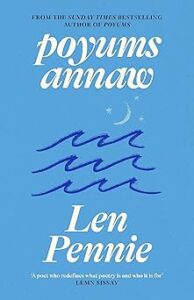 Poyums Annaw
By Len Pennie
The follow-up collection to her bestselling Poyums, this collection is just as fiery, honest and expressive as her debut. With poems on social justice, feminism, relationships and perseverance, it’s perfect reading for those looking for inspiration and ideas on living today.
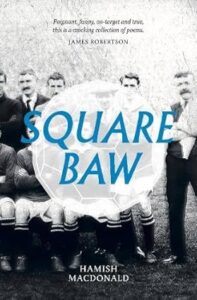 Square Baw
By Hamish MacDonald
A beautiful, nostalgic and robust collection of poetry on football and what it means for family, community and history. Hamish MacDonald gives a starring role in this collection to his grandfather who played at junior and amateur level and fought in the First World War.
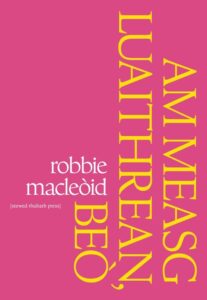 Am Measg Luaithrean, Beò
By Robbie MacLeòid
Robbie MacLeòid’s debut pamphlet is about transgression and rebellion in many forms. The bilingual poems are provocative and exciting, and break form and language to interrogate Scotland, sensuality, and sin.
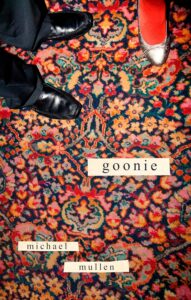 Goonie
By Michael Mullen
Goonie is the raw and joyful debut collection from award-winning Scottish poet and spoken word artist Michael Mullen. It combines the oral tradition of Scots with whip-sharp Glaswegian humour to bring alive in language and form the full spectrum of human connection, from family parties to city living, to a chat with a hairdresser, to abiding friendship and queer awakenings.
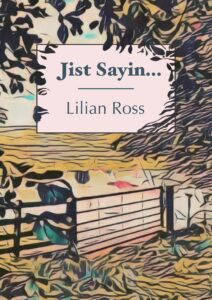 Jist Sayin’
By Lilian Ross
A lovely collection of short stories, poems, and prose based on the author’s own memories and observations of the folk and culture of Aberdeenshire, marrying autobiography and imagination illuminated with humour and intimate nostalgia.
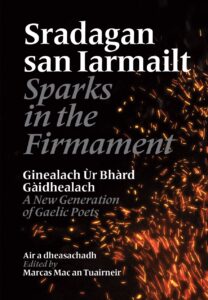 Sradagan san Iarmailt
Edited by Marcas Mac an Tuairneir
This anthology showcases the talents of Gaelic poets who have come to prominence since the turn of the millennium. The poems cover a diverse range of subjects including social concerns, identity, cultural exchange, love, land and language.
The Gaelic Writings of Donald Sinclair
Edited by Aonghas MacLeòid
Dòmhnall Mac na Ceàrdaich (Donald Sinclair, 1885–1932) is a crucial writer in the development of Gaelic literature in the early twentieth century. This study guide covers a range of issues and concerns in his work, including Scottish Nationalism, the Celtic Revival, land reform, migration, and religion.
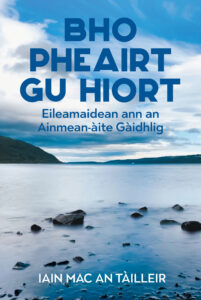 Bho Pheairt Gu Hiort
By Iain Taylor
This is a Gaelic deep-dive into place-names and explains all the most common elements that appear in place-names accross Scotland. By the end of the book, readers will be able to piece together the meaning behind place-names across the country.
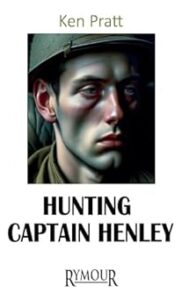 Hunting Captain Henley
By Ken Pratt
Young Billy Queen is angry. He’s going to find the English officer who bullied his dad in the army and probably kill him. This bold, powerful novel tracks the progress of a tormented boy who turns into a subversive man hell-bent on vengeance.
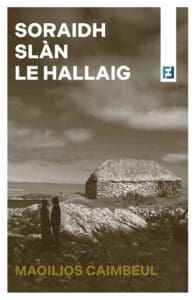 Soraidh Slan le Hallaig
By Myles Campbell
Hallaig, Raasay, 1853. There are rumours that the people are going to be evicted by the landlord, Seòras Rainy, who keeps a tight rein on them with unreasonable rules, including a ban on marriage. This Gaelic historical novel explores power, love and the fight between tradition and change.
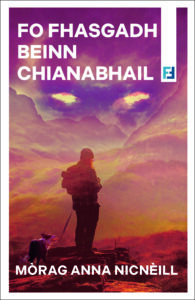 Fo Fhasgadh Beinn Chianabhail
By Mòrag Anna NicNèill
When Kenneth returns to the island after being away for years, he plans to make a good life for himself in his old house. But he soon realizes that things are not going to be as easy as he had hoped. This psychological, gothic thriller asks questions on home, madness, and the supernatural.
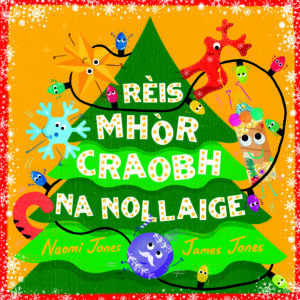 Rèis Mhòr Craobh na Nollaig
By Naomi Jones; illustrated by James Jones
A jolly Christmas story that sees three shiny friends race to be the star on top of the three. This picture book is geared towards children aged 3 – 7 years old.
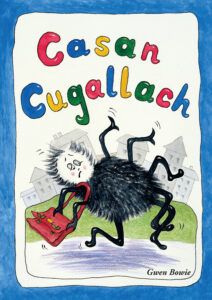 Casan Cugallach
By Gwen Bowie
Introduce yourself to the trials of Donaidh, the wobbly legged spider! This picture book is suitable for readers aged 3 – 7.
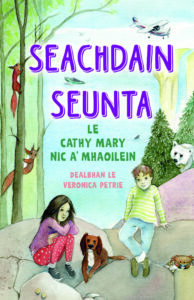 Seachdain Seunta
By Cathy Mary Nic a’ Mhaoilein
At the start of the summer holidays, Eilidh is disappointed that all the girls have gone on holiday to interesting places. Then she meets Patrick and they, along with Eilidh’s dog Peasan, end up going on a time travelling adventure! For readers aged 8 – 12.
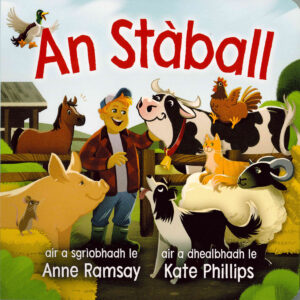 An Stàball
By Anne Ramsay
A gorgeous board book for babies and toddlers that will teach Gaelic words on animals.
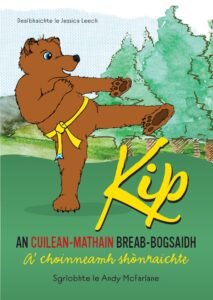 Kip an Cuilean-mathain Bhreab-bhogsaidh
By Andy McFarlane
Kip is a Scottish bear cub. He practices martial arts and lives by the guiding principles of Taekwondo: Courtesy, Integrity, Perseverance, Self-Control, and Indomitable Spirit. This is a heartwarming picture book for readers aged 5 – 8, that addresses themes of inclusivity and resilience.
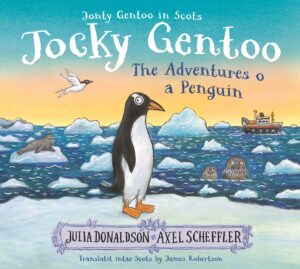 Jocky Gentoo: The Adventures of a Penguin in Scots
By Julia Donaldson; illustrated by Axel Scheffler; translated into Scots by James Robertson
Are ye aw set for a pole-tae-pole adventure? Jocky, a gallus wee gentoo penguin, is awa for the jaunt o a lifetime. But shairly he’ll no can hoddle aw the wey tae Antarctica? Ideal for readers aged 3 – 6 years old.
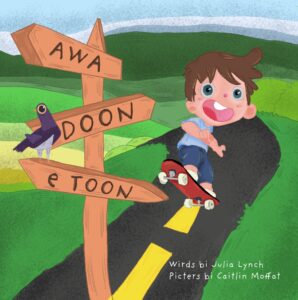 Awa Doon e Toon
By Julia Lynch; illustrated by Caitlin Moffat
In Awa Doon e Toon, we follow one boy as he travels into town but is thwarted by the unpredictable Scottish weather! This is a great introduction to Doric Scots for readers aged 3 – 6 years old.
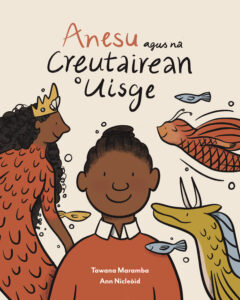 Anesu agus na Creutairean Uisge
By Tawana Maramba; illustrated by Ann Macleod
Anesu is nervous about starting her first day in a new school. Join her and her classmates as they share stories of mythical creatures from across the world, bringing them closer together. For readers aged 5 – 10.
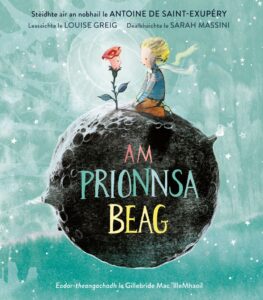 Am Prionnsa Beag
By Antoine de Saint-Exupery; adapted by Louise Greig; illustrated by Sarah Massini; translated into Gaelic by Gillebride Mac ‘IlleMhaoil
Scottish Gaelic translation of Louise Greig’s stylish adaptation of Antoine de Saint-Exupery’s children’s classic bestseller The Little Prince for younger readers. It’s enchanting fable of a pilot crashed in the desert who wakes one morning to discover a most extraordinary boy standing before him with stories of remarkable worlds and characters, each offering an insight into what is important in life.
David Robinson finds that Allan Radcliffe’s second novel, Blurred Faces, impresses him just as much as Radcliffe’s debut.
Blurred Faces
By Allan Radcliffe
Published by Fairlight Books
Tinder began in 2012, Grindr in 2009 and ever since then, I can’t help thinking, the meet-cute in film and fiction has been on its way out. Allan Radcliffe’s Blurred Faces, for example, begins like this:
‘David lives 1.07 miles away. I walk the blue line on the screen of my phone, the usual thrill and shame in my body.’
David (or Davie as he then becomes once introductions are over) answers the door, and within a couple of pages, he and Jordan are having sex. Barbara Cartland it ain’t.
You would have to loosen the stays of any traditional definition of romantic fiction to an extent before it would fit Blurred Faces. And yet – what’s this? – only a couple of days later, the two men are having a meal in a cafe-bistro on Edinburgh’s Elm Row, when Jordan spills a drink over his shirt, Davie tries to mop it up over a napkin, and their hands meet ‘in full view of the street’ and well, I’ll let Davie take up the story: ‘Course, my brain’s doing its dinger… I’ve forgotten how this is meant to work. Romance. Not that I’m looking.’
So yes, Romance. But straight afterwards, all its cliches undercut.
Or rather, reversed. Because that accidental meeting of hands is how romance used to begin in the pre-dating app age, those distant days when sex was something a relationship put some way off in the future rather than right at the starting post. The post-app age has different ways of expressing that state of wishful anxiety about hand-holding where one half of the couple doesn’t know whether or not their feelings are reciprocated by the other. These days, I presume, the equivalent is worrying over whether a text message like ‘Maybe we could meet again?’ counts as being too forward or whether putting an X at the end is too uncool. Jane Austen could crank out a whole chapter on how her heroines faced this precise emotional turmoil in Regency England. In the 21st century, all we can hope to match that with is a finger hovering over the Send button.
Yet so far, I must confess, I have been doing Allan Radcliffe – whose fiction I have admired since reading his McKittrick and Saltire shortlisted debut novel The Old Haunts – a disservice. Because the key question about Blurred Faces isn’t whether or not it is a romantic novel, but something that happens as soon as Davie opens the door to Jordan. And no, I don’t mean the sex.
What drives the entire novel is the fact that the two men – in their early forties, though both told the dating app they were in their late thirties – knew each other from school. Back then, when neither was out, Jordan was bullied relentlessly. Davie was one of the bullies – not the worst, but enough of one to feel guilty about it all these years later. Somehow, the fact that Jordan doesn’t remember this makes it all the worse. Is he just pretending not to recognise Davie from all those years ago or has he genuinely forgotten?
So that’s the story: a casual hook-up between Jordan, a language teacher from London on his first visit home for five years, and Davie, an unemployed barista who has just broken up with his boyfriend of 17 years. At the end of their first brief encounter, they go through the ‘panto of swapping numbers’ and that, you might think, will be that. A short story with an intriguing secret at its heart, but not a novel.
I can understand that critique. It was also made about The Old Haunts (another teacher coming back from London for a short-stay visit to his native Edinburgh) and I thought it was wrong there too. For one thing, the whole subject of just what it is that sparks a loving relationship from a casual encounter isn’t slight at all, but one of life’s great, delicious mysteries. Not only that, but it’s one that, of all art forms, the novel excels.
Why? Because it can handle complexity. In Blurred Faces that business of bullying at school isn’t the only buried secret between the two men. Both have lost a parent, and in the case of Jordan’s alcoholic dad, that death badly scarred the rest of the family. Both are emotionally fragile after having lost lovers: in Davie’s case, the collapse of his long-term relationship (one in which, significantly perhaps for our story, he and his partner never held hands) has left him feeling aimless, while Jordan is still shaken by his failure to realise that a younger man he had fantasised about wasn’t interested in him sexually.
The format – alternate chapters from either Davie or Jordan’s point of view – is an obvious way of showing what each of the characters is missing about the other. It could be clunky but here it’s not, mainly because of the ease with which Radcliffe slips between his characters’ past and present. Just to take one example, the moment Davie realises who he’s just had sex with, that he’d known Jordan at school, is only later that night in the gay pub when he is drinking to assuage his raging loneliness. There’s a snooker game going on in the background as he remembers, some of his ex-lover’s mates are pointing him out, and all of this registers at least as much as the first stirrings of guilt over Jordan. In a couple of paragraphs inside Davie’s head, you have slid back – first by four hours and then by three decades – and you have hardly noticed at all.
Initially, the two men don’t seem to have much in common. At that first meeting, for example, while Davie answers the door in a T-shirt advertising Ingliston Truck and Trailer Fest 2004, Jordan is ‘smart and sober, like he’d taken a wrong turn on his way to the Lyceum’. And although that dark schooldays secret hangs between them, they have other shared memories too. Both have lived through times when anti-gay prejudice was rife, when they would be terrified of being seen in a gay disco by any of their parents’ friends or anyone from school. And though some yobs catcall them as they walk down the street together, times have clearly changed; We’re mainstream now,’ Davie says. ‘We’ve assimilated.’
Radcliffe writes with an enviably economical and engaging style. The secondary characters do more than just triangulate the relationship of Jordan and Davie – Jordan’s brother Niall and his retired nurse mother are particularly well drawn. The Edinburgh background – the city has, according to VisitBritain, ‘the largest gay scene in the country’ – is equally true to life: indeed, with so many of the places mentioned retaining their authentic names, Blurred Faces is probably the most clearly Edinburgh-focussed novel I have read for a long time.
Blurred Faces, by Allan Radcliffe, is published by Fairlight Books, priced £10.99.
The latest exhibition at the National Galleries of Scotland is a celebration of the work of pioneering photographer Alfred Buckham. The accompanying book is packed with amazing images and explores his astounding working methods. Here are a selection of images from the book.
Alfred Buckham: Daredevil Photographer
By Louise Pearson
Published by National Galleries of Scotland
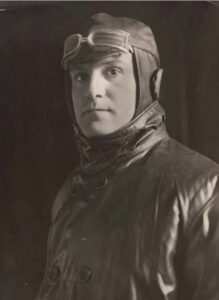
Alfred Buckham wearing goggles, unknown photographer, c.1918. Collection of Richard and John Buckham
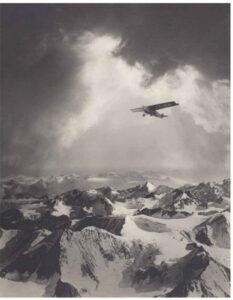
Over the Alps, c.1930. Collection of Richard and John Buckham

Edinburgh Castle, c.1918. National Galleries of Scotland. Purchased from Richard and John Buckham 2019.
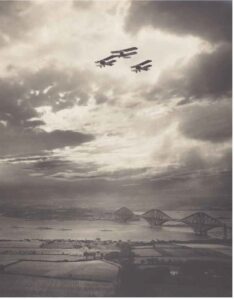
The Forth Bridge, c.1920. Collection of Richard and John Buckham
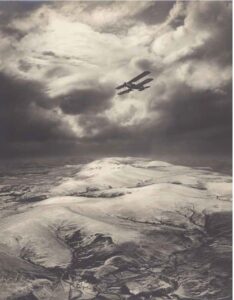
Sunset over the Pentland Range, c.1920. National Galleries of Scotland. Purchased with Art Fund support, 2008
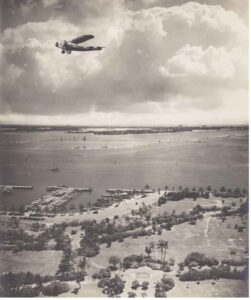
Miami, Florida, 1931. Collection of Richard and John Buckham
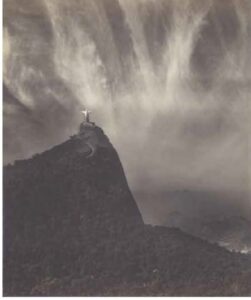
Christ the Redeemer, Rio de Janeiro, 1931. Collection of Richard and John Buckham
Alfred Buckham: Daredevil Photographer by Louise Pearson is published by National Galleries of Scotland, priced £19.99.
What would we do without our marvellous booksellers? They’re always on hand to give readers just the right book for any occasion. So as we near the festive season, and we think about gifts, who better as about their favourite Scottish books of the year. Here are some brilliant books from some of Scotland’s best booksellers!
Recommendations from Rebecca Wall at Night Owl Books, East Linton
Ingrained: The Making of a Craftsman, by Callum Robinson
Robinson’s intensely readable memoir is stunningly written, and incredibly broad in scope. Part nature writing, part coming-of-age tale, Ingrained skilfully explores the relationship between fathers and sons, the challenges faced by small businesses, and the importance of craftsmanship in an increasingly digital world. A well-deserved winner of the Indie Book Awards for Non-Fiction 2025.
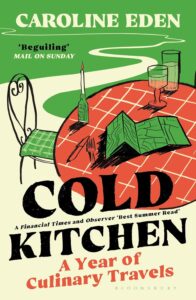 Cold Kitchen: A Year of Culinary Travels, by Caroline Eden
Journeying between the author’s kitchen in Edinburgh’s New Town and her travels to Central Asia, the Baltics, and beyond, Cold Kitchen is a mouth-watering exploration of the importance of food in our lives, and its ability to transport us across time and space without ever leaving the table. Divided into twelve chapters that chart the changing seasons of the year, each focusing on a single recipe and journey, this exquisitely written memoir is a must-read for anyone with an interest in food or travel.
The Mourning Necklace, by Kate Foster
Just when I thought I couldn’t love Foster’s writing any more than I already did, she released The Mourning Necklace, her third novel. Based on the true-life story of Maggie Dickson, a young woman who survived her execution by hanging in eighteenth-century Edinburgh, The Mourning Necklace is a moving historical novel that is bitingly relevant to our own times.
Recommendations from Lindsay Macgregor at Atkinson Pryce, Biggar
Witches: A King’s Obsession, by Steven Veerapen
This book provides a measured insight into the role of King James VI and I in igniting the witch-hunts which blazed across Scotland and England. It examines where our perceptions and stereotypes about witches emanated from and it explores, unflinchingly, how alleged witches were identified, tortured and punished. As Veerapen states, it’s “a sobering reminder that history is not always a progressive march to enlightenment but frequently one which sees many stumbles, wrong turns, and reactionary waves of violence and brutality.” I found it a fascinating read for anyone interested in early modern history, witch hunts, or the rationale behind the irrational.
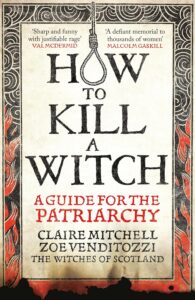 How to Kill a Witch, A Guide for the Patriarchy, by Claire Mitchell and Zoe Venditozzi
This is another fascinating book about women accused as witches, rich in historical detail but also providing insights on the patriarchal context in which witchcraft accusations flourish. The range of sources is impressive, including testimony from “experts” and witnesses, transcripts from trials, and portrayals of the women accused. I also appreciated the chapter on present-day witch hunts. It’s a harrowing read but the authors bring wit and compassion to a story which is as relevant as ever.
The Cadence of a Song: The Life of Margaret Fay Shaw, by Fiona J MacKenzie,
This biography relates the remarkable story of Margaret Fay Shaw, the American-born musician and folklorist who documented and preserved the traditions, lore and songs of the Hebrides at her home on Canna. The biographer, herself a noted musician with Gaelic fluency, brings knowledge and expertise to our understanding of Shaw’s life commitment, work and legacy. And I particularly appreciated anecdotes and insights from people who met and knew Shaw. A very engaging read whether or not you’ve come across Margaret Fay Shaw before.
Recommendation from Elaine Sinclair at Daydreams Bookshop, Milngavie
Kitten Heels, by Margaret Cullen
It’s full of wonderful Glasgow charm and patter. In essence, it’s a coming-of-age tale dealing with dark issues which faced many communities living by the Clyde in the 1960s, but it brings hope and humour at the same time. A real wee gem of a book.
Recommendations from Samantha and Stephen at The Nairn Bookshop, Nairn
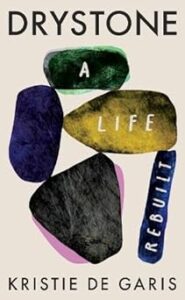 Drystone: A Life Rebuilt, by Kristie de Garis
With splashes of humour, this memoir skilfully sets out the difficulties of managing a childhood move from town to country, racism and bullying, and the traumas borne of an uncertain start in life. Never dwelling overly long on its powerful central image of drystone walling, this beautiful book illustrates how a shift in pace, embracing non-traditional work and family structures, and hard-won self-learning can make for a far more fulfilling life.
Fower Pessoas, by Colin Bramwell
A remarkable act of reimagining, this is translation, or rather transcreation, of Fernando Pessoa’s poetry into vernacular Scots is carried out with wit and playfulness, and with a cipher at its heart.
The River, by Craig A. Smith
An everyday epic, we meet protagonist Lachlan McCormack in a nursing home, then learn about his earlier life, drifting along with him. A brilliant book about how loss, love and shocks shape Lachlan’s life, with Scotland and its evolving politics as a gentle character in its own right.
Recommendation from Kirsty Smith at the RIAS Bookshop, Edinburgh
Art Deco Scotland by Bruce Peter
Beautifully illustrated with images and photographs from the HES archive and the author’s own collection this book is a comprehensive guide to architecture and design across Scotland in the interwar period. Alongside familiar buildings like Portobello Lido, the Dominion Cinema and Basil Spence’s Southern Motors Garage there is an impressive range of structures from all sectors documented within its pages. Some particular favourites are the surprisingly elegant power stations and colliery baths featured in the chapter on Industry and Energy and the fabulous story of the Bennie Railplane at Milngarvie.
Recommendations from Carly Penderis at The Wee Bookshop, Dollar
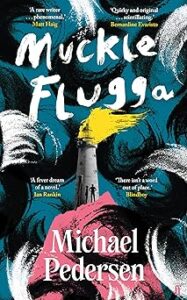 Muckle Flugga, by Michael Pedersen
I loved this lyrical explosion of a book . The prose rather like Michael himself just leaps joyously off the page and you can’t help smiling with delight. The narration is evocative and elemental and the story an intimate portrayal of love, loss, masculinity and island life. I adored this book.
Only Here Only Now, by Tom Newlands
A stunning debut novel. I devoured this book and fell in love with Cora the main character. Despite the setting amidst poverty grief and hardship it is hopeful and uplifting and written with such tender empathy – never patronising . I often still think of Cora and wonder what she is up to now …I’m delighted to hear there is a sequel on the way !
Recommendations from Molly Drummond at the Portobello Bookshop, Edinburgh
Foreign Fruit, by Katie Goh
Who Will Be Remembered Here, edited by Lewis Hetherington & CJ Mahony
Two of my favourite Scottish books this year (although it’s hard to choose) are non-fiction titles! Foreign Fruit is a measured yet powerful examination of the history, symbolism and travels of the orange told through the lens of Katie Goh’s family history. The Edinburgh-based writer begins their investigation with the fruit bowl on their parents’ kitchen table and goes on to cross continents and follow historic trade routes, all in the pursuit of big questions about memory, family and identity. Meanwhile, Who Will Be Remembered Here is a fantastic anthology from Historic Environment Scotland packed to the brim full of stories of queer spaces in Scotland, with a host of brilliant authors – like Damian Barr, Amanda Thomson and Ali Smith, to name a few – shedding new light on places in Scotland that matter to both their personal history and Scotland’s history at large.
If you’re of a certain vintage, and we are here at BooksfromScotland, it was a BIG DEAL who got the number one single slot for Christmas. And we all have our favourites. Marc Burrows has written an entertaining history about the pop charts at Christmas, and here he gives his thoughts on his five favourite number ones!
The Story of the Christmas No. 1: Mistletoe & Vinyl
By Marc Burrows
Published by McNidder & Grace
1) Slade – Merry Xmas Everybody (1973)
There are some Christmas songs that are non-negotiables. This is one of them. It’s built completely into the structure of our annual celebrations, to the point that Doctor Who, on more than one occasion, uses our familiarity with its opening bars as a quick short hand to say ‘this scene is set at Christmas by the way’. It’s almost impossible to be raised in Britain and not know Slade’s ‘Merry Xmas Everybody’. 50 years on, it’s written into cultural DNA. There’s two other reasons for picking it though, aside from sheer ubiquity. Firstly, this was the first true Christmas no. 1. It’s the one that started them all. Before Slade no-one had any real interest in what was number one at Christmas, after 1973 that changed. This was year zero for the tradition. Secondly, and I think this often gets overlooked, ‘Merry Xmas Everybody’ is an incredible pop single. Most Christmas songs, including Slade’s 1973 rivals Wizzard, instinctively go maximalist, throwing Phil Spector’s kitchen sink at the recording studio and drenching the clangs it makes with reverb and jingle bells. Slade don’t do any of that. This is a really lean rock song, with chords that slash rather than jangle, and a grounding shuffle beat. Jim Lea’s bass line, which dances in and out of the slashes, gives it some musicality, but otherwise this is rock n’ roll cut to the bone and then topped with one of the best set of pop lyrics ever written. Altogether now, ‘Does yer granny always tell ya, that the old songs are the best?’

2) Rage Against The Machine – Killing In The Name (2009)
It’s hard to think of a less Christmassy piece of music than the LA rap-metal agitators’ breakthrough song, but that’s okay. No-one ever said Christmas No. 1 had to be Christmassy, did they? Again, there’s two reasons for this being here. Firstly it’s a rock masterpiece. Literally one of the best rock singles ever recorded; an anthem for saying ‘no’, for fighting back against the narratives imposed upon us. Zak De La Roche’s lyrics, about a freed slave’s exhilaration when he finally refused his enslaver, resonate with anyone taking a stand against pretty much everything, up to and including, it has to be said, having to tidy your bedroom. And that brings us to the second reason. ‘Killing In The Name’ became Christmas no. 1 exactly for its spirit of riot and rebellion. 2009 was peak X-Factor, when Simon Cowell thought he owned the December charts. The campaign to get RATM to number one ahead of that year’s X-Factor champ, poor old Joe McElderry, was a nation saying, as one, “NO! This weird tradition is ours, and it’s too important to let a TV show dictate it to us”. Slade’s ‘Merry Xmas Everybody’ was the first time the Christmas No. 1 mattered to people … Rage Against The Machine was probably one of the last.

3) Mr Blobby – Mr Blobby (1993)
Look, it’s a horrible song. I know that. It’s musically irredeemable, it’s irritating, vacuous and almost painful to listen to. But hear me out, because that doesn’t matter. What matters is how gloriously, brilliantly weird its very existence is. No other country on Earth would have let this single get to number one, let alone in the biggest chart week of the year. In no other country, anywhere in the universe, probably, would a spoof kids TV monster invented to prank celebrities on Saturday tea-time telly become a symbol of oddly loveable anarchy. The whole Blobby story is completely unique, entirely British and monumentally bonkers. I’d be happy to never actually hear it again as long as I live, but good grief … what a time to be alive.
4) Band Aid – Do They Know It’s Christmas (1984)
I’m going to do something fairly unfashionable here. I’m going to go to bat for Band Aid. People will rightly point to Bob Geldof and Midge Ure’s song as a fundraising achievement, and as a cultural moment that redefined charitable giving on a national level. And fair play, that is absolutely its legacy. At the time Geldof said he didn’t care if people liked the song, as long as they bought it and saved a life. I can’t fault that. But I also think the focus on the context does it a disservice. ‘Do They Know It’s Christmas’ is a brilliant song. And yes, I’m aware that’s not a very fashionable view these days, and I’m also well aware that its lyrics are naive. You don’t need me to point out that there actually *will* be snow in Africa, somewhere, most Christmases. That it’s not a place where ‘nothing ever grows’, and that as there’s a 65% Christian population in Ethiopia, they probably do, indeed, know it’s Christmas. Despite all that, I think there’s a genuine heart and real charm to it. The way it was thrown together, dragged out of chaos with its rough edges intact still makes it sound interesting, far more so than any of its sequels. The lyrics are plaintive and heartfelt. Especially it’s most controversial line, Bono’s ‘Tonight thank god it’s them instead of you’. People point to that lyric as selfish or insensitive, but to me it’s urgent and genuine. There but by the grace of god go we. It hammers the point home, starkly, and Bono’s urgent delivery is what makes it. And, well, there’s no more powerful a phrase in pop, surely, than ‘feed the world’?
5) WHAM! – Last Christmas (2023/2024)
George Michael was always a tiny bit bitter about Band Aid. He was proud to be involved, obviously, and was fully behind the cause (even donating the royalties from ‘Last Christmas’ itself to famine relief), but he also resented it. Because ‘Last Christmas’ was meant to be his crowning moment – a fourth number one in 1984, following peerless pop masterpieces ‘Wake Me Up Before You Go Go’, ‘Careless Whisper’ and ‘Freedom’. Capping a perfect year. Plus George loved Christmas. He lived for it, buying his friends extravagant presents, even going carol singing around the neighbourhood. Christmas No.1 really meant something to him, and he hoped Band Aid would come and go in a single week, allowing his song to swoop in and take the crown at the last minute. Alas, it wasn’t to be. ‘Do They Know It’s Christmas’ proved unstoppable – literally the best selling British single of all time at that point. Which is a shame, because George really had composed a pop masterpiece, sad and lovely, soulful and a little bit raw. Fortunately, the evolving nature of pop media has been kind. Once downloads, and later streaming started to dominate the top 40 it opened the field for a myriad of Christmas classics to return to the chart every year. In 2023 George finally got his wish, alas too late for him to ever know. ‘Last Christmas’ went to number one in the week of December 25th, a feat it repeated the following year for its 40th anniversary. A belated, but extremely well-deserved triumph. There’s every chance it’ll be there again in 2025. Who knows, maybe ‘Last Christmas’ is now the ultimate Christmas No. 1? Forever occupying the holiest chart of the year. And would that really be such a bad thing?
The Story of the Christmas No. 1: Mistletoe & Vinyl by Marc Burrows is published by McNidder & Grace, priced £14.99.
Benbecula is Graeme Macrae Burnet’s addition to the excellent Darklands series of books published by Polygon. It tells the tale of a real life murder on the island in the 19th century as narrated by the murderer’s brother. We hope you enjoy this extract.
Benbecula
By Graeme Macrae Burnet
Published by Polygon
In happier times our family consisted of myself, my father, my mother, my three siblings and aunt – that is my father’s sister – who lived in a smaller dwelling a few yards behind our own and took most of her meals with us. Though they were not related by blood, my mother and my aunt were of such similar physical type, being likewise squat, big-bosomed and wide in the hip, that they were often taken to be twins. If it had been my father’s intention to seek the image of his sister when he had taken a wife he could have done no better. The weather in these parts is harsh. Throughout the black months our island is lashed with rain and gales blow continually off the sea. Women of my mother and aunt’s type are as well adapted to this climate here as the black-faced sheep that seem oblivious to the elements. They were ill-natured women and their conversation consisted mainly of plaints about their circumstances and the denigration of our neighbours.
My father was taller and lean in the face and body. When not anchored by a cas-chrom or flaughter you might fear the wind would carry him off. And feeble as he was in body he was likewise in character, being placid and biddable. I never heard him raise his voice in anger and he met good and ill fortune with the same apathy. Had he had the opportunity to be informed of his death at the hands of his own son, he would likely have replied, Ach, these things happen.
Of we four siblings Marion was the eldest and best, and it is her removal from this place that pains me most. She herited not from my mother’s side but my father’s, being slender and long-faced. She was strong and never one to shirk labour more fitted to men but there was a solemnity about her. Laughter did not come readily to her lips and she appeared to take more satisfaction in the service of others than in her own pleasure. Of John, the youngest, there is little to be said. He was my father’s replica in character but more simple-minded. He was not work-shy but required constant supervision and praise. We were none of us MacPhees greatly educated but John was incapable of learning anything. If he one day dropped a stone on his foot, he would the next day drop another stone on his foot and treat the pain he experienced with the same idiotic surprise. He was neither melancholy nor cheerful, and if there was ever a gathering of some sort it was difficult to recall if he had been present or not. Unless John takes it upon himself to procreate – and I fear he has not the wherewithal– I will be the last of the MacPhees of Liniclate. That is no bad thing. It is a poisoned lineage and no one round here shall lament our extinction.
Which brings us to the individual this narrative most concerns and who bears responsibility for my solitary existence. Angus was from the beginning quite singular. From the moment he could walk, he was never still. He would tear around the house upsetting whatever objects were set upon the table, unmoved by our mother’s reprimands. She often grabbed and slapped him mercilessly but this had no effect. Outside he would chase after livestock which greatly antagonised our neighbours. I do not think he intended any harm to the beasts he chased. Rather I think he was simply in thrall to his own impact on the world. As a child he continually indulged in pranks and would laugh uncontrollably if someone tripped on a wire he had set or was soaked by a pail of water he had balanced above a door. The beatings such transgressions earned him were no deterrent. Angus was never cowed by authority, whether that of the priest, his teachers or the ground officers who were on his account frequent visitors to our house. Despite this, there was something endearing about him. His laughter infected people even as they chastised him and he had a way of looking contrite and then casting up his eyes and smiling that disarmed even those who sought his punishment. On account of the five years which separated us we were not close. I did not enjoy the attention he attracted and would take myself as far from him as possible. As a result I acquired a reputation of being truculent and aloof and it may be true that I was what people supposed me to be. It was only when Angus reached the age at which certain changes visit the body that he became properly troublesome. Certain traits that may be excused in a child are less easily forgiven in a man. From the moment he grew hair on his balls Angus had a shameless fascination for those parts of his body and their functions that decency normally dictates are kept private. Perhaps on account of his degenerate habits, he ceased to grow beyond the age of fourteen or so. He was squat like our mother, but barrel-chested and powerful. When he moved across the landscape, he seemed to do so with preternatural speed. There was also something hideous in his demeanour. He had no nameable deformity, yet even those encountering him for the first spurned him. By this time I would be gathering seaware, hard at work on the rig or sometimes labouring for a few shillings on the dykes and tracks of the parish. Through this industry, I sought to differentiate myself from Angus, yet I was haunted by the sense that I was not his opposite but his mirror image.
Benbecula by Graeme Macrae Burnet is published by Polygon, priced £12.00.
David Robinson finds a lot to love in Andrew O’ Hagan’s collection of essays On Friendship.
On Friendship
By Andrew O’ Hagan
Published by Faber
One day next spring I will climb Cairnpapple Hill. I will only go on a clear day, because the whole point of Cairnpapple Hill – about three miles north-east of Bathgate - is that from it you can see both of Scotland’s coasts. It is, Wikipedia tells me, a Marilyn (meaning that it is at least 150m high) and has been used as a ritual site for at least 4,000 years. That’s two facts I didn’t know, and when I check how far away it is, there’s a third: by car it will only take me 45 minutes to get there. Easy.
Yet when I do go up Cairnpapple Hill (the site reopens in April), it won’t be for any of those reasons. It will be because of Andrew O’Hagan’s latest book, On Friendship. In it, he writes about walking there with his friends Karl Miller, the writer, critic and founding editor of the London Review of Books (where O’Hagan is editor-at-large), and Seamus Heaney. I have interviewed Miller once, O’Hagan four or five times, and Heaney not at all. I can imagine their friendship – just – but I can’t imagine the view.
Both Heaney and Miller are dead now, but that hasn’t wiped them from O’Hagan’s consciousness. If anything, the opposite has happened. ‘Death,’ O’Hagan writes, ‘doesn’t really end friendship; it sanctifies it. It makes the closeness permanent.’ Or again: ‘The greatest friendships can never really end. They embody one’s basic faith in togetherness: you are just another body suspended in air until someone puts out a hand to you.’
Look again at those quotes and try to find grief in them. If it is there at all, it is buried in gratitude, or appreciation of how friendship brings out the deepest joys in life – ‘all the sweets of being’ in Boswell’s phrase from A Journal of a Tour to the Hebrides as he looked back on the conversations he had enjoyed with Samuel Johnson.
O’Hagan’s friendship with Heaney, Edna O’Brien and so many more leading writers mentioned in this book – sometimes while making their own tours in these islands – is similarly joyous and vitalising. Nor is it remotely one-sided: the framed and personally inscribed manuscript of Heaney’s poem ‘Postscript’ in his Primrose Hill home is testament to that, as is the fact that O’Brien chose him to give her eulogy at her funeral last year. Proof, if any were needed, that alongside his talents as a writer, Andrew O’Hagan has an impressive talent for friendship too.
We already knew that from his ‘almost completely autobiographical’ (his words) 2020 novel Mayflies. In it, Jimmy, the bookish teenage narrator, goes with his best friend Tully and their working-class Ayrshire mates on a booze-and drug-fuelled weekend of music and mayhem in 1986 Manchester. Thirty years later, when he has carved out a successful career as a writer in London, Tully tells him he has terminal cancer and asks him to ‘help him across the line’.
That happened in real life when Keith Martin – the charismatic lead singer in their short-lived band Big Gun – got in touch in 2017. O’Hagan was already well into writing what he had always planned to be his magnum opus, Caledonian Road, a state-of-the-nation novel (61 characters, 641 pages, 10 years in the writing) which covers an almost indecently wide stretch of society, ranging from polo-playing royal hangers-on at Windsor to Bangladeshi women sweatshop workers in Leicester. But the demands of friendship couldn’t wait, and he put it aside to work on the narrower, but arguably deeper canvas of a 1980s teenage kicks seen through the prism of a middle-age Scottish litterateur in London.
On most readings, those two worlds don’t mix. The successful Scot returns 30 years on and is embarrassed, or condescends, or feels guilty. He has left his roots behind, grown out of his long-ago friends, gone on to better things. Yet that’s not the story in Mayflies, nor is it the story in O’Hagan’s own life. His working-class teenage friends, he insists, were as bright and sparky as any he has met since, even though as editor-at-large at the London Review of Books, he met any number of bright and sparky people. In fiction as in real life Jimmy/O’Hagan doesn’t dream of quietly dropping them. Because not only can true friendships endure, but sometimes the people that we meet when we are still only partially grown-up are the best people we ever will meet.
There is, in other words, an impressive social breadth behind O’Hagan’s writing in general and his writing about friendship in particular. Keith Martin’s death made him realise that ‘friendship was a subject that had laid unannounced at the centre of my writing life’. In On Friendship he puts it in focus, from the early friendships formed with neighbouring boys on his Irvine scheme (‘the first great challenge of our social lives is to find a friend who might somehow match our capacity for wonder’) to arranging a first meeting with Edna O’Brien for dinner at the Wolsey (‘Ask for the corner table,’ she tells him. ‘Lucien Freud’s table. If he’s not there they always give it to me.’)
In eight elegant essays, O’Hagan expands his thoughts on friendship to include lost friends, pets, imaginary friends, and workmates. Throughout, he insists on its importance: as great or greater, in most of our lives, than romantic love. A good friend, he says, ‘is a lesson in empathy that no one can do without’, but he sets the bar high. Friendship demands the best of us: not taking offence when offence is implied; resisting making everything about you; being generous when down on your luck; lightening someone else’s mood when feeling low yourself; defending your friend when it would be easier to keep quiet or drop in a bit of poisonous gossip. And because true friendship IS so important, it’s pointless wasting one’s time on false friends, those ‘who think everybody is a contact’, and those who just enjoy the psychodrama of involving someone else in their own angst.
Maybe, he fears, true friendship is becoming rarer. Perhaps the nature of friendship did indeed change between 1990 and 2010 with the advent of the internet and social media. As I write this, for example, a story appears in my news feed telling me that 54 per cent of Americans ‘have some sort of relationship with an artificial intelligence platform’ and that for 28 per cent of them that relationship was ‘intimate or romantic’. What does this mean for friendship? Will our best friends soon be bots? Has ‘friending’ someone on Facebook, Instagram or Twitter, where we know precisely what version of themselves they want to project to the world, replaced befriending someone in real life when we find out what they think for ourselves?
Yet even such a potentially wonderful thing as true friendship has limits. Sex is one of them, but so too is asking a question like ‘What do you really think of me?’ Walking up Cairnpapple Hill or anywhere else, a true friend wouldn’t need to ask.
On Friendship by Andrew O’Hagan is published by Faber, priced £12.99.
Poor Creatures in Mairi Kidd’s latest historical novel which looks at Mary Shelley’s time in Scotland as a teenager and imagines its influence in the creation of Frankenstein. We chatted to Mairi Kidd about the genesis of the book.
Poor Creatures
By Mairi Kidd
Published by Black & White
Mairi, I’m sure it’s lovely to see another novel of yours out in the world; what can you tell our readers about Poor Creatures?
Thank you – it’s a strange and slightly scary time, when the book becomes ‘real’ after being a file on a laptop for so long!
Poor Creatures introduces readers to a group of wild, wonderful and occasionally wretched women, all of whom lived in the early years of the nineteenth century. There’s Margaret, a seamstress imprisoned in Bedlam, and Isabel, the teenage daughter of a family of Dundee radicals. Harriet is the very young, pregnant wife of a poet trying to cope with an itinerant existence. Mary-Jane is a translator and publisher eking out a living in London and struggling with the trials of being a second wife and stepmother.
What all of these women have in common is a link to Mary Godwin, better known by her married name of Mary Shelley. When Mary was a teenager, she was sent away from home, first to Ramsgate and later to Dundee. The book picks up her story as she arrives in Scotland, and forms an intense bond with Isabel. In writing it, I wanted to do some ‘visible mending’ where there are gaping holes in Mary’s story, and invite the reader to consider how Frankenstein may have cast a shadow over Mary, and Mary in turn over the other women in her life.
What drew you to this part of Mary Shelley’s life?
The idea was actually suggested to me by my publisher. I had been in a TV programme about Mary Shelley’s links with Dundee, and then had rather put her out of my mind. When Ali McBride at Black and White asked if I thought there was a book in it, I did initially wonder whether there was anything new to say. I started researching fairly idly, and the first thing that happened was that I wondered some more about whether there was a story there, because there is a real paucity of material about that period in Mary’s life. But I kept on reading, and then it seemed that alarm bells were going off in my head constantly. It’s a period in which absolutely unthinkable things happened. A girl is sent away from home, apparently because there is something wrong with her arm. Somehow this arm issue affects her father’s trust in her. A man marries a girl half his age, she dies – we know not how – and then he marries her younger sister. A poet runs away with a schoolgirl, then abandons her and runs away with another schoolgirl. Two young women kill themselves. It’s all hugely troubling, and it seems to me that there has been a distinct lack of curiosity about these events among Mary’s biographers. Lots of things are taken at face value, ignored, or explained away. One might begin to suspect that the paucity of records could have happened on purpose…
Once all that was in my head, I decided I thought there was a novel in it after all – but I didn’t just want to focus on Mary. I wanted also to explore the other women in her life.
You focus of the kinship, loyalties, and jealousies between friends and sisters rather than the characters romantic relationships. Why did you make this choice?
There are two slightly different answers to this.
The first is simple(ish): when we meet Mary and Isabel in the novel, they are very young, and so it seemed to me natural that friendships versus love affairs would be central to their lives. We know their friendship was important to Mary because she wrote as much down; a break came later, and when they met again, Mary told people that Isabel was mad. That seems to me a pretty unpleasant thing to do to one’s supposed friend today, let alone in Regency England where reputation was all-important. That action of Mary’s makes me even surer that the friendship was quite an intense one; I see the falling-out as the flip side, the hate as fierce as the love.
The second answer is that I wonder about the Mary/Shelley relationship. Shelley didn’t believe in monogamy and there were always other women around. Some of them may have been around because Mary invited them, which is slightly disturbing. Did she arrange them as proxies? When Shelley died, Mary did not remarry and later in life she would say she became ‘tousy mousy’ for other women. I wonder whether her relationships with women were actually the major relationships of her life.
Alongside all this, I was also interested in playing with ideas of how Isabel and Mary might have – separately and/or together – started to become writers. We know Mary wrote as a young girl, but those papers were also ‘lost’.
You often write about history from a woman’s point of view, would you ever consider writing a novel in a contemporary setting? What is it about history that fascinates you?
I suppose I was pre-destined to be interested in history; my mum was a history teacher, my dad studied history, and I come from a long line of people who told stories of a type that might be called oral histories. I’m not the right person to be a historian, though, I always want to go a step further and try to imagine how people felt, how they thought – to step into their shoes, I suppose. Conjuring a world through places and things is such a lovely thing to do – it’s something historical fiction shares with fantasy, that element of world-building. It also lets us do that ‘visible mending’ trick of writing people back into the story, and for me that’s so important as women have been so badly neglected – or straight-up traduced – in traditional histories for so long. Of course it also lends us a lens to look at contemporary issues, how we have progressed – or not – and the roots of issues that may still plague us today. That’s the appeal for me.
I have written contemporary pieces for stage and TV and I have modern novel drafts at various stages from various periods in my life – they don’t half date quickly, though! I would never say never to writing about the present day; if I thought the time and the idea were right, I would certainly give it a go. The next book I’m working on is set further back than Poor Creatures, but the one after that does come forward in time quite a bit. It’s not modern, but it feels modern by comparison with my last books.
There’s a cheeky epilogue in the story concerning an old doll. Without giving any spoilers, what were you looking to explore with that addition?
I had fun writing that part. It’s partly just about the unknowability of the past and how easy it can be to overlook significance, while, simultaneously, many of us attribute all sorts of significance to old objects and may have a desire to own them – almost to ‘own the past’. It’s partly a tribute to textile crafts and all of the things women (and children) owned and made in history that haven’t been recognised as important, whether tangible or intangible. The doll appears elsewhere in the book, too, where it links to the Frankenstein idea of an inanimate object made animate. And I suppose I wanted to play with the idea of dolls as slightly uncanny. The doll is based on two separate real-life examples, one of which conceals a secret (readers can find out more in the end-notes if they wish). Oh, and it’s also my little tribute to one of my favourite books, A.S.Byatt’s Possession, but I won’t say any more on that for fear of spoilering!
What do you think Frankenstein offers the modern reader? Why is it still relevant today?
I think Frankenstein can be read in all sorts of ways. I spoke with a writer recently who saw the creature as an analogy for AI; I see him as reading across to a lot of modern bioethical debates, to the climate crisis, to the ways that children and young people – and indeed all of us – are being reprogrammed in a way by social media. It’s very human to create something, unleash it, and only then ask questions about what might happen next.
It is, of course, also a classic work of Gothic fiction and Gothic fiction is perennial; if Angela Carter was right in the 70s to say we lived in ‘Gothic times’, the modern world must be reckoned at least as challenging.
There is also something amazing about the fact that this book was written by such a young woman. I don’t think I ‘like’ Mary but I am fascinated by her and I do think she was – as a writer – a genius.
Now that we are nearing the end of 2025, what has been your favourite Scottish book this year?
That’s a tough question, there have been many wonderful books this year. In my day job at the Saltire Society, we deliver The Saltires, Scotland’s National Book Awards and I am very glad I only administer and don’t judge! I was lucky enough to go to Germany in Spring with Scottish Books International and discovered David Farrier’s gorgeously written, fascinating, clever books on the trip, so I will pick Nature’s Genius as a favourite among favourites.
Poor Creatures by Mairi Kidd is published by Black & White, priced £16.99.
Lari Don is a powerhouse when it comes to children’s books on Scotland’s myths and legends. Her latest book widens her scope across all the Celtic nations, and is a beautiful collection of tales with stunning illustrations from Elise Carmichael. We asked Lari to tell us about her inspirations.
Celtic Folk and Fairy Tales
By Lari Don, Illustrated by Elise Carmichael
Published by Floris
Celtic Connections
I’ve always loved stories about kelpies, changelings and selkies. I’ve always loved Scottish traditional tales. Not in a ‘my stories are better than your stories’ way, because all traditional tales are wonderful and valuable, but in a ‘these are the unique stories from the land and landscape I know and love, let me share them with you!’ way.
So, I remember being a bit … surprised, when I realised that shapeshifting waterhorses weren’t just a Scottish thing. There are, for example, shapeshifting waterhorses in Ireland, Wales and the Isle of Man. The name may be different – each-uisce, ceffyl dŵr, glashtin, rather than kelpie – but the magical beast is equally beautiful and dangerous. (Discover my version of the Manx waterhorse story from Celtic Folk and Fairy Tales in this video!)
And it’s not just Scottish fairies who steal children and leave changelings in their place, or who mess about with time. There are Irish changelings, and Breton fairies have odd time-twisting powers.
And it’s not only on Scottish coasts and islands that people tell tales of seals who shed their skins and become human. There are selkies swimming, singing and dancing on other shores too.
At first I was surprised. ‘Oh, these stories aren’t just Scottish?’ Then I was excited! Because I’ve always been interested in the connections between stories told in different places, stories that are spoken out loud rather than written down, stories that travel with people as they move around the world.
So are there waterhorses and selkies everywhere? No, it turns out, there aren’t. Not many of them, anyway. Some stories are genuinely international, for example dragons roar in many locations, and Cinderella-type tales are ancient and very widespread. But these tales, the waterhorses who want to steal you away and eat you, the fairies who mess with time and steal babies, the shapeshifting seals, are mainly told in… the Celtic lands. (Not just here, though. I’m sure someone will be able to tell me about similar stories elsewhere, and I will be excited about those too!)
However, there are specific magical images, beings, monsters and lore – particularly shapeshifters, strong women, water creatures and human-sized fairies – which tend to turn up, similar but with intriguing differences, in one particular part of the world. In the lands on the northwest coast of Europe: Scotland, Ireland, Wales, the Isle of Man, Cornwall and Brittany. Lands connected by similar languages, and by the sea, which in the past was often an easier way to travel than by land.
As I learnt more about tales from other Celtic lands, I became fascinated by them too. That’s why I wanted to create a collection of Celtic tales, to share my fascination and love of these magical stories.
Celtic Folk and Fairy Tales is that collection! Filled with waterhorses, fairies, monsters, giants, piskies, selkies and so much magic! And every story is beautifully illustrated by the wonderful Elise Carmichael.
I hope you find this collection of tales fascinating, and possibly a wee bit surprising, just like I found the kelpies’ Celtic cousins…
Celtic Folk and Fairy Tales by Lari Don & illustrated by Elise Carmichael is published by Floris, priced £16.99.
Francine Toon follows up her McIllvanney prize-winning debut, Pine, with Bluff, another gothic thriller, this time set in the fictional coastal town of St Rule, inspired by St Andrews. We spoke to Francine about Bluff.
Bluff
By Francine Toon
Published by Transworld
Congratulations, Francine, on the publication of your new novel, Bluff. Tell us what you wanted to explore in writing it?
I think we all have that one friend we lost touch with from school. I wanted to explore the idea of trying to look them up online and finding nothing. When my main character, Cameron, returns home to Fife for Christmas, he starts to become worried when no one seems to know what happened to his friend Joanie, last seen at a post-exam party, ten years ago.
I also wanted to explore the area of north east Fife where I spent my teenage years, and how things that happened in the past can create a butterfly effect in the present.
Your debut, Pine, had a fantastic reception. Did you have the difficult second novel syndrome when you were writing Bluff?
I think I did, yes. It was a learning process for me, finding my way into the story. Bluff took on a number of different forms before this one, which I think is the most compelling and satisfying – I really hope readers enjoy it.
Though Bluff isn’t quite dark academia, the social perils of life at that late-teenage stage is a key component to the plot. Why do you think the dark side of university life and the university town is proving so popular to readers just now?
The world is quite a daunting and often scary place right now. I think there is something comforting about being cloistered away in a medieval university town, like the one in Bluff, even if there are dark histories to explore. I definitely felt that way actually living in St Andrews, which I’ve reimagined slightly differently as the town of St Rule in my novel. Who doesn’t want to puzzle over an ancient manuscript with a cup of tea in the university library? We could all do with a bit of escapism. It’s also an environment that can become claustrophobic and intense, even ritualistic – which definitely captures the imagination.
Your settings are always atmospheric and add that sense of gothic menace to your novels. What is it about the Scottish landscape that inspires this in your writing?
I feel lucky to have spent my formative years surrounded by sprawling pine forests, windswept beaches, crumbling castles and gothic architecture. How could I not write about them? Some writers are inspired by the landscape to write romance but I have always been drawn to darker mysteries, influenced by stories I heard growing up of ghosts, witches and Viking burial sites.
Bluff is written with a dual-timeline narrative. How do you manage to keep on top of the challenge of maintaining the suspense and providing the reveals at the rights times?
Well, it certainly was a challenge to get two timelines to sync up and interact with each other, at least at first. At one stage I had a list of plot beats and mapped out how the chapters would all work together. Towards the end of the editing process, making changes such as moving a chapter or taking one out altogether meant that it had a knock on effect for the whole book!
Were there any books and/or authors that inspired your writing this time round?
Iain Banks was definitely looming in the background of the writing process. My main character Cameron was inspired in part by Prentice McHoan, the protagonist of The Crow Road. I was drawn to his easy going, sometimes humorous narration as he returns home and tries to piece together clues from the past. The dark academic setting of Donna Tartt’s The Secret History also played on my mind.
We’re coming to the end of 2025, so we’re asking what has been your favourite Scottish book you’ve read this year?
That’s a really hard question as I have read so many great Scottish books this year! I think it would have to be Ootlin by Jenni Fagan, which is beautifully written and incredibly moving. I raced through it. I also really enjoyed One Came Back by Rose McDonagh and Idle Grounds by Krystelle Bamford.
Bluff by Francine Toon is published by Transworld, priced £16.99.
ALSO ON BOOKS FROM SCOTLAND
-


Saltwater: A Midsummer Ghost Story by Elaine Thomson
‘The very thought of those grey faces made my skin grow cold.’
-

‘An Odious Campaign’ by Rob McInroy – Why a 1936 By-Election Still Resonates
‘This enraged the locals and he came close to being run out of town on several occasions.’
-

‘‘That’s right, Bobby,’ he growled. ‘I haven’t seen you in – well, since you decided to kill me.’ ‘
-

David Robinson Reviews: Solitary Agents by David Goodman
‘This is very much an up-to-the-minute story of spycraft, positively revelling in all the things tha …
-

The Savage Landscape by Cal Flyn
‘It is their resistance to the intrusions of the outside world − culturally, economically, environme …
-

The Shortest History of Scotland: A Q & A with Murray Pittock
‘We need to be better aware of that to understand the challenges and achievements of the past, and t …
FEATURED AUTHOR:
Kirsty Logan

Kirsty Logan is the author of the novels Now She is Witch, The Gracekeepers, and The Gloaming, the short story collections A Portable Shelter and The Rental Heart & Other Fairytales, the flash fiction chapbook The Psychology of Animals Swallowed Al …
FEATURED PUBLISHER:
Sparsile Books

Sparsile Books is a small independent publisher, based in Glasgow, specializing in high quality fiction and non-fiction. We see publishing as an art in itself, and we work closely with our authors to ensure that the books we publish give readers a uniq …