


And if you can’t get enough of Tam o’ Shanter-inspired children’s books, we have another adventure hot on the heels of Victoria Williamson’s Hag Storm. Garry Stewart’s The Shanter Legacy has his protagonists Fin and Fiona swept into a magical, mystical world on a quest to find Meg the mare’s grey tail. Are they a match for the fearsome druid, Morbidea? You’ll have to get a copy to find out! But first, enjoy this extract, as Fin and Fiona are introduced to what’s in store for them . . .
Extract taken from The Shanter Legacy
By Garry Stewart
Published by Tippermuir Books
31 october 1804 — start of the strangest day
Once downstairs, steaming bowls of porridge and cups of warm milk awaited the children. The fire blazed in the hearth as Finn’s wooden spoon scraped the last morsel from his bowl. He always finished first.
‘Mum,’ he asked ‘will you count my freckles later? I think I’ve got a new one.’
‘I’ll count them tonight at bedtime but I haven’t noticed any new ones.’
‘It’s not fair. I hate having freckles.’
‘Well, you shouldn’t. Freckles are faerie kisses, kisses they only give to the bonniest of babies. They’ll bring you luck.’
‘You are just saying that to make me feel better.’
Fiona was waiting impatiently for the freckle talk to stop. She wanted to ask her mother something much more important.
‘Mum, Tilly Tulloch’s granny says this is the worst winter that anyone can remember.’
Fiona’s statement was calculated to bring her mother out of herself. Kate had seemed preoccupied lately.
‘Is that so?’ Kate stirred the large pot over the fire without looking up.
‘Aye, and she says it’ll get worse. She was talking to big smiddy Jock and he said that the Earth would get as hard as iron, harder than the shoes he was putting on the minister’s cuddy.’
Kate swung the pot around the griddle away from the direct heat of the fire and joined the children at the table. Smiling, she smoothed her apron and tucked a wayward strand of hair behind her ear.
‘Granny Tulloch’s imagination is famous in these parts. She never could put plain words to things.’
Fiona pressed on despite her mother’s attempts to avoid the subject. ‘She said there was weirdrie in the way the weather had turned.’
‘If there’s weirdrie in anything it’s in Granny Tulloch’s head,’ said Finn. His interruption was intended to be humorous but it was too close to cheek for his mother to let it pass.
‘Finn, if you can’t speak well of your elders then it is best to say nothing at all.’
‘I didn’t mean anything by it mother, it was just a wee joke.’ Finn loved practical jokes and sometimes his love of fun meant he carried things too far.
Fiona was angry that his attempt at humour had stopped her questioning her mother and blurted out, ‘Granny Tulloch said the weirdrie in it was our father’s fault. She said he spoiled the witches’ dance.’
Kate’s voice was firm as she held Fiona’s gaze with determined hazel eyes. ‘That’s enough Fiona, we’ll not have old wives clishmaclash at this table.’
But Fiona was not to be put off. She could tell from her mother’s tone that she was on the right track. ‘She said the weather had been dreadful on the seventh solstice and that the fourteenth would see the powers of the dark triumph over good. She said it was our father’s fault.’
‘That’ll do, Fiona.’
‘No, it will not do, Mother.’ Fiona’s anger and frustration had caused her to top her mother vocally and all three were stunned into silence. Finn sat gawping, looking from one to the other. He’d never heard Fiona speak like that to their mother.
Kate repeated herself quietly. ‘I said that will do. Your father was a good man, Fiona. We’ll not listen to superstitious rumours about him.’
‘Mother, what’s going on? Everything’s different. You’re different. The neighbours whisper when they see us in the town; the weather is scary. Something unnatural is happening and everyone thinks it’s to do with us.’
Finn was not at all sure about what was going on. He’d not noticed anything unusual apart from the weather being exceptionally bad and Fiona being a bit odd. But she was a girl and an older sister at that. Girls were always behaving in odd ways. All the same, he was beginning to feel a bit uneasy.
‘Is Fiona alright, Mum? Has she maybe banged her head? Should I get a poultice in case her brain melts through her ears?’
Rising from the table Kate crossed to the fire and gracefully lowered herself into the armchair. She motioned the children to come and sit on the floor at her feet. Fiona felt the excitement rise inside her. Her mother never sat at the fire after breakfast, there was always too much work to be done. They were always given a list of chores to be tackled right away. Even Finn realised that this day was already beginning to be very different from any he could remember. The children settled on the warm hearthstone and listened eagerly.
‘Fourteen years ago,’ Kate began, ‘when you were just a baby, Fiona, your father disturbed a coven of witches gathered at Alloway Kirkyard. When the witches spotted your father they chased after him. He rode Meg as fast as she could gallop but the witches caught up with them as he and Meg approached the bridge over the River Doon. You see, witches cannot cross running water. Just as your father raced across the keystone of the bridge one of the witches reached out and caught Meg by the tail ripping it clean off, leaving poor Meg badly wounded.’
‘That’s my nightmare,’ Fiona knelt up gripping her mother’s skirt. ‘I dream it every night.’
‘Your nightmare is real, Fiona.’
‘But I never find out what happens next. I wake up just as the witch rips Meg’s tail off. How does the nightmare end?’
‘It hasn’t ended, Fiona. The worst is still to come.’
‘So where is Meg’s tail now?’ asked Finn.
‘They say it was taken to a dark and evil land called Dracadonia where it was presented to a Druid queen, the beautiful but deadly Morbidea. A powerful and potent magic was bestowed upon the tail. Tonight, the night of the Samhain, Morbidea will absorb that magic and use it as the key to a mystical portal, the Yett of Abandoned Time, allowing her armies to flood through the portal wreaking vengeance and destruction upon our world.’
‘Tonight?’ gasped Finn, fear showing in his eyes. ‘This will happen tonight?’ Finn searched his mother’s face for some kind of reassurance but Kate could only nod in response to his question as she stared into the crackling flames of the fire.
‘Why do they want to attack our world? What have we ever done to them?’ asked Fiona.
‘Many thousands of years ago Morbidea’s ancestors were part of the elite Druids who ruled the ancient Celtic world. They revered and worshipped Mother Nature. One however, by the name of Morrigan, turned her back on those beliefs and began to learn the secrets of a dark and evil magic. Her followers became known as the Dark Druids. Mannan, the king of the Celts banished her and those who followed her to the underworld. Morrigan’s descendants have searched for ways back, intent on erasing all history of the elite Druids, destroying their stone circles and sacred mounds, eradicating the land and people of their memory for ever. Morrigan is long dead but it is said her descendant, Morbidea, now has the power to open that portal and lead her armies in a war of revenge.’
‘Can’t anyone stop her?’ Fiona asked. ‘There must be a way.’
‘Our world is about to change, my dears. We will have to survive as best we can.’ Kate stood and smoothed her apron as Kirsty lifted her head in anticipation. ‘Now we have work to do and we are far enough behind as it is. We’ll talk again tonight. Don’t worry. I have a plan that will keep you both safe.’
The Shanter Legacy by Garry Stewart is published by Tippermuir Books, priced £8.99.
When William McIlvanney, one of the crime writing greats, passed away in 2015, he left a handwritten manuscript of the infamous Laidlaw’s first case. Years later, Ian Rankin is back to finish what McIlvanney started – two iconic authors bringing to life the criminal world of 1970s Glasgow, and Laidlaw’s relentless quest for truth. David Robinson reviews.
The Dark Remains
By William McIlvanney and Ian Rankin
Published by Canongate
In Val McDermid’s new novel 1979, set in Glasgow in that year, there’s a moment when her journalist protagonist remembers the first time she read William McIlvanney’s Laidlaw. ‘It was set in a working-class Glasgow she recognised immediately,’ she notes. ‘She was intrigued by the quality of the prose, which was an uncommon feature in the detective stories she’d previously read.’
This is one of those moment when fiction hovers close to autobiography, because in 1977, when Laidlaw came out, McDermid was a 22-year-old reporter working on the Daily Record. She bought a copy and had a similar epiphany. ‘From its opening chapter,’ she has written, ‘I’d never read a crime novel like this. Patricia Highsmith had taken us into the heads of killers; Ruth Rendell had explored sexuality; Alexander McArthur had exposed Glasgow to the world; Raymond Chandler had dressed the darkness in clever words. But nobody had ever smashed those elements together in so accomplished a synthesis.’
It’s this shock of Laidlaw’s newness, back in 1977, that we should keep in mind. To recapture its freshness, try unimagining 27 seasons of Taggart and the entire output of the Glasgow Branch of the Tartan Noir Writers’ Union. The debt to McIvanney isn’t any smaller at the other end of the M8. In 1985, for example, Ian Rankin – just 25 and still with no published book to his name – tentatively approached McIlvanney at the Edinburgh book festival, and told him that he was working on a crime novel ‘that’s a bit like Laidlaw, but set in Edinburgh’. ‘Good luck with the Edinburgh Laidlaw’ McIlvanney wrote in Rankin’s copy.
With The Dark Remains, in which Rankin has completed a half-written manuscript McIlvanney left behind when he died in 2015, he has repaid any lingering literary debt in full. McIlvanney fans will want to read it, and so will Rankin’s own worldwide army of followers: I fully expect it to be bobbing at or near the top of the hardback fiction bestseller charts for months on end. Yet because the two writers are so distinct, I can understand anyone feeling a certain degree of apprehension too: yes, this could easily be a book in which Rankin’s virtuosity with plot enhances McIlvanney’s visceral characterisation. But what if becomes a Rankin novel not a McIlvanney one, or if Rankin is too respectful of Jack Laidlaw’s occasional offkey speechifying and leaves things that should have been lost in the edit? And while the prospect of a joint Rankin/McIvanney novel would make any crime fan salivate, couldn’t it just as easily be a charade, one song to the tune of another, an inharmonious hybrid pleasing no-one?
Well, yes it could, but no it isn’t. Because although Rankin has gone on to become Britain’s pre-eminent crime writer, he didn’t start off with that aim in mind – far from it: when Noughts & Crosses came out in 1987, he would surreptitiously switch bookshop copies from the ‘crime’ to the ‘fiction’ sections. McIlvanney would have understood: when he wrote Laidlaw years earlier, he too had been adamant that this didn’t mean that he’d become a crime writer. Both men started writing about a detective in their city for the same reason – when it comes to getting an all-encompassing, top-to-bottom view of the place, who is better than a gruff, unfooled, CID officer?
Given Rankin’s respect for McIlvanney, it’s no surprise that he hasn’t made too many changes to Laidlaw’s world. The main one is McIlvanney’s – this is a prequel, set in 1972, when Laidlaw is still a detective constable, and after the first-person experiment of Strange Loyalties, we’re back with third-person narration. But everything about DC Laidlaw’s modus operandi appears to be the same, even when it seems frankly batty, like catching buses around Glasgow rather than learning to drive and practically living in a city centre hotel while on a case rather than heading back home to Graithnock (to what is, admittedly a stale marriage even then).
The rest of the setup is also recognisable. John Rhodes is still the vaguely moral gang boss of Calton, the cops still drink in The Top Spot, DI Milligan is still spectacularly dim-witted, Laidlaw still drinks Antiquary and lugs around copies of Unamuno, Kierkegaard and Camus (though, we are told, the real reason is that he wants to bamboozle his colleagues). The bigger background picture – the sectarianism that rips through families, that makes fathers doubt daughters if there’s ever a hint of them even flirting across the great divide – is omnipresent, and written into the tiniest details.
Then there’s the violence. We forget how ubiquitous it was in the early Seventies Glasgow. In his recent autobiography, The Accidental Footballer, Pat Nevin recalls playing in an under-12s side in Easterhouse, when play was stopped by two gangs clashing on the pitch and about 50 gangsters wielding swords, baseball bats and (for some reason) cricket bats. ‘They fought their way from one side of the pitch to the other, and when they’d gone, the referee blew his whistle and play restarted as if nothing had happened.’ In No Mean City, no big deal.
Here, as well as teen gangs such as the Gorbals Cumbie, are the even more violent adult variety. Glasgow is divided between three of them, and as The Dark Remains opens, one gang has had its consigliere murdered. His body has been dumped in a back alley on a rival’s patch. Is this something to do with his ex-girlfriend or entirely to do with gangs? Is the placing of the body a declaration of war by the most obvious gang rival or an attempt by the third gang leader to divide and rule? All these possibilities are equally balanced, but the novel looks at another hard-to-guage future too. Suppose you were a gangster in the weakened gang, would you sense an opportunity in the consigliere’s death or start to suspect your fellow gang members of cutting deals with the stronger gang?
This part of the plot is drum-tight, certainly more than any of the three Laidlaw novels. It pushes forwards more insistently than I remember a McIlvanney novel doing, where there always seemed to be time to spend a page lovingly describing an incidental and maybe even irrelevant character, like Fast Frankie’s dying mother in Strange Loyalties or the small man in a boiler suit (not even named) in a printing works who gossips about his boss’s sexual shenanigans and saunters irresistibly off page 148 in Canongate’s new edition of Laidlaw. Personally, I never read McIlvanney for plot (everything else, yes), so it’s slightly unexpected to come across one here, like finding a reconditioned engine in a much-loved car.
Let’s zoom in on those two gangsters I mentioned earlier. Just as the central characters in Docherty and The Big Man are partly admired for being good with their fists, so are the gangsters in The Dark Remains. When they walk Glasgow’s mean streets, the citizenry know better than to get in their way. Mickey and Spanner are doing just that on page 220, and because of the plot’s fancy footwork, the reader knows that neither of them has the slightest inkling about whether or not to trust the other. The tension between them is exquisite: it’s a scene so balanced that if this book ever gets made into a film, it will get the full treatment, with all of the dialogue going in as written. Let’s look at how Rankin/McIlvanney describes the scene:
‘They were passing a knot of middle-aged men, caps fixed tightly to heads, collars up. There were greetings, the intoning of ‘Mickey’ and ‘Spanner’. It felt almost liturgical, these men hungry for a blessing, receiving at best a nodded acknowledgement of their existence.’
Who wrote that? Rankin? It would fit my notion that he’s the man behind the tighter plotting and it does come quite late on in the book, which could well be another indication. But that respect for the Big Man, violent enforcer of sometimes oddly moral codes? Well, that could be McIlvanney’s description of gangster John Rhodes in Laidlaw: ‘The man looked big and strong [but] what impressed him was the stillness. He didn’t fidget under the stare.’ I really can’t tell. Can you?
The Dark Remains by William McIlvanney and Ian Rankin is published by Canongate this month, priced £20. Canongate is also bringing out new editions of McIlvanney’s novels Laidlaw, The Papers of Tony Veitch and Strange Loyalties, priced £8.99 each.
A leading showcase of the country’s brightest writing talent, the new collection of New Writing Scotland showcases a brilliant breadth of contemporary literature from dozens of authors – some well established, some just starting out, all worth reading. Here are a few new treats for you to dive into.
Break in Case of Silence: New Writing Scotland
Edited by Rachelle Atalla and Marjorie Lotfi with Gaelic editor Maggie Rabatski
Published by ASLS
Robbie MacLeòid
GUN BHREITH
a nighean, mo nighean,
bha thu gu bhith nighean
d’ athar. sheallainn ort
a’ turraman mun cuairt
ruadhag am measg guirmead
an fheòir, làmhan beaga
a’ greimeachadh air stocan nam flùr,
fo sgàil na craoibhe malpais.
annas sgàrlaid thu.
faileas do chasan air mo dhà ghualainn
a’ teannachadh, is tu a’ sealltainn
bho àirde fuamhaire
a’ gàireachdainn
sunnd saor, solas buidhe
na grèine, gruag
ruadh, air neo,
’s dòcha nach biodh,
is gàire, gàire
do mhàthar,
carach, glacadh
mo chridhe. cha bhithinn
air dhìochuimhneachadh.
bha mi ’g obair air d’ òran-tàlaidh
ach uaireannan falbhaidh nithean leis an t-sruth.
UNBORN
you were (to be) a daddy’s girl.
I’d watch you teeter along –
little taller than the grass
– wee hands on the dandelions
and the maple tree.
a bright red anomaly.
ghost of your legs on my shoulders,
clung on tight, looking out
from a giant’s height.
giggling mirth
yellow sunshine
little redhead
(or not).
just a smile,
your mam’s half-smirk.
it was (to be)
never forgotten,
unlost.
I’ve been working on your lullaby
but sometimes these things slip away.
***
Joshua Lander
THIS IS THE MOST BEAUTIFUL LOVE LETTER EVER WRITTEN
It’s gotta have a sick line about love. Something really deep. No roses or chocolates or anything like that. Maybe go down the Carol Ann Duffy road and whip out a vegetable? Not an onion, obviously, Duffy’s got dibs on that, but something as symbolically weighty. Avoid the phallic stuff, tho. No carrots or parsnips. You don’t wanna start making comparisons. Maybe a potato? Yeah, a potato – that works, because you gotta peel those layers off to get to the really good stuff . . . and then douse it in water to get rid of the starch, and that – maybe that – could be like the metaphor for her breaking it off with me, ya know? So there we go: we’ve got a potato on the cards and it’s beautiful, right? Maybe you could say something like she’s gotta bake me in her oven? Maybe not. Maybe something else. Come back to this.
Remember, you’re funny. Like real, real, funny. So, make her laugh. Not at you, though. Don’t, for example, tell her about the time you brought a raw egg into your viva and how it broke in your jacket and dripped onto the table which made it look like you’d come on the desk. Don’t tell her that. Don’t tell her about how you passed your viva but felt so incredibly depressed after you convinced yourself six months later that you hadn’t really passed because it was only on a single author and your internal clearly hated the project so much you know in your heart of hearts it wasn’t actually a real pass and you don’t deserve to have a PhD. Don’t tell her any of that. Talk about how you’re an academic now. A Doctor. Doctor Silverman, PhD in Literature, Theology, and the Arts. That sounds good. That sounds powerful and impressive. Never mind the abandoned book. Never mind the failed career in academia. You don’t need to talk about that. Tell her a joke. Keep it light and casual and breezy. Extra, extra, breezy.
The key thing here is to be cool. Coolness is how you win her affection. You were cool when you met her. Remember when you met her? God, you were happy. For years, you had thrush coming out your ass: red, raw, itchy thrush and then one day you went and got happy and POOOOF – it disappeared. And you were walking thrush-free like a normal person. You were swaggering happily along without having to stick a sneaky finger up your bum to settle the scratch down. You walked for hours and hours, showboating your bum’s ability to not burst into flames. Then you and her matched on Tinder and you were really clever and cool and funny because you could walk for hours without
scratching your bum; you felt confident and capable and when she asked you, super casual like, if you wanted to go back to hers, you did so nonchalantly, as though you weren’t at all fazed that this woman was asking you back to her place, even though you and her both knew what that meant: sex – holy fucking shitballs, S–E–X. And best of all, because your asshole wasn’t itchy and sore and red you went and had good sex; it wasn’t like the mind-blowing sex you would go on to have later, because, well, let’s not get carried away here, but it was good with an emphasis on the ooooooo. Remember that when you write this letter; it’s key to show her that you’ve still got it. You’re still that guy. You can still have sex. You don’t cry after masturbating. Fuck no, that’s not you. That’s not your style. You’re still the guy from way back when. So make sure to tell her all that.
But don’t make it nostalgic. You’re not doing this because you are hankering for the days of yore or anything like that. You’re all about being present. You’re into mindfulness, these days. You’re Captain Chill. You smoke weed now. You even buy your own stuff and have your own dealer. You meditate and do yoga. You’re the new and improved You. Sure, you’ve started eating meat again, but don’t tell her that. Just pretend you don’t, and we’ll deal with it after. Maybe tell her you’re going to be a teacher now. Will she like that? Maybe . . . Teachers are kind of straightlaced and dull, though. Maybe tell her you’re only gonna be a teacher until you get that book deal. That it’s just a means to an
end. You’re gonna be a writer. She’ll fucking love that. Who doesn’t love a writer? Especially a writer like you. Tell her about the novel you’re working on. Be sure to mention it’s on the Holocaust. She’ll be impressed by that. She’ll like that you’re exploring your history. She’ll think you’re deep and serious and stuff.
Be poetic, too. But don’t be clichéd. You don’t just read Mary Oliver anymore. Sure, by all means, mention her casually. She’s her favourite poet, so it’s worth slipping her into the conversation. But be really subtle about it. You don’t continuously listen to readings of ‘Wild Geese’ and ‘The Journey’ and cry in the shower. No, of course not. Nor, whilst we’re on the subject of crying, do you still watch the birthday video she made for you on YouTube. Those Russian bots, I reckon, are responsible for all those views. You read other poets now. Make sure to name a Black poet or two. She’ll be impressed by how woke you are. But don’t, for fuck sakes, say you’re woke. Nobody woke ever calls themselves woke; that would make them virtue signallers, tokenistic gesturers. You know, phoneys. And you’re not a phoney. You’re real and
serious. Deadly serious. Tell her when you get a salary you’re gonna donate money to BLM. Maybe to Palestine, too. Maybe both, you haven’t decided. Tell her how hard it is to think about what charities deserve your money most. She’ll recognise how charitable you are, and she’ll remember how concerned and caring you have always been.
Maybe don’t tell her you listen to Bukowski after every wank. That’s a bit weird, that. Do other men listen to poetry after they’ve masturbated? I hope so. Maybe ask the therapist. Oh, remind her that you see a therapist. She’ll remember how reflective you are.
You’re always willing to have a big old chat about your feelings because you’re always doing that anyway. You’re a writer, after all, and a writer is all about expression and feeling. You’ve got a beautiful inside, especially now that the thrush has cleared up. What else? Nature. She fucking loved nature. She loved the trees and the leaves and the branches and the birds and all that stuff. So make sure to mention that. Tell her how you listen to the sound of the wind and stand and stare at the petals of the flowers. Maybe mention how you have thought about posting flowers on Instagram but chickened out because you didn’t want to seem contrived. Tell her that you love being outdoors because of how pure it all is. You feel all peaceful and serene when you’re around the sea. You love watching birds fly, even pigeons, and you adore the sound of the seagulls squawking in the early hours of the morning. God, she’ll read this, and she’ll remember: she’ll remember how layered you are. Like an onion, amirite, Carol?
Don’t forget to mention your spiritual turn. I mean it’s all well and good being an atheist because organised religion is so obviously corrupt and wicked – definitely use ‘wicked’ here – but you’ve come to realise, after spending so much time outside of the city, that there’s something real here in the world, and the only word you can muster for it is spiritual. And you don’t know exactly what it means, and she’ll think that’s fantastic, too, because precision isn’t sexy. Factuality isn’t what anyone wants. No, it’s gushing, vivacious pontification! You, the eternal philosopher, are always lost in thought, running around with yet another idea regarding the meaning of life, a theorem that is beyond any words or formulas. It can’t be explained, because words inevitably fail your extraordinary ideas.
Tell her all that. Remind her of just how beautiful a mind you have. Who could possibly resist such an extraordinary letter? It’s perfect. She’ll read this and realise what a huge, huge mistake she’s made. She’ll call you straight away. No WhatsApp or Facebook. Straight on the phone. I’m sorry, she’ll cry, I never knew! I never knew! And you’ll be so chill about it. You’ll slowly rise up off the bench press, where you’ve just finished yet another PR, and you’ll tell her it’s okay, you still love her, and you’re ready to try again. And she’ll be so grateful. And you’ll move out there to be with her. And you’ll both live happily ever after. Just as soon as she reads this and realises: This is the Most Beautiful Love Letter Ever Written.
***
Wendy Miller
SKIMMIN STANES WI MA WEE BRITHER
geed up tryin ah says, whitz the point
o these mark-missin dayz? wur aw scunnert.
But then you says tay me Backspin. Frisbee.
N ah felt a strange sense o epiphany
Loch Doon turnt roon n winkt at me
your words drappt like beats intay this treacle sea
harsh deep or shalla sweet it flows richt thru us baith.
So ah picked oot the best kinni stane
wee, oval n flat, fit fur the croassin, ken
ye showed me hoo tay lean in nice n low
(level wi a loach but staun up tay a sea)
by this time, ma stane wiz perched in the porch
atween thumb n forefingur
Don’t Overthink It, ye sayz
Backspin. Flick. N lit go
when ah lit go ah felt aw ma failures take aff
fay ma fingurtipz fur the first time
ah’d harbuurt thum fur years
inside fists o fear. Well-nae-mare.
We baith stood back n held oor breath
watched as ah struck stane gold, conductin
four brass-bold skims, (doot doot doo doo)
n then. A fifth wan landit oan your lips
settlet intay a smile that could launch ships
ah did it
ah did it
ah did it
ah did it
AH DID IT
Break in Case of Silence: New Writing Scotland is published by ASLS, price £9.95
Second in Peterson’s series circling the village of Duncul, Eamon’s newfound happiness is shattered by the kind of murder governments don’t want to believe happen anymore – something worse than a body has been found in its waters, and the TV crews are incoming. Read an excerpt below.
The Purified
By C.F. Peterson
Published by Scotland Street Press
Prologue
On the hill above the village the thin figure moved in the dark, capturing light. From the shadows of the pines he could see into thirty windows. He felt safe up here, armed with a long lens. They were all in their boxes, beneath him. Some drew him in more than others. Mhairi Macintosh in her bedroom, for one. But there was not only that. There was Freda Macrae, an old woman, sitting an armchair in front of a television, with her eyes closed, slowly dying. Tom Blackett, in high-waisted trousers tight around his belly, watching soup boil. The Camerons; the mother with dark hair and a sphinx smile, playing board games and drawing with her children; the father in his shed, spinning bowls and candlesticks from his lathe. There was a Macdonald child on his stomach in a bare room in Tarr Bow, eyes inches from an iPad. All there, all safe, all his. Apart from the ones at the manse. They did not make sense. They were flies in the ointment. They were men that were not men. They had no routine, and would not stay in their box. They were strangers, and they crept about, by day and night, stealing things. He had to get closer, into the trees behind the manse, to see through their window. Tonight he was going down there to watch, knowing he would see things that should not be. He was going to catch their light, and put it in a box.
Malky had been hearing stories about ‘The Chosen One’ for months and was prepared to be disappointed. When she took the bag of his head he saw that she was just a girl, as he had heard. She had a flat face and a turned-up nose and her blonde hair was matted into dreadlocks. The lips were slightly parted and the face thoughtful. She was wearing jeans and scruffy trainers and a baggy jumper with over-long arms that hid the shape of breasts and thighs. She wasn’t making any attempt at beauty, but something was shining from somewhere inside, brighter than the single bare bulb hanging from the ceiling. The four young men with scarves over their faces who had tied him to the chair loomed behind her. She gestured to the tallest and he handed her a bolt-cutter. This was what she was known for; getting to the point. Her accent was a strange mixture of East London and German.
‘If you really believe in something, you are prepared to die for it. These will help you decide if you are for us or them.’
‘False dichotomy,’ said Malky in the accent of a lowland Scot. ‘I’m not for them or you. Maybe what I choose is just to keep things hidden.’
‘I do not believe you. We have your map.’
‘Maybe what I choose is silence.’
‘That is not likely,’ she said. He smiled, but she did not.
She moved behind him and he felt the cold of the cutter on his hands. He clenched his fists, but two men held his arms while a third stretched out one of the fingers. He felt the jaws tighten on the bone. He swallowed as she squeezed the handles with her girl-strength, which was enough. The wave of pain had the familiar effect of clearing his head. He breathed fast through the nose and bit blood from his lip, trying to stop the explosion from his lungs, but could not stop himself howling at the bare bulb. No, there was nothing disappointing about Brigitta Neilsen, he thought, as the darkness returned.
Chapter 1
It was the end of a hot June day in the Highlands and after a long and timid approach a soft, half-night had settled upon the hills and forests that surround the village of Duncul. Among the handful of streets and lanes the not-quite darkness skirmished with street-lights, warmth-filled windows and the cold flames of televisions, but recovered itself about the lawns of Duncul Castle at the edge of the village and beneath the avenue of beech and elm that lined the drive, raising strength for an assault upon the one light high up in the ancient sentinel, and upon the dim lamp that glowed outside a small cabin in the Ash Woods to the south. Beyond the door beneath the lamp Eamon Ansgar was looking at the broad back of his gardener, Mike Mack, who sat hunched before a potbellied stove. Eamon’s phone buzzed.
‘The police are up at the manse,’ said Rona. ‘I thought you might want to know.’
‘Thanks. I’ll be back soon,’ said Eamon. ‘Something up at the manse,’ he said to Mike. ‘Probably something to do with those boys. You were up there yourself lately. What’s the story?’
‘A hollowed out sycamore at the back. Could fall on the house,’ Mike said to the stove. He seemed more taciturn than usual, if that was possible. At one point during the evening he had seemed on the verge of weeping.
‘You don’t have to live here,’ said Eamon, looking around the one-room wooden hut that his gardener had built. He took in the smell of woodsmoke, the neat bed, the sagging armchair, the store of firewood, the gardening tools in the corner. It was a real man-cave. Perhaps that is why I like it, he thought. Like his brother Stevie’s caravan in the quarry on the other side of the village, it had become a refuge from the castle, which had become the domain of women and a child; Kirsty the housekeeper, his wife, her mother, and his infant son. He was being ousted by a six month old; the heir already taking over. ‘There’s a house in the village, a proper house, that you can have.’
‘This suits me,’ said Mike.
‘How is Finlay?’ said Eamon, getting round to the subject he had been avoiding for an hour. Finlay Mack, Mike’s brother, had been taken to the mental hospital in Aberdeen for the second time in a year.
‘Not good,’ said Mike. Eamon waited but knew he would not say anything more. Mike Mack had never spoken much for the forty years he had known him. He needed companionship right now, but it would not come from conversation; it would come from silent, hard work. The way forward was not into the subject, but around and alongside it. He reminded himself to concentrate on the practical, the details of doing things.
‘I’ve got to go. But tomorrow we can start chopping that beech. Is the chainsaw sharp?’
‘Aye.’
‘Have you put a new handle on the axe?’
Mike nodded.
Eamon walked back to the castle through last year’s crisp-dry beech leaves, entering the gardens by the door in the south wall and crossing the yellow lawn to the tower door. Perhaps Mike was still annoyed about not being allowed to water the lawn. They had plenty of water from the castle’s private supply, but after thirty days without rain the village had been warned of imminent mains rationing, and it didn’t seem fair to water a full acre. ‘Let it burn,’ Eamon had said.
The Purified by C.L. Peterson is published by Scotland Street Press, price £9.99
Asked by an acquaintance to investigate a curse on the Isle of Sonna, Leo Moran is drawn into a drama beyond anything he could have predicted. Have a listen to Charles E. McGarry reading from his new book below.
The Mystery of the Strange Piper
By Charles E McGarry
Published by Backpage Press
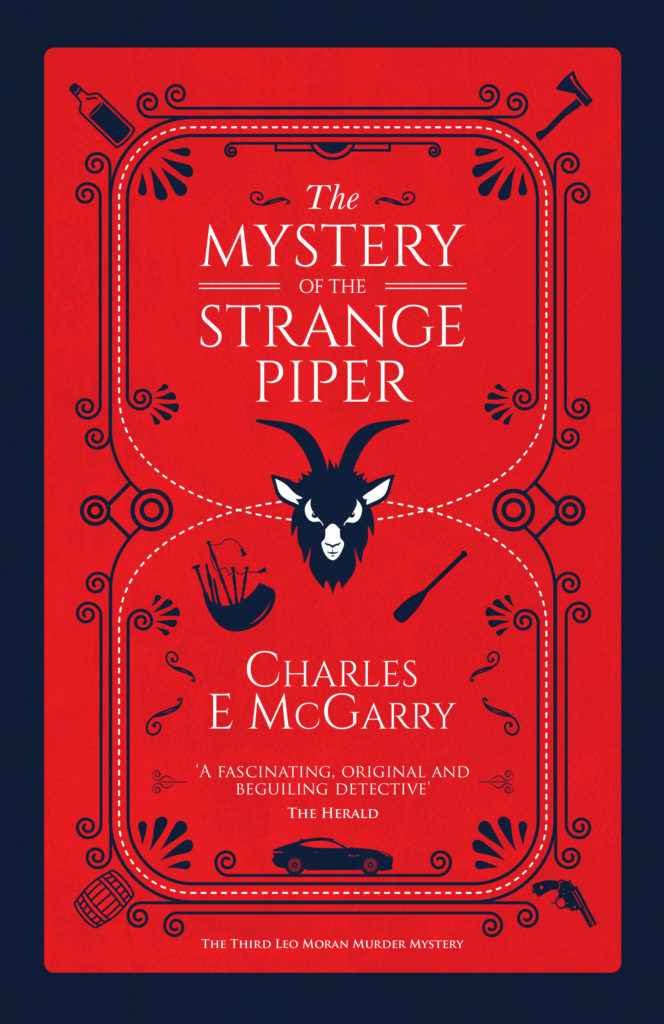
The Mystery of the Strange Piper by Charles E McGarry is published by Backpage Press, price £8.99
A debut taking the reader on a journey through dark literary fiction, through the twists of grief, regret, love and hope. “The past is never far behind,” reads the blurb. “If we do not leave it, if we insist on carrying it with us to the end… that end is a monster.” Read for yourself.
Extract from Men Playing Ghosts, Playing God,
from Look Where You Are Going, Not Where You Have Been
By Steven J Dines
Published by Luna Press Publishing
Men Playing Ghosts, Playing God
Age will not be defied
-Francis Bacon
Let me tell you about the time four old ghosts held death captive in a basement. Let me tell you what that power can do to a man and the sacrifice he will make for the gift of time. But first, let me tell you how we became ghosts in the first place.
At the age of seventy-seven, I, Henry Eddowes, died. Nobody seemed to notice, nobody seemed to care, which only made it harder for me coming to terms with my demise. Not my literal demise, you should understand, otherwise how would I be writing this account? But there are other ways to die, just as there are other ways to live. The name of the one who took my life away was Russell Hobbs. That’s right, it was one of his toasters that caused the fire, his defective workmanship; not me, not mine. All I wanted on that September evening of last year was to put my tired feet up, eat spaghetti and sausages on toast, and listen to a little Piano Sonata No.14 until I fell asleep. Contrary to what the fire inspector concluded I never turned the dial all the way to the darkest setting, and even if I had, which I cannot completely disclaim since I don’t have what you might call ‘one hundred percent recall’, the fool contraption still should not have flame-grilled the toast, the toast the kitchen window-blind, and so on.
Being old is worse than being a child. When a child sets fire to something, they get a ticking off or a slap on the wrist, but do the same thing at my age and the powers that be—and I am referring to my children here—are prepared to throw you in a padded cell.
Or worse.
They call Wintercroft a residential home. I call it the waiting room to Hell. The brochure boasts it is situated in four acres of landscaped gardens on the outskirts of the city. It does not, anywhere, use the phrase, ‘out of the way.’ But it is and we are.
And that is an altogether different kind of death.
*
When we first heard of Constance’ husband’s passing, it was one minute to midnight and we were playing cards. It was quiet, the lights were low, and everyone else had been fed and bedded, except the four of us with our special pass, paid for with sixty cigarettes and the assurance that we would keep it down. We were in Wintercroft’s communal room. Kensington chairs lined two of the walls, hand upholstered, red floral pattern on a backdrop of somnolent green. In time, our bones turn to straw; in time, our brains too. None of the residents were really capable of lying on the grass to look at the sky anymore, so that was as good as it got: a chair and a window. We were scarecrows, propped up and left to watch the black birds circling.
But the four of us—we had poker.
Forget Bridge and Canasta, we left those to the nonagenarians. We young ones in our seventies, Walshy, Bullamore, Sheldon, and myself, we enjoyed nothing more than a game of five card stud. All right, so we used onion rings instead of actual poker chips, and our table, a walnut coffee commandeered from the women’s corner, was a little on the low side, something our backs incessantly complained about afterward, but we could lose ourselves, really lose ourselves: in the cards, in our hand, in the game.
The scream changed that. One soul-torn scream from just along the corridor.
Her scream.
It changed everything.
Walshy looked at Bullamore then Sheldon; Bullamore at Sheldon then Walshy; Sheldon at Walshy then Bullamore. Then all three turned to look at me.
None of us needed to say anything: we all knew what it meant. We were all putting in our twilight time in Wintercroft, and darkness was never too far away.
‘So he’s gone,’ I said in a low voice, raising my coffee mug in the air. ‘To George.’
‘To George,’ the others echoed.
We touched the rims to our lips and drank to him, or rather we breathed deeply of the aroma lingering at the bottom of our near-empty cups.
And then we played another hand.
I forget who won it. Not me. My heart was no longer in the game. It was, with my mind, just along the corridor…with Constance.
*
It was no secret among the other residents that I was madly in love with her. There is no time for secrets when time is short. Even George had known my feelings, but he’d also understood that I was nothing if not honourable. I respected the sanctity of their marriage as much as I respected the sanctity of my own. A growing shortness of time on this earth does not make licentious wolves of us all.
But I do love her.
Before we ever met, on my first day in Wintercroft, I heard someone mention her name, and the jolt I felt as a result rattled my heart. I fell in love with her name before I met and fell for the woman herself. Constance. Constance. And when I learned of the others they fell one behind the next, like a trail of warm autumn petals across a slab of frozen ground: Constance Harriet Willington-Wright.
Petals, yes—or four elegant train carriages lighting up the walls of a darkened tunnel: me.
But I digress.
Back to what happened.
*
I could not visit Constance in her room that night. The staff would not allow it. So I spent the hours until morning pacing my room like some poor love-starved teenager. When I grew tired of pacing, I stretched myself out on the bed and traced the cracks in the ceiling, imagining that I was somehow clinging to a comet up in space, looking down upon the rivers of the Earth. It was a game I used to play as a boy while my parents argued in the next room, after someone told me there was no sound in space.
It isn’t true.
The words become lost in the great vacuum of time and distance but somehow the screams never seem to lose their power. If anything, they become comets themselves, orbiting the world right alongside you. The next morning I was a Jack-out-of-his-box, hurrying along the corridor to Constance’ room. I found her curled up on a large chair, a little girl in posture but an ancient woman in appearance. Who knew one night could last so long? Enough to add years to a woman’s face when years were the thing none of us really had.
I stood before her, trying not to block her view out of the window. She needed distance—if not the ability to distance herself then at least the ability to see something distant. A lone-standing tree. A car coming over a hill. The sun climbing the sky.
‘Four years ago, when my Mary died,’ I said, ‘the window became my best friend too.’
Constance’ eyes changed focus, narrowing in on the movement of my lips, a matter of feet and inches from her own. A pained expression flitted across her face before she turned her head slightly, back to the distance on the other side of the glass. It was like she had not recognised me.
‘I’m sorry about George,’ I said.
‘He was a good man,’ I said.
‘A loss to us all,’ I said.
And I meant it, every word.
Constance said nothing, only nodding in places. Whether it was in response to me or to some other conversation playing inside her head, I did not know. I only knew that I was completely alone in the room with her.
And that somehow I had to bring her back.
*
‘Eddowes—no. No! It’s madness.’
I opened the door to my room and hurried Sheldon inside, out of earshot of the other residents. The service wasn’t over by thirty minutes and we were both still dressed in our funeral attire, but it had been two days and Constance was slipping further and further away.
Sheldon had been the one to share my idea with first. He was a cautious soul; he only ever went in on a winning hand and never, never went for the bluff. He had the scars to prove it too: every one of his three wives had been unfaithful, leaving him for other, less cautious men. But, bless his heart, some people never change and some people never win at poker; it didn’t stop them anteing up.
‘I need to do this,’ I told him. ‘Something to stop the rot setting in.’
Sheldon loosened his black tie but left it on. ‘It’s an awful risk, Henry,’ he said. ‘If she finds out, if she catches you, she’ll never forgive you. And you’d be giving them grounds to throw you out of here. There are worse places than Wintercroft, you know.’
I could think of only one.
‘I can’t do this alone,’ I said. ‘Are you in or not?’
‘Christ, Henry, his ashes have hardly had a chance to cool and you’re talking about…well, let’s just say it, you’re talking about sneaking into his widow’s room and planting clues—’
‘They’re not clues,’ I corrected, trying to placate him. ‘This isn’t some treasure hunt. Try not to get over-excited. They’re messages. Simple but clear messages—from George to his wife.’
‘And what do you hope to achieve by doing this?’ he asked.
I had given the question a lot of thought, and it boiled down to a single grain of truth.
‘Time,’ I said.
‘With Constance?’ he asked, suspicious.
I nodded.
Sheldon shook his head. It was a cautious shake.
‘There are other, better ways to steal a man’s wife—widow or not.’
Before I could stop myself, I reached for the loose tie around his neck and yanked it up and around like a noose. A tiny puff of air escaped from his mouth and passed into my nostrils the sweet-sharp smell of peppermint on his breath. Reality struck me then, and I snapped out of my rage in an instant, letting go of his tie and backing off to stand next to the window. Sheldon fixed his tie, trying to maintain his composure as he struggled to catch his breath. Suddenly the room felt smaller, the walls pressing in like hands around a bug.
‘I’m not trying to steal anyone,’ I said. ‘I simply want a little more time with her, that’s all. More time. Do you understand?’
Sheldon nodded.
With three ex-wives, he understood better than anyone.
*
To sweeten the mood, later that evening I folded on a Three of a Kind and two Flushes. The other two saw through it right away. Sheldon was too quiet and I rarely, if ever, lost at cards. Walshy, ever the clown, got a kick out of just playing the game, good hand or not. Bullamore always went in too heavy and came out light.
‘You’re one sick old dog,’ Walshy said, once he’d heard my plan.
‘But I’m in. Just try and keep me out.’
Bullamore took a little more convincing. He huffed and puffed but in the end blew nothing down. ‘As long as no one finds out and no one gets hurt then I’m in too.’
And so four ghosts we became.
I should have been pleased, and I was, briefly—my plan to rescue Constance was in early motion. But my tired old skin went cold as I watched myself gather up all of the cards and shuffle them in readiness of the hand about to be played. The sun was sinking outside, pouring in through the windows of the communal room a kind of thin, jaundiced light. It clung to the backs of my hands, to all of our skins in fact, and made of us strange yellow men. Men who had no right to think of themselves as ghosts, who had no right to meddle furtively in the lives of another. Men, strange and yellow.
And before a card was dealt, my hands began to shake.
Look Where You Are Going, Not Where You Have Been by Steven J Dines is published by Luna Press Publishing, price £12.99
Sharon Bairden’s debut Sins of the Father follows Rebecca, who disconnects from the world around her as the past comes back to haunt her, secrets gradually unravelling. Sharon shares her favourite crime debuts for you to dive into.
Sins of the Father
By Sharon Bairden
Published by Red Dog Press
I started blogging over at Chapter in my Life six years ago as a place to keep my thoughts on the books I had read and loved. Then I discovered an online community of book lovers just like me, people who wanted to shout from the rooftops about the books they had enjoyed and so my life as bona fide book blogger began.
I’ve lost count of the number of books I have read over the years but I have picked five debut crime novels which have all left their mark on me. In no particular order:
First up is Dead Inside written by fellow blogger, Noelle Holten who has now gone on to write a total of five books featuring Detective Maggie Jamieson and each one just gets darker and more twisted. The author’s own background as a Senior Probation Officer and a survivor of domestic abuse brings a real authenticity to her characters. Dead Inside is a fantastic portrayal of domestic abuse and shatters the myth that abuse only happens to a certain section of society. It also addresses that whole issue of “why doesn’t she just leave” underlying the many reasons why people stay in abusive relationships.
Next I’m going to choose fellow Scottish author Lisa Gray and her debut, Thin Air, featuring Private Investigator, Jessica Shaw. Thin Air was possibly one of the most self-assured debut’s I’d read. Thin Air ticked all my boxes, characters, plot and sense of place all married together to provide an outstanding debut novel. The writing flows effortlessly, the storyline is unique and refreshing, it was a winner for me.
S.E Lynes is a writer who inspires me book after book, her writing is sublime and it gets under my skin every time. Her debut, Valentina, is one very close to my heart. I met the author, not long after the book was published and I remember her expressing a level of anxiety that I would be reading her book as a Scottish reader when she had created a Scottish character, she feared that she would have got the voice wrong. She could not have been any more wrong. She nailed her characterisation and in Valentina she explored relationships, trust and deceit and did so in a spine-tingling fashion; with a cast of characters whom I loved and hated in the same measure, this debut had me glued to the pages throughout.
Next on my list has to be Douglas Skelton, and although the book I am choosing isn’t the very first book he wrote, it was his first crime fiction novel. Douglas Skelton is a well known writer with a long backlist of non-fiction crime books to his name, with a background in Investigative Journalism and a penchant for all things dark, I am delighted that in 2013 he took the plunge into the world of fiction with the release of Blood City, featuring Davie McCall, a bad boy, with his own set of values and moral code. Davie McCall features up there in my top characters of all times and I’d urge everyone to read this series. The novel is set on the mean streets of Glasgow in the 1970s/80s and it immediately catapulted me back in time as the author brought the streets of Glasgow and their inhabitants alive. It is a must read for lovers of Scottish Crime Fiction.
Last but not least is Random from Craig Robertson, another one of my go to Scottish Crime writers. Random blew my mind when I first read it, A serial killer is terrorising the streets of Glasgow leaving the police baffled, there seems to be no rhyme nor reason to the killings. This book is told from the killers perspective so from the outset you know who he is but not why. A dark and brutal tale of a man driven to the depths of despair, it firmly places the reader in a very dark place and it is not to be missed!
Thanks to the encouragement of the crime writing community, I finally bit the bullet and decided to write a book, something I’d always wanted to do, but never believed I could. Sins of the Father was published by Red Dog Press in November 2020.
Initially when I wrote the book, all I wanted to achieve was to start and finish writing a novel, I didn’t have any grand ideas that it would be published. A number of people in the business beta read it and suggested I work on it and submit it. It was at that point I really started to think about what I was trying to achieve other than fulfilling a dream. My main character in Sins of the Father is Rebecca Findlay, she is a troubled young woman and the reader soon discovers why this is the case. It is story about the impact of trauma and adverse system experiences. She is not always a likeable character and one that the reader may struggle to connect with at times, but her story, although fictional, is the story of vulnerable people being exploited and falling through the net of a system.
Sins of the Father by Sharon Bairden is published by Red Dog Press, price £8.99
It’s Christmas day. Japan Cormac is heading for the hills. His bar is shut through the pandemic, his marriage disintegrating, a call from his doctor awaits. It’s the late 1980s in Tokyo. Eri documented the rise of a legendary female punk band. She now has to confront her past. Over 24 hours, everything they’ve been repressing comes to the fore. Read an excerpt below.
Life is Elsewhere, Burn Your Flags
By Iain Maloney
Published by Liminal Ink
Snow fell during the night, a sugar coating on the mountains. Frosted pine trees, an icy sheen on the clean, bright wood, yet even after the snow it’s all still dusty scrub. These hills – hills, not mountains, whatever the tourist info says – are never going to inspire any great poetry. No hermits ever retreated to these sandy bumps to live out their lives in quiet contemplation. Lives of quiet desperation. Not here.
These aren’t Mishima mountains where you can imagine the ill-fated world-rejected hero of a Mishima Yukio story coming to end it all, muscled torso exposed to the morning sun, a sharp blade – a meaningful blade, historical steel – cleansed and waiting, a suitable death poem on his lips. A romantic death. Meaningful death. Beautiful death.
You don’t get beautiful deaths anymore. Not in 2020. You get deaths behind closed doors. Death behind plastic sheeting and infection controls. Death by statistics. Death by policy. The plague times. The end of days. No beautiful deaths, alone in an isolation room, a voice through an intercom. We built hospitals so we could keep death from our doors. Clean, tidy, elsewhere.
Life is elsewhere. I am elsewhere. But this year death is everywhere. Death is here. On the way here I killed a snake. I saw it too late; a hosepipe stretched across the single-track road, just round the hairpin bend. My wheels were over it before I had time to register what I was seeing. Not even a dunt like in the movies, the sound of machine rolling over life, the jolt inside the car. Expensive suspension, thick tyres, a smooth ride. A shimahebi, harmless, but powerful, long. The head was moving, its back broken, flattened into the tarmac. I didn’t know what to do so I left it. Another ugly death, alone and broken. Why did the snake cross the road? To get to the other side. Shouldn’t go outside. Death is coming round every corner, silent.
I check my phone. Nothing. They said I’d get the results today. She’ll call herself, Dr Endo, to deliver the news, good news, bad news. Either way, there will be news today. April 18, 1930 there was no news on the BBC. Here’s some music instead. Music while you wait. Wait for the news. I looked on Wikipedia once about April 18, 1930. A typhoon made landfall in the Philippines, but that wasn’t news-worthy in Britain then. Or maybe they didn’t know. The news wasn’t news then, it was always already yesterday’s news. Yesterday, in the Philippines, a typhoon made landfall. We’ll tell you how many died tomorrow. Now here’s some music.
There’s a website that tracks the cases, the deaths. One page, two counters, scrolling round, scrolling up, and up, and up. News in an instant. Up and up. I don’t usually climb in silence but I can’t think of any sounds I want to hear. Nothing fits the mood but silence, the crump of my boots on the rocky path, the screech of those Chinese birds wintering here. Noisy, brightly coloured. Stereotypes abound in nature. There was one other car in the car park, a white Kei truck, a tiny pickup, almost like a toy. Some old guy fishing, his camping stove and a frying pan, a one-cup sake and the din of family safely out of earshot. No one else on the paths. I have to keep reminding myself it’s Christmas Day.
Back in Dublin, it’s still Christmas Eve. Saoirse will be wrestling the kids into bed, stockings over the – where do you hang stockings if you don’t have a fire? Off the bookcase? Stockings up, tree lights on, Santa on his way. A glass of wine, her and Gerry wrapping presents stashed on top of the wardrobe for a week at the most. Saoirse was always lastminute. Homework at school; ready for a date; driving me to the airport in March, the rush to get back to Japan before the borders closed. We only noticed as we came off the last roundabout that she still had her slippers on. You’re getting just like Ma, I said. Well don’t be telling Gerry that or he’ll be off after a younger model. Just the excuse he needs, she said. Problems there? I asked. Nothing castration wouldn’t solve, she said. And that’s where you leave it because there were bigger problems than whether Gerry had been at it.
Only just got home. Japan closed the borders in March and us lifers weren’t allowed back in until October and even then there were more hoops than at Celtic Park. Permanent residence. Contingent status. We’re here under sufferance. Thanks for the taxes but once we perfect the robots, you’ll not be needed. Right now entry to Japan is banned except for Japanese nationals. As if the virus checks your passport.
Eri picked me up, threw a mask at me, a bottle of hand gel, even though I already had both. Don’t tell anyone where you’ve been, she said. Don’t tell the neighbours you were in Europe. Should I wear a badge? I said. Tattoo something on my forehead?
She wasn’t laughing. She hasn’t laughed much recently. Not much to laugh about. Even schadenfreude took a hammering this year. Can’t laugh at the suffering of others when there’s so much of it about. Where to start? Schadenfreude, like charity, starts at home. Laugh at thyself, you fucker, if you want something to laugh at. Christmas Day and you’re on your own up in the hills. Not a present exchanged. Not even a merry or a happy. She was up late, locked in the spare room with her old boxes and that sake we got from Kochi, all of it. I could hear her snoring in there as I went downstairs and pulled my boots on.
Christmas really is fucking ridiculous when you think about it. Kids aside, of course. The niblings will be excited as anything for Santa and the works. Eighteen years in Japan and the word has lost all meaning. Grown-up adults decorating the house and putting on paper hats like they don’t all hate each other 364 days. I kick a rock and before I realise it’s gone over the edge and is tumbling down, gathering speed, gathering no moss. There’s a golf course down there somewhere. Good. A rock, like the Indiana Jones rock at the start of Raiders, battering through the twelfth green, knocking some old executive in a pink cap and one glove flying. A few Facebook Merry Christmases, a retweet of a retweet of a retweet. No news.
I stop and take a drink of water. It’s even colder than when it came out the tap. Or maybe I’m just hotter. It’s been a while since I got much above sea level. At the start of lockdown I did a bit, made myself get outside, but all the enthusiasm drained somewhere around June. Best intentions.
Every year Eri and I get in a couple of good hikes and every year one of us says, we should keep it up this year, get fitter. We should have a goal. Maybe Kiso-Komagatake in the summer. Camp on the plateau like we did back in the day. Under the stars. By February I couldn’t tell you whether the piping on my boots was red or yellow.
Shouldn’t have taken the car. It’s a faff with the trains but I hate retracing, going back. Makes the walk seem twice as long, half as interesting. Plus I could have a drink. A wee flask. A couple of cans. I know I shouldn’t but it’s Christmas. The Lord forgives a drink at Christmas. The Lord forgives but the body doesn’t. The doctors won’t.
Very, very cold water, water just above freezing, tastes of nothing, tastes of absence, tastes of the void. Swallow it inside me, swallow it down, taste the emptiness.
Hiking here is a recent import, 150 years or so. People climbed mountains, obviously, but mainly for religious reasons. Temples at the top, pilgrimages up the long and winding roads, barefoot, carrying a rock, devotional. Mental. No one did it for fun, as a hobby, as a way to fill the time while you’re waiting. Not until some mad westerners showed up with poles and tennis rackets and buggered off up these divine slopes for a laugh. They didn’t half embrace it, though, that mix of suffering and satisfaction potent, contagious and oh so human. Old women carrying enough equipment to restock basecamp for a forty-five minute round trip because you’ve gotta have the gear, and what’s a climb without a cup of ramen at the top? Without a wee flask?
on snow
so easy
to slip
I’ve always liked the haiku. It’s what brought me to Japan in the first place. Like most men I had a Beat phase. On The Road, wine and jazz, girls and drugs, cut up and the best minds. But I never had much concentration for reading. Kerouac’s haiku, that got me. That short sharp shock, the single moment, a story in a few words. Why does Tolstoy need so many when Bashō needs so few? Brevity is the soul of wit, said Shakespeare, so a haiku poet is wittier than a novelist. Joyce should’ve done Ulysses as a haiku.
On June 16th
Bloom had a shite
Stephen had a drink
Molly had a ride
Yes, they did, yes.
Not really a haiku but there you go.
Life is Elsewhere, Burn Your Flags by Iain Maloney is published by Liminal Ink, price £6.99
After the brutal murder of his son, gangland boss Zander Finn disappears – leaving everything behind. When Malky Maloney tracks him down, the stakes for his real and crime families couldn’t be greater. Denzil Meyrick discusses his latest book.
Terms of Restitution
By Denzil Meyrick
Published by Polygon
Congratulations Denzil on your latest book release! Could you tell us a little more about Terms of Restitution and what you wanted to explore in its writing?
Terms of Restitution is set between Paisley, London and rural Italy. It’s a gangster novel. Zander Finn, kingpin of Paisley crime, flees the town when his youngest son is gunned down in a brutal attack. He takes up a job driving a patient transport ambulance in London.
When his second in command Malky Maloney tracks him down, he realises he must return home to save both his domestic and criminal families from extinction at the hands of avaricious foreign gangs. Look out for thrilling action with a fair dollop of humour.
I was anxious to explore all sides of the bad guy, encompassing a life of crime through the lens of someone with the problems we all face.
You’ve left your beloved Kinloch for this book. What has it been like for you as a writer creating a new fictional world from the one you’re so familiar with?
I think many perceive that writing a long series is easier than conjuring up a one-off novel. In some ways that’s true. However, with a series like Daley, the writer must be careful with character arcs, back-stories, names of relatives friends, etc., etc. So, it can be quite an exacting business.
A completely new setting and characters can be quite liberating, though you are starting again, so to speak. I enjoyed the process.
You’ve also switched sides too, with your protagonist a criminal instead of a detective. Why did you want to write a story from a criminal’s point of view?
I think it’s always interesting to try something new – look at an alternative perspective. Zander Finn and Daley couldn’t be less alike.
But, as with the Daley novels, I write both the police officers and criminals. Same here with Terms of Restitution, though much more emphasis is placed on the bad guys. Even so, there are some strong characters from law enforcement, including Amelia Langley, the police officer tasked with bringing Finn to justice . . . but nothing is that simple.
It’s billed as a stand-alone thriller, but the reviews have been so positive. Are you tempted to revisit the Finn family?
It’s always nice to be in receipt of good reviews. Very pleasing in this case as it’s something completely new. I think it’s too early to say, but I wouldn’t rule anything out. So, the door hasn’t closed on the Finns yet. Who knows? I’ll be interested to hear what readers think.
What influences are behind this book? You’ve been writing crime fiction for a long time now; how do you stay motivated and excited about the genre’s potential?
I’ve always enjoyed gangster movies – some of the best in the business. Who can forget The Godfather, Goodfellows, Casino, etc.? But, as with Daley, The Sopranos TV show remains my primary inspiration. When you look at Brian Scott, for example, he isn’t a million miles away from Paulie Walnuts. Same goes for Zander Finn and Tony Soprano. That show has become the TV lockdown phenomenon, with younger people who didn’t catch it the first time round doing so via streaming services during the terrible Covid crisis. Though, however inspired, my characters are fresh and new, with hidden depths and secrets all of their own.
I think the crime fiction genre is perhaps too well served at the moment. The trick to achieving success, as with so many creative things, is to come up with something a wee bit off-kilter, different. I often think that’s why Daley became a success, and hope the same for Terms of Restitution. Keeping things fresh keeps readers and writers motivated, I think.
And you don’t stop! You have a 3rd book coming out this year, another of the Hamish historical spin-offs, A Toast of Old Stones. Can you tell us what to expect from that?
Ah, good old Hamish. In the new novella A Toast to the Old Stones, we see the younger version of what is going to become the sage-like older character. Yet again, he’s mentored by Sandy Hoynes, skipper of the old tub The Girl Maggie, plying their trade in the late 60s.
This time we find our intrepid crew and some of the rest of Kinloch’s fishing community following tradition, off to celebrate the arrival of the Old New Year (12 January) by paying their obeisance to The Auld Stones.
It’s a tradition going back to the Viking age and beyond. But nothing is that simple for Hoynes and Hamish. True nostalgia with bags of humour – a perfect festive gift!
We can’t not mention DCI Daley too. Can you give us any hints on what’s next for him and the rest of the gang in present-day Kinloch?
Our brave detectives are about to embark on their tenth outing in the book entitled The Death of Remembrance.
We’ve read much about Daley’s back story via short stories and in the sixth novel The Relentless Tide. This time we discover more about Brian Scott’s early career in the police. Woven through a contemporary storyline with flashbacks, we see how Brian became who he is. Look out for some shocks and surprises, with the return of some old faces like John Donald and James Machie.
Meanwhile, in the present, Daley and Scott face an unexpected foe with links to the past, uniting the book’s themes.
As usual though, very little is as it seems.
Terms of Restitution by Denzil Meyrick is published by Polygon, price £12.99
A time before police patrol cars, radio, helicopters, drones and specialised equipment became everyday resources for those on duty, Gary Knight’s Fatal Duty details officers killed Scotland from the 1810s to 1950s, and those responsible for their deaths. Read an excerpt on Hogmanay 1811 below.
Fatal Duty
By Gary Knight
Published by Tippermuir Books
On Hogmanay 1811 (the night of 31 December 1811 and 1 January 1812), those Edinburgh street gangs – known in the city as ‘Thief Gangs’ – based in Niddry Street, the Canongate, Calton and the Grassmarket, joined together to attack and rob those out enjoying the turn of the year. At sunrise on New Year’s Day, many ‘gentlemen’ lay in the hospital, battered and bruised. They were picked up from the street after lying prostrate amongst the shattered glass from seventy streetlamps, smashed during the turmoil of violence and destruction. Two of the men lay clinging on to life, and both would die in the next few days. One of them was Police Watchman Dugald Campbell, the other a clerk, James Campbell. Dugald was the first police officer to die while on duty in Scotland.
Young apprentice boys would often meet at the bottom of Niddry Street after work at around 9pm. They would pick quarrels with people and often lash out using fists and kicks. Sometimes they would crowd around a passer-by as they walked along the street. A blow of a whistle or a predefined word or phrase would be cried out – this was the signal to attack and rob this unsuspecting victim.
In the days before the New Year celebrations of 1812, these gangs had met up. The youths planned to work together and had decided to give the police a licking. These young ruffians were anxious to get their hands on a police officer called Murray, whom they despised as he often chased them off the North and South Bridges. The gangs had armed themselves with sticks cut from trees in the city’s Meadows.
At 11pm on 31 December 1811, the gangs took to the streets. The affluent were attacked and robbed, often beaten during the assaults. The police turned out in large numbers and tried to keep order in the busy, bustling streets. They managed to drive the gangs out of Hunter Square and off the South Bridge. On the Royal Mile, gang members chased a police officer up the road – he was tripped as he ran and fell to the ground. The gang set about him, hitting him over and over with sticks. A cry of ‘It is the Royal Arch!’ seemed to intensify the beating the man received. Royal Arch was the nickname the gangs had given to Dugald Campbell, who was despised by the young hoodlums. A few people tried to step in and protect the police officer, but they were driven back by the gang members. By the time the gang left to search for new victims, Campbell was lying motionless in the entrance to Stamp Office Close (today Old Stamp Office Close) in a pool of his own blood. He was lifted and taken to the nearby police office, but he was unable to talk and died three days later.
In the days and weeks after the events, the shaken authorities rounded up those they believed to be involved in this unrest. Three men were arrested in connection to the murder of the police officer: Hugh MacDonald, Neil Sutherland and Hugh MacIntosh. Sutherland and MacIntosh had fled to Glasgow where they were picked up and taken back to Edinburgh.
All three were tried at the High Court in Edinburgh on 20 March 1812. The charges were:
- The murder of Dugald Campbell, police watchman, at the head of Stamp Office Close.
- Knocking down Ensign Humphry Cochrane, of the Renfrew Militia, on the High Street, and robbing him of a silver watch, a watch chain of gold, two guineas and two one-pound notes, five shillings in silver, a neck handkerchief and a silk pocket handkerchief.
- Knocking down Mr Roger Hog Lawrie, a writer’s clerk, on the North Bridge, and robbing him of a seal set in gold, part of a watch chain of gold, a gold watch key and five shillings in silver.
- Knocking down Gustavus Richard Alexander Brown, Esq, on the North Bridge, and robbing him of four pounds sterling in notes, ten shillings in silver, a penknife and a round hat.
- Knocking down Mr Francis James Hughes, near the Tron Church, and robbing him of a gold repeating watch, a gold watch chain, four seals set in gold, a gold watch key and a round hat.
- Assaulting Mr Nicol Allan, Manager of the Hercules Insurance Company, near the Tron Church, and robbing him of a yellow metal hunting watch, a gold watch chain, two seals set in gold, a gold watch key, and 14 shillings in silver.
- 7. Knocking down Mr Duncan Ferguson, writer, near Barclay’s Tavern, Adam Square, and robbing him of a gold seal, a gold watch chain, a round hat and nine shillings in silver.
- Assaulting Mr David Scott Kinloch MacLaurin, on the South Bridge, and robbing him of two gold watch cases, a pocket-handkerchief, a round hat and six shillings.
- Knocking down Mr John Buchan Brodie, writer, on the North Bridge, and robbing him of a watch with a shagreen case, a watch ribbon, four seals set in gold, a gold watch key, a blue Morocco leather purse containing a Bank of Scotland one-pound note, a seven-shilling gold piece, eight shillings in silver and a round hat.
- Assaulting Mr Duncan MacLauchlan, student of medicine, on the South Bridge, and robbing him of a round hat, a pocket-handkerchief and a pair of gloves.
- Knocking down Mr Peter Bruce, student of medicine, on the South Bridge, and robbing him of a green silk purse, five shillings and sixpence in silver, a gold ring and a round hat.
All three pled not guilty.
—
Duncan Fergusson, a clerk, said that on the night in question he was drinking in Barclay’s Tavern in Adam Square. (The pub no longer exists but was located somewhere between the George IV Bridge and the South Bridge.) Fergusson left at about midnight. When he and a companion reached the South Bridge, they were attacked. Fergusson was knocked down but did not realise that he had been robbed; it was only after returning to the tavern that someone pointed out his watch was missing. Fergusson noticed that along with the watch, his seal and money had also been taken.
The next witness was John Brodie, who stated that at 12.30am he was passing Milne’s Square at which point he saw young men carrying large bludgeons. Brodie told the court that he initially thought that the armed men had been fighting each other. Suddenly one of the men struck him a violent blow. During the attack, Brodie called for the police, but the attacker sneered, ‘Your police is long gone’.
Brodie was struck again and fell unconscious. When he came round, he could feel two sets of hands rifling through his pockets. A third person ripped his watch from him, and a little boy took his hat. When asked if he could identify any of his attackers, he looked at the dock and stated that Neil Sutherland could be the one who struck the first blow.
—
With all these witnesses for the prosecution, things were not looking good for the three accused. However, witnesses did come forward for their defence. Margaret Ross, a thirteen-year-old girl, said that she saw MacDonald at home on the night in question between 9pm and 10pm. Although he was drunk, he remained indoors until after midnight. Two of MacIntosh’s work colleagues, George Petrie and John Riddel, both shoemakers, stated that on Hogmanay night the accused worked late: till near 12am. Janet Ross, who was the sister of Margaret, lived in Blair Street. She said that she had known MacDonald for a long time and that she thought him a good character, mild and obliging. Shoemaker James Cameron thought MacDonald a sober, innocent, regular man, and he went on to say that he had confidence in him as honest and faithful. James Anderson who had employed MacDonald for four months stated that MacDonald was sober, honest and respectable. Joseph Petrie described Sutherland as a quiet youth.
The jury retired at 4am on 21 March and nine hours later the judge was told a verdict had been agreed. A guard of the Edinburgh Volunteers was stationed in and around the court to keep the peace.
Fatal Duty by Gary Knight is published by Tippermuir Books, price £9.99
David Alston’s new book explores the prominent role of Highland Scots in the exploitation of enslaved Africans and their descendants in the cotton, sugar and coffee plantations of the 18th and 19th centuries. Read an excerpt below.
Slaves and Highlanders
By David Alston
Published by Edinburgh University Press
Historiography is not simply a description of the writing of history − it is an attempt to understand why history is written in a particular way. In this case it must involve an attempt to answer the question: why did Scottish historians not give more attention to the evidence of Scotland’s involvement with slavery? I believe that finding an answer requires enough humility to acknowledge that academics, including historians, are as prone as anyone else to the many biases inherent in human thought.
The study of Scottish history in the second half of the twentieth century was the creation, from almost nothing, of a substantial body of academic work which, allowing for healthy debates within the academic community, nevertheless presented an increasingly comprehensive and coherent account of Scotland’s history, especially for the period after the Union of the Parliaments in 1707. While not all agreed on the answers, Scottish social and economic history focused on key issues of industrialisation, urbanisation, agricultural improvement and radical change in rural communities, internal migration, emigration, the role of women in Scottish society and, especially towards the end of the century, the place of Scotland within the United Kingdom. In the Highlands, mere romanticism for the Jacobites was replaced by hard-edged studies of clearances, emigration and military service. The daunting task which had been undertaken, the success of well-researched and widely read academic studies, and the general coherence of the resulting body of knowledge had the result − as it always does − of establishing an orthodoxy, resistant to the idea that something big and important might have been ignored. If we try to understand why this happened, then we are asking a question, not about history or the study of history, but about the systematic biases inherent in human thought. They are the same biases which led economists and financial experts to ignore the impending crash of 2008 and which created resistance in the medical community to the evidence that most stomach and duodenal ulcers were caused by bacteria rather than stress and lifestyle. Fortunately the intellectual tools which enable us to better recognise such systematic biases have been provided by the relatively new discipline of behavioural economics.
***
Some Scottish novelists, perhaps being more subtle storytellers, appear to have had a greater awareness of slavery than the historians. In a review of Arthur Herman’s overly enthusiastic How the Scots Invented the Modern World, Irvine Welsh commented:
‘Herman almost seems to claim that the ‘good’ things in the empire − education, social reform and engineering − were solely the Scots’ doing. The bad bits − racism, slavery, religious indoctrination − were down to others (the English). For example, it seems remiss to refer to Hutcheson, whose A System of Moral Philosophy inspired anti-slavery abolitionists in both Britain and America, while ignoring the compelling evidence of the Scots’ darker role in the slave trade.’
And Welsh also showed an awareness of the role of Highlanders in the ‘bad bits’ of Scottish imperial history.
‘While it’s refreshing to hear such an enthusiastic account of the Scottish ideas and practices that shaped the modern world, we need to offset them with harsher realities. Given the traditional role of Highlanders as mercenaries and soldiers, some cultures’ first contact with Scottishness is more likely to have been on the receiving end of a broadsword, bullet, whip, stick, knife, boot or fist.’
Yet Herman’s upbeat approach remained influential, still enthusiastically and repeatedly quoted in 2014 by Scotland’s then First Minister, Alex Salmond, during the referendum campaign.
In 2003 James Robertson published Joseph Knight, a historical novel based on a Scottish court case of 1778 − ‘Joseph Knight, a Negro of Africa v. John Wedderburn of Ballindean’ − in which the former slave won his right to freedom. Ali Smith described it as ‘a book which doesn’t flinch from the ceremonies of torture, execution, slavery and power, all the foul things people are capable of inflicting on each other in the name of fashionable politics and economic prosperity’.
So, had Scotland’s historians flinched? Not all of them. In the late 1990s I had become aware that, at the University of Aberdeen, Douglas Hamilton was working on his doctoral thesis ‘Patronage and Profit: Scottish Networks in the British West Indies, c. 1763−1807’. He was generous in sharing his research, in which he gave due attention to the networks based around Inverness and the Highlands, and when his thesis was developed into Scotland, the Caribbean and the Atlantic World 1750−1820 (2005) we had the first book devoted to the links between Scotland and the Caribbean. There was, as Professor Kenneth Morgan noted, ‘no comparable study’ and it placed Highlanders clearly in the framework of an extensive Scottish involvement in these plantation economies. Devine’s Scotland’s Empire: 1600−1815, published in 2003, had similarly devoted a chapter to ‘The Caribbean World’ and had begun to raise questions as to the extent and impact of Scotland’s involvement in the slave plantations, in marked contrast to Michael Fry’s The Scottish Empire of two years before.
The 2007 bicentenary of the abolition of the slave trade in the British colonies should have been the point at which Scotland woke up to its past. In 2006 Iain Whyte published Scotland and the Abolition of Black Slavery, 1756–1838 which, although focused on Scotland’s role in the abolitionist movement, also made clear the extent to which Scottish prosperity in the eighteenth century was based on slavery and the slave trade. Yet the material prepared in the same year by Iain Whyte and Dr Eric Graham for a planned official publication– Scotland’s Involvement in the Transatlantic Slave Trade and its Abolition: A Historical Review – was rejected by civil servants in the Scottish Executive as too sensitive. At the same time the Heritage Lottery Fund made grants available for projects which marked the bicentenary but a decade later, in her thesis ‘The end of amnesia?’, Cait Gillespie observed that:
‘Scotland took part in the bicentenary, but it displayed a lacklustre response. Only seven commemorative projects took place in Scotland, compared to hundreds throughout England and Wales, and to a lesser degree Northern Ireland. The National Museum of Scotland did nothing to mark the bicentenary.’
In the same year, Thomas Devine gave a lecture at the Edinburgh Book Festival called ‘Did slavery make Scotland great?’, which grew to become a chapter in his To the Ends of the Earth: Scotland’s Global Diaspora, 1750−2010 (2011). At the same time, a team of scholars at University College London, led by Nick Draper and Catherine Hall, had begun a systematic examination of the records of compensation paid to slave owners following emancipation in 1834. As this progressed it showed that the compensation received by Scots was, in proportion to the country’s population, greater than that paid to people in England.
It was not, however, until 2015 that there was a further publication to complement Douglas Hamilton’s Scotland, the Caribbean and the Atlantic World and Iain Whyte’s Scotland and the Abolition of Black Slavery. I am proud to have been a contributor to Recovering Scotland’s Slavery Past: The Caribbean Connection, a collection of essays edited and introduced by Thomas Devine, which was hailed by Kevin McKenna in the Observer as ‘one of the most important books to have been published in Scotland this century’ and by Ian Bell in the Herald as ‘an illuminating marvel’. There has been much more attention paid to this aspect of Scotland’s past since then, including material directed to a wider audience such as the two-part BBC documentary Slavery: Scotland’s Hidden Shame (2018) presented by David Hayman, who has continued to take an active interest in the subject. And in 2020 the Black Lives Matter movement extended the discussion to even more people.
If all that has happened is to mark a real turning point in the assessment of ‘Scotland’s slavery past’ then it must open new areas of study, begin debate and, in the words of Professor Ewen Cameron, invite ‘a long overdue national conversation’. Unfortunately there is a regressive strand in the discussion of Scottish identity which thrives on the false view that Scotland was a colony of England.
‘Nor is the identification of Scotland as a downtrodden colony any longer confined to the margins of political debate . . . The phenomenon is sufficiently widespread to have attracted the notice of outside observers. The distinguished historian Linda Colley–English-born but based at Princeton University in the USA–recently expressed her surprise at the number of Scots who believe Scotland’s relationship with England to be a colonial one . . . This is not only largely nonsensical as history, but offensive and insulting to many non-white, non-European peoples who did, in fact, find themselves oppressed or even dispossessed by the ‘British’ Empire.’
A consequence of this myth is that many Scots, once again, distance themselves from the reality of their country’s involvement with slavery and some claim instead to be fellow victims with the enslaved of a colonial past. In a single week in August 2020 the National newspaper published contributions which included the historian Michael Fry’s claim that ‘Edinburgh’s part in the Caribbean slave trade was minimal’ and a reader’s comment that ‘the vast majority of Scots were in no position to have either profited or prospered from the slave trade as they were often little better than slaves themselves’. A report by Iain MacKinnon and Andrew Mackillop on plantation slavery and landownership in the western Highlands and Islands, published in 2020, is a useful corrective to this, indicating as it does the extensive impact of wealth derived from slavery on the region and acknowledging that ‘culpability and complicity in the benefits of enslaving other human beings spread throughout the region and down its social order’. We might also remember Douglas Hamilton’s observation that, as the Bill to abolish slavery passed through Parliament in 1833, ‘. . . the preponderance of [pro-slavery petitions] came from the north . . . [and] of the sixteen places named in the petitions, ten came from the Black Isle . . . more than from the whole of England’. I hope that the following chapters will encourage a continued reassessment of the connections between the Highlands of Scotland, the slave trade and the slave-worked plantations of the Caribbean and South America.
Slaves and Highlanders by David Alston is published by Edinburgh University Press, price £14.99 (paperback) and £90 (hardback)
Grace’s family are wardens of the Griffin Map, using it to teleport and fight crime across Moreland. Stretched through helping as many people as possible, they could do with another warden on their team, while Grace is investigating a series of pretty puzzling thefts. Books From Scotland spoke to award-winning author Vashti Hardy about the tale.
The Puffin Portal
By Vashti Hardy
Published by Barrington Stoke
Congratulations Vashti on the publication of The Puffin Portal, another Griffin Gate adventure! Can you tell us a little more about you have in store for Grace in this book?
I was thrilled when Barrington Stoke asked me to continue Grace’s adventures! In The Puffin Portal, Grace is back but is now a full warden of the Griffin map with its teleport technology. She’s investigating a series of puzzling petty thefts, along with her robot raven sidekick, Watson. The clues lead her to a ramshackle castle on a lonely island, where the mystery deepens and Grace meets a young boy called Tom, who appears to be all alone. It’s another mystery-led adventure with a few new inventions, and it has kindness and found family at its heart. Once again the book is dyslexia-friendly with more fabulous illustrations by Natalie Smilie who has an amazing ability to bring this world to life visually. I adore her portrayal of the characters and settings.
You capture that sense of longing for adventure so well in these books. Were you similar to Grace as a youngster? Did you get involved in various scrapes?
That’s very kind of you, thank you! As a child we didn’t have much money for travelling, but my Nan had a brilliant and interesting large house with a wonderful garden, so most of my adventures took place there. During the holidays I would create games with my siblings and cousins and use my imagination to have pretend adventures. I was always the one who was seen as quirky and a little bit bonkers in my imagination! Luckily most of my scrapes were limited to sneaking cookies from the special cupboard to take on the imaginary adventures, so nothing as bold or interesting as Grace Griffin, but fun nonetheless!
In The Puffin Portal Grace is now a fully-fledged warden. Does this change her relationship with Moreland and its inhabitants?
Now that Grace is officially allowed to tackle calls on her own, she’s relishing the opportunity and rising to the challenge, which is very much part of her personality — she doesn’t tend to give up easily and tackles situations with grit and tenacity. Her place in Moreland feels more set in this story, which leaves room for her to become a guiding force with another character (which I won’t say too much about because of spoilers…).
Can you tell us a little more on how you go about creating the fictional world of Moreland and all its mysteries?
I have always loved maps and the idea of being able to teleport into one, so the world of Moreland grew from there. I like to ground my fantasy worlds with nods to our own world. That way they feel familiar yet other-worldly with their own rules and inventions. For example, by taking the old-fashioned red telephone boxes in our world and using them as the warden call boxes that connect to the teleporting map, it brings a nostalgic, yet inventive, scientific feel. I love bringing that combination into my world-building. I also like to take images of real places and use it to ground my settings, so although Moreland is a fantasy land, the village Grace travels to in The Puffin Portal has a bit of a Scottish fishing village feel to it. With the mysteries, it’s fun to introduce magical-feeling technology into the mix, so I enjoy creating the sort of inventions I would love to see in our own world, but perhaps aren’t possible (yet!), like walking street-lamps and advanced AI robots with personality like Watson.
There are a lot of great inventions that help the Griffins with their investigations. What invention would you like right now that would help you in your life as a writer?
Definitely a machine that could pause time but would allow me to keep moving within it. Then I’d have more time to write and imagine more story worlds and adventures alongside having more real-world adventures too. A tea-pot with an endless supply of honey tea and an infinity biscuit machine would go down well too!
We’ve seen readers describe the Griffin Gate series as Steampunk, Sci-Fi, Fantasy, Mystery . . . what writers and books influenced the creation of this series?
As a child, a teacher read me Rebecca’s World written by Terry Nation (who also wrote for Doctor Who). Rebecca is magically transported to another world through a telescope and has a great adventure trying to bring the trees back to the planet and bring down the rather shiny but nasty antagonist Mr Glister. It was the book that made me fall in love with stories and was the moment I decided that one day I wanted to create my own story worlds. There’s a brilliant map with riddles in Rebecca’s World, which is where my love of map adventures began, and there’s an unlikely group of friends, which I’m also a fan of in stories.
What great books have you been reading recently?
I love adventures where animals play a part and this year I enjoyed The Last Bear by Hannah Gold, which is a wonderful eco-adventure. I was also lucky to have an early read of a new book which will be out in October called The Secret Animal Society by real-life vet Luke Gamble. It’s an irresistible magical adventure with a classic feel, and lots of inventive creatures for children to discover.
Can we look forward to more adventures with The Griffins? Can you give us a hint of what’s next for Grace?
There will be more adventures for Grace, which I’m so excited about. The Raven Riddle will be the third in the series and is due out March 2022. This time Grace is heading to solve a mystery in a remote mountain village where ravens are causing mischief and there are rumours of a witch and a haunted house which can move. Readers can expect more mystery, inventions, and heart, and more lovely illustrations from Natalie Smilie. I’m also about to start work on a book four in the series, so watch this space! I love the moment before I start a story, when I’m thinking of all the possible inventions, fun, and mystery ahead…
Thank you for your brilliant questions and teleporting into the map with Grace and co!
The Puffin Portal by Vashti Hardy is published by Barrington Stoke, price £6.99
Dark Travellers charts the rise of crime fiction in Scotland. Taking as its inspiration William McIlvanney’s novel Laidlaw published in the 1970s, the short film, commissioned by Publishing Scotland in partnership with Bloody Scotland, (annual crime writing festival held in Autumn each year), is written and presented by Jamie Crawford and produced and directed by Richard Nicholls of Swift Films. The writers featured are, in order, Val McDermid, Denise Mina, Chris Brookmyre, Marisa Haetzman, Graeme Macrae Burnet, Abir Mukherjee and Ian Rankin.
The film was premiered at the Bloody Scotland festival, Stirling, Scotland, on 17 September 2021.
Here is a selection of the books featured in the film:
Laidlaw, by William McIlvanney
The Dark Remains, by William McIlvanney and Ian Rankin
1979, by Val McDermid
Rizzio, by Denise Mina
The Way of All Flesh, by Ambrose Parry
His Bloody Project, by Graeme Macrae Burnet
The Shadows of Men, by Abir Mukherjee
In a House of Lies, by Ian Rankin
Detective Levine knew his transfer was a punishment – but he had no idea just how bad it would get. We journey to Cooper, Nebraska – a town you apparently only stumble into when life has taken a bad turn – and where the detective has found himself, trying to solve a murder when his new partner shoots their prime suspect using Levine’s gun. Read an excerpt below.
Welcome to Cooper
By Tariq Ashkanani
Published by Thomas and Mercer
They ask me to tell them a story.
Friendly words, spoken by tired men wearing crushed suits, over lukewarm coffee in a paper cup and a bagel that was cold long before it ever reached me.
Tell us a story.
A red-hooded girl visits her grandmother. I think they’ve heard that one before.
The problem is, I was never any good at telling stories. Never could work out the best place to start. It’s all about making an impact—see, I get that. Grabbing their attention and not letting up till you’re done. I get that part plenty. I got that part spilling out my pockets. Pick a moment, buddy, they say, like we’re friends. Like we’re in a bar and not in a room with the blinds closed.
I think back over everything that’s happened these past few weeks. I remember the snow, snow up to my shins. Snow like ash, from a blackened sky to bury all beneath it. Flakes of the stuff gathering in my hair and in the folds of my ears. I remember watching as she stood at the window and stared out at me. She couldn’t see me—even from where she was standing she couldn’t see me, even from twenty yards away. I remember moving down her hallway, and the sound my wet shoes made on her wooden floors. I remember my hands didn’t shake like they used to, like they had the first time. And I remember music playing, but don’t ask me what it was. It was noise, and noise was good. I could hide in the noise.
Or maybe I should just jump straight to the end. Give these boys what they want. The forest and the early morning sun and the spot where I led a man to his death. Only they don’t want that story. They want history. They want backstory. I can see it in their eyes, I’m losing them, and they interrupt with their questions, with their confusion. Back it up now, they say, like my memory’s an old SUV with a busted axle. A hand pushes a fresh cup of coffee across the table to help me remember.
So I’ll take them back. Not to the very start, because I don’t know them all that well just yet and, besides, most of that stuff isn’t important to them. But I’ll lead them far enough. Back to my arrival in town, back to the tall grass and the cornfields, and that long freeway, cracked and uneven, and the sign that read Welcome to Cooper in bleached, looped writing.
I push the coffee away, ask for something stronger. Glances all around but I keep my mouth shut, like I’d be happy keeping my mouth shut forever. Eventually someone shuffles out the door and I lean back in my chair to wait.
I think I’ll start with the girl.
Chapter One
She was dead and dressed for dancing.
Face up, that’s how they found her. On her back and stretched out across the grass like the only thing being killed was time.
I stood at the back door next to Joe and pulled on a pair of latex gloves. Snow drifted across her crowded backyard.
I thought about that sign on the way into town. Some welcome. Her body was lying at the foot of a tree. Don’t ask me what kind. Big and brown, with blossoms on the branches. White petals, whatever. Rachel would have known what it was.
A group of men had gathered. A murder like this, they always did. No-name men in chinos, from departments I didn’t care enough about to ask. Bureaucracy, who gives a damn. They weren’t here because they cared and I’m sure you all know something about that. As we got close I could see it in their eyes, in their bent heads, in the way they were talking, in the way they sucked back on their cigarettes, in the way they gazed down at her. Detached. Like she was a bad cut of meat. Like she was a problem.
I followed Joe across the yard and he turned to me and said he wanted me to take point on this, and I said alright. I figured he was testing me, and I guessed this was as good a way as any. I wasn’t worried. I didn’t much care what he thought of me. People sometimes say I’m emotionally closed off, but people say a lot of things. A woman once said I was an asshole and I reckon she was right.
The men shifted as we approached. I caught a glimpse of a bare arm in the fresh snow. Pale white.
‘Who’s your boy?’ one of them asked Joe. I couldn’t tell who.
‘This here is Tommy Levine,’ he said. ‘Make him feel welcome.’
I swept my gaze around the group, got a perverse pleasure that no one bothered to try. Joe slid a cigarette into his mouth. Waved me on as he lit up.
I pushed through to the center of the circle. Bodies shifting just enough to let me pass. Shoulders brushing, the tang of stale coffee and bad breath. When I emerged she was revealed to me in all her grotesque beauty, and when I stood over her it was like some tribal ritual.
Black shoe, the fancy kind, and only on one foot. Light-brown pantyhose. A thin black dress and a slim leather belt. Her legs outstretched, her arms tossed up above her head, her hands crumpled together. A dark, heavy necklace of bruises around her neck. Blonde hair, long and curled at the ends. She was young, maybe mid-twenties, and if whoever had killed her had left her eyes behind she’d have been pretty, too. Hell, you’ve seen the photos.
I felt it then. Uncoiling in my gut, warm and slick. That strange mix of feebleness and fury, like I wanted to throw up and beat my fists against a brick wall at the same time. Staring at a mutilated woman tends to do that to a guy.
‘What do we know?’ I said, hoping someone would answer.
Welcome to Cooper by Tariq Ashkanani is published by Thomas and Mercer, price £8.99.
A tale of two times. It’s 2019 – Hannah Greenshields has her first day at Memory Lane, a memory clinic in Edinburgh’s centre, which houses advanced technology which allows clients to relive their favourite memories for a substantial fee. Fly back to 1975 and John Valentine, another client, is reliving his wedding day over and over, hoping to change one key event he can’t forget. John soon realises his memory isn’t such a safe place after all. The pair must work together to get John back to the real world before it’s too late.
Ross Sayers had a quick chat with Books From Scotland to celebrate his latest release.
The Everliving Memory of John Valentine
By Ross Sayers
Published by Fledgling Press
Another publication day for you – congratulations! Could you tell us about your latest book The Everliving Memory of John Valentine?
Thank you so much! Of course, the book is about a mysterious memory facility in the middle of Edinburgh, Memory Lane, which allows wealthy clients to pay to relive 12 hour segments from their memory. The narrative is mainly split between Hannah, who is a new employee of Memory Lane, and John, who is reliving his wedding day over and over again. Hannah discovers that clients can’t be automatically removed from their memories when the 12 hour period is up, and it’s her job to go into client’s memories if they refuse to leave after their allotted time. I don’t think it’s too much of a spoiler to say that Hannah ends up going into John’s memory at some point…
You’re a bit of a writing machine! This is your second book in the space of a year, and a year, let’s face it, that has been quite challenging. How have you stayed motivated to write?
I definitely think I had a bit more motivation at the start of lockdown, when the novelty of being at home all the time hadn’t worn off. I had the idea for the book a couple of months in and was fortunate enough to have the time to get going with it. As more and more opens up, I’m finding it harder to sit down at the laptop!
You’re normally better known for writing Young Adult fiction, what made you decide to write your first novel for adults?
I think I just wanted to try something different. YA is great but you’re a little restricted in that your main characters have to be quite young, whereas I knew for this story I needed one of the main characters to be an older gent. Personally I don’t think there’s a huge difference in the writing/ tone etc, and certainly there’s just as much swearing in my YA books as in this one! I’m aware that even the phrase ‘YA’ will put certain readers off, so I wonder if I’ll get anyone reading this book that wouldn’t have read my previous ones.
Both your latest novels feature time travel, though The Everliving Memory of John Valentine is more internal time travel than physical time travel, which brings its own problems! What did you want to explore in writing this novel?
So I wanted to explore this technology, the tech that allows the clients to relive their memories. I wanted to explore the limits of it, eg what you can and can’t do within memories. For the character of John, he’s trying to change something in his memory, trying to do something differently, and is finding that, well, it’s a struggle. But also, it’s not impossible? Just as memories in your head can change over time, the technology begins to change. I also wanted to explore the relationship between John and his dad, and fathers and sons as a whole. And then with Hannah’s storyline, that’s more about the relationship young people have with both their workplaces and workmates. I’ve found that no matter the workplace, there are always the same kind of dynamics. So it doesn’t matter that this Memory Lane place is hugely wealthy clinic with incredible technology…the vending machine in the canteen still doesn’t work properly.
Do you enjoy reading sci-fi or speculative fiction yourself? Which writers, books and films have influenced your work here?
I loved Red Dwarf growing up (both the show and the books: Infinity Welcomes Careful Drivers and Better Than Life), and then the Back to the Future films are some of my favourites. The Discworld books too. And then more recently, I really loved Trackman by Catriona Child, which did that great thing that the best speculative fiction does, of introducing an unreal concept (an MP3 player which independently plays the perfect song at the perfect moment) into the real world.
Are there any favourite memories of yours that you would like to visit again, that you can share?
When I was in my early twenties, I got really lucky that I was able to visit some really cool places (Rio, Tokyo, San Diego), but I only got a day or two in each. I think I was too young to properly appreciate these trips to be honest, I wouldn’t mind doing them again. Wouldn’t mind spending longer than 48 in each place as well mind you …
Your novels always have great humour in them. Do you have any tricks or tips for writers who would like to write comedy?
Thank you! I think taking notes is a good thing to do, and it’s a lot easier these days when you can note it down on your phone rather than having to be that weirdo who’s scribbling on a notepad at the football. But yeah, if you hear someone say something funny, just take a note of it and then when you’re writing, and you think, this character would make a funny comment here, you can look through your notes and see if you can slide anything in. Just steal from others, basically.
Do you know what you’ll be working on next, or are you ready for a rest now?
I’m working on a new YA book but I’m keeping all details under wraps for now. I think I am anyway. I find I forget what I’ve said publicly. But as far as I know, I haven’t said anything about it!
What’s been your favourite books of the year so far?
Ok the main ones which spring to mind: Happiness Is Wasted On Me by Kirkland Ciccone, Luckenbooth by Jenni Fagan, and Duck Feet by Ely Percy. Can’t go wrong with those three.
The Everliving Memory of John Valentine by Ross Sayers is published by Fledgling Press, priced £9.99.
Author Barbara Henderson’s new novel for children, The Chessmen Thief, takes its inspiration from the beautiful and mysterious Lewis Chessmen. Here, she tells BooksfromScotland the full story behind her latest creation.
The Chessmen Thief
By Barbara Henderson
Published by Cranachan Publishing
Inspiration across the board
Can you play chess?
I suspect many of us know some moves or can hold our own on the chequered board, up to a point.
After the success of The Queen’s Gambit on Netflix, you’d be forgiven for thinking that the game of chess is ‘of the moment’, hip and cool. Many people, including myself, are therefore surprised to discover that the game of chess was popular in Norse-held Scotland almost a thousand years ago. Vikings were not only warriors, pillagers, slavers, adventurers, looters and explorers – no, these Norsemen were the original gamers – and skilful crafters too!
I vividly remember the first time I came face to face with the Lewis Chessmen, iconic relics of our Viking past. Dated to the second half of the 12th century and carved of walrus ivory, they were discovered on a remote beach in the Uig region on the Isle of Lewis. Now they can be seen by museum visitors in the National Museum of Scotland, in the British Museum in London and, fittingly, in the Museum nan Eilean in Stornoway. Dad would have loved these figures, I remember thinking. My father was a competitive chess player.
I had seen the Chessmen in London and Edinburgh, but the impact of visiting the figures on the Isle of Lewis was particularly profound. The exhibition room is airy and bright, the display is transparent on all sides and roughly at the level that a gaming table. For the first time, these figures struck me powerfully as objects, to be made, carved, polished, purchased and played with. Instead of artefacts of abstract significance, they felt real, despite the mysteries surrounding them. Who had crafted them, and why? Who did they belong to? Who placed them where they were found? What could have made that person part with such priceless treasure? Some research was in order, because the story sprites of my imagination were off, and I needed to keep up.
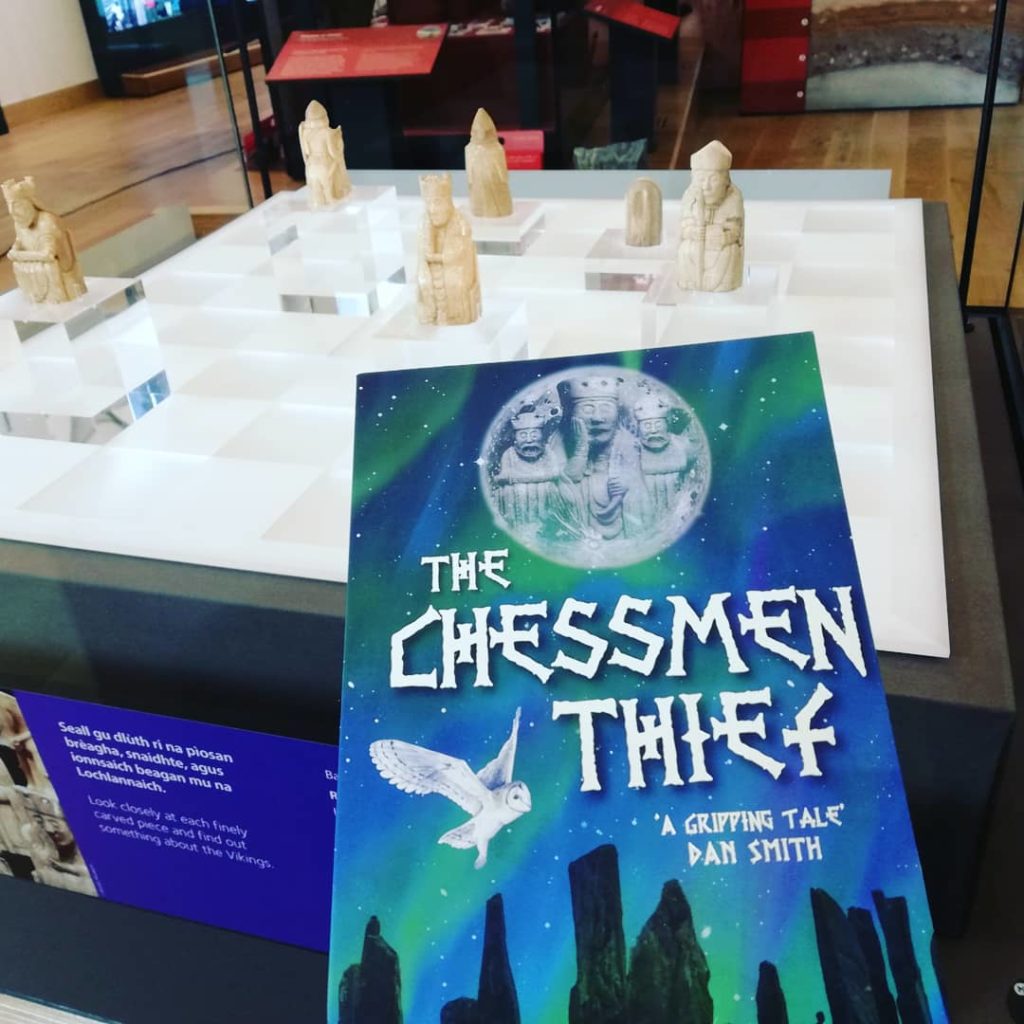
I find it helpful to read around a subject for a while, until some quirky detail or other jumps out at me. I don’t overthink it: if it is interesting enough to lodge itself in my brain, chances are it will be interesting enough to hold the attention of a young reader too. The figures are most likely to have been produced in Trondheim in Norway. A perilous sea journey to the Hebrides beckoned for my book, probably with a stopover in the Northern Isles.
Of course, I needed a young protagonist – easy! Many youngsters were abducted from Scotland and Ireland in Viking raids. And with that came the central motivation too: my young hero Kylan would hail from the Isle of Lewis and long to return. Alongside this, he dreams of freedom: to be more than a pawn in someone else’s game. The handy chess phrases were springing to mind alongside the plotting. My story was beginning to come together!
I was particularly fascinated by the carving process behind the Lewis Chessmen. The idea of shining a light on Norse culture – skilled craftsmanship, sophisticated strategy games and storytelling – really appealed to me. It would be a fresh new angle on the Norsemen, a society where prayers and pillaging went hand in hand. I was hooked, and the writing began in earnest. In the early stages of the manuscript, and just before Covid came along, I managed to get across to Orkney to research the lie of the land and to learn more about the famous 12th century Orkneyinga Saga which was to provide many of the adult characters in the book, including my most terrifying villain.
In the weeks that followed, The Chessmen Thief became much, much more than a story or a conventional work-in-progress. Writing this book was my lockdown routine, my coping mechanism, my escape when I couldn’t go anywhere – and yes, a tribute to my much-missed father.
My hope is that this Viking adventure will provide the same escape, the same flight of the imagination, for youngsters around the country – and perhaps recruit a handful of new chess players too.
My father would have approved.
The Chessmen Thief by Barbara Henderson is published by Cranachan Publishing, priced £7.99
We love the picture books Floris Books publish, and their latest, Home of Wild by Louise Greig is just as beautiful as the rest. We caught up with her to ask her more about her gorgeous book.
Home of the Wild
By Louise Greig, illustrated by Júlia Moscardó
Published by Floris Books
Where did the story of this book begin for you? Where did the idea come from?
I have three great loves; nature, animals and the beauty of Scotland. I think this book has lived inside me all my life. The fawn is probably a metaphor for everything I feel about animals; their need for our understanding and protection whether they are wild or tame. It all seemed to bubble up to the surface and once I had the first line it took wings.
Were there any special places that inspired the story?
Some years ago we had a cottage in Strathdon and my neighbours in a remote glen rescued an orphan fawn. They called him Scooter and although he ultimately lived out in the glen he used to come in now and again and lie by the kitchen range with their family dogs. I cannot say Home of the Wild is based on this but it is an enchanting memory I have and may have influenced the story on some level.
The book feels like a real celebration of the natural world. Is it important to you to feel connected to nature?
A deep connection to nature is at the absolute centre of my life. I could not function without it. There are places that mean so much to me where the rivers, the woods and the fields have become my friends. It is a fundamental need in my life. I am eternally grateful for the endless nourishment, comfort and inspiration nature has given me.
How important do you think it is for children to have access to nature?
I think it’s crucial for today’s children to connect with nature when so much of their lives today are screen based and screen stimulated and their freedoms are restricted. As humans we are of nature, our ancestors were hunter gatherers living to the pulse of nature. The seasons defined what we ate and when we slept. There is a song of nature deep within all of us. Thank goodness for the wonderful initiatives that exist to get children connecting with nature.
Do you have a favourite Scottish spot you’re looking forward to visiting post-lockdown?
I would love to visit the Outer Hebrides some day and see the wild Eriskay ponies.
I am also one for a bit of a pilgrimage so I would love to visit Sandaig Bay where Gavin Maxwell , the writer, lived with his otters. Ring of Brightwater is one of my favourite nature books.
Have you ever had an animal companion you’ve connected in the way that the wee boy and Alba the deer connect in the story?
I have had many animal companions in my life and all of them have touched me greatly, but the one that stands out was my rescue Greyhound, Smoky. I had him from 2007 to 2018 and from the first day we were inseparable friends. He was with me all the time. He had lived a rough life and was picked up stray in terrible condition before he came to me. The connection I had with him was profoundly special.
How did it feel to see the story realised visually with Julia’s illustrations for the first time?
It was incredible. I had been shown samples of Julia’s work which were beautiful but nothing could have prepared me for the finished artwork. She has captured the wild and wistful beauty of the Scottish landscape perfectly but most of all she has absolutely nailed the relationship between the boy and Alba. I am captivated, utterly, by what Julia has done.
Do you have a favourite illustrated spread from the book?
I am one for small telling details and there is a spread of the boy’s bedroom which is full of glorious clues which give the reader a real insight into the little boy’s interior world. He is a child of nature and the details are gorgeous. But the spread that carries the most emotional resonance for me is the very last one where there is now a deep understanding between the boy and Alba. Alba belongs to the wild but they are always together in spirit. The wind is blowing and will carry their bond forever. It actually brings a tear to my eye every time I look at it. That is the power of Julia’s work.
https://youtu.be/5R3wa1qiqzw
Home of the Wild by Louise Greig, illustrated by Júlia Moscardó is published by Floris Books, priced £12.99.
This is a book about abandoned places: ghost towns and exclusion zones, no man’s lands and fortress islands – and what happens when nature is allowed to reclaim its place.
This book explores the extraordinary places where humans no longer live – or survive in tiny, precarious numbers – to give us a possible glimpse of what happens when mankind’s impact on nature is forced to stop. From Tanzanian mountains to the volcanic Caribbean, the forbidden areas of France to the mining regions of Scotland, Flyn brings together some of the most desolate, eerie, ravaged and polluted areas in the world – and shows how, against all odds, they offer our best opportunities for environmental recovery. This extract is about nature reclaiming what was thought to be ruined land – the shale bings of West Lothian.
Extract taken from Islands of Abandonment
By Cal Flynn
Published by William Collins
Fifteen miles south west of Edinburgh, a knuckled red fist rises from a soft green landscape: five peaks of rose-gold gravel stand bound together by grass and moss, like a Martian mountain range or earthworks on the grandest of scales. They are spoil heaps..
Each peak rises along a sharp ridge from the same point on the ground, fanning outwards, in geometric simplicity. Along these ridges, tracks once bore carriages aloft, bearing tons of steaming, shattered rock: discards from the early days of the modern oil industry.
For around six decades from the 1860s, Scotland was the world’s leading oil producer, thanks to an innovative new method of distillation which transformed oil shale into fuel. These strange peaks stand in monument to those years, when 120 works belched and roared, wrestling 600,000 barrels of oil a year from the ground in what had been, shortly before, a sleepy, agricultural region. The process was costly and effortful, however. To extract the oil, the shale had to be shattered and superheated. And it produced huge quantities of waste: for every ten barrels of oil, 7 tons of spent shale would be produced. In all, more than a hundred million tons of the stuff – and it had to go somewhere. Hence these enormous slag heaps. Twenty-seven of them in all, of which nineteen survive.
But to call them slag heaps is to understate their size, their stature, their constant presence in the landscape; unnatural both in form and scale. Locally, they are called ‘bings’ – from the Gaelic, binnean, a high and conical hill.
This particular formation, the five-pronged pyramid, is known as the Five Sisters. Each of the sisters slopes gradually to its highest point, then falls steeply away. They rise from a flat and otherwise rather unremarkable landscape – muddy fields, pylons, hay bales, cattle – to become the most significant landmarks of the region: some pyramidal or square; some organic and lumpen; others still rising raw-flanked and red to plateaus like Uluru.
Mere tips at first, they grew into heaps that shifted and reformed like dunes. Then hillocks. Then, finally, mountains made from small chips of stone – each the size of a fingernail or a coin, with the brittle texture of broken terracotta. These mountains grew and spread, as barrow after barrow was dumped upon the heap. They rose from the land like loaves, swallowing all they came into contact with: thatched cottages, farmyards, trees. Under the northernmost arm of the Five Sisters an entire Victorian country house – stone-built and grand, with wide bay windows and a central cupola – lies entombed beneath the shale. Oil production continued on a massive scale here until the Middle East’s vast reserves of liquid oil came into ascendancy. In Scotland, the last shale mine closed in 1962, bringing to an end a local culture and way of life, leaving mining villages without the mines to employ them, and only the massive, brick-red bings as souvenirs. For a long time the bings were disliked: barren wastes that dominated the skyline, fit only to remind the region’s inhabitants of an industry gone bust and an environment pillaged. No one wants to be defined by their spoil heaps.
But what to do about them? That wasn’t clear.
A few were levelled. A few later quarried afresh, as the red stone flakes – ‘blaes’ as they are technically known –found a second life as a construction material. For a time blaes turned up everywhere: fashioned into pinkish building blocks, used as motorway infill, and – for a time –surfacing every all-weather pitch in Scotland, including the one at my high school. Blaes stuck in grazed knees, collected in our gym shoes, left a tell-tale dust across the jumpers used as goal posts – and generally formed the brick-red backdrop to our communal coming of age. But mainly the bings lay abandoned and ignored. After a while, the villages in their shadows grew used to their silent presence. To enjoy them, even.
It’s easy to find the bings. You can see them from miles off. Just drive until you can’t get any closer, and hop the fence. There’s no fanfare. They are spoil heaps the size of cathedrals or hangars or office blocks, rising from the fields in artificial formations.
* * *
My aunt and uncle live in West Lothian, not far from the Five Sisters and even closer to their even larger cousin at Greendykes. Last time we went to visit my relatives, my partner and I took a detour to climb the sleeping giant. The light was flat and silver, the sky grey and cottoned over with cloud. We parked in a semi-derelict industrial estate, between rust-streaked Nissen huts and faded signposts, and wandered out into a landscape of almost unbelievable strangeness, like the first colonists on a new planet. Sculpted by wind and rain, there were outcrops and boulders comprised of a conglomerate of compressed blaes, a rock form all its own, in Martian red and violet-grey where the outer blaes had chipped away to reveal fresher stones – with that smooth, almost greasy look of chipped flint, olive-tinged – not yet discoloured by oxidation.
Deep ponds of bottle green had gathered in hollows at the base of the slope, at the foot of each dell and gully formed by the tip’s puckered edges, their outlines picked out in the acid green of the pond weed and hair-thin grasses that intermingled in the shallows. Water lilies poked their noses through the surface, where tiny insects skated by. Whip-thin birches sprung with unlikely fervour from their gravel beds, silk-skinned and shining and bearing tiny buds of sweet new leaves. We pressed between the birches, along a narrow footpath, to emerge at the base of the bing proper, and found its vast red flanks rising ahead of us, contours and crannies picked out dramatically in vegetation, and striated with tracks.
We began to climb, but the going was difficult. The blaes had solidified into a dense conglomerate to form rock faces in places, in others scree. Elsewhere, the outer- most layer was grassed over but crumpled, like laundry, where the skin had slipped down, and when we put our weight on it we post-holed as if through rotten snow. Grit collected in our shoes. We had to stop to empty them out, and I felt a flush of something like nostalgia.
After a fashion, we reached the top – a wind-battered upland that offered panoramic views across clean-swept fields to Niddry Castle, a sixteenth-century tower, behind which yet another bing – a sheer cliff of spent blaes, ruddy-faced but streaked with green and grey – stood breathing down its neck. And beyond, yet more, rising proud from the flats.
The flora here was a strange mix; it was hard to get a fix on the sort of climate we found ourselves in. Russet shoots of willowherb were coming up across the tops, as it might along any roadside in the country. But other than that, the vegetation had a sparse, sub-arctic feel: a close crop of soft-furred leaves and starred flowers and short, blonde grass. But there was red clover too, with their sweet heads full of nectar just beginning to open, and spotted orchids. The year’s first bumblebees blundered by, revving their engines. Buds and shoots were snaking up, out of the gravel. The land basking, warming, ready to bloom. It was the end of April. Impossible not to think of T. S. Eliot:
breeding
Lilacs out of the dead land, mixing
Memory and desire, stirring
Dull roots with spring rain.
Back in 2004, the ecologist Barbra Harvie made a survey of the bings’ flora and fauna and found to almost everyone’s surprise that, while no one had been looking, they had transformed into unlikely hotspots for wildlife. ‘Island refugia’ she termed them: little islands of wildness in a landscape dominated by agriculture and urban development. Hares and badgers, red grouse, skylarks, ringlet butterflies and elephant hawkmoths, ten-spotted ladybirds. Among the flora were a diverse array of orchids – the endangered Young’s helleborine, a delicate, many-headed flower in pale greens and pinks, found in only ten locations in Britain (all post-industrial, two of them bings); the early purple orchid in ragged mauve; the greater butterfly orchid, with its winged petals – and a genetically distinct birch woodland that had established naturally at the base of the tiny bing at Mid Breich.
Overall, Harvie recorded more than 350 plant species on the bings – more than can be found on Ben Nevis – including eight nationally rare species of moss and lichen, among them the exquisite brown shield-moss, whose thin tendrils loft targes to the sky like an army in miniature. Over the space of a half-century, these once-bare wastelands had somehow, magically, shivered into life.
Eliot’s wastelanders – or some of them – transpire to be his contemporaries: modern commuters flooding across London Bridge at dawn, lonely typists whiling away evenings in bedsits. In a sense, we are all residents of the Waste Land still – and I felt it keenly then, standing at the prow of this great memorial to ecological degradation.
What are the roots that clutch, what branches grow
Out of this stony rubbish?
Eliot’s Waste Land drew from the ‘perilous forest’ of Celtic mythology, a land ‘barren beyond description’ through which a hero must pass to find the Otherworld, or the holy grail. The bings, too, already offer a glimpse of what we might find on the other side: recuperation, reclamation. A self-willed ecosystem is in the process of building new life, of pulling itself bodily from the wreckage. In starting again from scratch, and creating something beautiful.
Blasted to 700ºC before they were dumped, still roasting, on the tip, the blaes would initially have formed a vast sterile desert devoid of seeds or spores. The regrowth we see now, then, began from absolute zero – no soil, no nothing – as part of a process known as ‘primary succession’.
First came the pioneers: lacy foliose lichens, curling at the edges and growing in coral-like reefs; Stereocaulon, the snow lichens, forming up in crusts. Green mosses laid over the gravel like a picnic blanket, soft and welcoming. Then, the ruderal plants – from the Latin, rudera: of the rubble – the wildflowers and deep-rooted grasses that colonised the loose chutes of scree, stabilising them like marram grass on sand dunes. Kidney vetch and toadflax, bluebells and plantain, yellow rattle, pearlwort, speedwell, sweet clovers. In the damp clefts, seeds of the hawthorn and the rosehip and the birch caught purchase, took root.
All these materialised as if by magic: blown in on the winds, or spread by birds, or dropped in the droppings of animals (what ecologists call, poetically, ‘seed rain’). They are the few survivors of a much greater experimental programme, the hardy few who found a toehold in the spoil heaps and made it work for them. The more there are, the easier it becomes for others, as organic matter builds up as leaf mould and deadwood and algae, and acts as a compost for the next generation. To begin with, the bings would have been species poor, and then a fluctuating assemblage of species would have played across their faces as each tried out new forms of what they might become. Montane species, common weeds, escaped ornamentals. But over time, species accrue, bed down. And now, the bings come to act almost as an archive of biodiversity for the local area.
And though the bings are a remarkable example of the process in action, they are not unprecedented. In nature, primary succession takes places only rarely – on newly formed dunes, or volcanic islands bubbling into the open from underwater vents. But humans have a bad habit of stripping the land bare of all its life, and starting the process all over again.
In the wake of the London Blitz, the then-director of Kew Gardens noted a similar process taking place in the charred and ruinous bombsites that pitted the capital. In a 1943 pamphlet, ‘The Flora of Bombed Areas’, E. J. Salisbury described ‘the rapid clothing of the blackened scars of war by the green mantle of vegetation’. These plants grew up spontaneously, he noted, upon the bare rubble and in the ruins of the houses. The ‘dust-like spores’ of mosses, ferns and fungi drifted in through the broken windows; the soft, silken seeds of the willowherb para- chuted in from site to site (each young plant, he added, might produce 80,000 seeds a season). So too did the pennant-yellow flags of ragwort and groundsel and colts- foot, and the wispy, wand-like fleabane, and the sow-thistle and the dandelion, and the tiny, star-flowered chickweed. All the time, these seeds and spores – the potential for wildflowers, of wild life – is drifting by us on the air, waiting for their chance. As a petri dish left out will soon grow cultures of its own, a sterilised bombsite or lava flow or bing will do the same, but on a grander scale. All they need is a place to land.
Islands of Abandonment by Cal Flynn is published by William Collins, priced £16.99.
Jim Crumley’s Nature quartet of books are some of the finest nature books in print. Here we celebrate the seasons of Spring and Summer. Firstly with St Kilda in the summer, then with a recollection of birds in spring.
Extracts taken from The Nature of Summer and The Nature of Spring
By Jim Crumley
Published by Saraband
St Kilda Summer 1988
Behind Boreray
It is black behind Boreray and small. All suns dance darkly here,
throw no shadows on rock this black.
Stac Lee is a black berg
its sunk seven-eighths beyond the scope of suns and me.
We who sail our puny daring under Stac an Armin
creep tinily by.
It all started in the early summer of 1988. I handed in my notice at the Edinburgh Evening News, where I had been working for eight years on the features desk, and at the invitation of publisher and landscape photographer Colin Baxter, I went to St Kilda, forty miles west of the Outer Hebrides, to write what would become my first book. Ian Nimmo, the editor of the Evening News at that time, and who had done much to encourage me to flex my writing muscles in his newspaper, gave me his blessing with the words “you must follow your star”. So began an adventure that changed my life utterly. I had been a journalist from the age of sixteen. At the age of forty, I became a full-time nature writer literally overnight (and halved my income at a stroke). It was a fast transition: the book was published three months later, on the day after I left the paper. The only copy of it I still possess is the one I gave to my mother, and which I had inscribed:
For Mum with much love from the author!
Jim
October 1988
She had been very critical of my decision to leave the Evening News (she was not the only one among my family and friends and ex-colleagues). But seeing that book and holding it in her hands and reading the inscription…all that changed everything: her opinion of the enterprise swung through 180 degrees from a headwind to a tailwind, and for the last five years of her life until her death in 1993, she became the champion of my cause.
My first book? I can no longer remember how it felt. Probably I walked on air for a few days, then I looked around, thought, “What’s next?” and started writing my second book. I thought that was how it was supposed to happen, and as no one has advised me differently, I have just kept on doing it ever since: forty books in thirty-two years. Still following my star, Ian. And thanks.
This book concludes a tetralogy of the seasons, and that life-redefining summer of 1988 seemed like a natural place to begin, the first of all my nature-writing summers, for all that it had been temporarily thwarted at the very first hurdle. On the day I was supposed to travel to Oban to join Colin Baxter for the sail to St Kilda aboard a two-masted schooner, I was floored by a violent gastric bug. So I went alone three weeks later by the rather less glamorous route of a flight to Benbecula, in the Outer Hebrides, and then the Army’s flat-bottomed landing-craft (the Army maintained a small base there at the time to service a cliff-top radar station). As one seasoned St Kilda veteran had counselled me: “She wallows like a drunken pig, that bitch.”
As it happened, she declined to wallow. The evening ocean was as benign as the Crinan Canal. HMS The Drunken Pig was sober and demure. I stared at the ocean, at its raft of islands astern and its absence of islands ahead. I slept. Then a voice gate-crashed a dream: “Anybody want to see St Kilda? It’s worth a look.”
Oh, yes please. I wanted to see St Kilda very much indeed, for was it not to be the passport to the rest of my life? My watch said 5a.m. I went up on deck and the Atlantic was barely astir and the sky was pink and St Kilda was purple. And the voice was right: it was worth a look.
It is that first look that I remember, the one utterly indelible souvenir that has survived those thirty-two intervening years intact. It was a cardboard cut-out, as two-dimensional as a stage set, and it floated upright among leisurely waves. And it was purple. Or rather it was purples. The nearest island, a dour little tea-cosy-shaped rock lump called Levenish, was the darkest purple. My particular sightline set it against the much larger island of Boreray, and Boreray not only stood more than 1,200 feet straight up out of the ocean, it was the silhouette of a sea monster, and it was paler purple, borderline lilac. Over the next two weeks of camping alone, I would see Borerary from many angles in many weathers and every hour of the day and the dusk and dawn, and including the view through a gauze of gannets from the un-horizontal deck of a yacht at very close quarters indeed; but not once did that extravagant portfolio I would amass ever threaten to dislodge from my mind’s eye that first of all my St Kildas on that first morning of all my nature-writing summers.
And Stac Lee was there too, a mere 600 feet high, but quite high enough for a lopsided parallelogram with no visible means of support, and that too was the paler shade of Boreray purple.
Then the boat dipped and I realised that parts of the superstructure were concealing parts of St Kilda, so I ran to the bow where wider oceanic miles lay unobscured. And there was Hirta, the main island, and there was the untidy sprawl of Dùn, Village Bay’s eccentric, wafer-thin breakwater, looking like a bar of Toblerone that had gone horribly wrong in the baking.
These set pieces of the St Kilda archipelago, so familiar to me (in outline, at least) from a few books, from other people’s photographs, from maps and film and drawings and paintings and word-of-mouth (it is astounding how many St Kilda veterans emerged like woodlice from under stones once the word of what I was doing leaked out) now made smithereens of my every preconception. While I stared and tried to respond in what I thought might be a suitably nature-writerly way to where I was and what I was seeing and what-the-hell-did-I-think-I-was-doing, by the way, something utterly new stole over me in the face of so much incomprehensible, volcanically tarnished age, and it was this: Though I turned very slowly through 360 degrees, I could not see any other land, in any direction, none at all. And these first moments became my all-purpose visual definition of St Kilda, the one I have carried in my mind ever since. And so primitive was the encounter, so elementally simple – one sea, one sky, one scatter of improbable rocks – that I might have been the first of all St Kilda voyagers, one of a tribe of nomadic herdsmen coming curiously up the margins of Europe, exchanging bemused glances and agreeing among themselves that surely here was nature’s last limit. For they would be accustomed to sailing where land was in sight, and on St Kilda, the only land very occasionally in sight (I would have one glimpse of a white-sanded Hebridean beach – Harris – in two weeks) is the land that you left forty miles behind to get here.
Time filters out the scents, the sounds, the touch and the taste of St Kilda on the air, and leaves only the sights (or the memory of some of them, at least), for every one of my fourteen days there was crammed with them. The freedom I was permitted to wander at will and alone meant that I crowded the days and some of the nights with everything all the time, occasionally retreating to my tent and my small portable typewriter to spill out the chaos of St Kilda into the manuscript of my first book. There was no time between the two, and no distance. And now, so much time has intervened, and so much distance; although I have returned often in my mind I have never returned in person. When I consider those first days of that first nature-writing summer (what a place and what astounding good fortune in which to begin), how could I ever improve on all that or add to or embellish it by going back? The simple passage of time, aided by memory’s tendency to edit selectively so that only the essential remnants stand forward in any kind of clarity from such a head-on collision with natural forces: all that has distilled down to a single time and place, the indispensable pure gold that sustains one traveller’s idea of that time, that place, my own personal St Kilda.
From The Nature of Spring:
Then, from the shore at Port Ramsay, just as sun-light began to enliven the visible world, a familiar shape emerged from a cursory scan of a wood across the water, an erect grey-brown slab that looked too big and too heavy for the comfort of the tree where it appeared to have been hung, like a sheet left out to dry. More careful consideration revealed that it was not hung but perched. Then it raised its head from its breast where it had been rearranging its feathers with an implement that looked like a cross between a sickle and a banana, and instantly became a sea eagle. And there it stood and there it stared and there it settled into prolonged stillness, looking as if it might spend the entire afternoon in that attitude. It was a telling example of one of the bird’s character traits that distinguishes it from the golden eagle: it has no fear of humankind and its works, humankind’s settlements and humankind’s noise. This one was in full view of Port Ramsay’s street of houses in the middle of the afternoon while the residents went about their business. The nearest house to the tree where the bird perched was about 200 yards. A collie barked. Two people worked on a boat. Three more chatted in a garden between house and shore, their voices carrying far over the quiet water. Two cars appeared from opposite directions at the one road junction, stopped there while the drivers conversed through open windows, engines running. The sea eagle feigned disinterest, but it is a safe bet that it took in everything.
Not one of the people I could see appeared to know that it was there; either that or its appearance in that tree was so familiar that it had become part of the furniture.
I mulled over the bird’s changing fortunes. One hundred years ago, almost to the day, the last of its kind in Scotland, in all Britain, was shot, and it was not as if no one knew that it was the last of its kind. Its extinction had been achieved deliberately. Now this, where a small island community appeared to be quite indifferent to the presence of one of the most astonishing birds in the northern hemisphere, casually perched on its doorstep. Mull across the water has even turned it into a tourist symbol.
A flashback barged into my mind. Twenty years before, I was in a small open boat motoring out from Hoonah, Alaska, a one-horse town in the Tongass National Forest. These were strange, eerie waters, lagoonishly glassy, lap-ping almost silently against shores of rock and mud, above which spruce and hemlock forest reached improbably far up mountains with no names, and extended for miles and miles. It takes the sudden appearance of a humpback whale a hundred yards off the port bow to inform a dislocated stranger that these waters are outposts of the Pacific Ocean too. As that dark-green shore glided past, tree by giant tree, we kept passing the erect, blond-headed totems of that country that are nesting bald eagles; they were as regular as milestones. My host, a part-Tlingit hunter and fishing guide called Floyd Petersen, cut the engine for a while so that we could talk more comfortably, with just the quiet accompaniment of the idling ocean. Suddenly a shrill, giddy voice poured a stream of molten silver down out of the trees, so that it bounced up at me off the water and hit me squarely between the eyes.
‘What the…?!’
‘Oh, that’s the eagle.’
Oh, that’s the eagle.
I found him with the binoculars, just as he was poised to let fly again. He threw his head back, opened his throat to the sky, and out poured the silver-tongued deluge again, and up it bounced again, and a chill rippled across my shoul-der blades. I thought of the opening bars of a concerto for wilderness. That image of an American bald eagle, head back and skirling is the one I carry in my head forever. Sea eagle and bald eagle are close biological kin, sharing the white tail if not the white head and the musicality. And the bald eagle is also unfazed by the proximity of humanity’s habitat. The first one I saw was flying across a hotel car park in downtown Juneau, Alaska’s state capital. But what the two tribes have in common most obviously is to stand erect in a conifer tree, sometimes for an entire afternoon. So what I saw when I scoured the woodland across the bay from Port Ramsay was a shape I remembered from a three-week expedition to Alaska for the BBC’s Natural History Unit, twenty years before.
The Nature of Summer and The Nature of Spring by Jim Crumley are published by Saraband, priced £9.99.
A professional biologist with wide experience of working both in the UK and overseas, Rory Putman takes us with him on working trips to Iceland, East Africa, Nigeria and Indonesia, introducing us to the countries and their people, their natural history, and explaining some of the wildlife issues which have prompted himself and his colleagues to travel there in the first place. The stories cover episodes from more than four decades of working as a jobbing biologist overseas. Here, he visits the other worldly landscapes of Iceland.
Extract taken from A Biologist Abroad
By Rory Putman
Published by Whittles
We had hired a big, four-wheel-drive bus to haul us out along the tourist road to Gullfoss and on up into the central highlands. We were to be working in the Þjórsárver, a big water meadow some 20 miles across, tucked neatly beneath the Hofsjökull (High Glacier) on the central massif. The vast meadow of sphagnum and sedge, crisscrossed with streams springing from the glacier, is the main breeding site of the Icelandic pinkfoot – it was here, too, that earlier expeditions, such as that run by Sir Peter Scott and James Fisher in 1952, had come to work on the birds. But now it looked as if we might not make it. The phlegmatic Jonasson was not prepared to take us in. The thaw, it seemed, had been late this year, and although the roads were now clear of snow the route was still in the grip of permafrost. That is to say that the gravel or moraines beneath the track were still frozen solid, but pressure from the weight of a vehicle would cause it to melt and mire the vehicle concerned. The most Jonasson could offer was to take us up part way, to another site, and then come out again later to collect us and take us on into the Þjórsárver. And it would cost us the double trip. Seething with frustration, we had little choice but to agree. Time was short, for the Icelandic summer is a brief one and the snows would be in again by mid-September. So we accepted the inevitable and settled to the task of sorting through all our supplies to break them into two lots: sorting out sufficient food and essential equipment to last us the first few weeks before we could press on to the Þjórsárver itself. A night in the excellent campsite in Reykjavík – and an early start. Our change of schedule meant that we would head for a little place called Fossrófulækur: a ford across a stream some 30 miles short of the Þjórsárver, and safe on the eastern side of the Kerlingarfjöll mountains. Although the place is graced with a name, there is no permanent settlement; indeed, it is little more than a name on a map. A solitary hut stands on the stream bank and marks it as a posting point. A short way further down the stream, the water plunges into a steep and narrow gorge. Along the top of this gorge, on the basalt stacks which tower above the water, a small group of pinkfeet nest – outliers to the main population in the Þjórsárver. It would be worth a look and if nothing else, would serve for us to start to get the feel of things. At all events it would be better than kicking our heels in Reykjavík, despite the hospitable reputation of the Icelandic girls.
Jonasson drove the big four-wheel-drive bus himself. Perhaps feeling slightly sorry for us, he’d brought along one of his tourist ‘guides’ for the trip. A pity that neither of them spoke much English, but the trip itself was compensation enough. We rolled out of Reykjavík and off the tarmac. Past Geysir – perhaps the best-known of Iceland’s attractions for tourists, yet in reality, something of an anticlimax: a few desultory steam spouts hissing away behind a barbed-wire fence. The Great Geysir, which used to erupt every so often with a jet of steam hundreds of feet high, was dead now: throttled with the tons of detergent poured into it over the years to make it oblige. Houses thinned; we had left the last major township behind at Hveragerði of the heated greenhouses. For the most part now, the bus wound over bare rock or hard-packed soil surrounded by desolate bog-meadows or deserts of dry lava. Redshanks and whimbrel called from the lonely landscape; blacktailed godwits, ringed plovers and ptarmigan scattered from in front of our wheels until we pulled off the road mid-morning at the head of the Gullfoss, Iceland’s Golden Waterfall.
Gullfoss is justly reputed to be one of the most beautiful waterfalls in the world. The waters of the Hvítá, gathered together from a myriad of little glacial meltstreams from under the Hofsjökull glacier – from the very meadows in which we were to be working – plunge steeply through a narrow gorge, crashing 160 feet in a double span. The top ‘flight’ of the fall is impressive enough as one stands above it gazing nervously down, but its lower leap into a deep chasm is spectacular in the extreme – throwing rainbows into its spray which reaches up 100 feet or more. It is remarkable that one could then approach right up to it: to stand just above or right below. No written description can really do it justice: the noise, the power and the spray of it.
Jonasson had clearly been disturbed that we had come to Iceland merely to work. Satisfied now that he had shown us at least something of the island’s stark beauty, he started the bus and prepared to move on. The tourist route stops at Gullfoss. Even the hard-packed soil which in those days made pretence of a road this far went no further. From here on across the central plateau to Varmahlið and Akureyri in the north, the trail is marked clearly only on the map.
Jonasson pulled out his two-way radio and kept in constant touch with other vehicles along the route, checking on the weather and road conditions ahead. Every few miles we would lurch to a halt and, despite the language barrier, we soon cottoned on to the routine as we dug out the bogged wheels or threw heavy lava boulders into the ruts ahead so that the bus could crawl forward once more. These road-making stops became a regular feature of the next 60 miles, and we soon became used to piling out of the bus to reduce its weight as we teetered over flimsy suspension bridges. We didn’t mind at all: we were revelling in the desolation and the birdlife.
We crawled steadily onwards; now even the bridges failed: the cost of throwing bridges across the many rivers had dictated to a country with little money that they were to be built only on routes with regular or heavy traffic. On roads in the interior, a span was bridged only for passing a very deep gorge or an impassable torrent. The remainder were forded. But even these were not fords as we knew them: there was no concrete base, and a vehicle had to pick its way across the shifting boulders of the natural stream bed. Further, the Icelanders’ definition of a torrent is not the same as ours, and many of the ‘fords’ crossed raging waters so deep and so fast that we occasionally spied family saloons literally afloat in the race and only disgorged on the opposite bank some considerable distance downstream. Indeed this was apparently the norm, the expected; so much so that the roads on either side of such a stream are deliberately set askew from each other to allow for this same drift.
More birds: harlequin ducks now, golden plovers wheeling above the meadows, ptarmigan – Iceland’s only gamebird – and merlins. Still, everywhere, whimbrel and the little red-necked phalaropes. And our first view ashore of a glacier: one of the outfalls of the Langjökull, brooding, distant and terribly grey, at the far end of Hvítavatn. The whole landscape, grey and desolate: a true desert of volcanic sputum, wild and incredibly vast. And then, as we straightened our backs after another road-mending stop, the sun caught the glistening top of a perfect sugarloaf icecap: the Hofsjökull and the end of our journey. Although Iceland is of sufficiently high latitude that in the summer the sun never truly sets, there is nonetheless an extended twilight period as the sun dips towards the horizon and lifts again. In this red twilight the Hofsjökull looked almost unreal. The last dozen miles seemed to pass in a trance as we dropped down to the ford at Fossrófulækur. This Hofsjökull was to dominate our landscape and our lives for the next 13 weeks as we camped and worked in the meadows at its feet. No matter where we worked or moved, still it was there, watching over us, implacable. But somehow it was more impressive now, at a distance, than when we were close under its shadow or high up on its ice. After we’d pitched the tents, we stood and gazed at it in the dwindling light, poured a solemn libation of good malt whisky to its guardian spirits – and crawled to bed.
A Biologist Abroad by Rory Putman is published by Whittles, priced £16.99.
ALSO ON BOOKS FROM SCOTLAND
-


Saltwater: A Midsummer Ghost Story by Elaine Thomson
‘The very thought of those grey faces made my skin grow cold.’
-
‘An Odious Campaign’ by Rob McInroy – Why a 1936 By-Election Still Resonates
‘This enraged the locals and he came close to being run out of town on several occasions.’
-

‘‘That’s right, Bobby,’ he growled. ‘I haven’t seen you in – well, since you decided to kill me.’ ‘
-

David Robinson Reviews: Solitary Agents by David Goodman
‘This is very much an up-to-the-minute story of spycraft, positively revelling in all the things tha …
-

The Savage Landscape by Cal Flyn
‘It is their resistance to the intrusions of the outside world − culturally, economically, environme …
-

The Shortest History of Scotland: A Q & A with Murray Pittock
‘We need to be better aware of that to understand the challenges and achievements of the past, and t …
FEATURED AUTHOR:
Caroline Logan

Caroline Logan is a writer of Young Adult Fantasy. Her debut novel, The Stone of Destiny, is the first in The Four Treasures series. She has since followed that up with The Cauldron of Life, The Sword of Light, and The Spear of Truth. Caroline is a hig …
FEATURED PUBLISHER:
Floris Books

Floris Books is an independent publisher based in Edinburgh and the largest children’s book publisher in Scotland. In 2016 Floris won the Saltire Society Scottish Publisher of the Year. We publish the Kelpies imprint, which includes Scottish books for …