


Any publication of new work by Alasdair Gray is a cultural event. And when Gray announced he was translating Dante’s epic The Divine Comedy, we’re sure BooksfromScotland were not the only ones on tenterhooks waiting for publication. The first part of the trilogy, Hell, is published this month, with Purgatory and Heaven to follow. We’re delighted to share with you the first canto.
Hell: Dante’s Divine Trilogy Part 1 Decorated and Englished in Prosaic Verse By Alasdair Gray
By Dante Aligheri & Alasdair Gray
Published by Canongate
1 In middle age I wholly lost my way,
finding myself within an evil wood
far from the right straight road we all should tread,
4 and what a wood! So densely tangled, dark,
jaggily thorned, so hard to press on through,
even the memory renews my dread.
7 My misery, my almost deadly fear
led on to such discovery of good,
I’ll tell you of it, if you care to hear.
10 I cannot say how I had wandered there,
when dozy, dull and desperate for sleep
my feet strayed out of the true thoroughfare,
13 till deep among the trees an upward slope
gave to my fearful soul a thrill of hope
as rising ground at last became a hill,
16 and looking up I saw a summit bright
with dawn – the rising sun that shows us all
where we should travel by its heavenly light.
19 This quieted a little while the fright
that churned the blood within my heart’s lagoon
through the long journey of that gloomy night.
22 Like shipwrecked swimmers in a stormy sea
who, tired and panting but at last ashore,
look back on swamping breakers thoughtfully,
25 I turned to view, though wishing still to leave,
the terrifying forest in the glen
no living soul but mine had struggled through.
28 My weary body rested then until,
rising, I climbed the sloping wilderness,
so that each footstep raised me higher still.
31 But see! The uphill climb had just begun
when suddenly a leopard, light, quick, gay
and brightly spotted, sprang before my feet,
34 dodging from side to side, blocking the way
so swiftly and with such determination
she sometimes nearly forced me to retreat.
37 The sun had reached a height dimming the stars
created with him on the second day,
after the birth of time and space and light,
40 and this recalled God’s generosity,
letting me feel some good at least might be
within the leopard’s carnival ferocity,
43 so dappled, bright and jolly was that beast,
but not so bright to stop me shuddering
at a fresh shock – a lion came in sight,
46 his mighty head held high, his savage glare
fixed upon me in such a hungry way
it seemed to terrify the very air.
49 A wolf beside him, rabid from starvation,
horribly hungry, far more dangerous,
has driven multitudes to desperation,
52 me too! For she established my disgrace,
(that worst of beasts) by killing my desire
to climb up higher to a better place.
55 A millionaire made glorious by gain
then hit by sudden loss of all he has,
cries out in vast astonishment and pain.
58 So did I, shoved down backwards, foot by foot,
by pressure of that grim relentless brute
till forced into the sunless wood again.
61 Appearing in its shade a human shape
both seemed and sounded centuries away,
murmuring words almost beyond my hearing,
64 therefore I yelled, “Pity and help me, please,
whether you be a living man or ghost!”
and pleaded, crouching down before his knees.
67 “Not man – though once I was, in Lombardy,
where both my parents dwelled in Mantua,
and I was born in Caesar’s reign,” said he,
70 “but educated in Augustan Rome
when the false gods were worshipped everywhere.
I sang the epic of Anchises’ son,
73 pious Aeneas, who fled blazing Troy
and founded Rome. I was a poet there.
Why are you here? Why turn back from your climb
76 towards the bright height of eternal bliss
and come again to a bad place like this?”
“You must be Virgil!” Awestruck, I replied,
79 “Fountain of all our pure Italian speech!”
Rising, I bowed and told him, “All I know
of poetry derives from what you teach!
82 The style which makes me famed in Italy
I learned from you who are my dominie!
Help me again, for see at the hill foot
85 the brute whose threats have rendered me distraught!
Master, please save me – show me the right way.
That rabid wolf has driven me so mad
88 my pulse and every sense have gone agley.”
I wept and, “Take another road,” he said,
“and leave this wasteland, leave that wolfish whore
91 who lets none pass before she bites them dead.
Her starving greedy lust is never sated.
Her appetite increases as she feasts.
94 Mated with many beasts, she’ll mate with more
till one great greyhound comes to hunt her down
whose fangs will end her life in deadly pain.
97 Wisdom, love, courage are his nourishment,
not gold nor land nor any earthly gain.
From birth among the lowly he will rise,
100 bringing new glory to the Italian plain
like the old Trojan colonists and kings
whose wars created Rome’s establishment.
103 Out of each city state he will expel
the wolf before he fixes her at last
back in the place she came from, which is Hell.
106 That is not yet; so now you’ll come with me
on a straight downward path into the jail
envy released her from, and see God’s wrath
109 afflicting sinners who forever wail –
no second death will end their agony!
Then a high fiery mountain we’ll ascend
112 past burning climbers, happy in their flame,
for they will one day join the heavenly choir.
The summit reached, since Heaven is your aim,
115 we two must part. A better guide than me
will lead you then. Living I did not know,
could not obey the last great law of He
118 who made the whole celestial universe.
His highest city, capital and throne
are places that I cannot hope to see.
121 Happy are those chosen to join Him there!”
I answered, “Poet, sent by the God whom you
(alas) can’t know, let us be gone, I pray,
124 out of this danger, down that hard, hard road,
then to the heavenly gate Saint Peter guards,
seeing the poor damned souls upon our way.”
127 We walked. I followed as he led me on.
Hell: Dante’s Divine Trilogy Part 1 Decorated and Englished in Prosaic Verse By Alasdair Gray is published by Canongate, priced £14.99
‘The Story of My Heart’
By Josué Ramos
Taken from Steam Punk Writers Around the World
Published by Luna Press
He could see him inside the casket, defenceless and dead, and couldn’t force himself to stand closer. He wanted to touch him. But he kept his hands in his pocket, ashamed.
“We’re going to incinerate him in an hour,” the employee mumbled without looking up, his eyes hidden by his hat.
“Can you give me a few minutes alone with him, please?”
“Sure, of course. All the time you need. Are you family?”
“I’m his father.”
*
Daniel Beltran felt dizzy to be surrounded by so many people, so much excitement and so much joy. He hadn’t known his class would be so big. Slouched in a corner, keeping the still-shut door in sight, he couldn’t stop his legs from trembling.
The courtyard was divided into circles of chatting friends – they all seemed to know each other – and only a few, like him, waited alone.
The groups that were the biggest, noisiest and most sure of themselves belonged to the sons of noble families. Daniel recognized at least one royal Borbon among them. Those families dominated Spain’s colonies across the galaxy, maintained contact with the Empire and made sure everyone paid their taxes to the metropoli and kept quiet. Less conspicuous were the nouveau riche: young men from families made wealthy by business. Finally, more discreet but much more numerous, other young students: middle class or working class, the ones who yearned to find their way into important circles one way or another.
But Daniel didn’t feel like he belonged anywhere. He came alone, he sat alone and he stayed alone. He told himself he must do what his father wanted for his career and attend every class during the seven years that the studies would last until he earned a medical degree, but he felt he would never fit into the system. And although he hoped no one would notice him during those seven years, peace only lasted seven weeks. The other students spotted him soon enough. He was too evidently different to avoid indiscreet questions. It didn’t take long before everyone was watching him. And he didn’t have to wait for jokes to be told behind his back.
But it was in one of Dr. Mendoza’s classes, Non-invasive Transplant Surgery, when things really got difficult.
Dr. Mendoza was recounting the history of modern transplants one more time while Daniel pretended to be interested and tried to hide the fact that everything he heard made him sick. Mendoza began by talking about the scientific advances and surgical techniques developed in England and France at the end of the nineteenth century. Later, thanks to everything that had been learned about medicine toward the world wars, he said, transplant applications led to cosmetic surgery in peacetime and, by the mid-twentieth century, everyone could get transplants for anything.
Mendoza himself had gotten his teaching post thanks to his eyes, extracted from a black slave with exceptional vision. Now he had eyes that let him observe every detail during class – and during exams – although he had needed to pay a little bit more since that man was said to see better than anyone when he was working in the mines in almost complete darkness. And Mendoza had no regrets. Besides, while he’d had to tighten his belt a bit, he’d taken advantage of the chance to recover twenty percent of the expense by selling his original eyes in an auction house. He never failed to repeat that story again and again.
“Why don’t you ask us this on the exam, eagle eyes?” a boy shouted from the back of the hall. “We’d all pass with flying colours since we’ve heard it so many times.”
“Silence please,” was all the doctor said, raising his perfect writer’s hands.
Daniel wondered if they were original. The professor had never talked about them, only about his eyes.
“If it wasn’t for scientific advances, you wouldn’t be here. Your father would never have amassed the fortune that lets you study medicine.”
“My father never worked in transplants. He had a mining business.”
“I’m afraid you’re wrong, Mr. Martinez. The human body tends to deteriorate and is always subject to some sort of failure. Always.
We may be nobles or plebeians, rich or poor, Spaniards or slaves, but we all live subject to that. We overcome it thanks to transplants. Your father benefitted from them by selling the most healthy slaves that worked in his mines as if they were gold. And the income from those sales allowed him to increase his profits every year, right? All due to transplant science. To the production and sale of material for transplants.”
“You’re really lucky, Martinez,” a Borbon said, laughing. “If it wasn’t for decolouration techniques so the donor skin adapts to the buyer skin, no one would ever buy anything from your old man.”
“Now you see how important these scientific advances are in your lives, gentlemen,” the professor continued as everyone laughed. “They do more than you think. And, thanks to them, we can correct our defects or change whatever we need to be happier with ourselves.”
“Not always, from what I can see.” Another boy laughed, looking at Daniel. “Mr. Chocolate there seems to be completely original.”
Daniel shrank in his seat, flushed, his head about to explode.
“What are you talking about, son?” the professor asked, surprised. “What do you mean?”
“I mean that Mr. Beltran has been healthy and happy with himself since the day he was born. At least it looks that way.”
“And from what it looks like, he must’ve been born in the jungle…”
The whole class laughed, egged on by those two perfect boys. They looked a lot alike even though they weren’t related: blond, blue eyes, implanted chins because theirs had been too weak, the same nose, eyes, skin, eyebrows, hands… And the most perfect bodies ever seen. Daniel had wondered more than once if anything was still theirs within the artificial shells formed around their tiny brains.
Dr. Mendoza raised both hands again, trying to calm everyone down as he walked toward Daniel’s desk.
“Is that true, Beltran? You’ve never had an operation?”
“Never, Doctor,” he murmured, wishing the earth would swallow him up.
“Never? Problems with money, perhaps?”
“No, Doctor,” was all he said.
“Mr. Beltran, pay no attention to them. They’re just talking foolishly. But I would appreciate it if you came to my office after classes are over, please, if you don’t mind.”
Daniel nodded and couldn’t pay attention for the rest of the day.
He was lost in thought until he heard the siren that marked the end of classes, when he headed toward Dr. Mendoza’s office.
Steam Punk Writers Around the World is published by Luna Press, priced £11.99
Charco Press is a relatively new independent publisher based in Edinburgh. Started by partners Carolina Orloff and Samuel McDowell in 2017, Charco focuses on contemporary fiction from Latin America. Here Samuel tells us the story behind the rise-and-rise of this great, independent publisher.
Our goal: to bring the best new voices and works from this region to UK readers.
The idea behind the press formed during our travels through Latin America. We realised that there was a wealth of amazing new authors in this region, and very few were available in English. Many were being translated into French, German, Italian, Chinese, and even Hebrew. Why should Anglophone readers be missing out? Carolina – originally from Argentina, a specialist in Latin American literature and a published translator – has always had a passion for the literature from this part of the world. Combined with my background in IT and business, we realised that we were in an ideal position to help change this situation.
There is something unique in this new generation of Latin American writers that attracted Charco’s attention, a generation stepping out of the shadows of their region’s history, stepping out of the shadows of silence, or of topics that were not broached, or at least broached easily. There is a feeling of renewed freedom in their writing, of being comfortable to experiment with style, and to question more searchingly the lives, emotions and experiences formed from living in this part of the world. We find many readers pick up one of our books, not quite knowing quite what to expect, and being blown away. We even received a handwritten letter from a reader in Australia, thanking us for bringing Fireflies by Luis Sagasti (and translated by a Scot – Fionn Petch) into English, he had loved it that much. This is possibly the most satisfying aspect of what we are doing.
Our first books were published in September 2017 and sought to showcase this freedom, the breadth of styles on offer. The standout from this first release has been Die, My Love by Argentinean author Ariana Harwicz. It has been listed for several prizes, most notably for the Man Booker International 2018. For a book written by an author previously unheard-of in the English-Speaking world, and published by a brand new publisher, to gain this sort of recognition was obviously a proud achievement. And it helped reinforce that, perhaps, we are doing something important.
A second part of our mission is to bring the very important role of the translator to the fore. It is an art form unto itself and deserves much wider recognition than it currently receives. We aim to work with an array of translators, including both those that are very experienced and established, and those in the early stages of their careers who haven’t yet broken into what can be a very exclusive circle of literary translation. All of our translators are named prominently on our jackets, along with the author.
As a new publisher starting out, and with neither of us having previous publishing experience, there have clearly been some steep learning curves involved! But our best decision was to start here in Scotland – the support, interest and comradery we have been shown since starting, by both the industry and readers alike, has been simply extraordinary. It helped us no end as we were (are!) finding our feet. To be able to bring some of our authors here, all the way from the other side of the world, with support from the likes of the Edinburgh International Book Festival, is just incredible and extremely important for us. It also further strengthens cultural cross-pollination between Scotland and Latin America, which we think is beneficial to both sides.
The biggest challenge we face is in changing attitudes towards ‘translated fiction’. The weight of demarcation between this and ‘non-translated fiction’ that exists in the UK is, to our minds, somewhat out of balance. We are very proud of the works we publish, and believe they are more than capable of standing side by side with non-translated authors. If you pick up a book, and it is in English, and you love it or it touches you in some way, then should you care that it was not written originally in English? Our challenge is to change this mindset, to rip off the ‘niche’ label, by making our books as accessible as possible and also by publishing different types of fiction.
2018 has been a busy year. We have just released our 9th title, the superb Resistance by Brazilian author Julián Fuks and translated by Daniel Hahn. This book has won some of the most prominent literary prizes in Brazil, Portugal and Germany, and we are proud to be finally giving readers here an opportunity to read it in English. We have The German Room, by Argentinean author and playwright Carla Maliandi coming in November, the film rights to which have already been acquired in that country. Looking forwards to 2019, we have authors lined up from countries such as Chile, Mexico, Colombia and Guatemala. We will also be bringing new titles from a couple of our previously published authors, including the second novel by Ariana Harwicz.
Along the way we have a few new things we will be trying out, such as partnering with the University of Edinburgh on a new novel by Gabriela Cabezón Cámara. Perhaps in that same spirit of our authors, then, Charco Press aims to continue exploring, experimenting and endeavouring. But above all, learning and growing. Making an impact.
Resistance is published by Charco Press, priced £12.99.
Scottish-born, Berlin-based musician/author/journalist Momus – real name Nick Currie – offers a delirium of visions, practical and absurd within a body of work that has assured him cult status across the globe. In Book of Scotlands he re-imagines many Scotlands from past, present, future and parallel universes, many of which we might like to visit someday.
Extract taken from The Book of Scotlands
by Momus
Published by Luath Press
scotland 164
The Scotland in which four hundred years of profound influence from Calvin is replaced by four hundred years of profound influence from Calvino.
scotland 78
The Scotland in which all maps of the country are displayed upside-down and back-to-front to make everything fresh.
scotland 130
The Scotland whose capital is known fondly as ‘Auld Greeky’ and the Greece whose capital is ‘the Edinburgh of the South’.
scotland 107
Schools, offices, mortgages and cars don’t really exist for the Scots; somehow they’ve diverted the things that preoccupy the rest of us and pared their lives down to bare essentials. They subsist without visible means of support, seeming to live on air, water and febrile nerves.
It takes a while to adjust to the nervous energy of the Scots. Their society is constantly bombarded with information – not from above, but rather from below, from the grassroots. Trends come and go in the twinkling of an eye, and everyone has a hand in it. Behind the façades of musty, gritty bohemian terraces, Scottish life is a scintillating string of inventions garlanded with witty bons mots.
A middle-aged lady in a shabby café might be wearing limited edition Lucha Libre retro basketball shoes and a Mexican wrestling mask while working on a script for a film she’ll shoot with a cheap digicam. A kid nearby is building a paper helicopter that really flies. Two bearded twins are talking about the links between cacti and calculus. Everyone seems super-bright, slightly neurotic, and joyfully intense.
Barter is widely practised, and most people live without bank accounts or, for that matter, incomes. They rarely leave the locality, and yet the whole world seems to come to them through the air, intellectually.
When acquaintances meet on Edinburgh’s George Street there’s immediately a flurry of enquiries about ‘projects’.
‘How’s your passive action project? Great to hear! Oh, my liquorice graveyard project is going well, over a dozen stones now, we have the launch on Friday, it’d be great to see you there! Bring Lachlan! And Rose! You’re still together? Oh, with both of them? Wonderful!’
None of these projects are commercial in any way. The Scots are post-money. They live for experience, for collaboration, for networking, for the intense sociability of the art opening, for the pleasures of the moment. They do everything without payment, just for the sake of doing it. Most grow their own food on allotments, some live in geodesic greenhouses. No gallery reception is complete without the ritual exchange of cabbage and cauliflower.
Scots seem always to be chewing gum; in fact it’s a natural drug similar to khat, and it keeps them hyper-alert and sharp. They call it ‘chaumy’ and grow it on their allotments to trade on the black market or to pass around their friends.
Many Scots smoke chaumy pipes in the dive bars called Chaumy Lairs. You can go to an Edinburgh Chaumy Lair at any hour of the night or day and a skeletal Scot with red, hollow, burning eyes will engage you immediately in debate about life, art and politics, for as long as you like. The storytellers, machars, will make you roar with laughter with one of the shaggy dog stories they call ‘bloont plooms’.
A Scottish party is only getting going at 6 or 7am, and won’t wind down until the next day, so take a packed lunch – and breakfast just in case.
You might think that this bohemian intensity would slow when couples have children, but not a bit of it: people just take their kids wherever they go, and if the parents stay up three days in a row, the kids do too.
Scots all seem of indeterminate age, but essentially they stay young forever and then, unexpectedly, they die. When this happens, nobody makes a fuss. The person’s absence at the most fashionable parties is duly noted, and a curt explanation provided: ‘Oh, Stuart died. It happens to the best of us, I hear.’
My time in Edinburgh passed in a whirlwind of parties under vast paper lanterns. I remember church cellars twinkling with artificial blossoms, beaches dotted with improvising dancers, sheep farmers piping their flocks across urban mountains, reciting epic poetry. Brilliant chatter rings in my ears, turns of phrase I will never forget, glimpses of profoundest wisdom lightly told, sexual encounters followed by food which tasted better than anything I’ve ever eaten.
Truly, the precious filament of existence burns more brightly in that happy land. I am convinced that every Scot has grasped the most salient and mysterious fact of being, its glowing ruby kernel: the knowledge that life rewards those who love – but really love – to live.
scotland 75
The Scotland in which all food is soup.
scotland 76
The mist-filled Scotland in which people chant Hugh MacDiarmid poems over Side Two of David Bowie’s Low.
scotland 145
The Scotland in which there is no repetition. No two houses are alike, nobody has the same name as anybody else, there are no habits. Every television show is seen just once, and no Web site visited twice. If you’ve used a word before, you have to make up a new one.
scotland 43
The Scotland which establishes a new world religion in which Scottishness is next to godliness.
The Book of Scotlands is published by Luath Press, priced £8.99
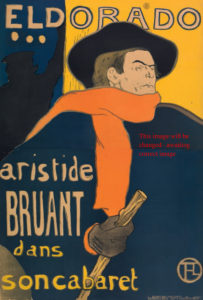
BooksfromScotland are very excited about the opening of the latest exhibition at the Scottish National Gallery celebrating Toulouse-Lautrec’s pioneering work in lithography. His posters from Paris in the late nineteenth-century are now considered icons, paving the way for multiple movements in modern art throughout the twentieth century. The accompanying book explores how Toulouse-Lautrec’s new artistic approach to the poster bridged visual and popular culture, turning the relationship between ‘high’ and ‘low’ art on its head, and highlights how he helped to define the famous hotspots of fin de siècle Paris.
Extract taken from Pin-Ups: Toulouse Lautrec and the Art of Celebrity
By Hannah Brocklehurst & Frances Fowle
Published by The National Galleries of Scotland
Toulouse-Lautrec is remembered today for his iconic images of Paris’s celebrity élite and his colourful posters of fin-de-siècle Montmartre. It was the music hall and the cabaret that guaranteed his own fame and fortune, and he was quickly accepted into the bohemian demi-monde. He was notoriously gregarious and his passions included food, entertaining, fancy dress and sport. He was also noted for his loyalty, kind-heartedness, charm, intellect and remarkable psychological insight. However, his private story, like that of many celebrities today, was one of a constant struggle with alcohol abuse, self-doubt and, in his case, with the added challenges of physical disability.
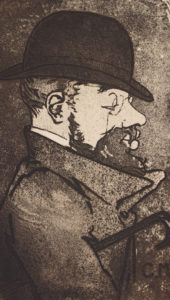
Charles Maurin, Toulouse-Lautrec. From L’Estampe originale album I, 1893 (detail of cat.8). (National Galleries of Scotland)
Henri Marie Raymond de Toulouse-Lautrec-Monfa was born on 4 November 1864 in Albi, near Toulouse in south-west France. He was of high birth, descended from three lines of French aristocrats, including the Counts of Toulouse who for centuries had controlled all of southern France. His parents, Alphonse Charles Comte de Toulouse-Lautrec-Monfa (1838–1913) and Adèle Zoë Tapié de Celeyran (1841–1930), were first cousins, which resulted in Henri inheriting serious health problems. He was frequently ill as a child and, most notably, suffered from a rare bone disorder. In his early teens he broke both legs as a consequence of two separate accidents, which left him crippled and halted the growth of his legs. He walked with a cane for the rest of his life and was just four-and-a-half feet (one-and-a-half metres) tall. In later life his physical appearance was often greeted with revulsion: the singer Yvette Guilbert (1867–1944), for example, described being ‘stopped cold by the sight’ on first meeting him. Unable to fully participate in physical pursuits such as hunting, and already displaying a talent for drawing and painting, the young Lautrec took art lessons with a local instructor and family friend, René Princeteau (1843–1914). In 1882 he travelled to Paris to study under the academic painter Léon Bonnat (1833–1922), and later at the studio of Fernand Cormon (1845–1924), where he met and befriended Vincent van Gogh (1853–1890), Émile Bernard (1868–1941) and Louis Anquetin (1861–1932), all of whom were to become leading artists of the avant-garde. It was during this period that Lautrec had his first taste of freedom, discovering café society and the art of the Impressionists. He soon settled in the bohemian district of Montmartre in northern Paris, where he fully embraced the vibrant and liberated lifestyle. This was an area of the capital where eccentric behaviour was welcomed and encouraged, and Lautrec, who had a regular income from his family, could be found every night drinking and constantly sketching at his favourite haunts: the Moulin Rouge (where he had a reserved seat), the Chat Noir and the Mirliton.
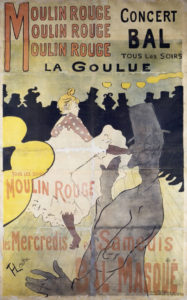
Henri de Toulouse-Lautrec, Moulin Rouge – La Goulue, 1891 (cat.2). (National Galleries of Scotland)
Théophile-Alexandre Steinlen 1859–1923, Cover for Le Mirliton, 9 June 1893, Lithograph in black ink on paper, 37.5 x 27.5 cm, Van Gogh Museum, Amsterdam (Vincent van Gogh Foundation)
Although his few submissions to the official Salon were rejected, Lautrec achieved commercial and popular success during his lifetime, and exhibited in independent and solo shows in Paris, Brussels and London. He frequently took the steamer across the channel to England, and was a good friend of the writer and aesthete Oscar Wilde (1854–1900). Indeed, he was a confirmed anglophile and, in Paris, moved in Anglo-French circles, along with the likes of Jacques-Émile Blanche (1861–1942) and Charles Conder (1868–1909). He entertained lavishly and, happier in company, would almost always share his living quarters with other artists. During the early 1890s, he took to spending time in brothels, where he was inspired to sketch the young women’s day-to-day lives. However, his debauched lifestyle, which included regularly imbibing absinthe, a potent drink known for its hallucinogenic side effects, eventually took its toll. In 1897, Lautrec began to show signs of alcoholism, and from this point onwards he became increasingly dependent. His health deteriorated rapidly. Following a bout of delirium in 1899, he was institutionalised at the Folie Saint-James asylum in Neuilly for eleven weeks. Eventually, in the late summer of 1901, his mother had him brought to her estate at the Château Malromé in Saint-André-du-Bois, where he suffered a stroke and died on 9 September, at the age of only thirty-six.
Pin Ups: Toulouse Lautrec and the Art of Celebrity is published by The National Galleries of Scotland, priced £19.95
Northern Italy, 1944: Gemmano is on the front lines of the battle for the Gothic Line, trapped between German occupation and the allied advance, as shell after shell rains down on the village. Author, David Will, has used his father’s war diary as inspiration for this compassionate and compelling novel.
Gemmano
By David Will
Published by Thunderpoint Publishing
Toni is distracted as considerable firing starts up, with smoke rising from where Montefiore Conca must be. They look at each other and fall silent, listening to what they suppose is a British attack. After a time the firing stops and then, a little later, it recommences, although it appears to have moved west. The sun has risen indicating mid-morning, and Toni can’t bear it any more. He climbs out of their hollow and up the rise to look back to Gemmano. It looks like a toy from here. As Papa joins him there is a huge explosion on the hill near Villa.
‘Perhaps they’re aiming at those dugouts I saw,’ says Toni.
He is wrong. In fact it is a signal for the start of an enormous bombardment. The whistles overhead intensify and the explosions are so numerous that they almost merge into one noise. Toni and Papa hold onto the dogs so that they will not run in panic. Shell after shell crashes onto the hill, and then onto the village of Gemmano. Those that hit the ground hurl great chunks of earth and vegetation about the place, and from the village pieces of masonry large enough for them to see, shoot out and down the hillsides. Now aircraft come flying in from the east, over their heads, and when they get near Gemmano they swoop, their bombs crashing into the village. The pounding goes on and on and they can see clouds of smoke boiling up into the air and falling down the Ventena valley, presumably covering those dugouts with dust and rubble. Other monstrous shells whistle in from the coast and join the assault.
‘Oh God help us! They are firing from ships as well,’ cries Papa.
The smoke and dust cloud grows in size and density so that it becomes almost impossible to see Gemmano. The shelling intensifies and the planes swoop in and out of the cloud, or shoot low over the rooftops. The flashes of the explosions are out of synch with the sounds, giving the whole scene a surreal aspect. The planes begin to machine gun the ground around the village, chewing up the ground in trails of spurting dust that Toni can still make out in spite of the distance.
At a certain point Papa unwittingly releases Remo and sinks to the ground. Toni joins him and they don’t say anything for there is nothing to say. They just look at each other in horror and then Papa drops his head in his hands and weeps.
Finally the bombardment ceases but they cannot see what has happened, for the cloud hanging over Gemmano shows no signs of dispersing. Toni and Papa hug and grip each other as if to convince themselves that they, at least, are still alive. Papa mutters into Toni’s shoulder, ‘Our home, our home.’
They are unable to move. In the end it is Romolo who comes and nudges Papa’s elbow. He looks up and says with an effort,
‘Come, we must start back. We must find out who is alive.’
‘We have no food or water and the river is no good. It’s so nearly dry that the pools are stagnant. Come, let us check the town for a well and some food, and then we’ll go back.’
Throwing caution to the wind, for they cannot be sure if the last Germans have finally left, they hurry into the town. There is nobody around and they hunt through the streets and lanes. It takes some time before they come to a little piazza and in the open Toni glances back to see if the cloud has lifted off Gemmano. But the haze makes it hard to see.
Gemmano is published by Thunderpoint Publishing, priced £9.99
Whisper it, but sometimes it’s ok to judge a book by its cover. In a new regular feature for BooksfromScotland we will delve into the stories behind the creation of the covers of some of Scotland’s most arresting books. Our first Cover Stories feature focusses on Muriel Spark and the gorgeous editions published by Polygon throughout Spark’s centenary year of celebrations. Designer Teresa Monachino, tasked with coming up with a series design for all 22 Spark novels, takes us through her creative process. . .
The Spark Centenary Editions
by Muriel Spark
Published by Polygon
One author. 22 novels. Where to start. With the author, of course. It’s the one thing that all 22 books have in common. It sounds obvious and it is obvious.
As a designer, however it’s important not to ignore what’s right there in front of us. Had I read any of Muriel Spark’s books; no. Thankfully, however, a lot has been written about her, from countless book reviews and interviews, to her 2006 obituary. It wasn’t difficult to assemble a picture of Muriel Spark, her life and her work and why she matters. I was, of course, given a design brief by the publisher from which I identified the following core values:
One of the world’s great writers
The writer’s writer
Controversial
Vivacious
Witty
Sharp
Waspish
Stylish
Modern
Cosmopolitan
There were a few design pointers that were particularly helpful: “representative, abstract, bold, unafraid of space … ”. And “sharp, stylish, modern, cosmopolitan … punch and panache … modern too to appeal to a younger generation being introduced to Spark …”.
Making a start I focused on the most famous and well-known of the 22 novels; The Prime of Miss Jean Brodie, the sixth book in the series. The one thing that I kept in the front of my mind was that Muriel Spark was ‘the writer’s writer’. I read the 22 blurbs that accompanied each story and I knew then that the work should speak for itself. If we mustn’t judge a book by its cover then we must judge it by its words. What happens then when the words are the cover? I proposed that the book blurb should be on the jacket cover so that the design lets the stories speak for themselves; they need no further embellishment, it’s all in the writing.
A designer must consider everything from paper to typeface to colour and with a typographic design, typeface choice and styling is crucial.
Typeface
I used Gill Sans but not as we’re used to seeing it; Gill Sans Ultra Bold. It’s quirky, witty and unashamedly prominent; a good representation of some of those core values. To complement the typeface I selected one of Eric Gill’s other faces; Perpetua, typeset in italic. Like Gill Sans, it too is very distinctive and, as sans serif and serif, they partner each other beautifully. The author is also shown in Gill Sans Ultra Bold. The title is given a full-point; definitive, end of, while also referencing the written word and narrative. The blurbs were moved to the front cover flap, where they would usually be found, and an intriguing extract from the book was selected to go under the title, maintaining the emphasis on story. The author is the constant and always appears in black and without the full point. This keeps the storytelling, written element, within the top half of the cover and makes for a cleaner layout.
Colour
The colour palette; a selection of colourful earthtones flood the background, very vintage, faithful to the eras in which the books were written, while the titles and extracts clash in vibrant contemporary brights.
The Paper
My first paper choice was GF Smith’s Tapestry Collection. A patterned/textured paper; like linen with a silky sheen. There simply weren’t enough varieties to stretch to 22 books from this collection so I chose a Fedrigoni Fine Art Paper, Arcoprint 140 gsm, an uncoated paper with a tactile vintage book jacket feel.
Collectable
The stylised typewriter key inspired graphic encourages the reader to buy and collect them all. ‘The writer’s writer’; this section of the design suggests a typewriter/keyboard/screen, the author’s name appearing on the paper or display area.
The elements of the design are simple. 6 background colours and 6 title and extract colours which repeat. It’s worth bearing in mind that book series are often displayed face up on a table or even face out on a shelf. The more variety on show, while demonstrating that they’re part of a set, the better.
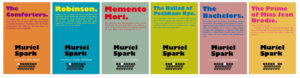
On the back cover appear 5 Muriel Spark photos that span the era in which she wrote her novels; the 1950s, 1960s, 1970s, 1980s and 1990s. These were identified and placed on the back cover in chronological order along with quotations from various sources in praise of Muriel Spark. But that’s not the end. It’s not all about fronts and backs. What about the book spines? Carrying the complete colour scheme on to the spines proved to be far too garish so I looked at how the collection could be more uniform. By making all the titles on the spine white the set is now unified. T H E N O V E L S O F M U R I E L S P A R K that’s a very pleasing 22 letters and here they are, one at the top of each spine. Likewise, for consistency, the author’s name appears in exactly the same place regardless of the length of the book’s title.

Last word goes to Muriel Spark: “Sooner or later I do what I want to do”.
The Spark Centenary Editions are published by Polygon, priced £9.99 each
Carcanet Press bring us Nameless Country: Selected Poems of AC Jacobs, bringing his poetry to a 21st century audience. His themes of exile, identity and belonging are still pertinent today.
Nameless Country: Selected Poems
By AC Jacobs
Published by Carcanet
Poet AC Jacobs was born into an Orthodox Jewish family in Glasgow in 1937. As an adult he became a self-made migrant, a wanderer through various countries never settling down in one spot for very long. He was a Jew in Scotland, a Scot in England, and a diaspora Jew wherever he traveled, and his poetry reflects his complex identities.
I Choose Neither …
I choose neither East nor West,
For I am shaped by the North,
And my history reaches down through old maps
Of Europe, and jumbled alphabets meaning,
‘I am for ever. This my Empire stands.’
Only those I seek who say: ‘Pain is real,
And not to be put by with a shrug,
Nor exhibited.’
And also: ‘Love is more than a gesture’ and
‘Know what you destroy’.
But those who scrutinize and say:
‘You do not fit the pattern of my analysis’,
‘So many laws are broken here’,
‘The gods, our teachers, do not like that’,
Are those whom I want to avoid, my enemies.
To those who think my choice simple I write:
For these and for want of these
The blood of my relatives and ancestors
Ran down the gutters of empires.
It flows in me like a cold, rough sea.
‘Introduction to A Scottish Sequence’
What called me north I do not know
Entirely. Not a piper on a rock
Dirling hypnotic music through my sky,
Nor lust for whisky washed down with strong ale
Against a foggy background of bare hills,
Nor Raeburn’s beauties near ethereal
(With jeans and shorter hairstyles, nowadays)
Made me leave her in the south
Who was cool and English, and the fierce
Jewish discussions of unfathomable hate.
I am no exile from a Celtic mist
Nor wanderer from ‘the Northern lights
of Aberdeen’. To me exile is a country,
That has the face of the cities of Europe,
A slum face pocked with treacherous suburbs.
And yet looking down South Portland Street
Towards an old fashioned stretch of the River Clyde
I perceive that what I am after is mostly
Again my grandfather, that man strong in Talmud,
(And I myself in Turriff Street long ago
Was taught the dialogue of ingenious rabbis)
What kept him here for almost fifty years,
That calls, but cannot keep me here, for one?
What gave this place the look of an outpost of exile
To woo the east here in his daily prayers?
His son’s son, I cross the river into town
Looking for bejeaned models of Raeburn (or any
Other painter) or listening to neutral music.
The old man’s secret rests with him
Behind these stricken stones.
Speech
Out here in the hills you get
Quite a bit of dialect,
more than many
People would imagine.
It’s had a way
Of surviving, breaking out, whatever
Gentility may say,
beyond where education
Leads.
I have an ear for it,
Scots or Yiddish,
raw expression
that
No one’s quite sure
how to handle.
Israeli Arab
His English was smooth and graceful,
And his Hebrew better than mine
Will ever be. He talked charmingly
Of Nazareth his home town
And its centuries-old, strange customs.
But his gift for holding together
Politeness in several cultures concealed
An injury, and his voice turned
Attention to itself, by reaching
Towards tones we need never seek.
He was trying, of course, to make
The best of an impossible situation.
Meeting him that evening I was mostly silent,
Though I have access to three or four cultures, myself.
Nameless Country: Selected Poems of AC Jacobs is published by Carcanet, priced £12.99
Douglas Skelton, author of the Davie McCall and Dominic Queste series of books, both set in Glasgow has turned his eye west to bring us his latest thriller.
The Janus Run
By Douglas Skelton
Published by Saraband
BooksfromScotland caught up with Douglas Skelton to get the lowdown on his new novel, The Janus Run.
- You’re better known for your crime fiction and non-fiction set in Scotland. What made you decide to set your latest thriller in the US?
It followed a discussion with author Craig Robertson about three years ago, over coffee in Bristol. He suggested I do something not set in Glasgow, or indeed Scotland. I am a huge admirer of his book The Last Refuge, which was set in the Faroe Islands. I wanted to do something that was fast-paced, in the mould of Robert Ludlum, but felt I couldn’t set it in Scotland as I’d already done a pacey, action-based thriller set in Glasgow called The Dead Don’t Boogie. So I decided if I was going to branch out from Tartan Noir (I so hate that term) then I might as well go the whole hog and cross the Atlantic.
- And why New York? Do you have a particular affinity with that city?
I’m a Glaswegian and I think we always have an affinity for New York, whether we know it or not! There are strong similarities, not just the grid structure of the streets, but also in outlook – gritty, tenacious, tough-talking, on the surface prickly and pugnacious but underneath a heart of gold – and in sense of humour. Also, I feel I know the city, being such a huge movie fan. Apart from that, I love New York! If I could ever afford to live there, I would. I have a friend over there while I write this and I am well jealous, let me tell you.
- Have you been influenced by American crime writers over the years? Do you have any favourites?
Whisper it – all my influences are American! From my teenage years I read the 87th Precinct novels of Ed McBain and I still return to them in the hope some of the mojo rubs off. Prior to that I read Ray Bradbury and Robert Bloch. Prior to that Mark Twain and Jack London and a prairie-load of westerns, especially Jack Schaefer. Now my go-to authors are Dennis Lehane, Robert Crais and John Connolly (although he’s Irish), among others. I realise that this is a very male-orientated list, but I did discover Dorothy Uhnak in the 1980s, read a lot of Patricia Cornwell and Paula Gosling while more recently I’ve chanced upon Rachel Howzell Hall, who writes some tough, no nonsense LA-set crime.
- Did you approach writing this novel in a different way to your Scottish books? Was it difficult to get the voice right?
It was more difficult than I thought to get the voice right. I thought, steeped as I am in movies and TV and US fiction, that it would be a breeze but it really wasn’t. By default I used UK spelling and words. Luckily, I think between the editors, the publishers, my beta readers and me we caught them all. I hope. The writing approach was, I’m sorry to say, as chaotic as usual. I had an idea, an opening, I had no clue where it would go but I ran with it. I don’t plan. I only research what I need to and generally as I go along. I wish I was more organised. I bought a white board but all it has on it is a shopping list.
- You pull out all the stops in The Janus Run: you have the Mafia, secret government agencies, the NYPD; there’s a certain glamour that you don’t normally get in Scottish crime fiction. Was that fun to write?
That was another reason why it had to be set in NY! I wanted all those elements. Yes, we have crooks in Glasgow but they don’t have the same feel in fiction as the Mafia. And I wanted it to be old school in a lot of ways. The mob isn’t the force it once was but it’s still there. Much of it was fun to write, particularly the scenes with the mob guys because I could really stylise the dialogue. I watched a lot of documentaries and listened to the way they speak, then put my own spin on it. When I first introduce Tony Falcone the words just tripped right out, the way he thought, the way he looked at things, his sense of humour. I also wanted there to be a larger than life feel to the book and its characters and that fitted NY, right down to its big apple.
- It’s a very cinematic book. Have you thought about who would play the characters if it was made into a film?
It’s purposely cinematic because that’s the way I think. My love of Three Days of the Condor (I have a wee sneaky nod to that in Janus) made me see Robert Redford as Cole Lang. And, naturally, Al Pacino as Tony. Sadly, both are perhaps too old now and Redford is retiring from the screen.
- What books have you been reading this year? Do you have any recommendations?
I’ve been reading a lot by authors I know personally this year and even though it seems very buddy-buddy, I’d recommend the latest titles from Neil Broadfoot, Denzil Meyrick, Michael J. Malone, Caro Ramsay, Theresa Talbot, Lin Anderson, Quintin Jardine, Mark Leggatt, Gordon Brown, Mason Cross, Alex Gray. Ambrose Parry’s The Way of all Flesh is a bloody good read. I’ll be diving into Liam McIlvanney’s The Quaker in the not too distant future.
The Janus Run is published by Saraband, priced £8.99
David Robinson reflects on our changing reading behaviours as he reads William Boyd’s latest novel.
Love is Blind
By William Boyd
Published by Viking
Twenty years ago, at a New York party hosted by David Bowie, William Boyd launched his monograph Nat Tate: An American Artist 1928-60 about the abstract expressionist who destroyed 99 per cent of his work before committing suicide by jumping off the Staten Island ferry. The book appeared with a glowing tribute on the back jacket by Gore Vidal, and Picasso’s biographer, John Richardson, spoke about Tate’s friendship with both Braque and Picasso.
There was just one problem. Nat Tate never existed. All those New York art experts at the party who claimed to know his work had been well and truly fooled. April Fooled, actually, and the fact that the party took place on 1 April and the subject had the names of two London galleries (Nat being short for National, and Tate) should have been a giveaway.
But look again at that date, and you can almost – almost – feel sorry for the people who were hoaxed. Within a few months that kind of arty leg-pull would become a lot harder. That August, Sergey Brin and Larry Page founded Google. If the Nat Tate joke was a cultural landmark of a kind, theirs was a far bigger one. Just over a decade later, Google was dealing with a billion searches every day. And that in turn has affected the way we read.
Let’s look at Boyd’s latest novel, Love is Blind, to examine this change. If he had claimed that its protagonist, Brodie Moncur was a real-life consumptive Scottish piano-tuner of genius, working for John Kilbarron, (“the Irish Liszt”), the real-life piano virtuoso to promote Scottish Channon grand pianos around Europe in the late 1890s, it would be easy enough for us all to check whether he was telling porkies. Potentially, the internet makes us the less deceived.
That entirely fictitious set-up – along with Moncur’s love for Kilbarron’s mistress, Lika Blum, and an ingenious musical subplot – forms the core of the new book. But just as in his acclaimed 2002 novel Any Human Heart, Boyd drags a few famous real-life people into the mix – although this time he goes to some trouble to mask their identity. So when Moncur meets a Russian doctor on the Promenade des Anglais in Nice, we are told that he didn’t catch his name. Yet as this is 1897, and as the Russian is a doctor in his late thirties who is staying in the Pension Russe, drinking fermented mare’s milk in a bid to keep consumption at bay, and as Chekhov did all of those things too, I think we can safely say that we have Anton on deck.
Boyd is a Chekhov obsessive, and has re-read and studied him for the last 30 years. Go to his Chelsea home and there’s a photo of Chekhov on the mantlepiece. In 2012, when I interviewed him for Waiting for Sunrise, he was working on a play about the writer that was staged in London the following year. Called Longing, it was based on a revelatory short story ‘A Visit to Friends’ which Chekhov wrote – yes, in 1897, and in Nice.
Chekhov, though unnamed, appears in only half a dozen pages of Love is Blind, yet his spirit hovers over nearly all of it. Without the internet, I wouldn’t have realised how much. The fact that Moncur is, like Chekhov, a consumptive, is an obvious link, but there are many others, from a plot which can be seen as amplifying the closing lines of Chekhov’s short story ‘The Lady and the Dog’ to a number of other details drawn from Chekhov’s own life.
I read Any Human Heart when it came out in 2002 and, like hundreds of thousands, loved it immediately. It works for two reasons. First, because it charts the inner life of Logan Mountstuart, as he bounces between careers as novelist, wartime spy, gallery owner, lecturer and impoverished pensioner, more convincingly than you would ever expect through using the (surprisingly rare) literary form of the intimate journal. Second, because of the sheer skill with which Boyd introduced real people into the narrative. No matter how implausibly exotic – Hemingway, the Duchess of Windsor – he placed them into the story as carefully as an expert fly fisherman, making sure there are no unnatural ripples on the surface.
But maybe there was a third reason too – one to do with me as a reader not Boyd as a writer. Back then, I let the novel wash over me. I immersed myself in the plot without pausing to check on its plausibility. I didn’t stop to examine, for example, the real-life murder of Harry Oakes when the Duke of Windsor was governor of the Bahamas in 1943. Even if I had wanted to, in 2002 that might still might not have been possible on the internet. That year, Wikipedia had only about 100,000 articles; now it has almost six million. Maybe Harry Oakes and his demise mightn’t have made it to cyberspace.
Now, with practically all of the facts in the world at my fingertips, I read differently. I read about Chekhov’s elder brothers Kolia and Alexander being alcoholics and his father being an abusive boor, and the circumstances in which Chekhov took his last drink of champagne and wonder whether that is the reason for an apparent mirroring of all these things in Love is Blind. And then there’s Lika.
In the novel, Lika Blum is the love of Brodie Moncur’s life. She is the reason the book has the title it does, because when it comes to her, his love really is blind. Type “Lika” and “Chekhov” into Google and you come up with the fact that Lika Mizinova was a blonde, buxom would-be opera singer, probably the great love of his life: 19 years old when Chekhov started a ten-year affair with her that was still continuing when he was in Nice in 1897. Who is the source of all this information? None other than William Boyd, writing a piece in The Guardian on the centenary of Chekhov’s death in 2004. So we shouldn’t perhaps be too surprised that the Lika here in his new novel – also a blonde, buxom, would-be opera singer – is very like the Lika there.
My point here isn’t to chart the extent of Love is Blind’s Chekhovian overlay but just to reflect on what the internet adds – and takes away from – reading fiction. Reading Boyd’s new novel has also involved me looking at YouTube videos of piano tuning (a key plot point, oddly enough) as well as realising, perhaps even more deeply than I have done before, the complexities involved in twisting the historical reality into credible fiction. I admire his craft as much as I ever have, even if the way I read – and maybe the way we all read – means I give in to it less.
Love is Blind is published by Viking, priced £20.
Yes, readers can’t seem to get enough of murder and mayhem solved by our vast array of detectives whether on the mean streets of our cities, or our picturesque, remote landscapes. Here’s a selection of some of the best new releases.
Sins of The Dead by Lin Anderson
Lin Anderson’s forensic science superstar is back for her thirteenth adventure which opens with a female Harley Davidson gang illegally racing in the old railway tunnel in Glasgow. They make a gruesome discovery: a dead body laid out in a way that mimics the medieval religious practice of sin-eating. There are few clues to help Rhona, and when another body is discovered near her home, she realises she is being stalked by a forensically aware killer.
All the Hidden Truths by Claire Askews
This debut, receiving great reviews and a lot of buzz, follows the story of the aftermath of an Edinburgh college massacre where 20-year-old Ryan Summers gunned down 13 fellow students before killing himself. The story is thoughtfully told through the characters of Moira Summers, Ryan’s mother, Helen Birch, the newly-promoted detective inspector investigating the case, and Ishbel Hodgekiss, the mother of one of the victims.
After He Died by Michael Malone
Michael Malone gives us another expert slice of domestic noir, telling the story of newly-widowed Paula Gadd, who is stunned when a young woman approaches her at the funeral, slipping her a note suggesting that Paula’s husband was not all that he seemed. An unpredictable thriller that wrong foots the reader at every turn, this is a novel that will make you question whether you can ever truly know anyone.
In the Silence by M. R. Mackenzie
Another intriguing debut, which sees Anna, a criminology lecturer based in Rome, return home to Glasgow to help celebrate an old friend’s birthday. In the one of the worst winter’s Glasgow has had, Anna bumps into her ex-boyfriend while on the night out. When he is murdered, she becomes the star witness and decides to investigate his death herself. She soon realises that the motive lies closer to home. . .
The Shadow of the Black Earl by Charles E. McGarry
Leo Moran returns for his second outing swapping his life in the West End of Glasgow for a visit to Biggnarbriggs Hall, the stately home of his friend Fordyce Greatorix. In the rolling hills of the Dumfries-shire countryside, Leo is delighted when romance starts to blossom. But he cannot escape who he is, and when he finds himself plagued by visions after a local girl goes missing, he is reminded of a similar disappearance thirty years previously.
The Relentless Tide by Denzil Meyrick
The hugely popular DCI Daley is back for his sixth adventure alongside his much-loved sidekick DS Brian Scott. The sleepy village of Kinloch is thrilled when a team of archaeologists believe they have discovered Viking remains, but the delight turns to horror when it becomes clear that these are the missing victims of the `Midweek Murderer’, a serial killer at work in Glasgow in the early 1990s – one of Daley’s first ever cases.
The Way of All Flesh by Ambrose Parry
Co-written by the bestselling writer Christopher Brookmyre and his wife, consultant anaesthetist Dr Marisa Haetzman, The Way of All Flesh is a rip-roaring tale of murder amid the medical experiments of 19th-century Edinburgh. Bright and ambitious medical student,Will Raven, is suspicious about a spate of mysterious deaths in the New Town, as is Sarah Fisher, housemaid to Raven’s renowned tutor, Dr Simpson. Can they overcome their differences to solve these gruesome murders?
Lethal White by Robert Galbraith
Another book in the Cormoran Strike series, written by J K Rowling under a pen name, is always a big publishing event: expect this book to rocket up the charts on its release this week. In Lethal White, the relationship between Strike and his agency partner, Robin Ellacott, is under the microscope while they negotiate political factions at play in Westminster while the rest of the country celebrate the London 2012 Olympics. And following his newfound fame as a private eye, Strike realises he can no longer operate behind the scenes as he once did.
And that’s just a taster. Check out the Bloody Scotland programme for more crime fiction recommendations. You are really spoiled for choice. . .
On 31 December 1918, hours from the first New Year of peace, hundreds of Royal Naval Reservists from the Isle of Lewis boarded the HMY Iolaire at the Kyle of Lochalsh to return home. As the boat headed into Stornoway pier, she piled onto rocks off the coast. 205 men drowned, on their own doorstep, in front of their loved ones. In one of the most eagerly-anticipated novels of year, As the Women Lay Dreaming explores the aftermath of this worst peacetime British disaster at sea, the grief, the survivors’ guilt, and the changes over time to a close-knit community. The novel will be released for Remembrance Day in November, and BooksfromScotland are thrilled to bring you an exclusive pre-publication extract.
Extract taken from As the Women Lay Dreaming
By Donald S Murray
Published by Saraband
It took me years to look at my grandfather’s journals. For decades they remained with me, undisturbed and unopened for fear that if I ever prised open their covers, the ghosts and demons of my own childhood, their sense of loss and sorrow, would leap out and overwhelm me, emerging from the darkness of my dreams. Besides, there was always so much to get on with. The everyday business of my own existence. My work as an art teacher in a secondary school in Glasgow. The joys and travails of my own family life, one that seemed, on occasion, to follow the pattern of my grandfather’s days. I, too, have had two marriages. Getting on in years now – already older than he was back then – and finding it hard to cope with the energy of my son, Jamie, I have often looked back with envy at the tolerance, patience and love my grandfather showed me. There have all too often been times when I could muster none of these, when I longed to be free of Jamie’s shadow, when I wanted to escape the hold that duty and obligation had over my life.
It was, perhaps, because of all this that I put off looking at my grandfather’s writing. His journals had all been created in the years after World War One and the Iolaire disaster in which he had been involved, each note and jotting an attempt to make sense of all that had happened at that time, a re-creation, too, of his original diaries, the ones he had lost when the ship went down in Stornoway harbour. In their rank disorder, they reminded me too much of my own life, the anarchy I felt within my own spirit: the way that one observation veers into another, perhaps mingling incidents that occurred over the distance of decades; the confusion of languages, Gaelic and English, blurring the sense of his words; even the fact that there are several events which I recall and I am sure – from my own memory – that he didn’t get quite right.
There is also the disintegration of his handwriting from time to time, the scribble of his pen when ink might have been running short in the household. The same is true of his drawings. Clear and fluid when he employed his pencil in the early days, they became indistinct in the later stages of his life, ragged and faint on paper. There are times, too, when I am all too aware of the limitations of his skill. Many of the women he drew possessed the same expression as his first wife, Morag. Such as the drawings of my mother, his own daughter Mairi, someone I suspect that he – just like me – barely knew as an adult. Or, indeed, the sketches of my sister, Rachel. The black curls. Grey eyes. Dimples. They all seem to merge into one portrait, allowing Morag to age in the form of an old woman working in the peats, to become young again in the expressions of his grandaughter. All in all, it was as if, despite her death many years before, she had become immortal, gaining the gift of not only eternal youth but also continual ageing, moving back and forth over the years. And so it is with much of his work. Time reels back and forth, shifting like a shuttle in one of those Hattersley looms that used to be heard around the village for years on end. It is very hard to make sound or sense of it.
And so I set all these things from me, pushing them to the side. It is only in the last decade or so – my son at long last gone from our home and just a few years from the centenary of the one event that so marked and darkened my grandfather’s life, as it did so many others living on the island – that I decided to pick up the journals again, trying to make sense of both their words and drawings. For all that it has taken me many years to do this, it seems to me important to try and provide both form and shape for the multiplicity of voices that are found within those pages, even occasionally try to fix my awareness of those years in the knowledge I have acquired since then, sometimes stepping out of my own skin and seeing the world as it might have appeared to an adult, imagining what it must have been like for him to take on the care of two children who had been bruised and damaged by their own early contact with the world, re-imagining his loss as if it were mine, narrowing my vision down till it blurred and blended with his own.
Writing down these words as if there was no distinction between us.
As if the incidents might have happened to me.
As if his every thought were my own.
As the Women Lay Dreaming is published by Saraband, and priced at £8.99.
In Who Built Scotland: 25 Journeys in Search of a Nation, five of Scotland’s most prominent writers and historians rediscover Scotland’s history through their appreciation of some of Scotland’s most iconic buildings. In one chapter, a rumination on Scotland’s most famous church – Auld Alloway Kirk – sends James Robertson on a journey back into his own family history.
Extract from Who Built Scotland? 25 Journeys in Search of a Nation
By Kathleen Jamie, Alexander McCall Smith, James Robertson, Alistair Moffat and James Crawford
Published by Historic Environment Scotland
Near the village of Evanton on the north side of the Cromarty Firth, is yet another ruinous church. You leave the A9 and go down a single-track road to the burial ground of Kiltearn, right on the shoreline. There is a new cemetery here, but the one that interests me surrounds the now derelict old parish church. This structure dates from the late eighteenth century, and many of the nearby gravestones are of similar or older vintage. Like Kirk Alloway, the site was previously occupied by older religious buildings, possibly including a medieval monastery.
Kiltearn’s proximity to the shore suggests that access by water may once have been as important as access by land, but after the Second World War its location became too inconvenient for the population of Evanton and it ceased to be used for worship. Photographs from the 1960s show it with its roof and windows still intact, but the slates and roof timbers were stripped soon afterwards and it is now in a very poor condition. Rabbit activity has undermined some of the old graveyard, and the retaining wall which protects it from the sea is also in need of attention. It remains, however, a remarkably beautiful and peaceful place. When you stand among the stones and tablets crowded at odd angles across the green turf, and look to the sea, you are caught between two ages, the pre-industrial and the post-industrial: oil rigs sit out on the water, anchored like some vast art installation or a herd of metallic monsters – all intestinal pipes, craning beaks and claws and rusted legs. The number of rigs changes all the time. They are brought in to the shelter of the Cromarty Firth for refitting or repair or, increasingly, just because they are no longer needed out in the North Sea.
To one side of the roofless kirk is a plot enclosed by a foot-high cast-iron fender. Centuries-old tablets lie half-submerged within this boundary. There is also an upright sandstone slab, eight foot high and ten foot wide, so weathered that most of the names and dates have disappeared and only a few words are still legible: BELOVED, DIED, TAKETH, TRUST – and ROBERTSON. This is one of the principal resting-places – the other is at Rosskeen, between Alness and Invergordon – of my once-wealthy ancestors, the Robertsons of Kindeace.
This northern branch of a clan whose heartland was in Highland Perthshire traces its lineage back to a merchant of Inverness, John Robertson, who flourished in the mid-fifteenth century. A William Robertson purchased land at Kindeace, twelve miles north of Kiltearn, in 1629. Successive generations acquired more land, farmed well, occasionally fought duels but by and large steered clear of disputes, whether personal or political. By the 1700s the lairds of Kindeace and their kin were prominent, prosperous, stoutly Presbyterian members of Ross-shire society: Jacobitism, even of a romantic, after-dinner kind, would not have been one of their indulgences.
Numerous children were produced by the wives of these lairds: of those that reached adulthood, the daughters either stayed at home to help run the household or were married off to neighbouring lairds, Edinburgh lawyers or London gentlemen, while the sons became ministers, lawyers, merchants, planters or – especially – soldiers. The family’s deep engagement in the burgeoning British Empire brought considerable rewards but sometimes at a great cost. In the second half of the eighteenth century Charles Robertson, the 5th Laird, had nine sons who survived infancy: one inherited the estate, one had a career as an army officer and two went into business in London; the other five all died overseas, three of yellow fever, one in battle in India, and one ‘of lockjaw, occasioned by the biting of a snake’.
The present Kindeace House – a sturdy construction of four storeys – was built in 1798 and redesigned and extended in the 1860s. You sense, looking at its crow-stepped gables and symmetrical frontage, that these Robertsons liked things plain and functional: it was how they lived their conventional and comfortable lives. The high point of the family’s fortunes was the nineteenth century, but things went into steep decline after the death of the 8th Laird in 1902. A combination of poor financial management and heavy taxes after the sudden demise of the heir, Gilbert, led to the land and the house itself being sold, and its seven surviving daughters and sons dispersing to Glasgow, England, South Africa, New Zealand and Canada. Among them was my paternal grandfather (who was born in 1877 and died in 1959, a year after I was born) and his sister Helena, or ‘Great Aunt Nella’, born in 1869. She lived to be nearly ninety-nine and my parents once took my sister, brother and me to see her at her home in London: I was three or perhaps four and remember only an austere, papery old lady clad in long black clothes. I was quite frightened, although she gave us chocolate bars.
All this history is a mere two generations away from me, yet it seems remote and ancient, not least because I have always felt politically at odds with what these ancestors of mine represent. Standing before that big sandstone memorial to them at Kiltearn, from which wind and rain have stripped nearly all their names, is like standing before a classroom blackboard, trying to decipher the rubbed-out lessons of the previous day.
The paperback of Who Built Scotland: 25 Journeys in Search of a Nation is published by Historic Environment Scotland, and is priced £9.99.
James Robertson is the Booker-longlisted author of highly acclaimed novels including And the Land Lay Still, The Testament of Gideon Mack, and To Be Continued
An interview and reading with Kirstin Innes at The Edinburgh Bookshop on the return to print of her bold, brilliant and award-winning debut novel.
Fishnet
By Kirstin Innes
Published by Black and White Publishing
At BooksfromScotland we are delighted to see Kirstin Innes’s Fishnet back in print with the great folks at Black and White Publishing. Acclaimed far and wide on its original publication, Kirstin’s tale of Rona Leonard on the hunt for her missing sister within the sex industry that claimed her will challenge you and stay with you long after the final page. The new edition of the novel has an afterword where Kirstin looks back at the journey she made while writing the novel, and its reception. She also pays tribute to Laura Lee, a committed sex-work campaigner, on her influence and inspiration. Many reviewers have hailed Fishnet an important book. Get yourselves a copy and find out why.
BooksfromScotland wish to thank The Edinburgh Bookshop for letting us share their interview.
We have 5 signed editions to give away to 5 lucky readers. All you have to do to get yourself one of those copies is to email editor@booksfromscotland.com with the subject heading Fishnet. Good luck!
Fishnet is published by Black and White Publishing, priced £8.99.
Artist Amanda Thomson curates and preserves for posterity those wonderful words of the Scots language relating to the world around us. It’s a joy to discover the deeply expressive vocabulary that has been used to describe land, wood, weather, birds, water and walking in Scotland.
Extract from A Scots Dictionary of Nature
by Amanda Thompson
Published by Saraband
This Scots Dictionary of Nature has been a long time in the making. As an artist, much of my work is about the Scottish Highlands, and in 2010, when I made an artist’s book called A Dictionary of Wood (which would be a first version of what you are reading now), I was doing research about the remnant Scots pinewood forests of Abernethy, and about Culbin, a Forestry Commission forest in Morayshire. Earlier that year, in a second-hand bookshop in Edinburgh, I had found an old Jamieson’s A Dictionary Of The Scottish Language, abridged by John Johnstone and published in 1846. The original price of £11 was embossed in gold on the spine, and I bought it for £20. In opening random pages, I’d come across words such as timmer breeks (timber trousers), meaning a coffin, and dedechack: the sound made by a woodworm in houses, so called from its clicking noise, and because vulgarly supposed to be a premonition of death.
I loved these words and more: they had a resonance and a particular feeling to them that was sometimes poignant and affecting, and sometimes conveyed a prosaic descriptiveness that nonetheless spoke of close connections and an attentiveness to the nuances of the landscape, what it contains, how we move through it, and even specific times of day or year. Break-back: the harvest moon, so called by the harvest labourers because of the additional work it entails. There were also words like huam: the moan of an owl in the warm days of summer, evocative of that feeling of the haziness of a long, hot summer’s day as it spills into evening. This old dictionary made me begin to wonder about lost connections to land and place and perhaps even ways of seeing and being in the world, and I began wondering what else I might find.
Eard-fast means a stone or boulder fixed firmly in the earth, or simply, deep rooted in the earth, and it’s a word that seems to get to the heart of this book. It resonates with ideas of place and belonging, makes me think of deep connections to places and particular landscapes and makes me consider how language can assist or be at the root of such connections.
Between 2009 and 2013 I was doing a doctorate and an element of my research related to the gradual changes that happen over time in the forests of Morayshire and Abernethy and how, when one is familiar with a place, one sees many more layers and begins to recognise the subtlest of these changes. I was also interested in how we make sense of and articulate our relationships to the land, both visually and verbally. As I walked with foresters and ecologists, I came across words like gralloch, used by a deerstalker to describe the innards of a dead deer (and the verb to gralloch, which so viscerally describes the task of removing them). Such words were unfamiliar to me, and yet foresters and ecologists used them with ease and specificity to describe their everyday activities. As I listened and heard these new (to me) words, they informed additional ways of seeing and gave me different understandings of the places where I was walking and of the activities they were carrying out. And there were other phrases too, some quirky, others pithy. An older forester told me about a man who started working for the Forestry Commission but was not very good at his job: he was not “wid material”, the forester said.
. . .
I’m not a lexicographer, a linguist, or a historian of the Scottish language, but as an artist I am interested in words and language and how we might describe our world. In mining these dictionaries, I’ve found words that are rarely heard, no longer in use or perhaps largely forgotten. These “found” words evidence a confluence of local and social histories, allude to changing ways of life and shifting connections, and point to fascinating relationships with nature and the land. Some show how land and nature permeate other aspects of our lives. The word flocht relates to birds and means on the wing, but then there’s to flochter, which means to give free scope to joyful feelings. Others give us immediate access to a language and a way of being in the world, being on and in the land, which may or may not be the same as now. While we see the same weather phenomena today, more or less, as when the Jamieson dictionary was published – over a century and a half ago – the impact and significance of particular kinds of weather is probably, for most of us, not the same. Naming denotes importance and significance, and the ability to notice angry teth (the fragment of a rainbow appearing on the horizon, and when seen on the north or east indicating bad weather), to recognise Banff-baillies (white, snowy-looking clouds on the horizon, betokening foul weather), or to observe that the day is lunkie (denoting the oppressive state of the atmosphere before rain or thunder) has very different implications for car drivers or city-dwellers than for someone out in a small fishing boat or for a farmer assessing whether the barley should be harvested.
A Scots Dictionary of Nature by Amanda Thompson is published by Saraband, priced £12.99.
Wild Goose Press have released an audio CD celebrating the beauty of the island of Iona. Poet Kenneth Steven has collaborated with musician Wendy Stewart and producer Mark Richards to create a soundscape that captures the island’s unique atmosphere, its spirituality, and its nature.
The Sound of Iona: Poems and Music Inspired by the Landscape
By Kenneth Steven, with music by Wendy Stewart
Published by Wild Goose Publications
Kenneth told BooksfromScotland:
‘It was Jane MacFadyen on Iona who first gave me the idea of recording an island soundscape. The best ideas are often the most obvious, and finally it has been made: a melding of the wind and the waves, the laughter of children, the sounds of birds, together with some of the poems I have written over the years. This soundscape is for those who know Iona as much as it’s for those who have always wanted to find a way of reaching Columba’s holy isle.’
Enjoy these audio extracts.
Iona
And God said:
Let there be a place made of stone
Out off the west of the world,
Roughed nine months by gale,
Rattled in Atlantic swell.
A place that rouses each Easter
With soft blessings of flowers
And shocks of white shell sand;
A place found only sometimes
By those who have lost their way.
The Hermit’s Cell
I had to listen for a silence
that was born inside.
It took a whole year to find
and now it does not fail.
I need nothing:
all I want is where I am.
I used to pray, and praying then
was struggle with myself.
Now I am made prayer, am hollowed out –
a song that needs no sound.
I pick the blow of flowers, bring them back
in blues and reds and golds,
and in the slow of winter dark
I watch for dawn and know
that I am growing into light
a little every day.
Both poems were originally published in Coracle, SPCK
The Sound of Iona, by Kenneth Steven with music by Wendy Stewart is released through Wild Goose Publications, and is £6.63.
ALSO ON BOOKS FROM SCOTLAND
-


Saltwater: A Midsummer Ghost Story by Elaine Thomson
‘The very thought of those grey faces made my skin grow cold.’
-
‘An Odious Campaign’ by Rob McInroy – Why a 1936 By-Election Still Resonates
‘This enraged the locals and he came close to being run out of town on several occasions.’
-

‘‘That’s right, Bobby,’ he growled. ‘I haven’t seen you in – well, since you decided to kill me.’ ‘
-

David Robinson Reviews: Solitary Agents by David Goodman
‘This is very much an up-to-the-minute story of spycraft, positively revelling in all the things tha …
-

The Savage Landscape by Cal Flyn
‘It is their resistance to the intrusions of the outside world − culturally, economically, environme …
-

The Shortest History of Scotland: A Q & A with Murray Pittock
‘We need to be better aware of that to understand the challenges and achievements of the past, and t …
FEATURED AUTHOR:
Nina Allan
Nina Allan was born in London and grew up in the south east of England. Her first published piece of fiction appeared in a magazine called Dark Horizons in 2002. Since then, her stories have featured in numerous magazines and anthologies including The …
FEATURED PUBLISHER:
Witherby Publishing Group

Witherby Publishing Group was established in 2008, initially as Witherby Seamanship Limited, through a merger between Witherbys Publishing and Seamanship International Ltd. The Witherby business dates back to 1740 when Thomas Witherby opened a statione …