


Hand in Hand is a UK charity, run by Grant Smith, working in Africa. It supports orphanages, a project for grandmothers and orphans, a vocational training centre and various other projects. He has written a memoir, The Accidental Social Entrepreneur, on his charity work and the life lessons he has gained from his experiences. Here he tells how how he first got involved with Hand in Hand.
Extract taken from The Accidental Social Entrepreneur
By Grant Smith
Published by Muddy Pearl
I have a friend called Pete. One evening, about thirty years ago, Pete rang me to say that he was going as part of a group on a ‘mercy mission’ to Romania: would I like to go?
My answer was,
No.
Why not? Pete asked.
I responded,
Everyone is going to Romania at the moment, I’m not jumping on the ‘bandwagon’.
Pete asked what else I was doing at that time to help people.
Nothing much, I replied.
Then why don’t you do something and come to Romania?
It seemed a fair enough argument, and so I went. Incidentally, I recall coming home from that visit in my socks, because Pete had given my trainers away.
I have another friend: Dave. Dave had visited an education project in the Brazilian city of Fortaleza. Dave became inspired. Subsequently, Dave brought Pete to the project and Pete, too, became inspired. The two of them began to raise money for the project unofficially, through various fundraising events including a sponsored cycle across the UK. Then, 10 years after the ‘Romanian’ phone call, Pete rings me again,
Dave and I would like to register a charity. You know how charities work; we need to have 3 trustees; so will you join us so we can register Hand in Hand as an official charity?
At that time, I was a volunteer consultant for another charity called Tearfund (a charity whose Christian response to poverty I really believed in). My consultancy, however, specialized in the development of theological colleges in East Africa; for Pete and Dave to suggest that I knew how charities operate was a bit like saying that I understand how aeroplanes work simply because I had flown in one. Regardless of Pete’s logic, my answer was, again,
No.
After the Romanian experience, I probably should have known better. I am sure you can guess Pete’s next question:
Why not?
Because we already have some great charities that are doing a great job, like Tearfund, World Vision and Christian Aid etc. What is the point in reinventing the wheel? We should support these existing charities.
Not at all put off by my response and knowing how easily I change my mind, Pete then said,
Go there then.
Go where? I asked.
To Brazil. Go to Fortaleza and see the project, then make your decision.
Pete has a way with words, and this seemed like a fair challenge. So I went.
Because he cared
I met a man called Marcondes. Marcondes was a local, was well-educated and had the potential to be a wealthy man. But he had given his life to helping some 300 children who lived in a slum close to him. Within this slum he had created an oasis of security and support, giving poor children the opportunity to have a fair start in life.
I will never forget that trip and what I saw there, yet it’s difficult to put into words. Here was an educated man who could have been very wealthy, but had given his life to help 300 children from the favela. He said his ambition had always been to build a 50m swimming pool in the slum. I asked,
What for?
And he said,
Because a poor kid can swim just as fast as a rich kid, and I want to give them the opportunity.
Some people give to charity because it makes them feel better. It makes them feel better about injustice – it makes them feel like they are doing something, and perhaps that is what we were doing by sponsoring Muja. But some people do it because they genuinely care. . .
Marcondes did not need to run a children’s home for the benefit of his own income, he did not fight poverty because he was brought up in poverty, he did not offer a good education to children because he was uneducated; he did it because he cared. He did it out of love. And as a consequence of his selfless love, he was loved. It was all about love. Not a distant, duty-bound response to poverty, but the giving something of yourself, getting involved and allowing yourself to be affected. Marcondes was an inspiration for me. I returned home, and Hand in Hand was registered.
The Accidental Social Entrepreneur by Grant Smith is published by Muddy Pearl, priced £12.99
Who doesn’t love the circus? Who doesn’t love a mystery? Much-loved author Alexander McCall Smith has combined both for his latest childrens’ series, The Big Top Mysteries, starring the intrepid investigative trio Billy, Fern and Joe Shortbread.
Extract taken from The Case of the Vanishing Granny
By Alexander McCall Smith
Published by Barrington Stoke
“What’s your name?” Billy asked as they sat down.
“Tom,” said the boy. “And … and I’m sorry about looking so sad, but you see I am sad inside, and when you’re sad inside it’s hard to be not sad outside – if you know what I mean.”
Billy assured Tom that he understood. “At times I feel a bit sad too,” he said.
Tom nodded. “You see,” he began, “it’s my granny.”
“Is she not feeling well?” asked Billy.
Tom looked down at his popcorn. “No,” he said. “She’s not ill. She’s disappeared.”
Billy had not been expecting this. “Disappeared?” he exclaimed. “Do you mean she’s vanished? Just like that?” He had read a story once about somebody who had become invisible. One moment she was there and then the next moment nobody could see her. She had come back of course, bit by bit, starting with her toes and ending up with the top of her head, but that was just a story. Things happen in stories that never happen in real life – except sometimes, of course.
“No,” answered Tom. “She didn’t vanish in a puff of smoke. Yesterday, she just left. Nobody knows where she is.”
“Have they looked everywhere?” asked Billy. There were plenty of places you might find your granny if she suddenly went missing. He had heard of a granny who had suddenly decided to go off on a cruise to Florida without telling anybody. Her family had no idea about this until she sent a postcard from Orlando telling them what a good time she was having. And then there was the granny who went off to France to join the Foreign Legion, which is part of the French Army, and only returned, most disappointed, when she was told that the Foreign Legion did not take grannies. These were unusual cases, of course: most grannies stayed put and could be found every day in more or less the same place.
Tom said that he had carried out a very thorough search. “I looked everywhere,” he said. “I looked in all the cupboards in her room. I looked under the table. I looked in the garden. But there was no trace of her.”
“Oh dear,” said Billy. “What about your parents?” he asked. “What did they have to say about this?”
Tom frowned. “That’s the odd thing,” he replied. “My parents didn’t seem to be very worried. They said, ‘Oh, Granny will be all right.’ That was all. But how do they know that?”
Billy was surprised. “So, they’re leaving it to you to find her?” he asked.
“Yes,” said Tom. “And that’s one of the reasons I’m so worried. I don’t know where else to look.”
It was at this point that Fern joined them. She sat on the other side of Tom as he told his story once more. Feeling sorry for him, Fern put her arm around his shoulder to comfort him.
“I’m so sorry,” she said. “Was she a good granny?”
“The best,” answered Tom.
Fern glanced at her brother. She was sure he was thinking the same thing. “We’re going to help find your granny, Tom,” she said softly.
Billy did not hesitate. “Yes,” he said. “We are.”
It was going to be their first case, and both of them were determined that they would help their unhappy new friend. They were not sure how they were going to do it, but they were sure they would.
Tom looked at them gratefully. And then, for the first time that day, he smiled.
But how were they going to help Tom? It is easy enough to say that you are going to solve a mystery, but a bit harder to work out how to do it.
Fern thought it might be a good idea to ask Mr Birdcage for help. Billy agreed. “He knows just about everything,” he said. “Surely he would know how to find a missing granny.”
They spoke to him after breakfast. Mr Birdcage was sitting outside his caravan, enjoying the morning sun and reading his newspaper. He listened as they told him about their conversation with Tom. Then he stroked his chin thoughtfully, as he often did when asked a difficult question.
“This won’t be easy,” he replied at length. “Grannies don’t usually go missing for no reason at all. When they do, it’s usually because somebody has made a terrible mistake.”
“Such as?” asked Billy.
“Well,” said Mr Birdcage. “There was a case a few years ago of a family who took their granny with them on holiday. They went off on an aeroplane to somewhere in Spain, I think. They had a very good holiday. There was a nice beach, I believe, and restaurants and so on. All very pleasant.”
“And then?” Fern asked.
“They went to the airport and boarded the plane to come home,” Mr Birdcage said. “It was only when they were halfway home that one of the children asked ‘Where’s Granny?’ And that was when they realised they’d left her in Spain – by mistake.”
Billy caught his breath. “What happened to that poor granny?” he asked.
Mr Birdcage frowned as he tried to remember. “I think it ended all right,” he began. “One of the family went straight back to Spain and found her sitting on a beach eating an ice cream. She was quite disappointed to hear that the holiday was over, as she had been enjoying herself.”
The Case of the Vanishing Granny by Alexander McCall Smith is published by Barrington Stoke, priced £6.99
When Donald O’ Connor sings ‘Make ‘Em Laugh’ in Singin’ in the Rain, it’s difficult to disagree with his point of view. Novelist Bobbie Darbyshire certainly follows Donald’s instruction in her latest novel, The Posthhumous Adventures of Harry Whittaker, and speaks to BooksfromScotland about comedic writing.
The Posthumous Adventures of Harry Whittaker
By Bobbie Darbyshire
Published by Sandstone Press
Tell us about your new novel, The Posthumous Adventures of Harry Whittaker.
Many thanks for featuring it! Harry is a hugely famous actor – think Laurence Olivier crossed with Jack Nicholson. He’s adored by his public, but in personal life he’s an outrageous old egotist. Dying of a heart attack, he finds himself still in this world, stuck in a bizarre afterlife, while his very much nicer son Richard tries to escape a failing café, a dotty mother and the wrong girlfriend.
What was the inspiration behind the book?
The story I’d begun to develop explored the effect of a father’s mean-spirited will on his family, but it wasn’t firing my imagination. Feeling stuck and downcast, I complained to a friend: ‘The problem is that the most interesting character is dead…’ As the words left my mouth – ping! – the light came on in my head: Harry would still be around, observing how his will was received. He would have obstacles to overcome in the afterlife, a predicament that would limit him severely, bring him down a peg and teach him some lessons. I couldn’t wait to start writing.
What is it about the world of showbusiness that makes it ripe for comedic writing?
I found great comic potential in the gulf between an individual’s personality on stage and off. Not just Harry himself. Richard’s dotty mother escapes her inner panic and ordinariness by constantly re-inventing herself theatrically to an invisible audience and pretending the junk she hoards is a props department. And Quentin, a detestable reality-show wannabe, may, just possibly, be a nice guy…
Can you tell us a little about how you approach writing about serious subjects with humour?
The honest answer is I can’t help the humour. I put my characters in serious situations and it just happens. I was startled when the first writing group I joined laughed aloud at the pieces I read – I hadn’t realised they were funny. When a scene is too serious for comedy, I write it entirely seriously, but my nature is to see the absurd side of grave situations and to let my characters express this. Conversely, I like the poignancy of a pang of sadness in an otherwise happy ending, and that’s what I’ve aimed for with Harry.
The novel has a great cast of supporting characters. How do you balance between having fun with them while keeping to the structure of the story you want to tell?
Thank you! I love them all – right down to Harry’s cat, Henry V – and, as you say, enjoy having fun with them. But my priority is always to keep the reader wanting to find out what happens. So, however much fun they are, a supporting character is always there to propel the story forward, raise the stakes, deepen suspense, or set something up for pay-off down the line.
You’ve had a very varied career along with your writing. Do you think that has helped you as a writer having put your feet into so many worlds?
It certainly broadened my outlook, and occasionally I draw on these worlds in my writing, but mainly I was distracting myself from acknowledging the itch to be a writer. Most of the toe-dipping – barmaid, mushroom picker, film extra, maths coach, care assistant, adult literacy teacher – happened when I was a student or after I’d quit the civil service to write novels. The civil service also opened windows on different worlds, notably during my stint as private secretary to a cabinet minister.
What other comic writers inspire you? (And non-comic ones too!)
It’s the small moments of humour in general fiction that arouse my envy. From classics (e.g. Jane Austen, E. M. Forster, George Eliot’s Middlemarch) through the twentieth century (e.g. Elizabeth Taylor, Kurt Vonnegut), to today’s writers (e.g. Anne Tyler, David Nicholls).
It’s often said that comedy is harder to write than drama. What advice would you give to writers who want to try their hand at comedic writing?
Humour delivers a moment of pleasurable surprise, ranging from mild (an inward smile) to hilarious (fits of laughter). So my advice is don’t plan or contrive or explain your humour. Trust your brain to surprise you, then quickly get it down fresh on the page. When the scene is ready, try it out on a few readers. If it amuses them, great! If not, maybe something needs tweaking – the timing or the word order (surprise works best at the end of a sentence). Maybe these readers are humourless! Try it on someone else. Or maybe it’s a dud – let it go.
The Posthumous Adventures of Harry Whittaker by Bobbie Darbyshire is published by Sandstone Press, priced £7.99
BooksfromScotland has been eagerly waiting in anticipation for each instalment of Ali Smith’s seasonal quartet, wondering how she will tackle her themes with each book. We have never been disappointed, and have loved each artful and full-hearted novel. Lee Randall reviews the latest instalment, Spring, and once again, it looks like Ali Smith has gifted us with another gem.
Spring
by Ali Smith
Published by Hamish Hamilton
Spring, by Ali Smith, resembles the eponymous season, with its wealth of fluctuations. There are storms and blasts of icy wind—especially in Smith’s depiction of the plight of refugees, and her descriptions of grief—but they’re countered by flashes of light, promises of renewal, even revolution.
The surprise is that Smith’s message is optimism. It’s flagged early, in this passage that nods to Dylan Thomas: ‘Or picture a crocus in snow. See the ring of the thaw round the crocus? That’s the door open into the earth. I’m the green in the bulb and the moment of split in the seed, the unfurl of the petal, the dabber of ends of the branches of trees with the green as if the green is alight.’
Spring is a treasure hunt, a symphony of voices and references. Smith’s writing is as vivid and playful as ever, turning every conversation into a Quickstep. This season’s Shakespearean touchstone is Pericles, with its themes of refugees, sex trafficking, rebirth, reconciliation, and purity. The artist referenced is Tacita Dean, particularly her 2018 Royal Academy exhibition, Landscape, featuring mountains and clouds—the former, massive, engulfing, oppressing, the latter allowing room to breathe. The Cloud is also where we store our data and memories online, and the internet is another point of reference at the start of each section.
Other references include Katherine Mansfield, Ranier Maria Rilke, and Charlie Chaplin; there’s a scene where refugees watch one of his films that will remind some of a key moment in Sullivan’s Travels. Here, too, are claustrophobic mash-ups of racist social media vitriol, or the worst platitudes of the internet leviathans consuming our data like krill, pretending all the while that it’s for our own good.
There’s also a fairy tale about a village’s annual virgin sacrifice that ends on a triumphant note when a young woman defiantly takes matters into her own hands—and young people taking action is another strong theme throughout the novel.
Like Pericles, Spring begins with love and loss. Seventy-year-old Richard Lease mourns the death of his glamorous, wise friend, screenwriter Patricia (Paddy) Heal, by recalling their final meetings, scrolling back and forth through their long, shared history.
Succumbing to grief and desperation, with only their imaginary child for company—his actual daughter has been incommunicado for decades—he skips out on a directing job, heading north to Scotland in search of mountains. The film was to be an adaptation of the novel April, a character-driven meditation about Mansfield and Rilke when both were near the ends of their lives. The novel riffs on the idea that these literary luminaries overlapped without meeting in the Swiss mountains in 1922. But the screenwriter, a young, thrusting type, insists on writing sex scenes between the dying authors.
Part Two introduces Brittany, a DCO [Detainee Custody Officer] in a UK IRC [purpose-built Immigration Removal Centre with a prison design]. She works for security firm SA4A, which has appeared before. Through her compassionate but pragmatic eyes we witness the inhumane conditions Britain considers suitable for refugees. It’s a shaming and disturbing litany, but one of the most devastating details is a quiet aside: ‘. . there was generally paracetamol available for the Kurdish deet on the wing with cancer unless it was the weekend . . . in which case he’d have to wait like everybody else for Monday.’
The IRC’s abuzz with rumours about a young girl who breezed past security to berate the governor about sanitation, ordering him to have all the toilets cleaned. Brittany discovers it’s true, and what’s more, if rumours are to be believed, the girl also walked into a knocking shop preaching chastity and emerged unscathed.
That girl is sassy, savvy 12-year-old, Florence Smith, one of many quasi-magical creatures cropping up in Ali Smith’s work. It can’t be a coincidence that Florence is the home of Botticelli’s Primavera. And Florence, like the goddess Persephone, comes and goes from underworlds unscathed, longing to be reunited with her mother. As if hypnotised (the excuse she’ll give her boss, later), Brittany joins Florence on a train journey to Kingussie.
Florence is good; she ‘makes people behave like they should, or like they live in a different better world.’ She’s our hope for the future, clinging to her integrity, keeping her personal details close, so no one else can tell her story. As Paddy has told Richard, and Smith has often said in interviews, the question of who controls the narrative is significant. Florence intends on taking control of more besides, promising that when the her generation gets its plans mobilised they will change everything.
Spring is also dusted with stories of battles, but rather than bloodshed, focuses on combatants who chose to lay down their weapons, who chose forgiveness and reconciliation. Is she overly optimistic? If so, this is the season for it. She explains that before the Gregorian calendar, March was the start of a new year. ‘To celebrate both the vernal equinox with its tilt to the North towards the sun again, and the Feast of the Annunciation. . . . Surprise. Happy new year. Everything impossible is possible.’
All the characters converge in Scotland, where Florence saves Richard’s life, instilling him with fresh hope. They meet Alda, a member of the Auld Alliance network, functioning as an Underground Railroad for refugees, ‘disappearing people from a system that’s already disappeared them.’ This reignites Richard’s enthusiasm, inspiring a documentary telling the stories of the dispossessed.
In closing, Smith circles back to vernal images, and to April: ‘Pass any flowering bush or tree and you can’t not hear it, the buzz of the engine, the new life already at work in it, time’s factory.’
Spring by Ali Smith is published by Hamish Hamilton, priced £16.99
Tom Pow is Creative Director of A Year of Conversation – a collaborative project designed to celebrate, initiate and explore conversation through the creativity of those who live within, and outwith, Scotland. Here, he celebrates the act of translation as conversation, and invites us to participate in conversations across borders throughout the year.
Alastair Reid, one of our finest poets and translator of Borges and Neruda enjoyed conversation more than anyone I’ve ever met. When my friend Richard Gwyn was working on a new anthology of Latin American poetry, I told him he had to meet Alastair. Richard drove to Dumfries and I then drove him to meet Alastair. Richard told me it was a meeting of great significance for him and in fact was the final spur he needed to finish the book. Six weeks later Alastair died.
To the Edinburgh launch of The Other Tiger, Recent Poetry from Latin America, edited and translated by Richard himself (Seren 2017), Richard brought two Mexican poets, a Chilean poet and the Argentinian poet and translator, Jorge Fondebrider. In a short discussion, Jorge commented, “It’s very hard to have a conversation with you (the audience), because you are so ignorant – pardon me for saying so.” This came as quite a shock to the Blackwell’s audience! Jorge explained: “If you go into a bookshop in Buenos Aires, it is full of translations from English-speaking poets. You go into a bookshop here and where are they? We are missing half the conversation.” The idea of translation as ‘conversation’ immediately struck me. I recalled Robyn Marsack saying, we must pay attention both to what goes out and what comes in, but I think the idea of conversation makes this much clearer: something that suggests two sides considered equally. It seems to me that such a process is culturally and politically necessary at the moment.
I recognise that export of our literature is of course hugely important for all kinds of reasons – which is why, as one of the advisory group for the recent Creative Scotland Literature Review, we argued for a dedicated post in that area, and why I now serve on the Scottish Publishers Translation Fund panel. This panel receives applications from foreign publishers who wish to publish Scottish writing in all genres. We attach great importance to the case that the publisher makes. These can show wide knowledge both of an author’s previous works, as well as of Scottish literature generally. Here is a short passage illustrating a publisher’s appreciation of Shapeshifters by Gavin Francis: “In some extraordinary passages in this new book, the author leaves aside the familiar synthesis of case study with cultural history, and aims for something more exacting and unsettling in his prose, full of profound and complex moments.”
Often, these ‘cases’ appear to be part of a conversation that publishers are having between Scottish writing and that of their own tradition – and with writing from other nationalities on their list – or simply with an idea of Scotland. But when the work is eventually published, it will add to the conversations readers can have with others and with themselves. Regarding the ‘what comes in’ part of Robyn’s equation, there is what has been called the ‘three percent problem’, denoting the proportion of works translated for the English-speaking market. So, I think we should applaud and (continue to) support the work of award-winning Charco Press, based in Edinburgh, and Vagabond Voices, based in Glasgow, for enriching our conversations with elsewhere. Without exception, the literature of every country is vital to it; so there needs to be, not sensitivity to a particular literature, but to ideas beyond our own circumstances. The taking in of such ideas can demand a certain kind of translation. As Kate Briggs writes, in This Little Art, “We need translations. The world, the English-speaking world, needs translations. Clearly and urgently it does; we do.”
But, when Jorge made his “missing half the conversation” comment, I was also struck by the fact that there is a great deal of activity that does not focus on the availability of individual books or sets of books. Such activity is also vitally important to our cultural health, although much of it takes place on a (less visible) practical interchange/conversational level: translation exchanges which Mireille Gansel has termed ‘the essence of hospitality’. Examples of those involved in this work are Highlight Arts, the Scottish Poetry Library, StAnza, Cove Park and the Edwin Morgan Trust. (Literature Across Frontiers has also offered valuable experiences for many Scottish writers.) Informal connections can thrive from more programmed exchanges – I think of the work of Ken Cockburn with German poets and of Anna Crowe with Catalan ones. Poetry, which is the genre with which I’m most familiar in terms of translation exchange, offers great rewards within a relatively short time-scale. Iain Galbraith, for example, who was part of the most recent EMT translation project, described at StAnza how Hungarian was an unknown language to him on the first day of the translation workshops, but by the fourth day, through intent listening and conversation, certain of its features had become familiar to him and he had a sense of the language himself.
However, perhaps the one thing that sensitised me most (unsurprisingly) to ideas of conversation was Brexit. Kate Briggs refers to an article published in The Observer in which Rachel Cooke declared, “It’s boom-time for translated fiction.” Briggs writes, “Cooke’s article celebrating the ‘subtle art of translated foreign fiction’ was published on 24 July 2016. Exactly a month and a day after the UK vote to leave the European Union; what sounded, to my ear, as to so many others, like a great big boom.”
Yet we must not be deafened by it. We must continue to be a culture that is attentive and engaged. Translation as Conversation is a vital strand of A Year of Conversation and BooksfromScotland will be featuring other writers reflecting on this theme throughout the year. As Mireille Gansel writes in Translation as Transhumance, “In these times of solitude and solidarities: translation, a hand reaching from one shore to another where there is no bridge.”
Find out more about A Year of Conversation at www.ayearofconversation.com (#AYOC2019)
Nostalgia aint what it used to be, especially when it comes to our Seventies TV heroes. David F. Ross takes us on a riotous ride in his latest novel, pulling back the curtain on the era’s talent shows. So, meet Archie Blunt, a man with a fair few disappointments as well as big ideas. And when opportunity knocks, will Archie be able to see it through?
Extract from Welcome to the Heady Heights
By David F. Ross
Published by Orenda Books
Hank Hendricks was the pre-eminent light entertainment star in the British television firmament. He had been for nearly twenty years. He had created an original and fast-moving talent show for radio in the late fifties called The Heady Heights, successfully transferring it to BBC television as the swinging-sixties obsession with pop music mushroomed. A bidding war between the broadcasting companies, skilfully plotted and manipulated by Hendricks, resulted in the show moving to the commercial ITV network. It was now a staple of Saturday night television, and ‘Heady’ – as he was now affectionately and universally known – was its executive producer and presenter.
Heady Hendricks was ‘represented’ by a brash Canadian known as Daryl W. Seberg. It was the stuff of legend that Seberg was an alias used by Heady Hendricks when negotiating his contracts. Heady had allegedly been witnessed by an industry insider answering the phone as Heady, responding that the subject of the call was something his associate would deal with, pausing, then continuing the call in a totally different voice … as Daryl W. Seberg. He reinforced this complex fabrication by ensuring Daryl’s severe agoraphobia was widely acknowledged. The Seberg Agency had one client and did not prospect for others. Daryl did all the tough negotiating; Heady – the talent – signed the deals. So Heady Hendricks had no agent and managed all his own contracts and legal affairs. This eccentric autonomy made him one of the richest and most powerful personalities in Britain. Even though he had no apparent influence over the programme’s guest judging panel, or the famous studio-applause rating mechanism, the clap-o-meter, when he uttered his catchphrase ‘My word, I think you’re heading for the Heady Heights’, no one ignored it.
In the early seventies the show had suffered a marked dip in ratings. Acts were felt to be either too insipid, too dull, or frankly too talentless. They were either cardigan-clad country-and-western crooners reclining in rocking chairs, or magicians sawing beaming, large-breasted female assistants in half. Additionally, damaging rumours of Heady’s voracious sexual appetite began to surface. A friendship with the newspaper magnate Robert Maxwell guaranteed tabloid media protection but only to a certain level. The star’s shining public profile made him a target of those wanting to see his polish tarnished. Heady Hendricks’ response was to get out of the big city spotlight to take the show on the road. He would fly his panel of judges around the country in his small Cessna 172. With their help, Heady handpicked the contestants personally. These new auditions had given the show a more regional flavour, resulting in its renaissance. Earlier in the year the show had made a victorious return to the London Palladium, as a segment on the Royal Variety Performance, with four previous series winners on stage in front of the Queen. And with Heady himself presenting the whole extravaganza, he was back on the very top of the showbiz pile. Rumours of a different kind now circulated – an honorary knighthood, perhaps – helped by his highly publicised donations to various homeless charities.
*
Archie Blunt was hyperventilating as he took in his charge’s identity. The only person equivalent to Sinatra in his fantasies was Heady Hendricks. He hadn’t dared imagine that it could possibly be him – The Dreammaker – in room 392. Yet, it was. And Archie Blunt was to be his Glaswegian chaperone.
Fifteen minutes after that first tentative knock on his hotel-room door, Heady Hendricks was on the other side of it, ready to take on the world. The dragged-through-a-hedge backwards look had disappeared and in its place was the very definition of showbiz sheen. His skin seemed several shades darker to Archie than it had only minutes earlier. Now it was the colour of teak. He wore a fawn three-piece suit with a large-collared shirt open at the neck. It revealed a large coruscating disc of silver, nestled comfortably into a nest of dark hair, like an alien spacecraft that had landed in a dense forest clearing. Shiny black hair was slicked back from a widow’s peak, giving Heady the air of a seductively tanned Ray Reardon. A pencil-thin black moustache hinted at charismatic menace. His flattened boxer’s nose made him look like a bank robber sheathed in American tan. Unlike many in the showbiz firmament, Heady Hendricks looked like he could handle himself in a pub brawl. The knuckle ridges and callouses on his thick-fingered hands, which could’ve built ships on the Clyde, hinted that he might’ve started a few fistfights as well. Heady Hendricks looked like a million dollars … and he smelled like he had just bathed in Hai Karate. This was surely Archie’s big chance.
You can listen to the Welcome to the Heady Heights playlist on Spotify.
Welcome to the Heady Heights by David F. Ross is published by Orenda Books, priced £8.99
Mandy Haggith’s Stone Stories trilogy, set in the Iron Age has been gathering fans since the publication of the first novel, The Walrus Mutterer. For the publication of the second instalment, The Amber Seeker, Mandy tells us how fourth-century explorer Pytheas not only inspired her trilogy but also her love of sailing.
The Amber Seeker
By Mandy Haggith
Published by Saraband
The Amber Seeker is the second of a trilogy of historical novels, set in the Iron Age, around 320 BC, and it was mostly written at sea. It is inspired by a Mediterranean explorer, Pytheas of Massalia (from modern day Marseilles, back then a Greek colony), who probably set foot in Assynt, where I live, on the northwest coast of Scotland, during an amazing voyage that included circumnavigating Britain, venturing as far north as Iceland and the pack ice and across the North Sea to the Baltic.
A few years ago, I was working for an archaeological dig that was excavating a broch, a tall, Iron Age cooling-tower shaped building, which may well have been standing when Pytheas sailed in. As I read Barry Cunliffe’s brilliant account in The Extraordinary Voyage of Pytheas the Greek I began to imagine the people that Pytheas would have encountered here. What sort of culture clash, I wondered, would have existed between a Greek scientist and his Celtic hosts? The seed of a novel was sown.
Pytheas was also a writer and wrote a book about his voyage, On the Ocean. One copy burned in the library at Alexandria and all the others seem also to have been lost. All we have are fragments from Greek and Roman geographers and historians who quoted Pytheas: some refer to him with admiration and respect for his scientific rigour and fascinating discoveries; others deride him as a fantasist. It seems that many of his adventures were, literally, incredible.
Most of the fragments are accounts of his ocean passages that were so outrageous and new to his Mediterranean readers that many took him to be making them up. He was mocked for his tales of great creatures rising out of the sea spouting fumes; islands where the land flows, smoking and burning, into the water; a place where the ocean becomes slushy and semi-frozen; not to mention locations with tidal ranges of many metres. To us, these details point not to a fabulist but to someone undertaking an extraordinary voyage for his time – daunting even to a modern sailor – up beyond the tidal islands of Britain to Iceland and the southern edge of the polar ice pack, encountering great whales along the way. I can vouch for the humbling strangeness of the blow of a bow-head whale among ice floes. I just hope the awe and thrill he experienced compensated for the lack of credulity of his readers.
To write about Pytheas I needed to understand better where he travelled. I began with a trip on an ice-breaker up into the Arctic, including time spent in the vast Greenland pack ice and a couple of weeks sailing around Svalbard. That got me hooked on sailing, so I set about qualifying as a skipper, bought a boat and discovered that it is a kind of time machine. The sea, paradoxically, appears to be, on the one hand, in perpetual change yet, on the other hand, exactly the same as it has always been. Although there is nylon, steel and aluminium onboard, the process of sailing is basically just as it would have been in Pytheas’ day: the winds are still Iron Age winds, the waves and the tides are as varied and as reliable then as now, the landscape, once you’re a mile off shore and the buildings mere dots, could be from anytime. Out on the ocean, twentieth century concerns sink away and the Iron Age looms into the present.
I therefore found the boat to be a perfect writing retreat. As I scribbled with my fountain pen in my notebook, I imagined Pytheas scratching observations for his book on vellum or parchment with a quill dipped in oak gall ink. Anchorages are usually devoid of mobile phone signals or other distractions, so I spent many happy hours swinging at anchor, allowing the story to ripple out onto the page, the boat populated with a crew of fictional characters. Out at sea, I have found an ease in sliding between past and present. Then and now are easily accommodated in the vastness of the ocean.
The Amber Seeker by Mandy Haggith is published by Saraband, priced £8.99
The good folks at Floris have just released a brand new series for younger readers and animal lovers. Come and and join Isla, Buzz and Gracie in their gang, the Animal Adventure Club! If there’s a wild animal in trouble, they’ll be there!
Extract taken from The Baby Deer Rescue (Animal Adventure Club 1)
By Michelle Sloan
Published by Kelpies
Isla MacLeod drummed her feet on the floor of the Pittendooey Nature Reserve rangers’ lodge. It was nearly four o’clock: time for the Animal Adventure Club meeting. Three afternoons a week, Isla and her friends Buzz and Gracie came to the nature reserve after school to help the rangers and, best of all, look after animals! Buzz was here, but there was no sign of Gracie. Isla couldn’t wait for her to arrive so they could go out on patrol.
“Can you give me a hand with Spiky?” called Buzz. He was helping Lisa, the head ranger, to take care of a poorly hedgehog. “Lisa asked me to give him his ear drops.”
“Sure,” said Isla. “We can help Spiky while we wait for Gracie.” Isla jumped up and headed towards Buzz and Spiky at the far end of the room. “Oof!” she said, pinching her nose. “Spiky’s a bit smelly. Maybe we should have called him Stinky.”
“That’s why we keep him back here!” Buzz laughed, and opened Spiky’s cage.
There was a big pile of straw bundled in one corner. Isla put on a pair of thick gloves, then reached in and gently teased the straw away to reveal a large ball of sharp prickles.
“Hello, wee pal,” said Isla softly,
lifting the hedgehog out and placing him on a towel on the table. His prickles bristled.
“Try stroking his back,” said Buzz. “That should relax him.”
Sure enough, as Isla stroked him, the ball began to slowly unfurl. A tiny snuffly nose poked out, followed by a paw. Buzz leaned in and had a good look at the little hedgehog’s face.
“He’s looking much brighter,” he said. Spiky let out a small squeak.
“Cheeky thing,” said Buzz. He pulled a little bottle out of his pocket and tipped the drops into Spiky’s tiny ears.
“I don’t know how you manage to find his ears under all those prickles!” laughed Isla. “You’re going to be a brilliant vet one day.”
Buzz’s face went red, but he smiled.
“So, what’s the Animal Adventure Club doing this afternoon?” he asked.
“Never mind this afternoon — we’ve got enough jobs to last us a month!” said Isla. She grabbed her notebook out of her rucksack and read aloud:
- Help Lisa find good trees for hanging bat boxes, then mark them with chalk so we can find them later.
- Collect bark, leaves, twigs, moss and pine cones for building bug hotels.
- Make fact sheets to teach visitors about the animals in the reserve.
“Whew!” said Buzz. “Sounds like hard work. Remember we’ve got to fill the bird feeders too. Speaking of feeding, I’m getting hungry and we haven’t even started yet! Do you think we can fit in a biscuit or two before we go?”
But Isla didn’t have time to answer, because a familiar voice outside shouted, “Buzz! Isla! Where are you?”
“We’re in the lodge,” Isla called back.
The door burst open. “Have you seen Lisa?” gasped a sweaty Gracie.
“She’s fixing some fencing by the boat sheds,” said Buzz, carefully placing Spiky back in his cage. “What’s up?”
“There’s no time to go and get her then,” said Gracie. “There’s an animal up by Craggy Woods in real danger! Bring Lisa’s cutters, Isla.”
Isla put them in her rucksack and they set off after Gracie, who led the way around Loch Dooey at a cracking pace. Squabbling black-headed gulls shrieked and swooped overhead. Even though Isla was in a hurry, she noticed some tiny and very fluffy chicks bobbing on the water near the gulls’ nesting area on the loch. She tried not to get distracted.
“What kind of animal is it?” asked Isla.
“I think it’s a baby deer,” puffed Gracie.
“You mean a fawn,” corrected Buzz.
“Fine, a fawn,” Gracie said impatiently.
“I didn’t have time to look properly. I was coming here on my bike when I heard screeches from the woods near the cycle path. I headed straight to the lodge to tell Lisa.”
They bolted round the loch, over Dooey Burn Bridge and into Craggy Woods. Gracie was a brilliant tracker and knew exactly which of the winding paths to take.
“Where now?” asked Isla.
“By the fence at the edge of the woods,” said Gracie. They could hear distant cries.
Isla slowed down as they drew closer, and signalled to the others to be quiet. Gracie pointed to the far end of the fence. There, almost hidden in the long grass, was a tiny golden fawn. Its head was caught in the wires and it was crying pitifully.
“Look, it’s bleeding,” said Gracie. “Poor thing.”
“We need to stay quiet so we don’t frighten it any more,” whispered Buzz. “Fawns can be scared of people.”
The fawn was panicking and struggling because its head was stuck.
“We have to free it,” Isla said quietly, “before it really hurts itself.”
“But how?” asked Gracie, her eyes wide.
Isla took off her rucksack and crept closer. She knelt beside the fawn, wondering what to do. Just stay still, she told herself. Maybe if I stay calm, the fawn will calm down too.
After what seemed like a long time, something extraordinary happened: the fawn stopped wailing and thrashing, and its breathing became steadier, almost in time with Isla’s.
“Pass me my rucksack please,” whispered Isla.
Carefully, Gracie handed it to her, trying not to make a sound.
Still moving slowly and calmly, Isla took out a pair of gloves and a small pair of cutters. Checking it was safe and that the fawn was calm, she made one swift snip in the wire fence.
Instantly, the baby deer pulled out its head. For a split second, the animal stared at Isla with its huge dark-brown eyes and blinked with long, feathery eyelashes. Its shiny black nose twitched, and then it turned and bounded into the depths of the forest.
“Wowza!” said Buzz.
“Double wowza!” said Gracie.
Isla watched after the beautiful baby animal, glad it was free.
“It was bleeding, wasn’t it?” said Gracie.
“I don’t think there was much blood,” added Buzz. “It should be fine.”
Gracie nodded. “I hope so.” She turned to Isla and helped her friend up. “Well done, Isla. You were so calm.”
Isla shrugged and smiled. “Thanks Gracie. It’s just as well you got to the lodge so fast. Any longer and the fawn might have been badly injured.”
“C’mon,” said Buzz. “Let’s get back and tell Lisa all about it. And we’ve still got to go through all the Animal Adventure Club tasks you have on your list, Isla.”
“And eat some biscuits, I bet?” she said cheekily, nudging Buzz.
“Too right!” he said. “There’s a packet of custard creams waiting for us, and I’m starving! Let’s go!”
The Baby Deer Rescue (Animal Adventure Club 1) is available now from Kelpies, priced at £5.99
Sometimes nothing will do for warmth and comfort other than a hearty bowl of soup! Seasonal Soups is just the book to bring that comfort to you every day, and we’re really pleased to share this mouthwatering recipe with you.
Recipe for Chilli Pepper Chickpea Soup
From Seasonal Soups by Fraser Reid
Published by Kitchen Press
Chilli Pepper Chickpea Soup
Serves 4
Try saying that quickly three times! A great warming but fresh soup: you can eat it chunky, but if you blend it then you will really taste the nutty flavour of the chickpeas.
1 tablespoon olive oil or butter
1 red onion, peeled and roughly chopped
2 garlic cloves, peeled and finely chopped
1 chilli, deseeded (optional) and finely chopped
3 carrots, peeled and roughly chopped
1 red pepper, deseeded and roughly chopped
1 x 400g tin chickpeas, drained
2 stock cubes
Salt and freshly ground black pepper to taste
Heat a pot on medium and add the oil or butter. Fry all of the vegetables for 10 minutes until soft but not coloured.
Stir in the drained chickpeas, give it all a good mix, and then add 1.2 litres of boiling water and the crumbled stock cubes. Bring to the boil and then lower the heat and simmer for 20 minutes.
Season the soup to taste and either serve as it is or put in the blender and blitz until smooth.
From Seasonal Soups by Fraser Reid published by Kitchen Press, priced £8.99. This is a new edition (2019) of the book originally published as Fraser’s Seasonal Soups (2014).
David Robinson found a lot to love and admire in reading Melanie Reid’s memoir of coming to terms with disability after her life-changing accident.
The World I Fell Out Of
By Melanie Reid
Published by 4th Estate
Everyone liked Mel. That’s the way I remember it, half a lifetime ago. Everyone liked Mel, because how could you not? She was warm and funny and bright and far more than halfway beautiful. Tall, of course: that, along with a full-beam smile, was her defining physical characteristic. And though I didn’t know her as well as I would have liked, back in our pre-kids, partying yesterdays, she seemed the very embodiment of joie de vivre. Even in a newspaper features department full of golden, flowering talent, her own writing stood out for its intelligence and panache. It still does.
On Good Friday 2010, Melanie Reid became tetraplegic after breaking her neck and back in a riding accident. For those of us who knew her a small bit, and for hundreds of thousands who don’t, the column she subsequently began writing in the Times has become required reading. Every Saturday, amid the magazine’s lifestyle features and high-end travel adverts, her dispatches from Planet Disability mix the blackest, bleakest humour with insight and wisdom from a world now lived at wheelchair height. Deservedly, it has won her awards both from Buckingham Palace (for services to journalism and disability) and from her fellow hacks. And good as they are, her new book, The World I Fell Out Of, is even better. So good, in fact, that I’ve even found myself doing something I’ve never done before: reading out whole chunks of it to my family.
Why? There are so many reasons and, before you ask, not a single one of them is to do with log-rolling, loyalty or friendship. The main one is honesty. These days, I mainly work as a ghostwriter, and when you are helping someone to describe their life, they usually want to talk about achievements, awards won, and how they made a mark on the world. This is understandable, but deluded: most readers just don’t care.
What they want from a memoir instead is a book which tells them what it is like to be somebody very different from themselves, adding width to their minds and understanding to their lives. Think of the very best Scottish memoirs of the last ten years – Richard Holloway’s Leaving Alexandria, for example, or Sally Magnusson’s Where Memories Go – and what sticks in the mind is the sharpness of their focus on lost love (divine in one case, maternal in another) and the clarity with which they describe struggles, sorrows, and rare but beautiful moments of redemptive joy. I will never be an Anglican monk or archbishop no more than I will (because my mother and father both died young) ever know about what it is like to lose a much-loved parent to dementia, but both those books told me that, and more.
The World I Fell Out Of belongs in this premier league: moving, honest, but – just in case you think it’s going to reek of worthiness – darkly droll too. Take this moment when Daz, the handsome RAF helicopter winchman who hauled up her shattered body from the grounds of a Perthshire riding school turned up almost a year later at her Glasgow hospital’s spinal unit gym to see her. He arrived just as Mel was trying and failing to shuffle her body from a wheelchair into a cut-in-half car.
‘“I’m really sorry I’m crying,” I sobbed, desperately trying to find a dry bit on my forearm to catch the mucus. “It’s just that I’ve been trying to get into a Fiat Punto.”
“Oh don’t worry,” said Daz, who routinely dangled on a cable over mountainous seas and cliffs to rescue people. “Getting into a Fiat Punto would make me want to cry too.”’
But look behind that anecdote, and there’s a different story. It is indeed one of mucus, and tears, and determination and yes, she admits in hindsight, a kind of madness that pushed her further than almost anyone with as bad injuries in the unit had gone. Walking again, however jerkily and mechanically assisted, became an obsession, as did forcing her body’s recovery beyond the plateau at which intensive physiotherapy would be withdrawn. Every twinge in her paralysed body, every willed wiggle of a toe, became a moment of hope. Miracles were possible, weren’t they?
All this time, she had avoided facing up to the physical reality of her wrecked body. So when the Times wanted a photo of her walking with the help of a Lokomat machine (“the supercar of the neuropathy world”), she turned them down. How about a picture of her MRI scan of her wrecked neck? Not even that. Because if her body had endured radical surgery, so too had her psyche. And time wasn’t particularly good at healing that either, what with all the feelings of guilt for what she was inadvertently putting her husband and son through, the psychological impact of double incontinence, the onset of depression, tearful rages at her inability to do the simplest of things, and the sudden slippage of any sense of self-worth.
Writing to a reader who had also broken his neck in a riding accident and was contemplating suicide, she writes that she had similar thoughts but was “in a trap of my own making, writing ‘inspirational columns’”. Reid is ridiculously hard on herself here, yet there is indeed a difference between the book, where she can admit such a thing, and her journalism, where she can’t. The book is similarly more honest about the nature of her second fall, which finally ended her lifelong love affair with horse riding. Unexplained in her column because she was too embarrassed to admit it, this was actually a freak accident at a supervised session of riding for the disabled.
Yet it’s important not to downplay the journalism too, because the real underlying strength of this book is in the quality of its cliche-free, unsentimental reportage from this occasionally brave new world in which Mel finds herself. Want to know what life is like among the half-neglected geriatrics awaiting hip replacements or find out what wide cross-section of humanity finds itself being intensively coaxed in the neurophysiotherapy classes? What kind of people are they, these harried nurses, loving auxiliaries (with some exceptions) handsome RAF winchmen, wise consultants, readers whose generosity might make you weep (that was you, Judith from Twickenham), and fellow non-walking wounded in the wards? How do her husband and son cope with such a loss? All of this is written up with the same kind of affection and intelligence and wisdom which Melanie Reid seems to bring to everything her mind touches, from describing her lifelong love of horses to her rage against teenage girls’ obsession with ideal body image.
The book ends, if not in acceptance of her paralysed body then at least in the realisation that the world still contains joys she can share, the quieter ones of nature around about what sounds very much like an idyllic cottage in the Trossachs and a sturdy enough marriage to her likeable, no-nonsense husband Dave. And even though tormenting memories will always linger from the world she fell out of, with its newspapers to run, mountains to be skied, trails to be hiked, stairs to be raced up, horses to ride and quick twirls to be made in front of the mirror before heading out for the night, as I finished this moving, mind-changing and well-written book, I couldn’t help but hope she finds all the happiness she possibly can in the world she fell into too.
The World I Fell Out Of by Melanie Reid is published by 4th Estate, priced £16.99.
Melanie will be at the Aye Write! Book Festival at the Mitchell Library in Glasgow on Saturday 30 March and at the Ullapool Book Festival on Saturday 11 May.
Floris Books have, yet again, produced a beautiful picture book telling the story of the many adventures of the animals to be found in our seas an oceans. This lovely trailer gives you a small taste of the wonder inside.
Trailer for The Whale, the Sea and the Stars
By Adrián Macho
Published by Floris Books
Follow your heart, discover the world.
When Gerda the blue whale was very small, her mother would sing a beautiful song telling her that if she were ever lost she should look to the stars and they would guide her.
When it’s time for the little whale to leave home, her adventures take her from the warm waters of the equator to the freezing poles. Along the way she meets clever killer whales, playful penguins, a friendly polar bear and the ancient narwhale.
Then one day, the little whale realises she wants to find somewhere to stay forever. How will she know when she’s found the right sea for her? With her mother’s song in her heart, Gerda follows the stars to a place she knows she can call home.
Dive straight in to Adrián Macho’s beautiful artwork and discover Gerda’s song with this trailer for The Whale, the Sea and the Stars.
The Whale, the Sea and the Stars by Adrián Macho is published by Floris Books, priced £12.99
Alan Brown is some adventurer! In his new book, Overlander, he shares his story of one man and his bike, and a whole lot of stunning – if tricky to navigate – scenery.
Extract taken from Overlander
By Alan Brown
Published by Saraband
It’s only a short distance up the glen to the planned stop for the night – a bothy three kilometres away. The track up is loose but easy to ride, closely hemmed in by the trees at the start but opening out with a great view up the glen in the evening sunshine.
Bothies come in all shapes and sizes and all states of repair, and what little I’ve found online gives only a vague picture of the state of the building. When we reach the location, it is not that easy to spot as it’s set back some way from the track and nestled in among some mature broadleaved woods that run down from the steep crag above. The crag is cut in two by the gorge of the Allt Narrachan in a way that reminds me of Chinese silk painting, with the strong diagonal of the stream flicking from side to side before leaping off into a waterfall with trees perched either side on crazy ledges, the whole thing draped in half-formed or half-dispersed clouds. It is utterly bewitching.
There’s a long-forgotten field of rough, tussocky grass between the track and the bothy itself, and the kidney-swilling lurch across it, with the suspension squeaking and groaning in the perfectly still Highland evening, is a lovely end to the first day’s cycling. The thing with bothies is that you never quite know what you’re going to find. It may be that the bothy burnt down the day before or got trashed, but what you usually find is a rough shelter in perfect order, and sometimes there will be a couple of candles, some packet food or even a can of beer.
The outside aspect of the building is in harmony with the surroundings. It’s a traditional cruck-framed cottage, likely from the era of the iron foundry. The cruck-frame design allowed people with timber but no cement to build cottages where the roof beams sat straight on the ground, and the stone walls were built to fill the gaps in the timber structure rather than to bear any weight. The lack of pointing or rendering makes the whole construction look like something talented children have put together on a dry riverbed, and it has an organic feel to it. As I move to open the door, a mouse, disturbed in the long grass, shoots into the space between two boulders in the wall. Anyone squeamish about sharing with mice or spiders might be best advised to avoid bothies altogether, but they’d be missing out on one of the great pleasures of the Highlands.
Because bothies are open to any traveller to use, you never know who’s in residence. It’s polite to knock, so I do and wait for a reply that doesn’t come. It feels like we are completely alone here, apart from the mice. I duck under the projecting edge of the roof and step in and down onto the floor, which is what the French would call terre battue if it was beaten a bit more. It’s actually fine, dry earth. My first instinct on entering a bothy is to have a good sniff. This place smells clean and dry. It’s dim but there are a couple of neatly fitted windows made from corrugated PVC sheet. The interior décor is sparse but functional – three benches made from a pair of logs and a plank each, a couple of coffee tables of the same design, a rustic fireplace and a couple of branches that have been taken inside to dry. The inside surface of the walls has been neatly pointed with cement and the whole place is wind- and watertight. Some bothies have wooden floors, interior walls even, and furniture. This is the real thing, just a dry shelter open to any passing traveller.
***
Later that evening, Nathalie and I set out up the glen for a short stroll. It is simply beautiful. Not in the slap-in-the-face picture postcard way that Glencoe is, but there’s a verdant intimacy about the flat ground either side of the river, with the rugged foothills of Ben Starav to the north and the gentler hills to the south. The floor of the glen is carpeted in lush, green grass that comes up to our knees and in which each wave of the breeze is visible as it rolls down the glen and into the scrubby oaks and alders, their leaves flashing their silvery undersides in ripples.
There’s an effortless joy in just standing still and letting the landscape – weird and familiar at the same time – seep into us. Wandering slowly through the tussock grass, we come across the clear impression of a deer that’s been resting there, quite possibly until just a few minutes ago, out of sight and out of the wind. We could curl up together in the green saucer and see nothing but the clouds ambling across a blue sky now tinged with pink as the sun goes down.
Overlander – Bikepacking coast to coast across the heart of the Highland by Alan Brown is published by Saraband on 21 March 2019, £9.99
Leila Aboulela gives readers a unique take on the road trip novel, as Kristian Kerr discovers in reading her latest novel Bird Summons.
Bird Summons
By Leila Aboulela
Published by Weidenfeld & Nicolson
Is there a Great Scottish Road Trip? The North Coast 500 claims that crown and, in its wake, new routes are opening up Scotland’s landscape and beckoning travellers to all corners of the land. The South West Coastal 300 and the North East 250 seem especially designed to lure tourists to forgotten corners. Drove roads, Roman roads, roads to the isles have crisscrossed the country since the earliest times bringing trade and connection. Not a road but a path, the Fife Pilgrim Way opens in 2019, reminding us that spiritual journeys were the earliest form of tourism. Into the midst of this feverish waymarking comes Bird Summons, Leila Aboulela’s new novel, and it brings us an illuminating, fantastical, contemporary Scottish road trip filled with humour, humanity and the unexpected.
Three women set out from Dundee on a journey conceived as an official excursion of the Arabic Speaking Muslim Women’s Group. Salma, their leader, had devised it with a lofty purpose, as an educational exercise that would foster integration through a better understanding of the history of Islam in Britain. They are to visit the grave of Lady Evelyn Cobbold at Glencarron in Wester Ross. Cobbold, whose Arabic name was Zainab, was a daughter of an Earl of Dunmore brought up in Cairo and Algiers in the late nineteenth century. She declared herself a Muslim during, of all things, a private audience with the Pope and, in 1933, she became the first British woman to make the pilgrimage to Mecca. At her burial in 1963, a piper played a lament and an Imam from Woking officiated because there were none close at hand.
While Zainab’s story will come to mean something to Aboulela’s characters, there is a fatal flaw in Salma’s scheme. The grave with its Arabic inscription has been defaced, and the women in the group chalk it up as yet another example of hostility and drop out. Salma adheres stubbornly to her plan, turning it into a holiday for her friends Moni and Iman. Her didactic impulses never fully subside, though, and the idea of pilgrimage as a spiritual quest and a time for reflection underpins the book.
The first third of their pilgrimage, which takes place primarily in the confined space of Salma’s car, is a brilliant reel of three, weaving between the women’s minds. They talk, sing, and inadvertently ruffle each other’s feathers. Each is preoccupied: Moni with the worry of leaving her son Adam for the first time; Iman with a dream of disappearing; and Salma with the giddy heat of a clandestine online correspondence with Amir, a former boyfriend in Egypt. Aboulela captures these conflicting moods deftly, with pathos and humour. Fired with naughtiness, Salma attempts to instigate a parlour game, asking everyone to name the sin they would choose to commit in a world with no consequences drops like a stone because both consequences and the desire to sin seem all too close.
As immigrants, each woman has a ‘before’ life and identity that hasn’t fully translated into the ‘now’ version of herself. Moni had been a business woman, bold and successful before becoming mother to her disabled son. Her life has been subsumed by her love for him and the perpetual work of being his carer, and her relationship with her husband has broken down. Salma had trained as a doctor in Cairo but, finding her qualifications useless in Britain, works as a masseuse at the hospital. She has four children with her Scottish husband but worries that they see her foremost as a funny foreigner rather than their mother. In both the before and after, Iman’s beauty defines her life, both a blessing and a curse. In war torn Syria it was her way out and in Britain it earns her keep, but it has never fulfilled its promise by bringing her a child in any of her three marriages.
Their journey exists as a pause from life, a chance to reflect on the struggle for self, to answer a summons that comes from within and from the world. As the trio travels further from their everyday lives and moves into a cottage in the grounds of a converted monastery, the women begin individual adventures, moving into a new reality fuelled by magical thinking. The Highland retreat is suffused with magical possibility, especially in the wild earthiness of the forest and in the thick atmosphere of the religious site. In abandoning the realism of the early chapters for a realm of myth, Aboulela opens a world of possibility and freedom.
Wild, wonderful, and terrifying things happen in the forest. The wisest of birds, the hoopoe, appears to Iman, to tell her stories about suffering, sacrifice, and redemption. A bird with a range across Europe and Africa, hoopoes are extremely rare in Scotland, though they have been spotted when their migration has strayed off course. They carry a large amount of mythical baggage from the cultures of the places that make up their territory. The hoopoe occupies a privileged place in the Qu’ran posing a question to Solomon; it is the leader of the eponymous conference of the birds in Attar’s Sufi masterpiece; its jazzy black, white, and orange be-quiffed shape is taken by a king in Aristophanes’s Birds. Aboulela plays with the hoopoe’s wisdom by adding a wealth of Scottish tales to his repertoire.
These stories, which are the bird’s summons, are allegories, beast fables, tales with morals or warnings that can guide or challenge. One of the messages of the book is that a landscape and a nation accommodates a plurality of stories, the story of the selkie wife or the life of Zainab Cobbold for instance, that makes a common cultural inheritance. Salma, Moni and Iman are not on a blink-and-you-miss-it road trip of instagrammable highlights, although mobile phones and a commemorative selfie are still part of this quest novel’s contemporary fabric. The connections here are real, and Aboulela has brilliantly shown the performative power of storytelling. This journey, her great Scottish road trip, fulfils the desire expressed in Iman’s song, “A yearning for a home that would be more than a physical space.”
Bird Summons by Leila Aboulela is published by Weidenfeld & Nicolson, priced £16.99
The award-winning Little Door Books are carrying on their amazing publishing this Spring with gorgeous picture books delving into the lives of a whole range of critters! Keep an eye on their website too to download songs that will accompany the books on publication!
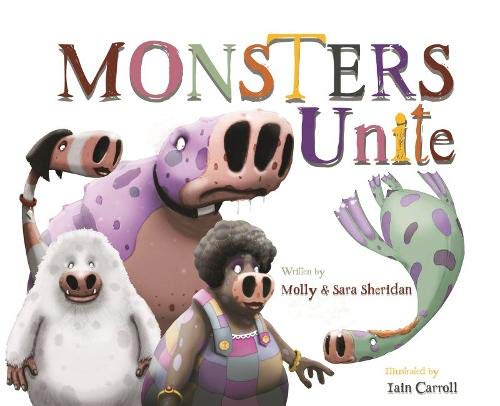
Monsters Unite
Written by Sara and Molly Sheridan
Illustrated by Iain Carroll
Best-selling author Sara Sheridan teams up with her daughter Molly to tell this fantastic and topical adventure about friendship and teamwork, and why discarding plastics and our waste in lochs, lakes and waterways is not good for us, the planet AND for all the monsters trying to visit their friends. Based on one of the stories Sara made up for Molly when she was a little girl, it also includes darkly quirky and fun illustrations by first-time picture book illustrator Iain Carroll.
When Nessie finds an ancient map showing a network of Monster tunnels, she decides to leave her high-profile life in Loch Ness and sets off on an adventure. She doesn’t know if there are other monsters out there or what the trip might hold, but she needn’t worry – from Tay Tay in Ireland to Pez in Spain – she discovers lots of new friends. The only trouble is that the tunnels are getting blocked with waste , so Nessie has to come up with a plan . . .
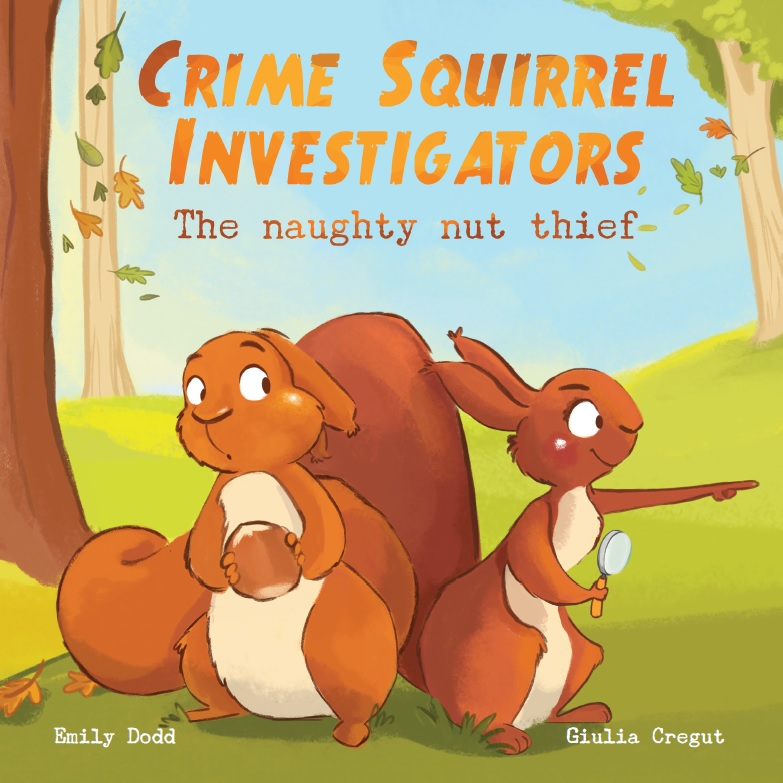 Crime Squirrel Investigators: The Naughty Nut Thief
Written by Emily Dodd
Illustrated by Giulia Cregut
Bestselling children’s author Emily Dodd brings her scientific background to this quirky, fun investigative tale that will encourage readers to play detective too! With brilliant illustrations by Giulia Cregut, you’ll learn too about the eating habits of all our woodland creatures.
Rosie’s secret hazelnut store has been ransacked and her best friend Charlie agrees to help her to find the naughty nut thief. The crime squirrel investigators only have left-over nutshells as a
clue, so they watch the different ways the three main suspects eat hazelnuts to try to solve the crime.
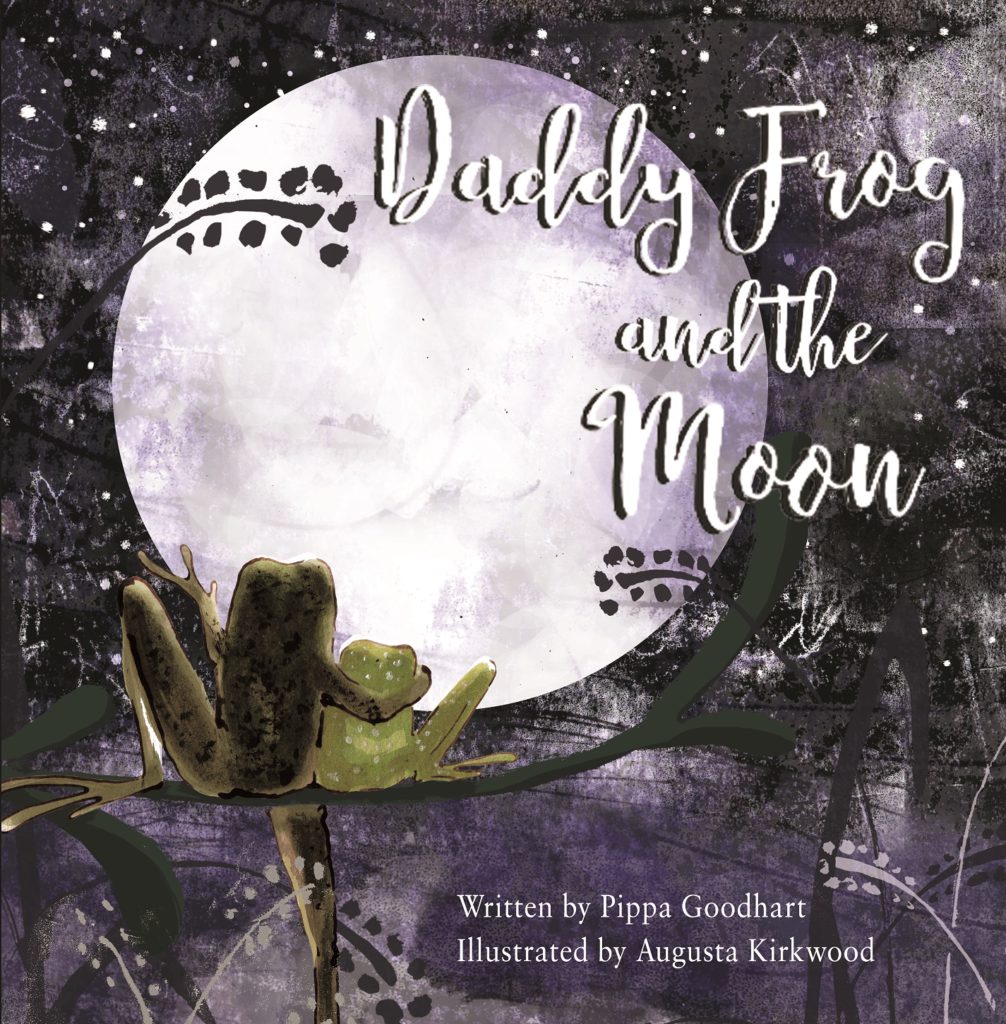
Daddy Frog and the Moon
Written by Pippa Goodhart
Illustrated by Augusta Kirkwood
Award-winning author Pippa Goodhart comes together with an exciting new illustrator Augusta Kirkwood to produce this gentle and heartwarming tale about the growing relationship between a father who wants to give his child the moon, and the child who just wants to spend time with her daddy.
When Frog becomes Daddy Frog he longs to show his little Baby Frog just how much he loves her. As he searches for a present that will express his love, he misses out on special time shared with Baby Frog as she grows into a little frog … until his great leap to try to catch her the moon launches Baby Frog into the leaping she longs to do with her Daddy.
Find Little Door’s full collection of books on their website.
Today is International Women’s Day and Books from Scotland couldn’t think of a better way to celebrate than to share with you poems from Nadine Aisha Jassat’s debut poetry collection, Let Me Tell You This. It is a brilliant, vital and inspiring collection, and we are excited to watch Nadine and her work flourish.
Extract taken from Let Me Tell You This
by Nadine Aisha Jassat
published by 404 Ink
Third Generation
After Langston Hughes’ ‘Cross’
My old man’s a brown old man,
and my old mother’s white.
When they ask if he’s from Pakistan,
I’m told to be polite.
When they say she’s not my Mother,
I say to me we look the same,
and when they tell me to be ashamed of them,
I say I have two worlds to gain.
My Bali wants a suburban house
to prove himself to you,
and if my Ma ever left that house
you’d condemn him for that too.
I grew myself from both of them
each bone, each nail, each tooth.
I wonder how my children will grow,
under the shadow of this roof?
*
Inheritance
She calls it having a word with herself.
My mother, looking at me,
saying all the things she needs
and doesn’t.
Fear does what it is supposed to,
to hold you tight,
until a word with yourself is the only way
you can try to pause the descending,
spiralling, tapping, trapping
paralysis but for the beating fist;
What if? But then? If I don’t? If I do?
Anxiety. 4 syllables given to this ceaseless, connecting string.
This genetic-chemical-taught-inherited
threaded parallel between
My mother and me.
My mother and me.
Threaded parallel between
this genetic-chemical-taught-inherited
Anxiety. 4 syllables given to this ceaseless, connecting string.
What if? But then? If I don’t? If I do?
Paralysis but for the beating fist
spiralling, tapping, trapping.
You can try to pause the descending,
until a word with yourself is the only way
to hold you tight.
Fear does what it is supposed to,
and doesn’t.
Saying all the things she needs,
My mother. Looking at me.
She calls it having a word with herself.
*
Coin Toss
In response to a One Penny Coin, branded with ‘Votes for
Women’ on the head of the King, held at Glasgow
Women’s Library’s Suffragette archive.
1. Heads
12th November, 1910
I say, you think you can tax so much of my wage
but then won’t give me a say on how it gets paid?
I say, it’s not my law
which makes the roof over my head
more my husband’s than mine;
nor that disavows me from quitting the swine
at a time of my own choosing.
A penny from my thoughts
meets a penny in my fist.
Friday next, me and my Sis
will make our mark,
not just on money but in minds:
Deeds Not Words, till the end of my days.
Votes for Women. That’s what I say.
2. Tails
6th February, 2018
I saw it online; women fighting head to tail for their rights.
Retweet: #votesforwomen #metoo
#timeforchange #changestartswithyou.
The thing is, there’s still so much to do:
women face violence every day,
are taxed on tampons, denied equal pay, even get scoffed at
if we save our own names for our children.
When you tell me we’ve won equality,
I’ll tell you at least two of my sisters are murdered a week
by men. We’re at a coin toss in history,
spinning in the air between how far we’ve come,
and where we need to be. I’ve heard the tales,
I’ll take them with me, as I use my words in protest.
As I forge ahead. As we forge ahead.
*
29
Congratulating me on turning twenty nine,
my friend tells me it’s a number in its prime,
and I ask her what she means.
‘It’s only divisible by itself,’
she replies, and I nod,
and say, its about time,
my age finally reflected
who I am inside.
Let Me Tell You This, by Nadine Aisha Jassat is published by 404 Ink, priced £8.99
Linda Cracknell is a writer of fiction, non-fiction and radio drama as well as a self-employed teacher and facilitator of creative writing in various settings. Landscape, place and memory are key themes in her work. Here is an extract from her current work-in-progress, When Tumblers Turn, which tells the story of Lucy, a young archaeology graduate who lost her mother in a mountain accident when she was a young child.
When Lucy put a mug of tea in front of her dad, the face he turned up to her was darkened, yet flamed with something feverish.
‘What?’ She’d been a step ahead of herself, mentally shuffling back along the corridor with her tea and oatcake. But he tipped her off course now, halting her on the far side of the kitchen table.
He looked down again and one hand swiped over the top of his balding head. ‘The thing is, Lucy.’ He took a deep breath. She saw his throat convulse when he swallowed. ‘They …’ One of his hands now fluttered towards the door and her eyes followed it as if an answer hung there.
She’d heard the doorbell earlier, a mutter of voices in the kitchen, the door clicking after goodbyes, and then her dad on the phone for a while. After that, no radio on, no chair scraping on the floor tiles, so she thought he’d gone to the pub. She’d crawled out from under her duvet then and come down the corridor from her childhood bedroom.
She paused, waiting.
A hand twisted across his forehead.
She put her tea down. ‘Are you ill?’
The silence was punctured by swifts screeching as they wove their evening net of flight-paths above the suburban midsummer gardens, revelling in the sultry air.
‘The police have been here,’ he said.
It felled her to sitting right where she was, opposite him at the table. Blood drained from her face, replaced by an icy certainty that this was news for her. She closed her eyes, ambushed by the scent of scorched rosemary, of burning oranges. Wanting, and yet not wanting to know something she had not faced, she held her breath.
‘It’s going to seem …’ He kept his eyes down. ‘After 23 years, it’s a bit of a shock.’ He looked up.
She met his gaze. What was he talking about? ‘I’m nearly 26,’ she said.
‘I know.’
So it wasn’t even about her. She slumped back, wiped moisture from her forehead with her T-shirt.
‘They found the passport. And of course the address hasn’t changed in all that time.’
‘Who? What passport?’
‘The British Embassy in Paris.’
This seemed to be something completely new.
He got up and blundered to her side of the table, stood just behind her, as if wanting to touch her but not quite daring to. She smelt the fox-scent of his underarm sweat, saw from the corner of her eye the rough black hair curling on one arm. His darkness and physical solidity had always seemed alien to her own small frame and her fairness. She’d loved to snuggle against her grandpa, breathing in tweed and peppermint, but how long it was since she’d been this physically close to her dad.
‘It’s about your mother,’ he said.
She turned to look up at him then but he didn’t meet her gaze.
‘She’s been found.’
The hands of a clock within her panicked backwards. As a child she’d anticipated this moment. Other people fantasised about discovering they were adopted, and that a foreign king was really their father. She’d instead invented a mother who came back mysterious and beautiful. Alive. But this homecoming was way too late. The idea of a mother was as vague now as a stain on the floor of Neolithic burial chamber where a body had once lain.
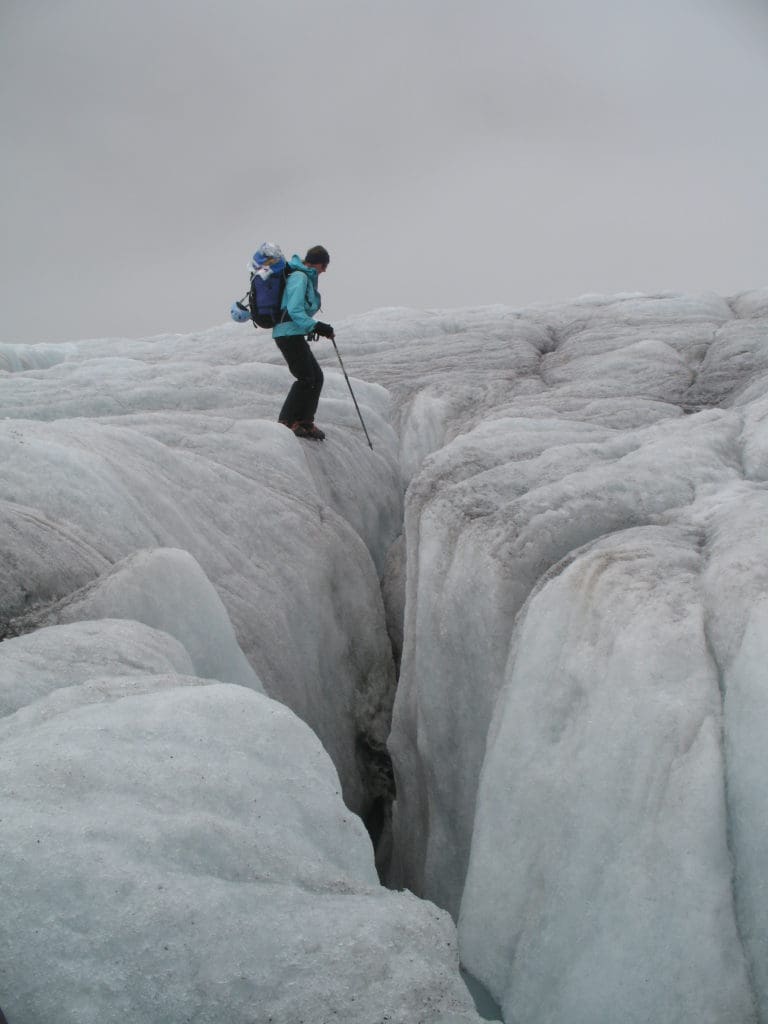
She listened to details that hardly made sense. The name of the glacier on Mont Blanc where her mother had fallen into a crevasse: ‘Bossons’.
‘A whole kilometre she’s moved from start to finish,’ he said. ‘In that 23 years the glacier has …’ He pushed a hand towards the floor. ‘You know, with melting …’
‘“Retreated?”’ she offered. Here she knew what she was talking about. Knew the right word. But she noticed he’d avoided saying ‘climate change’.
‘So the Embassy woman said. A lot.’
‘I know,’ she said. ‘There was a huge international conference about it recently. Because the retreat’s so dramatic on some of the Mont Blanc glaciers.’
He frowned. ‘That right?’
He sat down opposite her again, eyes down, hands clenched in front of him. She remembered the sensation of running her small fingers along the string of calluses under each of his finger joints raised by the run of hemp and nylon rope; his work as a lock-keeper on the Caledonian Canal.
‘Thirty years ago you could step out of your cable car straight onto the Mer de Glace,’ she said. These facts were easily retrievable for her even though she had no idea how a glacier would look or feel or move. She’d read the reports, studied the diagrams. ‘Now you have to go down 370 steps.’
He breathed out noisily. Perhaps she’d provoked again the seismic growling which had finally erupted between them after her grandpa’s funeral back in February when he’d dug up a store of rage about sacrifices made for her. It was that spitting, blazing version of her dad who had driven her directly to Spain, securing them each in their own silent quarter. Perhaps their cautious settlement was again at risk.
A scent of expectation hung in the room, an assumption that she should care or feel something after all this time for someone she never seemed to have known.
He opened his mouth to speak but she was quicker: ‘I never knew it was Mont Blanc. Or have I just forgotten?’ She folded her arms, drew in a quick breath. Here it was again – the desire she felt to needle, to put him in the wrong. But he’d barely whispered of her mother before. Family photos were hidden away in the loft along with old camping gear and endless pairs of boots. It required a ladder and a lot of muscle to get up there, leaving the archive to hover above them; an unexplored land.
‘It was quite a long time ago,’ he said, not answering the question. ‘The thing is…’.
She watched his face closely, noticed the map of lines that had spread across it sometime in the last years.
He laid the words down slowly; counters in a steady game: ‘They’re recovering the body. Soon. In a day or two. She’s a little way off the main climbing routes apparently. Discovered by chance. But they’re going to drill the ice around to release her. She can come back then, be flown back.’
So what? she wanted to say.
‘We can have a funeral.’ He took a ragged breath. ‘Or,’ he said slowly, carefully, looking up at her. ‘It’s possible to go there.’
‘To the Alps?’
Lucy heard the siren for the road-bridge, which meant it was lifting to allow boats to chug out of the canal for the freedom of the Beauly Firth and the wide-open arms of the North Sea beyond.
‘To meet her halfway,’ he said.
She imagined her dad going to one of those cold-slab mortuary rooms you saw on TV thrillers, to find a heap of remains in a bag. A foul image came to her of a tuber fermented within its skin after being underground for too long. Her mouth flooded and she gripped her hand on the table, ready to rise.
He looked up. ‘You see, they said… it’s a bit remarkable. How she’s been. Preserved.’
A shock thudded across the table.
‘It sometimes happens if there’s a lot of moisture, apparently. No oxygen. It’s like the body’s been in a sealed casket.’
She pictured a carved wooden box with a brass fastening.
‘It turns to a kind of wax. The body,’ he said. ‘You probably know about it from, you know, archaeology stuff.’
‘Not heard of anything quite that crazy.’
He pushed across the table some printed-out pages from a climbing website. It wasn’t the smooth Christmas-cake icing she might have imagined. Crevasses carved across a glacier at tormented angles; corrugated, wildly disordered.
‘The Grand Mulets hut is … perched there.’ A rock speared up in a steep dark triangle on a schematic map. ‘She fell somewhere above it, on the Bossons Glacier. The steepest in the Alps, apparently.’ He pointed to where a small cross had been marked in red below the hut, some GPS coordinates next to it. ‘That’s where she’s been found. On La Jonction. A kilometre below where she fell.’
‘Yes, you said.’ It was as if he was proud of her spectral mini-marathon.
Lucy couldn’t locate this story amidst the sludgy sediment of their history. Did she even want to engage with this long-delayed narrative? A dormant sense of injustice began to boil within her.
‘Did I ever know about this? I just remember that it was an accident on a mountain.’ She felt her mouth wrench into an unruly shape. A part of her wanted to leave the table with her cup of tea, stay on the course she’d determined, turn away from the intrusion. So much else was at stake.
‘Don’t do that,’ he said, taking from her hand a fork she’d been raking into the grain of the wooden table.
She threw herself back in her seat.
‘You don’t remember?’ he said.
She shook her head, arms folded, eyes down. A chasm had been revealed where a bridge should have been.
The photograph was taken by Rick Worrell.
There’s the saying that if you love what you do, you’ll never work a day in your life. This dictum could easily apply to Bill Innes, who tells us about his life in aviation in his memoir, Flight from the Croft. BooksfromScotland caught up with him to ask him about his career.
Flight from the Croft
By Bill Innes
Published by Whittles Publishing
You’ve written an entertaining memoir on your love affair with all things aviation. Tell us what it was about flying that enraptured you as a boy.
As the book explains, it was the sight of a Spitfire flying low through Glencoe at the time of the Battle of Britain that captured my imagination and fired an unlikely ambition.
How have you enjoyed the experience of writing and publishing your memoir?
This is my sixth book but the one which took longest to complete. I abandoned the project for some years and it took the encouragement of friends who had heard my aviation talks to give me the belief that the story was worth telling. The challenge was to alleviate technical detail with anecdote and humour.
You have many great memories of a vast array of flying experiences. What are your favourite moments of your flying career?
I have been fortunate to have been able to fly a wide variety of aircraft – with differing challenges and differing levels of enjoyment. Aerobatics in vintage open-cockpit biplanes are a more immediate experience than in modern military jets – or even in a WW2 Mustang. It has been my privilege to be part of the launch team for the Boeing 757 in BA and have the satisfaction of introducing it to four different airlines. The joy of being paid for a pursuit that was essentially my hobby meant it was always a pleasure to go to work.
To be able to bring your passengers safely to their destination regardless of all the weather gods can throw at you is the greatest job satisfaction for a pilot
Love (and flying!) can have its downs as well as its ups. What were your scariest moments on an airplane?
As the book explains, I had no right to survive a crash in an air race. I have had engine failures and an engine fire – but professional airline pilots are trained to deal with such.
You have been mentored and been a mentor yourself. What do you think are the key attributes in passing on wisdom?
Having suffered from mentors who could only criticise rather than teach, my generation determined that we would teach before we assessed. There is no point in telling an experienced pilot he/she is doing something wrong unless you can diagnose the problem and suggest what needs to be done to resolve it. Pilots need self-confidence. Good performance must be recognised by praise while unqualified negative criticism can cause serious damage.
Many people don’t feel the same enthusiasm you do about being up in the air. What would you say to nervous flyers to put them at ease?
There is a chapter on this towards the end of the book. While it is no help to sufferers to be told their fears are often irrational, we found that more information on aircraft noises and movements could alleviate some misconceptions. For example, I would tell passengers that, while turbulence was uncomfortable for them, the aircraft was perfectly comfortable with it.
It is also helpful for the anxious to know that they are not alone – with up to 20% of passengers believed to suffer from some degree of fear. Above all – do not be afraid to confess fears to crew. Cabin attendants are familiar with the problem and will offer sympathetic reassurance.
How do you keep your passion for flying going now that you’ve retired?
After 45 years in various fields in a golden era of aviation, I felt that box had been ticked and concentrated on other interests. Since retirement I have written six books on a variety of subjects, been a presenter and actor on TV and radio, lectured on Gaelic traditional poetry at several universities here and abroad and done numerous presentations connected with my books.
For my 70th birthday I did treat myself to a new aviation experience and had a short lesson in a helicopter. Although that was fun, increasing aviation bureaucracy makes it difficult to maintain the currency of a pilot licence. I am content to try and keep up with developments in the field at long distance.
Flight from the Croft by Bill Innes is published by Whittles Publishing, priced £18.99
Fictionalising the love lives of great artists is having a bit of a moment in publishing. We’ve had novels on Ernest Hemingway and Zelda Fitzgerald, and now Lynn Bushell is tackling the life and loves of Pierre Bonnard. Here she talks to BooksfromScotland about the real life story that inspired her book.
Painted Ladies
By Lynn Bushell
Published by Sandstone Press
Bonnard is almost unique amongst artists in that he was not a philanderer and although he had two mistresses, one of them was his common law wife Marthe, who remained with him for half a century. In 1917 when ‘Painted Ladies’ opens, she and Bonnard had already been together twenty-five years. He had met her on her way to the funeral parlour where she worked sewing artificial flowers onto wreaths. Recognising perhaps that Bonnard was a class above her she told him her name was Marthe de Méligny and that she was sixteen. It wasn’t until he married her in 1925 and she signed the register ‘Maria Boursin’ that he realised she had lied not just about her name, but her age. She had in fact been twenty-four at the time.
By then, however, the artist had other things on his mind. His affair with his model, the captivating eighteen year old Renée Montchaty, had been going on for five years and Bonnard had finally reached a decision. He told Marthe he was taking Renée to Rome and intended marrying her on their return. One can only imagine Marthe’s despair – approaching fifty, no longer beautiful and with a skin complaint that necessitated spending hours in the bath each day, she had been relying on Bonnard’s obsessive insistence on everything in his life remaining constant, to keep her in place until the affair had run its course.
We don’t know what happened in Rome. The one painting to come out of it shows two women in the Piazza del Popolo; one is holding up a set of scales. The pair returned to Paris prematurely and Bonnard went straight back to the house he shared with Marthe in St Germain-en-Laye and proposed to her instead. Three weeks after the marriage, Renée was dead. She was just twenty-four.
You could say Bonnard was unlucky. In trying to do right by one woman he had destroyed them both. He and Marthe fled to the south of France where they remained for the rest of their lives. Always reclusive, Marthe now made a career of being ill and developed a paranoid reluctance to see anyone. With an eye on posterity she insisted that any remaining images of Renée be destroyed. By the time of her death in 1942 the scandal had been forgotten, Bonnard was the ‘Grand Old Man’ of painting and Marthe was his acknowledged muse – ‘the woman in the bath’. She had even managed to turn her psoriasis to good use.
However, there was a curious post-script to the affair. In the last year of his life Bonnard returned to a painting he’d abandoned twenty-five years earlier and which Marthe must have overlooked in her war of attrition. In ‘The Women in the Garden’ we have virtually the only surviving image of Renée. Bonnard places her centre stage – young, beautiful and very much alive. He gilds the background so the painting resembles an icon. It’s only because the title is ‘The Women in the Garden’ that one’s eye looks for a second woman and there in the bottom right hand corner, buried in shadow and staring grimly at her rival, is Marthe.
It’s enough to cast doubt on the idea that Marthe was Bonnard’s muse and Renée was just a blip in his artistic career. The young woman who died so tragically and who’d been whited out of history, survived to tease historians a century later. In ‘The Colour of Memory’ Tate Modern’s Bonnard exhibition, ‘The Women in the Garden’ has pride of place. One can’t help thinking that poor Marthe would be turning in her grave.
Painted Ladies by Lynn Bushell is published by Sandstone Press, priced £7.99
Love of a place can inspire callbacks to favourite memories and spark off inspirations and connections. Charlotte Runcie’s Salt on my Tongue is a fascinating exploration on our relationship with sea, and on how she herself is inspired and drawn to its salty depths.
Extract taken from Salt on your Tongue: Women and the Sea
By Charlotte Runcie
Published by Canongate
I loved Edinburgh again as soon as I saw it with fresh adult eyes. It was the place my sister and parents had lived before, though I’d only visited for holidays, and heard about it wistfully in stories, until my parents finally decided to move back when I turned eighteen. Then, when I carelessly betrayed it by studying in England, it became my refuge during university holidays.
In Edinburgh I fell in love with the heat that builds encouragingly in your calves when you find yourself walking breathlessly up the hills and over the bridges in the Old Town, late to meet a friend. My lungs love the sensation of Edinburgh’s atmosphere, the biting freshness of it, never still but always thrilled with a shock of salted air, and sometimes the yeasty smell from the brewery on thick evenings. And the way the city is always almost entirely at the mercy of the spooky mystique of the haar, the rolling sea fog that comes on quick with its smoky white haze on a chilly evening and blinds you, if you don’t see it coming first, as it rounds the corner and somersaults its way towards you through the Cowgate.
On a clear day, I love that you can see right the way over the bright blue water towards the green and mauve hills of Fife. You can see the islands nestling there. Inchcolm, with its twelfth-century monastery. Inchkeith, where in 1493, King James IV is said to have performed a strange and entirely unethical language experiment, leaving two babies on the island to be looked after by a deaf and mute nurse in order to determine which language they eventually learned to speak, and which he could therefore conclude was the natural language of mankind as given by God. According to sixteenth-century historian Robert Lindsay of Pitscottie’s The Historie and Cronicles of Scotland, ‘Some say they could speak Hebrew, but for my part I know not.’ Walter Scott was unconvinced (in The History of Scotland): ‘It is more likely they would scream like their dumb nurse, or bleat like the goats and sheep on the island.’ Maybe, of course, it never happened at all, and is just a legend attributed to a king who was known to be a polyglot, an eager amateur scientist, and an oddball.
Then Fidra, another nature reserve with its own automated lighthouse, and the Isle of May, a boat trip away from Anstruther in the East Neuk on a boat called the May Princess, and St Baldred’s Boat, the rock formation off Seacliff Beach in East Lothian, where the medieval monk and hermit St Baldred is said to have retreated for contemplation. Go up high enough and look past the islands and over to the right of the three broad, spiked bridges that bind Fife to the Lothians, the Forth Rail Bridge, the old Forth Road Bridge and the new Queensferry Crossing, one red, one silver, one white, with the water stretching across towards the little white dots of the coastal towns, winking in the sun as they bend right around towards the East Neuk. The three bridges, each constructed in a different century, binding the land and the sea. The estuary is the only place we can do that, with the sea at its narrowest point that we can still just about build across, the last point at which it’s not yet so inscrutably large.
*
There is no easily exact difference between the river and the sea; no invisible line where the freshwater ends and saltwater begins. The sea is a gradual process of becoming, of widening and ageing and growing into more. There’s a human scale to an estuary. Settlements cluster around them, growing into industrial heartlands over the centuries because they’re so useful for transport and trade and connection to the world. Even before industry, though, people were drawn to them to build their homes. They are poised on the edge, but still connected to home, to land, and to life-giving fresh drinking water as it turns to the salt of the sea.
In salmon you see the difference that a saltwater environment makes to living creatures. Salmon are small mud-brown creatures when young and just-hatched in the freshwater. By the time they have made the journey from the river into the sea as adults they are transformed: big, shimmering rainbow-streaked blue dashes of light, ready to return home to their origins upstream to lay their eggs and begin the process of life over again. The river is where they begin, but the sea is where they become brightest and strongest.
Estuaries are where we can control the tide a little. At the Thames Barrier at Woolwich, London is kept safe from flood, the sea a little tamer because of a human presence. At Cramond, the village on the beach to the west of Edinburgh, there is a causeway path out to the tidal Cramond Island, the concrete on the route cracked into rockpools by thousands of days of tide washing in and out. In Cramond itself – where the River Almond drains into the Firth – there’s a decent pub (which means that dogs are allowed in the bar, with biscuits provided for them), a café with a good line in Cullen skink and hot chocolate, and generally an ice cream van parked out beside the small harbour, hard by the sign warning about tide times and instructing walkers to make sure to time their journeys out to the island so as not to get cut off.
If the tide is far enough out to be safe, two hours either side of its lowest point, you can walk right out along the causeway towards the little grassy islet with a few stony ruins on the top. As you walk, you’re flanked always to your right by a line of tall, imposing, triangular anti-boat pylons, put there during the Second World War. Once you get to the island you can look at the Firth from its middle, the water all around you and Edinburgh settled and finite before you, with Arthur’s Seat and the southern hills in the far distance. You are standing in the middle of the estuary, the river behind you, and the wide sea beyond, out into the myth and unknown. As you hurry back to the mainland – which you will want to do, for the cold of the coast winds will have by this time stirred within you a violent appetite for soup from the café or a pint of beer in the warmth of the decent pub with the dogs – if you’ve timed your trip right, the water will only just be beginning to fill in either side of the causeway, lapping around the bases of the anti-boat pylons, bringing more seaweed and fish to leave in the rockpools it cracked open on its last visit. If you feel the sea anywhere close to your feet, walk faster, because soon it will be several feet above your head, and you’ll be left to swim with the seals, and the legends of others caught out by the tides before you.
Salt on your Tongue: Women and the Sea by Charlotte Runcie is published by Canongate, priced £14.99
Catastrophe can sometimes bring the best out of people, and in Ricky Monaghan Brown’s memoir about his stroke – which he suffered aged just 38 – he writes with honesty, emotion, and a fair few laughs, on his recovery and how love helped him through. He talks to BooksfromScotland about his writing and his continuing recovery.
Stroke: A 5% Chance of Survival
By Ricky Monaghan Brown
Published by Sandstone Press
Firstly, could you tell us a bit about the book?
It kicks off with me suffering a catastrophic stroke – the day after I lost my job! I was wheeled into hospital with a one-in-twenty chance of achieving what the doctors delicately called ‘a good outcome’. What follows is the story of a miraculous recovery. It’s a lot funnier than that sounds, I think. I’ve heard many survivors’ supporters say that it was the laughs that they shared at absurd moments that helped them get through, and that was certainly the case for us.
This is a story of survival and recovery, but at its core it’s also a love story – could you tell us a bit about how those strands work together?
I feel it’s important to tread carefully here – if love on its own was enough to save us from health crises, then there would be a lot more healthy and happy people around. There’s a huge dollop of luck involved, too. But if I’m the protagonist of Stroke, then Beth (who acts as my partner, lover, carer and friend in the book) is the hero. She started the process of saving my life from what it might otherwise have become long before the stroke hit, and she still does it every day. The survival story can’t be separated from that.
How did you start getting into writing after having the stroke?
When the lights first went back on in my head, Beth brought me my phone, and I started tweeting out some of the silly little things that would happen each day. When people responded, I felt like I was re-establishing my connection to the world outside the hospital. Soon, I realised that I had stories to tell. Like many victims of brain injuries, I wanted to make sense of what I had lost and find a version of my story that made sense to me. I found out that I had been lucky enough to gain things, as well. Hopefully people in similar situations, and their loved ones, will be able to read Stroke and find some potential for optimism, too.
This is a deeply personal and emotional story – were there bits that were particularly hard to write? Were there bits that you enjoyed revisiting?
The writing wasn’t so bad. I think that I was focused on the story and finding the best way to tell it. Reading back through the final proof, though, I found I was crying tears of laughter as well as sympathy for the Ricky who is often so very scared in the book. I still think that the scene where I try to remember any of the details of our home that I’m working so hard to get back to – and can’t – is absolutely heart-breaking. Many of the laughs come from the antics of the supporting characters: my hospital roommate, the doctors, the nurses and the therapists. It was lovely to reacquaint myself with them again.
One of the things readers comment on is the humour in your memoir when dealing with something scary and painful. Could you tell us a bit about making people laugh with a story about a haemorrhagic stroke?
Well, that’s part of it, isn’t it? The ridiculousness of there being anything funny coming out of this. It’s absurd, and you can’t help but laugh! Like the time I ordered a nurse to get me some ice chips – I’m a very important man, I told him. I’m going to be the vice president! ‘Of what?’ he asked. Of the country, man! What do you think? I’ve no idea what I was thinking, but it made sense to me at the time.
Beth would sometime feel guilty about laughing at the things that would happen, but then she would see me enjoying them, too. Hopefully, readers will feel that I’ve given them permission to join in. Spoiler alert: I survived!
Stroke: A 5% Chance of Survival by Ricky Monaghan Brown is published by Sandstone Press, priced £7.99
ALSO ON BOOKS FROM SCOTLAND
-


Saltwater: A Midsummer Ghost Story by Elaine Thomson
‘The very thought of those grey faces made my skin grow cold.’
-

‘An Odious Campaign’ by Rob McInroy – Why a 1936 By-Election Still Resonates
‘This enraged the locals and he came close to being run out of town on several occasions.’
-

‘‘That’s right, Bobby,’ he growled. ‘I haven’t seen you in – well, since you decided to kill me.’ ‘
-

David Robinson Reviews: Solitary Agents by David Goodman
‘This is very much an up-to-the-minute story of spycraft, positively revelling in all the things tha …
-

The Savage Landscape by Cal Flyn
‘It is their resistance to the intrusions of the outside world − culturally, economically, environme …
-

The Shortest History of Scotland: A Q & A with Murray Pittock
‘We need to be better aware of that to understand the challenges and achievements of the past, and t …
FEATURED AUTHOR:
Leela Soma

Leela Soma was a Scottish-based writer who was born in Madras (former name for Chennai) in India, and lived in Glasgow. She came to Glasgow in 1969 with her husband. She worked, until her retirement, as a teacher of Modern Studies. During this time she …
FEATURED PUBLISHER:
Frontline Noir

Frontline Noir, founded in 2008, is a publisher of current affairs and recent history titles covering controversial topics and events, often written by people who were participants or otherwise affected. Our aim is to ensure such subjects are given a h …